A market surge runs ahead of the recovery
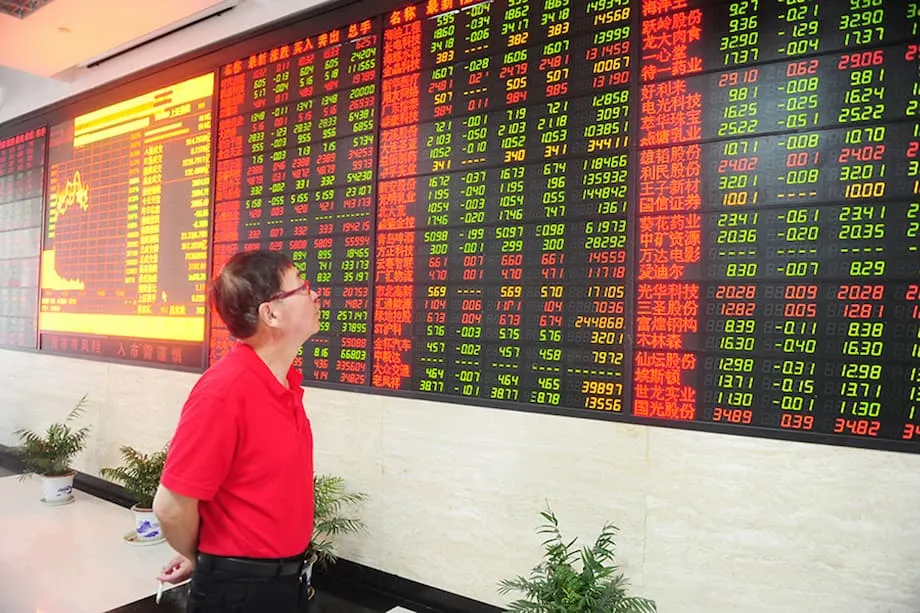
China's mainland and Hong Kong stock markets have added more than $3 trillion in value in 2025, even as economic figures point to weak consumption, falling property investment and pressure on company profits. As of October 3, the CSI 300, which tracks large mainland companies, is up around 16% for the year, while several technology benchmarks have reached their strongest levels in a decade.
Contents
- A market surge runs ahead of the recovery
- How far have shares climbed?
- AI and chips reshape expectations
- Household savings provide buying power
- Policy support reaches beyond share prices
- August figures show why doubts persist
- A broad bubble or overheated pockets?
- Foreign investors and new listings return
- What could interrupt the advance?
- The evidence investors need next
- Key Points
The rally reflects a bet that China's next stage of growth will come from advanced manufacturing, green energy and artificial intelligence rather than property. Investors are paying more for businesses they expect to benefit from that shift, before the wider economy has shown a convincing recovery. Supporters see a market anticipating change. Skeptics see prices moving faster than the profits needed to support them.
Households are moving money away from bank deposits offering low returns after years of heavy saving. Retail investors, meaning individuals trading their own money, account for close to 90% of daily turnover on mainland exchanges. Their participation has helped turn improving sentiment into stronger buying.
Beijing has also reduced investors' sense of downside risk through policy measures introduced since late 2024. Interest rate cuts, reductions in bank reserve requirements, easier share buybacks and improvements to the systems supporting trading have helped confidence. Lower reserve requirements allow banks to keep a smaller share of deposits aside, giving them more room to lend.
Rising prices attract buyers, those purchases lift prices further, and the gains encourage more investors to join. That cycle helps explain the strength of the advance. Its durability will depend on whether corporate earnings improve and policy support continues.
How far have shares climbed?
The MSCI China Index has gained more than 40% in 2025. The Shanghai Composite has reached a high last seen a decade ago, while Hong Kong's Hang Seng Index has returned more than 30%. The Hang Seng Tech Index has reached its strongest level in nearly four years, and the mainland CSI 300 Information Technology Index has climbed to its highest mark since 2015.
Technology, consumer platforms and communications companies have drawn much of the buying. Alibaba has more than doubled this year, Semiconductor Manufacturing International Corporation, or SMIC, has risen about 180%, and Tencent, Baidu and Xiaomi have each gained roughly 60%.
Those advances have given the largest internet companies more influence over the benchmarks that investors use to judge the market. The three biggest names now make up a large share of MSCI China. When a few companies carry substantial weight, their gains can pull an index higher even when other businesses are doing less well.
Many smaller companies have also rallied, but earnings have not improved consistently across the market. In several sectors, investors are paying a higher price for each unit of profit rather than responding to stronger profit forecasts.
That relationship is captured by the price to earnings ratio, which compares a company's share price with its earnings per share. A rising ratio means investors are willing to pay more for the same amount of earnings. It can reflect confidence in future growth, but it also makes prices more sensitive to disappointment.
AI and chips reshape expectations
Powerful domestic artificial intelligence models released at the beginning of 2025 changed expectations about the speed of Chinese innovation. Major internet platforms increased investment in data centers, cloud computing capacity and AI applications. The drive for greater independence in chips also supported companies supplying critical hardware and software.
Cambricon provides one example of improving earnings in parts of the semiconductor industry. The company reported profits of 2.88 billion yuan for the first half, more than forty times the level a year earlier. Such results have helped give substance to some of the enthusiasm surrounding computing technology.
Investors see AI as a technology that can work across many industries, including retail, logistics, entertainment and industrial automation. If companies use it widely enough to improve productivity, they could generate more cash and retain a larger share of revenue as profit over time.
Large internet companies have integrated domestic AI models into search, electronic commerce, content and advertising. Their spending on cloud services and data infrastructure supports those efforts. Companies with substantial user bases, strong cash generation and credible plans for AI have been among those rewarded by investors.
Semiconductor suppliers and hardware companies linked to computing power have benefited from demand for servers and networking equipment, alongside the push to develop domestic chip capabilities. The recovery in smartphone supply chains and signs of stabilization in electric vehicles have supported related shares. These developments help explain why investors are focusing on selected industries despite the weakness in broader economic figures.
Household savings provide buying power
Chinese households hold more than 160 trillion yuan in savings, with only a small share invested in equities. Falling deposit rates and continued caution about property have made stocks more attractive by comparison. Even a limited shift from such a large savings pool can provide substantial buying power.
Central bank data point to a steady rotation away from term deposits, which hold money for an agreed period. Deposits at financial institutions outside the banking sector increased by 2.15 trillion yuan in July and 1.17 trillion yuan in August. Together, those increases amounted to 3.32 trillion yuan across the two months.
M1, a measure of money that can be put to use quickly, grew 6% from a year earlier in August. That was its fastest increase since early 2023. Read alongside the deposit figures, the change helps explain why investors see more readily available money supporting financial markets.
Household savings remain a potential source of further investment if stock returns stay attractive. The same heavy participation by individuals also makes market sentiment important: confidence can bring money into shares quickly, while disappointing news can prompt rapid selling.
The sequence behind the rally stretches from policy changes in late 2024 to the latest summer figures:
- Late 2024: Beijing began measures including interest rate and reserve requirement cuts, easier share buybacks and improvements to market infrastructure.
- Early 2025: Releases of powerful domestic AI models renewed enthusiasm for Chinese technology and encouraged investment in computing capacity.
- July 2025: Deposits at financial institutions outside banks rose by 2.15 trillion yuan.
- August 2025: Those deposits increased by another 1.17 trillion yuan, while M1 growth reached 6% from a year earlier.
- October 3, 2025: The rally stood alongside a mixed economic picture, with technology shares advancing despite weak demand and a continuing property contraction.
Policy support reaches beyond share prices
Beijing's support has included changes to the way markets operate, as well as measures affecting the supply of money. Authorities have taken steps to widen access to derivatives, encourage companies to buy back shares and improve market supervision. Derivatives are financial contracts whose value follows an underlying asset and can be used to manage investment risks.
Buybacks allow companies to purchase their own shares. Alongside better trading infrastructure and supervision, these measures have reassured institutions that the investment environment is improving. They are gradual changes, but they can encourage investors willing to commit money for longer periods.
Regulators have also discussed curbing extreme discounting in industries with excess production capacity. The aim is to reduce destructive price competition, where companies repeatedly cut prices to win sales and weaken their own profitability in the process.
Autos, electronics and renewable energy are among the sectors that could benefit if businesses regain some ability to set prices. Investors view the campaign as part of a broader effort to strengthen corporate balance sheets and improve returns on equity, a measure of profit relative to shareholder investment.
Enforcement matters. A measured approach could help restore profit margins, while investors also want clarity about how authorities will address excess capacity without damaging employment. The policy case for the rally therefore rests partly on stronger company finances, alongside the immediate support for market confidence.
August figures show why doubts persist
Industrial output grew 5.2% in August from a year earlier, slowing from 5.7% in July. Retail sales rose 3.4%, below expectations and slower than the previous month. Exports increased 4.4%. The figures describe an economy still expanding, but with important areas losing momentum.
Property investment fell 12.9% in the first eight months of the year. The prolonged real estate adjustment continues to weigh on household wealth and local government finances, leaving a major source of economic weakness unresolved.
Producer prices have been falling for nearly three years, while consumer price inflation has hovered around zero for more than two years. Producer prices measure what companies receive for goods leaving factories. Persistent declines can squeeze profits, especially when businesses face excess supply and customers remain cautious.
Chaoping Zhu, a global market strategist at J.P. Morgan Asset Management, described the rally as being supported by expectations of economic change rather than a visible recovery in the broad figures:
So far, we have not seen signs of a turnaround in macro fundamentals, although the current momentum might be supported by expectations for structural improvements in the economy.
Semiconductors, AI and renewables show early signs of stabilization. Efforts to limit extreme price cutting could also help margins if implemented carefully. For now, many investors are buying on the expectation that reform and productivity gains will deliver future growth, while property continues to drag on the present economy.
A broad bubble or overheated pockets?
Strong policy support and large cash reserves outside the stock market have encouraged investors who believe the rally can continue. The opposing concern is that valuations have risen faster than earnings, leaving less room for disappointing results.
Raymond Cheng, regional chief investment officer for North Asia at Standard Chartered, pointed to the distance between stock prices and current economic conditions:
China's ongoing equity rally appears disconnected with the economic fundamentals.
Hao Hong, managing partner and chief investment officer at Lotus Asset Management, drew a distinction between the broad market and its hottest segments:
There are few signs of overheating in the overall market, but pockets of the market are a little too hot. This is not yet a bubble, but it is going that way.
Contract research organizations and selected companies connected to AI have seen valuations move beyond historical ranges. Heavy optimism in those businesses leaves them exposed if earnings disappoint or too many investors try to exit the same trade at once.
The strongest advances have centered on businesses associated with strategic priorities and future growth. Paying more for those prospects becomes harder to sustain when profit forecasts stay unchanged or fall. That makes the quality of individual earnings increasingly important, even while market sentiment remains strong.
Foreign investors and new listings return
Global investors are moving back into China after a prolonged period of caution. Hedge funds have been active in mainland A shares, and investment flows across borders have picked up across several asset classes, a pattern rarely seen in recent years.
The fear of missing a broad Chinese market recovery now competes with concerns about policy risk and geopolitical tensions. Foreign participation can add liquidity, making it easier to buy and sell, and help price discovery, the process through which trading establishes an asset's market value.
Chinese equities trade above their average valuation over the past decade, but remain cheaper than the S&P 500. For some global managers, that relative discount, the prospect of AI earnings growth and Beijing's focus on capital markets have encouraged a cautious return.
Companies are also seeking fresh funding. More technology listings are moving toward Shanghai and Hong Kong as founders look to raise capital closer to home. The revival in the primary equity market, where companies sell new shares, accompanies the gains in shares already trading.
What could interrupt the advance?
Earnings forecasts for major Chinese stock indexes have drifted lower for both 2025 and 2026 while share prices have risen. That combination means a larger part of the rally comes from investors accepting higher valuations. Those valuations can fall quickly if expected growth fails to arrive.
Borrowing to buy shares is another risk. Retail participation brings substantial trading activity, but higher margin borrowing can make swings sharper when investors react to headlines. Borrowed positions become harder to maintain as prices fall, adding pressure during a selloff.
Regulatory surprises remain a concern after earlier crackdowns affecting technology, education and property. Abrupt changes in rules can lead investors to demand a higher risk premium, meaning they will pay less for shares unless the potential return compensates them for greater uncertainty.
Export controls on advanced chips, tighter screening of investment and a slowing global economy could restrict gains for manufacturers. These pressures matter especially for companies whose prospects depend on access to sophisticated technology, overseas customers or international capital.
Property weakness continues to weigh on household confidence and bank balance sheets. Local governments also face strained finances, with unpaid obligations estimated at more than $1 trillion. A rising stock market may help through greater dividend income and opportunities to sell equity holdings, but the continuing contraction in property remains a substantial burden.
The evidence investors need next
Major internet and hardware companies will need to turn enthusiasm about AI into earnings. Spending on data centers and computing infrastructure represents a commitment to future business; stronger cash generation and profits would give investors a firmer basis for the prices they are paying.
Autos, solar and consumer electronics are other areas to watch. Sustained price discipline could improve profitability, while clearer guidance on excess capacity would help investors judge how the campaign will affect output, margins and employment.
Property sales stabilizing, even at lower levels, would reduce a major drag on household wealth. Stronger household consumption would also support the argument that productivity gains can feed into wider growth rather than remain concentrated in selected technology companies.
Steady foreign inflows and larger allocations to equities by domestic funds would help sustain buying power. Continued policy support would matter alongside them. No specific forthcoming hearing, decision deadline or data release date was identified in the October 3 account.
China's rally has thrived because investors look ahead, and because cash, policy support and technological progress have arrived together. The next test is whether company profits and household demand can begin to match the expectations already reflected in share prices.
Key Points
- Mainland and Hong Kong stocks added more than $3 trillion in value in 2025, with the CSI 300 up around 16% and MSCI China ahead more than 40%.
- Domestic AI progress, chip development, household savings and policy support have driven much of the buying.
- Retail investors account for close to 90% of daily mainland turnover, while household savings exceed 160 trillion yuan.
- Alibaba more than doubled, SMIC rose about 180%, and Tencent, Baidu and Xiaomi each gained roughly 60%.
- August industrial output rose 5.2% and retail sales increased 3.4%, while property investment fell 12.9% over the first eight months.
- Foreign investors are returning, and technology companies are seeking new listings in Shanghai and Hong Kong.
- Falling earnings forecasts, stretched valuations in some sectors, borrowing, regulatory changes and external restrictions remain risks.
- Stronger corporate profits, steadier property sales and firmer consumption would give the rally broader economic support.