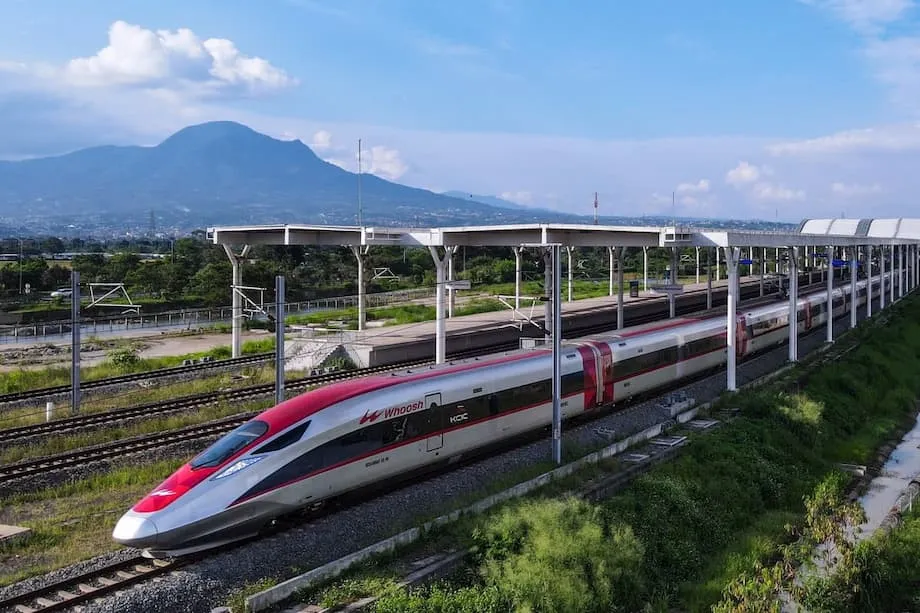
Whoosh faces a financial test as Indonesia prepares loan talks
Indonesia is preparing to renegotiate debt for its $7.27 billion Jakarta Bandung high speed railway, seeking relief for a service that carries passengers between the capital and West Java in about 45 minutes but earns too little from tickets to cover operating costs and loan payments.
Contents
- Whoosh faces a financial test as Indonesia prepares loan talks
- How the project reached this point
- Who borrowed the money and who carries the losses?
- Why the extra construction loan matters
- Passenger growth remains below early forecasts
- Better connections and fares could bring more riders
- What Danantara and Parliament are considering
- Negotiations carry weight for Jakarta and Beijing
- Can income beyond fares help close the gap?
- Protecting the national railway and public finances
- Surabaya plans depend on stabilizing the first line
- The Bottom Line
As of September 24, 2025, policymakers have asked Danantara, the country's new sovereign wealth fund, to coordinate a restructuring plan. The immediate task is to ease repayment pressure and stabilize cash flow while protecting PT Kereta Api Indonesia, the national railway operator and a major shareholder in the project.
The 142 kilometer railway, branded Whoosh, opened to the public in October 2023 after years of delay and a large cost overrun. Its financial difficulties now sit alongside its strategic importance as a flagship partnership between Indonesia and China.
PT Kereta Api Indonesia president director Bobby Rasyidin described the danger during an August 20 parliamentary hearing. The executive, leading efforts to stabilize the railway's finances, told lawmakers that the company would work with Danantara and other stakeholders:
We are also investigating the Whoosh issue; it's indeed a ticking time bomb. We will coordinate with Danantara to resolve this issue and then improve and restructure the existing portfolios.
His warning brought urgency to proposals for changing loan terms and the project's mix of borrowing and shareholder funding. Indonesia wants to give the railway time to attract more passengers and develop other income without allowing debt payments to crowd out daily operations or impose an excessive burden on the state budget.
How the project reached this point
Indonesia chose a partnership with Chinese companies and financing from a Chinese policy bank in 2015, turning down a competing Japanese proposal. The prospect of faster construction and financing without a sovereign guarantee appealed to Jakarta. A sovereign guarantee is a government promise to repay a loan if the borrower cannot.
Land acquisition delays and the pandemic subsequently pushed up construction costs. The railway eventually opened with a larger bill and additional borrowing carrying a higher interest rate. Its history explains why the current discussion concerns both the cost of construction and the income available to repay it.
- 2015: Indonesia selected the Chinese partnership over Japan's competing proposal.
- October 2023: Whoosh opened to the public after years of delay.
- 2024: The railway venture recorded a loss of around 4.2 trillion rupiah.
- First half of 2025: Passenger numbers reached about 2.9 million, while the venture lost approximately 1.6 trillion rupiah.
- August 20, 2025: Bobby Rasyidin warned lawmakers about the financial risk and pledged coordination with Danantara.
- September 24, 2025: Indonesia was preparing to reopen debt talks and develop a restructuring plan.
The next steps are a Danantara blueprint and formal discussions with lenders and Chinese partners. No date or final agreement on revised borrowing terms had been announced.
Who borrowed the money and who carries the losses?
China Development Bank supplied the original construction loan, covering roughly 75 percent of the initial project cost, or about $4.5 billion. Shareholders supplied the remainder as equity, money invested in return for ownership rather than scheduled interest payments.
The project company is PT Kereta Cepat Indonesia China, known as KCIC. Indonesian partners grouped under Pilar Sinergi BUMN Indonesia own 60 percent, while Chinese state companies hold 40 percent. PT Kereta Api Indonesia has the largest stake within the Indonesian consortium, alongside construction company Wijaya Karya, toll road operator Jasa Marga and a plantation company.
KCIC recorded losses of around 4.2 trillion rupiah in 2024 and approximately 1.6 trillion rupiah in the first half of 2025, according to financial filings and parliamentary testimony. PT Kereta Api Indonesia absorbed a large share, putting pressure on its otherwise stable core business.
The ownership arrangement spreads the project's financial results among several companies, but the national railway operator has particular reason to seek relief. It must manage its exposure to Whoosh while continuing the passenger and freight operations that people and businesses already depend on.
Why the extra construction loan matters
Construction delays increased the project price by about $1.2 billion. The final cost overrun was settled at roughly 18 trillion rupiah, close to that dollar amount, and additional borrowing helped cover the gap.
The original loan carried an interest rate near 2 percent, consistent with policy bank financing for strategic infrastructure. The additional debt carried a rate closer to 3.4 percent. That is a difference of about 1.4 percentage points, making the extra borrowing more expensive for each dollar owed.
KCIC therefore faces two pressures at once: a larger principal, meaning the amount borrowed, and a higher interest charge on the additional tranche. A tranche is a portion of financing with its own terms. Both pressures increase repayment demands while passenger demand is still developing.
Officials are assessing a lower rate on the overrun loan, a longer repayment period and a possible extension of the grace period before principal repayments accelerate. A longer maturity spreads payments across more years. A longer grace period postpones some repayments, leaving more cash available during the railway's early operating years.
Even a modest rate reduction on the additional debt could produce meaningful annual savings. Extending maturities could also bring the repayment schedule closer to the gradual growth in demand that new rail services commonly experience. The purpose is to reduce immediate pressure while passenger and other revenue grows.
Passenger growth remains below early forecasts
Whoosh carried about 2.9 million passengers during the first half of 2025, a double digit increase from the same period a year earlier. The service is attracting more users, but it remains well below the traffic levels considered during early planning.
Those scenarios envisaged between 50,000 and 76,000 passengers a day, depending on ticket prices and feeder connections. The current gap matters because fares are not yet generating enough money to shoulder operating costs and financing obligations.
The corridor is relatively short for a very high speed service. Its stations are also not all in the historic centers of Jakarta and Bandung, so passengers may need another train, a bus or a car journey to reach their final destination. A fast ride between stations is only one part of the trip.
Conventional intercity trains, buses and private cars remain attractive alternatives for travelers watching their spending. Families traveling together may find a shared car competitive with buying several rail tickets. The journey to the departure station and onward from the arrival station can determine whether Whoosh feels convenient enough to choose.
Higher passenger numbers would help the railway's finances, but its repayment timetable places demands on cash before demand has reached the levels imagined in those early scenarios. That timing problem is central to the case for restructuring.
Better connections and fares could bring more riders
Closer integration with Jakarta's MRT and LRT systems and regional commuter rail could reduce transfer times. Timed feeder trains and buses into central Bandung would make it easier to complete the journey without a long or uncertain wait.
Bundled tickets are another option, allowing passengers to buy connected parts of their trip together. Promotions during quieter hours and more flexible fares could help fill seats that might otherwise remain empty. The load factor, the share of available seats occupied, is important because a train still incurs operating costs when fewer people board.
Halim, Padalarang and Tegalluar are also places where practical changes could improve the passenger experience. Clearer signs, better parking arrangements and convenient pickup areas for ride hailing services could make the stations easier to use, particularly for occasional travelers.
These measures would address the total journey rather than simply the speed of the train. They are options for improving demand alongside financial negotiations, not announced replacements for the debt restructuring effort.
What Danantara and Parliament are considering
Parliament's Commission VI, which oversees state enterprises and investment, has pressed the railway operator and Danantara to produce a clear plan. Lawmakers have discussed bringing in new equity investors, moving some debt to the sovereign fund and temporarily placing liabilities with the state if doing so would cost less than allowing losses to grow.
Commission members warned that interest expenses could weigh on PT Kereta Api Indonesia's broader operations in 2026 and beyond. Their concern extends beyond the high speed line to the financial capacity of the national railway operator.
Danantara's work could involve fresh shareholder capital, taking over certain obligations or refinancing some debt in local currency if competitive terms are available. Refinancing means replacing existing borrowing with a new loan. Moving borrowing into rupiah is among the possibilities being explored, rather than a settled part of the plan.
Debt could also be partly converted into equity held by public bodies. That would replace fixed interest obligations with an ownership claim whose return depends on future profits. Another possibility is a payment schedule linked to revenue, under which repayments rise as passenger and station income increases.
Indonesia's central objective is to give operations more breathing room without placing unpredictable risks on taxpayers. Lower interest, longer maturities, a longer grace period and changes in ownership funding could be combined, depending on what creditors and shareholders accept.
Negotiations carry weight for Jakarta and Beijing
The railway is both a daily transport service used by millions of Indonesians and a prominent symbol of cooperation with China. Preserving that partnership is part of the negotiation alongside the financial calculations.
Chinese officials have maintained that cooperation under the Belt and Road framework follows international norms and have rejected claims that such projects create debt traps. Across Southeast Asia, governments have also trimmed project costs or stretched payments to bring large infrastructure commitments closer to their budgets and traffic levels.
Indonesia's approach has sought to retain control of the railway and avoid blanket sovereign guarantees while asking for fairer terms where costs exceeded the original plan. Keeping the original borrowing without a sovereign guarantee preserved room in the government budget. The more expensive overrun financing now creates a different repayment challenge.
The project's political importance in both capitals supports the prospect of an accommodation. Any negotiated solution would still need to align the larger construction bill with the revenue the service can generate. Interest relief and longer repayment periods could work alongside efforts to improve connections and passenger demand.
Can income beyond fares help close the gap?
Many public transport systems rely on more than ticket sales. Their public value includes shorter journeys, safer travel, less road congestion and cleaner air. Indonesia already provides budgeted support for passenger rail routes serving social needs.
Early operating losses on Whoosh therefore form part of a wider debate about how transport should be funded. The practical question is how to support this particular service while keeping spending controlled and giving its operators reasons to improve performance.
Direct fare subsidies would benefit all shareholders, including foreign partners, in proportion to their stakes. That has helped steer government thinking toward options such as capital injections, waiving station leases or supporting rolling stock, the trains and related vehicles used to run the service, instead of using public money to cut fares.
Land value capture offers another possible source of funding. When a railway makes nearby land more valuable, developers can contribute part of that gain toward the transport system through fees or payments. Those proceeds can support the network without reducing fares that help manage demand during busy periods.
Development around Halim, Padalarang and Tegalluar could bring housing, offices and shops that generate rents, fees and payments made when land is developed. Station retail concessions, parking and advertising could supply smaller but steadier income streams.
Many Asian railways use property and commercial income to help cover the gap between fares and construction costs. For Whoosh, progress would depend on zoning rules, land rights and the ability to put suitable development plans into action quickly while meeting local needs.
Protecting the national railway and public finances
PT Kereta Api Indonesia reported liabilities of about $3.7 billion, assets of roughly $5.8 billion and equity above $2 billion in 2024. That gives the company a financial buffer, but repeated losses from Whoosh would reduce it.
Keeping the project's obligations separate from the wider railway business and making Danantara the main debt holder could help protect core passenger and freight services. The aim would be to contain the pressure on an operating company whose responsibilities reach beyond the Jakarta Bandung corridor.
A transfer to Danantara would leave the public sector responsible for the obligation. Its potential benefit lies in the fund's access to a wider range of financing sources, strategic partners and repayment structures than an operating railway company can readily use.
Clear financial disclosure and independent audits would help maintain market confidence if the government chooses that arrangement. They would also make the costs and responsibilities of any public support easier to follow.
Surabaya plans depend on stabilizing the first line
Indonesian leaders continue to explore extending high speed rail eastward to Surabaya, the country's second largest city. A longer corridor could attract more travelers and provide a larger economic return than the existing short route.
Senior officials have said a legal framework for the extension is being prepared. They have also acknowledged that regulatory obstacles and the existing debt burden must be addressed first. An extension would require new financing and decisions about the route, station locations and construction schedule.
A stabilized first phase, with better local transport connections, could support a longer railway by attracting passengers traveling through several cities. The wider vision also includes changes in travel linked to freight and logistics work, with workers potentially using fast passenger services.
Disciplined procurement and safeguards against another construction cost overrun would be central to that plan. The first line's experience shows how delays and additional borrowing can affect finances long after trains begin running.
In the coming months, the main markers are Danantara's restructuring blueprint, formal talks with creditors and Chinese partners, and any proposed changes to interest rates, grace periods or loan maturities. Parliament and financial markets will watch those terms alongside the allocation of responsibility for repayment.
Holiday travel peaks will test the railway's ability to lift demand toward earlier forecasts. Feeder connections, integrated ticketing and other operational changes could help. Decisions on Surabaya will also indicate whether expansion is being staged around the financial health of the existing service.
The Bottom Line
- Indonesia is preparing debt talks for the $7.27 billion Whoosh railway, whose fares do not cover operating and financing costs.
- The 142 kilometer line opened in October 2023 and cuts travel between Jakarta and Bandung to about 45 minutes.
- China Development Bank financed roughly 75 percent of the initial cost, about $4.5 billion. Additional borrowing for the overrun carries a higher interest rate.
- KCIC lost around 4.2 trillion rupiah in 2024 and 1.6 trillion rupiah in the first half of 2025.
- About 2.9 million passengers traveled in the first half of 2025, with demand still below early planning scenarios.
- Danantara is coordinating options including lower interest, longer repayment periods, fresh equity and changes in who holds the debt.
- Better feeder connections, flexible fares and station development could increase revenue alongside financial restructuring.
- A Surabaya extension remains under consideration, with the existing debt burden and financing needs still to be addressed.