Behind the lunch tray, damaged hands and lungs
Health checks involving 42,077 school kitchen workers across South Korea found that about a third had lung problems, including cancer. Around 170 workers have had lung cancer officially recognized as linked to exposure to kitchen smoke. In the past three years alone, at least 14 workers have died of lung cancer.
Contents
- Behind the lunch tray, damaged hands and lungs
- Eight workers, 890 students and a fixed lunch bell
- Why vacancies make every task harder
- The hazards extend beyond burns and heavy pots
- Ventilation upgrades face costs and disruption
- Why stopping work brings a public backlash
- Women's care work, treated as an extension of home
- Fresh, free meals were a deliberate public choice
- Can cooking robots take on the dangerous tasks?
- Workers seek protection that matches the job
- Families have a role in safer kitchens
- What to Know
Those figures sit behind a very different picture circulating on social media: trays of crispy prawns with tartar sauce, egg fried rice, beef noodle soup, fresh fruit salad, kimchi and even ice cream. Videos attract millions of views and excited captions. Viewers abroad compare the meals with the cafeteria food they remember, while Korean families see a public service that feeds students regardless of income.
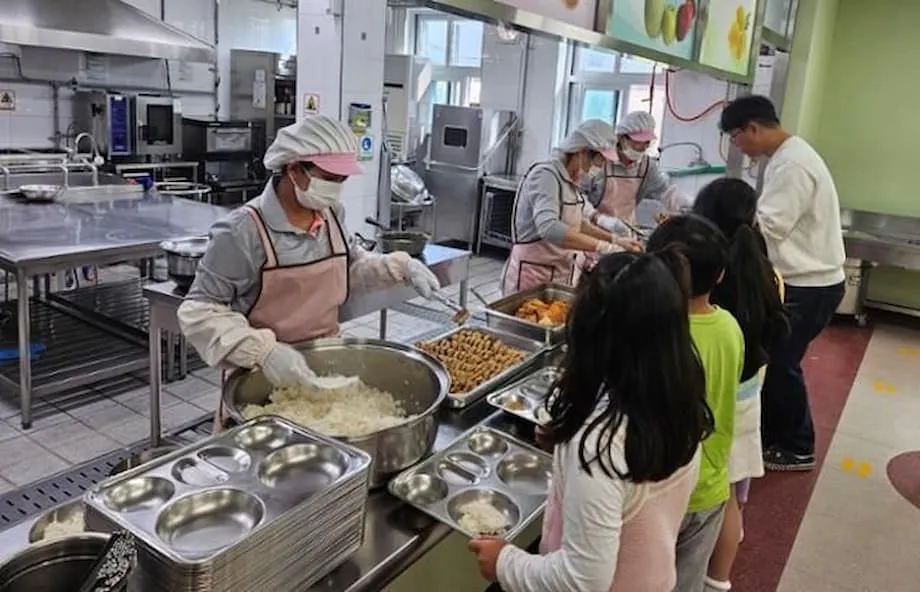
Public schools provide these hot meals free. Their variety, fresh ingredients and resemblance to home cooking have helped give Korean school lunches a reputation as among the world's best. Tens of thousands of kitchen staff make that possible, mostly women in their 40s and 50s earning little more than the legal minimum wage.
Workers chop vegetables by the crate, lift vats of soup and operate large fryers and griddles against a fixed deadline. Many describe lasting pain, persistent coughs and fear about the air they breathe. Understaffing and delayed safety improvements have left the people producing a celebrated public service carrying much of its physical cost.
Park Mi Hyang, a school kitchen worker and labor rights activist, described that cost at a parliamentary forum attended by fellow workers and lawmakers:
The world class free school meals South Koreans enjoy today came at the cost of kitchen workers' deformed hands, burn scarred skin and the cancer cells growing in their lungs.
Eight workers, 890 students and a fixed lunch bell
A middle school in Daejeon had eight kitchen workers serving 890 students each day. That works out to about 111 students for each worker, although the team shares preparation, cooking, serving and cleaning rather than dividing children into individual groups.
A dispute at the school over who should cut sheets of seaweed ended with seaweed soup served without seaweed. The incident captures how a seemingly small task can become a pressure point when a small team must feed hundreds of children at the same time.
Workers describe the job as factory work disguised as cooking. Lunch generally requires steamed rice, simmering soup and two or three side dishes, rather than simply reheating prepared food. A basic side dish can involve soaking, shredding, blanching, stir frying and cooling. Fresh fruit adds washing, trimming and portioning.
A dish of stir fried vegetables begins well before anything reaches a pan. Staff arrive early to receive deliveries, sort and inspect produce, wash and tune knives, and move bins to preparation stations. They trim and slice vegetables, blanch and cool batches, heat oil in deep pans and add seasoning at the right moment.
Heavy stainless steel pans must be lifted and tilted carefully to avoid burns. Soup needs attention at the same time, rice must finish on schedule and fruit must be divided into servings. A delay early in the morning can push later tasks into a rush, increasing the chance of mistakes or injuries.
Once lunch has been plated and served, the same workers clean industrial equipment and prepare for the following day. The workload continues after the last tray leaves the counter.
Why vacancies make every task harder
Hiring campaigns in some districts have attracted few applicants compared with the number of vacancies, and turnover is high. Workers describe a gap between the demands of the job and its pay and protections. Manufacturing and logistics jobs offering better wages and safer conditions draw potential recruits elsewhere.
A smaller team still has the same number of meals to produce. That leaves remaining staff with more lifting, chopping and cleaning, often within an unchanged timetable. The pressure can encourage workers to continue despite pain because lunch must be ready when the bell rings.
Deliveries can make the schedule harder to manage. Produce arriving late, or arriving uncut when a dish requires precise sizes, adds preparation work at a point when little spare time exists. A change that looks minor on an order form can mean many extra cuts when hundreds of portions are involved.
Menus built around freshness, variety and nutrition have value for children, but they require sufficient staff and suitable equipment. Schools depend on cooking from fresh ingredients while workers say funding has historically failed to match the protections that such cooking requires at scale.
Many kitchen workers are hired on contracts with limited job security. Some fear that raising concerns will mark them as troublemakers. In a kitchen already short of staff, accepting another painful shift can feel easier than challenging the conditions and risking a backlash.
The hazards extend beyond burns and heavy pots
Back, shoulder and hand pain are common complaints among school kitchen workers. Repeated peeling and chopping can deform joints over time. Wet floors create slipping risks, while hot oil, steam and soup can burn skin. Knives create a constant risk of cuts.
Surveys and compensation cases suggest injury rates far above the national average. Workers face heat, speed and heavy lifting together, often in confined spaces. Each task also competes for attention with the need to keep the meal service moving.
Cooking fumes add a hazard that is harder to see. Oil heated during cooking releases tiny particles and gases that can inflame and scar the airways. High temperatures, poor ventilation and frying large quantities of food can produce aldehydes such as acrolein and formaldehyde, along with polycyclic aromatic hydrocarbons.
These chemical names describe substances carried in cooking emissions. Workers standing over hot equipment can breathe those emissions repeatedly throughout their working lives. Studies of cooks in multiple countries link prolonged exposure with chronic cough, symptoms resembling asthma, chronic obstructive pulmonary disease and higher rates of lung cancer. Chronic obstructive pulmonary disease is a lasting condition that makes breathing difficult.
The screening findings, cancer recognition cases and deaths describe different parts of the health burden: lung abnormalities found during checks, cancers accepted as occupational illnesses, and workers who have died. Union advocates and occupational health experts say the true toll is likely higher because strict industrial injury claim criteria exclude cases that lack the required documentation or exposure history.
Ventilation upgrades face costs and disruption
Workers' estimates and local audits put the share of school kitchens without safe ventilation at more than 97 percent. Ventilation is the first line of protection against cooking fumes because it removes contaminated air before workers spend long periods breathing it.
Older school buildings were not designed for heavy frying and mass cooking with efficient extraction. Installing new systems takes money and time, and construction can interrupt meals. Where school budgets are tight, projects can fall behind more visible needs.
Workers and their allies want funded ventilation standards that cover local exhaust systems above fryers and griddles. Local exhaust captures smoke close to where it is produced. They also seek replacement air, sometimes called make up air, so fresh air can enter as polluted air is pulled out, along with maintenance schedules that keep extraction hoods working.
The scale of the reported ventilation problem makes equipment spending a central part of the labor dispute. Better extraction must serve kitchens preparing substantial quantities of food each day, while installation plans must account for the disruption to students' lunches.
Why stopping work brings a public backlash
School kitchen staff face a strong expectation that meals should never stop. When workers have walked out, some parents and media voices have accused them of starving children. The missing meal can attract more attention than the years of exposure and physical strain behind the protest.
During a strike at an elementary school in Suwon, students received plain rice and dried seaweed. Some parents bought sandwiches to fill the gap. A longer strike can require families to pack lunches or keep children home, quickly turning the dispute into a source of tension.
Many workers are classified as non regular public sector employees, a status affecting pay scales, benefits and bargaining power. Even where unions operate, opposition to interrupted meals limits their room to press demands.
Workers therefore face pressure from two directions: health and staffing problems inside kitchens, and public anger if they stop cooking. Safety discussions can lose attention until another injury or illness brings them briefly back into view.
Women's care work, treated as an extension of home
Many school kitchen workers are middle aged women returning to employment after raising children or seeking steady hours close to home. Their work is often treated as an extension of unpaid household care rather than skilled labor involving serious hazards.
The word ajumma, used for middle aged women and sometimes used dismissively, hangs over the occupation in daily conversation and popular media. That social framing has helped keep wages low and safety investment slow, even as menus become more complex and expectations rise.
Researchers studying school food systems internationally describe a recurring pattern: work associated with caring for others, including feeding children, is assigned mainly to women and undervalued in both pay and status. Meals that look homemade depend on knowledge, coordination and physical effort that can disappear from public view once the tray reaches a child.
Those researchers point toward giving workers a voice in policy, paying for the skills involved and investing in safe equipment. They also call for community participation in decisions about menus and purchasing, where choices can directly affect kitchen workloads.
Studies of platform workers and other precarious workers in Korea also report higher rates of musculoskeletal pain, fatigue and depression than in the general population. School kitchens expose a related weakness in occupational health and social insurance: people doing essential work on low wages can struggle to obtain protection and recognition when their jobs damage their health.
Fresh, free meals were a deliberate public choice
South Korea's school meal program grew through pressure from parents, educators and local leaders after food safety scandals in the 2000s. Campaigners argued that children deserved healthy meals and that public spending should support local farms.
Many regions developed a universal, free and environmentally friendly approach favoring fresh, locally grown ingredients and balanced menus. Cooking with seasonal produce is part of that design. The resemblance to food prepared at home follows from those choices.
The program treats school meals as part of public health. It supports regional farmers, shortens supply chains and introduces children to a wider range of vegetables, grains and flavors. That exposure builds food literacy, helping students become familiar with different foods.
Parents also value the dignity of providing the same free meal to everyone. Children from families with lower incomes do not have to be singled out in the lunch line to receive support.
Fresh ingredients, however, often arrive needing cleaning and cutting. Varied menus require more preparation, while large pots and hot fryers create demands for safe equipment and enough time. When staffing, ventilation and training budgets fail to keep pace, workers absorb the strain created by the program's ambitions.
Can cooking robots take on the dangerous tasks?
A middle school in Seoul uses four cooking robots for tasks including frying, stir frying and simmering soups. Incheon plans to spend hundreds of millions of won installing cooking robot systems in several schools.
Companies at trade fairs display automated stirrers that use cameras to monitor temperature and adjust heat. Other systems use robot arms to manage fryers and shake off oil, or prepare noodles from start to finish.
A machine stirring a deep pan can reduce the time a worker spends standing over hot oil. A robot loading and unloading a fryer can reduce exposure to splashes and the awkward reaching that strains shoulders. Such equipment can also reduce heavy lifting, allowing staff to spend more time supervising cooking and seasoning food.
Workers remain cautious. Current systems require human help at several stages, and moving machinery introduces risks such as pinch points and unexpected movements in crowded kitchens. Robots also leave unresolved the disputes over wages, staff numbers and ventilation.
No dates are given for the Incheon installations or for completing wider ventilation improvements. Workers argue that practical relief begins with adequate staffing, schedules allowing recovery and equipment that captures smoke at its source.
Workers seek protection that matches the job
Kitchen staff and their allies want regular health screening for respiratory conditions and problems affecting muscles and joints. They also seek a clear route to compensation when illness is linked to work, alongside funded ventilation standards and maintenance.
Staffing ratios, they argue, should account for cooking from fresh ingredients, heavy lifting and the speed required to serve lunch. Wages should reflect the skill and risk involved. Stable employment, stronger training and protections comparable with other hazardous public sector jobs are also among their demands.
Workers point to how readily applicants pursue safer factory jobs with better pay and predictable schedules. Schools seeking to recruit and retain experienced kitchen staff face the same competition for workers and need to offer pay, safety and respect that make the job worth staying in.
At a recent rally, workers wore pink aprons and carried nameplates bearing the names of colleagues who had died. A protester diagnosed with lung cancer recognized as related to work described continuing to cook while her health deteriorated:
For years I endured a bone crushing workload and the toxic smoke, trying to cook meals good enough for my own children too. Meanwhile, my body was breaking apart.
Families have a role in safer kitchens
Parents and students can influence school boards and education offices by making ventilation, sufficient staffing and realistic menus budget priorities. Support for simpler meals during building work or staff shortages can give kitchens room to manage without treating every change to lunch as a failure.
Parent teacher groups can invite kitchen staff to describe their work, support equipment upgrades and seek transparent reporting on injuries and air quality. Community involvement in purchasing and menu decisions can connect expectations about meals with the labor required to produce them.
Students can learn both why cooking from fresh ingredients matters for health and taste and why the people doing that work need protection. The benefits families value, including free access, varied food and support for local farms, depend on workers being able to prepare meals without sacrificing their health.
What to Know
- South Korea's free public school lunches depend heavily on women in their 40s and 50s working for little more than the legal minimum wage.
- Health checks involving 42,077 kitchen workers found lung problems, including cancer, in about a third.
- Around 170 workers have had lung cancer officially linked to kitchen smoke exposure; at least 14 have died of lung cancer in the past three years.
- Workers' estimates and local audits indicate that more than 97 percent of school kitchens lack safe ventilation.
- Fresh, varied meals require substantial preparation, while vacancies increase pressure on the staff who remain.
- Cooking robots are being tested, but workers also seek better ventilation, staffing, pay, health checks and employment protections.
- Families can support safer kitchens through budget priorities, transparent safety reporting and flexibility during upgrades.