Two new schools target gaps in regional healthcare
South Korea has allocated 60 medical school places to Sunchon National University and 40 to Gyeongkuk National University, with both schools aiming to admit their first students in 2030. The decision directs new training capacity toward the former Jeonnam region and Gyeongsangbuk-do, where shortages of doctors and access to essential treatment have driven demands for medical schools for decades.
Contents
- Two new schools target gaps in regional healthcare
- Why the government chose these regions
- Why 150 requested places became 100
- How the new schools fit the national expansion
- A long campaign reaches a contested decision
- Why Mokpo is challenging the selection
- Suncheon promises a school for east and west
- Gyeongbuk maps out a hospital and phased campus
- Faculty and local careers are the next tests
- What happens before the first admissions
- Key Points
The Ministry of Education and the Ministry of Health and Welfare announced the selections on November 4. Sunchon National University is in Jeonnam-Gwangju Special City, while Gyeongkuk National University is in Gyeongsangbuk-do, also known as North Gyeongsang or Gyeongbuk.
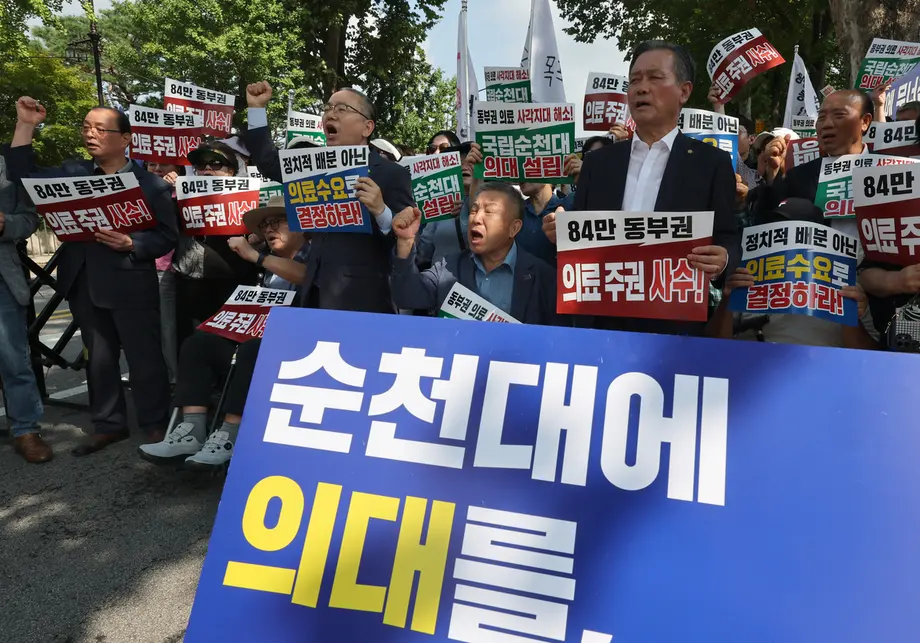
Gyeongbuk has outlined a project costing about 630 billion won for a medical school and teaching hospital with at least 500 beds. In Jeonnam-Gwangju, the decision has brought celebrations in Suncheon and renewed opposition in Mokpo, whose national university lost the competition to host the school by 1.3 evaluation points.
The universities must now turn their plans into classrooms, laboratories, faculty appointments and hospital training. Students entering Gyeongkuk in 2030 are expected to follow six years of medical education, making 2036 the earliest expected graduation year for that first class.
Second Vice Minister of Health and Welfare Lee Hyung-hoon described the purpose of the new schools when announcing the decision:
Establishing regional medical schools is a critical national task to resolve regional medical disparities that cannot be addressed solely by expanding existing medical schools and to strengthen the system for training, nurturing, and retaining regional medical personnel.
Why the government chose these regions
A joint planning group from the two ministries assessed 13 indicators across four areas: access to medical schools, shortages in healthcare provision, medical vulnerability and expected policy effectiveness. It held three meetings between July and August before choosing the two candidate regions.
Gyeongbuk provincial figures show 1.42 doctors per 1,000 residents, compared with a national average of 2.28. That puts the province at about 62% of the national rate. Its plan also records that 30.9% of patients with severe emergency conditions use medical institutions outside the province.
Figures on specialists in essential medical fields show an even wider gap. Gyeongbuk has 0.36 such specialists per 1,000 people and the former Jeonnam region has 0.29, compared with 3.02 in Seoul. Essential care includes services such as emergency treatment, childbirth and care for children, which residents need close enough to reach promptly.
The National Medical Center's 2025 Medical Vulnerability Monitoring Research Report classified 76 of 250 cities, counties and districts, or 30.4%, as medically vulnerable. Its assessment used measures of access to a general hospital within 60 minutes and actual use of care within that travel time.
Jeonnam began seeking a medical school in 1990. Before its integration with Gwangju, it was the country's only provincial jurisdiction without one. Many of its 22 cities and counties lack sufficient emergency, maternity or pediatric infrastructure, with rural communities and islands facing particular difficulties reaching treatment.
Why 150 requested places became 100
Sunchon National University requested an annual intake of 100 students but received 60, a reduction of 40%. Gyeongkuk requested 50 and received 40, a reduction of 20%. Together, the universities sought 150 places against a government allocation of 100.
The Health and Medical Policy Deliberation Committee had already agreed in February to provide 100 annual places at new regional medical schools in 2030 and 2031. The November decision divided that existing allocation between the two universities.
The ministries said Sunchon would have difficulty operating an intake of 100 from the outset. They also considered facilities, faculty capacity and the presence of Dongguk University's medical school in southern Gyeongbuk, which the final announcement described as having 55 places. An August account had listed Dongguk's intake as 49.
The smaller intakes mean the universities can begin with fewer students while assembling their teaching capacity. A medical school needs both academic instruction and supervised experience with patients, so the number of available teachers and hospital placements matters alongside the need for more doctors.
How the new schools fit the national expansion
National medical school enrollment is scheduled to rise to 3,548 in 2027 and 3,671 in both 2028 and 2029. From 2030, the planned total is 3,871, including the 100 places at Sunchon and Gyeongkuk and another 100 at a separate public medical institution in Namwon, North Jeolla.
The government's planned annual increases are 490 places in 2027, 613 in each of 2028 and 2029, and 813 in each of 2030 and 2031. Across those five admission years, the increases add up to 3,342 places.
The Namwon institution has a separate mission and service requirement. Its graduates are scheduled to serve for 15 years in public medical institutions and other designated settings. Earlier planning for the regional schools envisaged a regional doctor scheme with 10 years of compulsory service; the final announcement left the application of that scheme and the graduates' required working areas undecided.
The new regional schools are intended to connect education with local hospital training and eventual employment. For residents, the intended benefit is more doctors who build their careers nearby, alongside hospitals able to deliver treatment that currently requires travel.
A long campaign reaches a contested decision
Mokpo National University proposed a medical school with 80 places in 1990. Sunchon applied for 40 places in 1993. Neither application succeeded, and the regional campaign continued through successive governments.
The two universities agreed in November 2024 to pursue an integrated medical school through a university merger. Talks later broke down over the locations of the medical school, university headquarters and hospital. A proposal placing the medical school and headquarters in Mokpo and a university hospital in Suncheon failed to bring agreement.
The main steps leading to the selection and the next scheduled milestones are:
- November 2024: Mokpo and Sunchon agreed to pursue an integrated medical school.
- February: The government approved 100 annual places for new regional schools in 2030 and 2031.
- July and August: The joint ministry planning group assessed candidate regions, while university merger talks broke down.
- August: Jeonnam-Gwangju recommended Sunchon following a separate evaluation.
- October 30: Democratic Party lawmaker Kim Won-i began a hunger strike demanding a new review.
- November 4: The ministries selected Sunchon and Gyeongkuk and allocated 60 and 40 places.
- November 5: The Gwangju High Court was scheduled to hold its first hearing in an appeal seeking to suspend the recommendation.
- 2029: A physician workforce reassessment is scheduled before discussions on allocations from 2032.
Gyeongbuk submitted a joint implementation plan with Gyeongkuk National University. Jeonnam-Gwangju initially submitted a regional opinion statement after the joint university project stalled, then obtained a separate opportunity to recommend one university.
Why Mokpo is challenging the selection
Sunchon scored 89.15 in the Jeonnam Research Institute evaluation, compared with Mokpo's 87.85. Mokpo disputed the treatment of land availability, the composition of the review committee and the weight given to medical vulnerability in the southwestern part of the region.
Mokpo argued that Sunchon described its medical school and hospital site as already secured despite lacking ownership. It also objected to the absence of an architectural expert from the committee. Five of the eight committee members reportedly awarded full marks for certainty of site acquisition.
The Mokpo Citizens' Coalition for Economic Justice filed a police complaint against all eight committee members, alleging outside pressure. Mokpo National University is pursuing litigation to cancel the recommendation and an appeal seeking to suspend its effect. It was also considering a constitutional petition against the final government decision.
The ministries said advance ownership of the site was not an explicit legal requirement for allocating places. They said a local government's commitment to provide land could support the site plan, and that an architectural expert was not a mandatory committee member.
The government also said medical vulnerability had been considered when selecting the former Jeonnam region. After obtaining additional explanations and external legal advice, it found no defect requiring rejection of the recommendation. The ministries said the local recommendation informed, rather than bound, their final selection.
Suncheon promises a school for east and west
Jeonnam-Gwangju welcomed the selection and promised a regional healthcare network connecting communities across the integrated city. Its stated aim is for residents to receive necessary treatment within the region instead of facing gaps between local services and larger hospitals.
Sunchon National University President Lee Byung-un addressed concerns that the benefits would be concentrated in the east:
We will develop it into a medical school for all of Jeonnam-Gwangju, regardless of east or west.
The university plans to recruit faculty, prepare educational facilities and work toward a university hospital. Suncheon City also pledged cooperation with the government, university and relevant agencies.
Jeonnam-Gwangju said it would soon announce a southwestern regional transformation plan, including expansion of medical infrastructure comparable to university hospitals for places and universities that were not selected. That promise is particularly relevant to Mokpo and surrounding communities, where opposition to the selection remains strong.
Gyeongbuk maps out a hospital and phased campus
Gyeongbuk's plan places the medical school and proposed teaching hospital on a 130,362 square meter site in the provincial government new town around Andong and Yecheon. The available site is about 134% of the planned space requirement of 97,111 square meters.
The province proposes about 630 billion won in investment and a hospital with at least 500 beds. The project schedule covers preliminary procedures and agreements in 2026 and 2027, budgeting and design in 2027 and 2028, and construction between 2029 and 2032.
Gyeongkuk plans to begin building its medical education facility in 2029. The first students would study preparatory medicine at its Andong campus in 2030, using existing educational space. A Global Bridge Center targeted for completion before February 2031 would provide further space, with dedicated medical facilities coming into use from 2032.
Andong Medical Center has been identified for a training hospital role. The province's larger proposal also includes the new hospital and agreements with Chilgok Kyungpook National University Hospital and Andong Hospital for clinical education and residency training. Clinical education means learning to care for patients under supervision; residency is further training after medical school toward specialist practice.
Hospital opening dates, operating departments, detailed residency arrangements and the division of responsibilities between the university and hospitals still need to be settled. The central announcement did not specify a hospital construction budget or expansion scale, while the province is pursuing funding for its broader project.
Faculty and local careers are the next tests
Gyeongbuk aims to secure 112 full time faculty members by 2032: 25 in basic medical sciences, 85 in clinical medicine, and one each in medical education and medical humanities. The province says it has already secured around 10, including doctors teaching basic medical sciences.
Basic medical sciences explain how the body works and how disease develops. Lee Jong-tae, chair of the Korean Association of Medical Colleges, identified recruitment in these fields as a central challenge, particularly because doctors qualified to teach them are difficult to find.
Kim Dae-jung, a professor at Ajou University Hospital, urged the schools to build their teaching around community medicine, primary care and public healthcare practice. He also called for local residency routes so graduates can train as specialists and establish careers in the regions.
Gyeongbuk's proposed network would link hospitals, public hospitals, health centers and smaller health branches across six areas. It includes teaching visits lasting two to four weeks in medically vulnerable communities, projects connecting students with local healthcare needs, and support for doctors to settle locally through 2036.
The province also plans research connections with the Andong branch of the International Vaccine Institute, the Vaccine Commercialization Technology Support Center, local biotechnology businesses, advanced facilities in Pohang and radiation medical science resources on the east coast.
Gyeongkuk National University President Jeong Tae-ju described the university's goal:
We will nurture outstanding medical talent in the region and help them settle locally so they can take responsibility for the health of local residents.
What happens before the first admissions
Regional implementation groups involving local governments, universities and experts will develop the medical schools and teaching hospital plans. A joint support group from the education and health ministries will monitor progress and coordinate assistance.
The universities need to recruit teachers, secure teaching and laboratory space, arrange supervised hospital placements and satisfy medical education accreditation requirements. Accreditation is an external assessment of whether a school meets the standards needed to educate future doctors.
The government plans to reassess physician supply and demand in 2029. Discussions about possible additional places for 2032 through 2036 will consider facilities, staffing, accreditation by the Korean Institute of Medical Education and Evaluation, changing medical needs and local efforts to train doctors.
Vice Education Minister Choi Eun-ok pledged support for the preparations:
We will provide the best possible support to prepare educational conditions.
For communities facing long journeys for treatment, the concrete milestones are hospital services, staffed departments and doctors who remain nearby. The 2030 admissions target begins the training process, while the planned hospital network and subsequent specialist training will determine how that investment reaches patients.
Key Points
- Sunchon National University received 60 annual medical school places and Gyeongkuk National University received 40, with first admissions targeted for 2030.
- The schools received 100 places combined against requests totaling 150.
- Gyeongbuk proposes about 630 billion won for a medical school and teaching hospital with at least 500 beds.
- Mokpo National University is challenging the recommendation process after losing the regional evaluation by 1.3 points.
- Faculty recruitment, accreditation, hospital arrangements and local training routes are central tasks before opening.
- A physician workforce reassessment in 2029 will inform discussions about additional places from 2032.