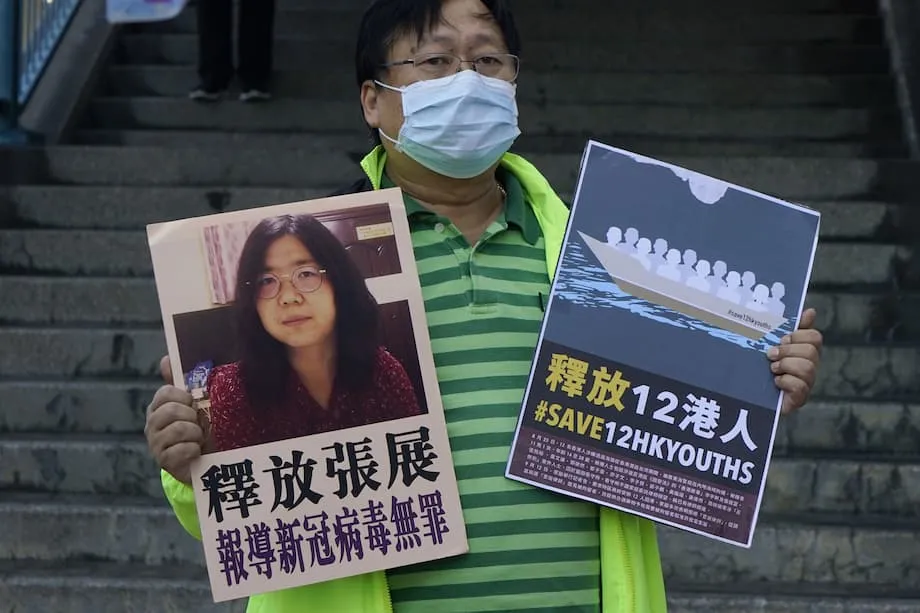
A second prison term after reporting from Wuhan
Chinese citizen journalist Zhang Zhan, 42, has been sentenced to another four years in prison following a closed proceeding in Shanghai, renewing international demands for her release. The former lawyer became known worldwide for documenting life in Wuhan as the coronavirus spread in 2020. Her new conviction uses the same charge as her first: picking quarrels and provoking trouble.
Contents
- A second prison term after reporting from Wuhan
- From a phone in Wuhan to a prison sentence
- The events leading to the new verdict
- What her former lawyer says the charge concerns
- How a public order law reaches online speech
- Press freedom groups demand her release
- Europe calls for due process and health information
- China's press restrictions in numbers
- A new route for reporting health emergencies
- The former lawyer behind the reporting
- What the case means for people documenting crises
- The Bottom Line
Zhang completed her previous four year sentence in May 2024, but her freedom lasted less than a year. Police detained her again in August, and she was later held at the Pudong Detention Center in Shanghai. Supporters said the latest hearing ended with a brief verdict. The case again puts her online speech at the center of a prosecution under a broadly worded public order law.
Authorities have not publicly detailed the specific acts behind the new charge or clarified whether Zhang had access to independent counsel during the latest trial. Rights groups tracking her case say the prosecution targets her speech and online commentary. They argue that her reporting during a rapidly developing health emergency served the public and should never have been criminalized.
The sentence also comes shortly after China approved a change allowing individuals to report public health emergencies directly, bypassing the usual chain of command. That measure aims to get warnings to authorities faster. Zhang's renewed imprisonment brings attention to a related concern: whether people who document a crisis can speak openly without facing punishment.
From a phone in Wuhan to a prison sentence
Zhang traveled to Wuhan in February 2020, when the city was under intense restrictions. Using a smartphone, she posted videos and short written accounts from hospitals, streets, neighborhoods, quarantine checkpoints and neighborhood committees. She also interviewed residents and small business owners, sometimes streaming from places where people queued for care or argued with officials.
Her reports documented crowding, shortages and restrictions. They contrasted with the early official narrative that the situation was under control and that critics were spreading rumors. For people outside Wuhan, the recordings offered accounts of daily life during the emergency from someone working independently of state media.
Chinese censors moved quickly in early 2020 to restrict independent coverage. Several citizen reporters disappeared or were detained. Fang Bin vanished after posting images of bodies. Li Zehua was taken by security officers, later reappeared and described his detention. Those cases formed part of a wider campaign against unauthorized pandemic reporting and what authorities called harmful rumors.
Zhang was arrested in May 2020 and tried that December. Her legal team said she began a hunger strike soon after her detention. Lawyers described police restraining her and inserting a feeding tube, and said she was force fed in custody. Rights groups warned about her health as her weight reportedly fell.
Her first prosecution made her a symbol of the risks facing people who document sensitive events without a state credential. The second sentence means she now faces another four years in prison after having already completed a term of the same length.
The events leading to the new verdict
Zhang kept a low profile in Shanghai after her release in May 2024. By late summer, she was back in police custody. The sequence stretches from the first months of the pandemic to a second prosecution after she had served her original sentence.
- February 2020: Zhang traveled to Wuhan and began publishing videos and written accounts of the coronavirus emergency.
- May 2020: She was arrested after reporting from the city.
- December 2020: She was tried in the case that resulted in her first four year prison term.
- May 2024: Zhang was released after completing that sentence.
- August 2024: She was detained again and was later held at Shanghai's Pudong Detention Center.
- By September 23, 2025: A Shanghai court had sentenced her to another four years following a closed Friday hearing.
Supporters said they were turned away outside the courthouse during the latest hearing. They also said the time and location were confirmed with little notice and that police maintained a heavy presence nearby. Diplomats were not allowed to attend.
Peng Yonghe, a lawyer who offered to testify in Zhang's defense, was placed under police control on the same day. Together, the restrictions around the hearing limited opportunities for people outside the proceedings to observe how the case was handled.
What her former lawyer says the charge concerns
Ren Quanniu, who represented Zhang in 2020, said the allegations in the new case focus on commentary she posted on overseas websites. He argued that expressing an opinion online should not lead to criminal punishment.
These charges are based on Zhang's comments on overseas websites. Expressing opinions online should not be treated as a crime.
Advocacy groups similarly describe the prosecution as punishment for speech rather than a response to a public disturbance. Supporters say Zhang's commentary was peaceful. The verdict nevertheless leaves her facing years in custody under the same offense used against her Wuhan reporting.
The reference to overseas websites matters because China's public order law has been used against online expression as well as conduct in physical public spaces. In Zhang's case, supporters say comments published on platforms outside China became the focus of the allegations.
How a public order law reaches online speech
Article 293 of China's criminal law sets out the offense of picking quarrels and provoking trouble. It covers conduct such as creating disturbances in public places, blocking traffic or causing serious disorder. The ordinary maximum penalty is five years, helping explain why many prominent cases involving speech result in sentences of four years.
Over the past decade, the provision has often been applied to online speech and nonviolent activism. Courts have used it to convict bloggers, human rights defenders and grassroots organizers. Rights groups argue that these uses extend the law far beyond its original public order purpose.
The law's broad wording and flexible interpretation give police wide discretion over what counts as a disturbance, particularly when online posts reach large audiences. In practical terms, a person publishing criticism can face a criminal case under a provision associated with maintaining order.
Jeremy Laurence, spokesperson for the United Nations human rights office, raised concerns about both the conduct of Zhang's trial and the wording of the offense. He said the provision should not punish peaceful expression and described the UN High Commissioner's call to stop using it and repeal it.
There are concerns over the conduct of Zhang's trial as independent observers were barred, and the charge she was convicted under is vague and ill defined. The High Commissioner has urged a moratorium on its use and called for repeal.
A moratorium means temporarily stopping the use of a measure; repeal means removing it from the law. Chinese courts do not publish full rulings in many politically sensitive cases, so outside scholars often rely on indictments or defense statements to understand why Article 293 was invoked.
Press freedom groups demand her release
Aleksandra Bielakowska, the Asia Pacific advocacy manager at Reporters Without Borders, praised Zhang's reporting in the public interest and urged governments to press Beijing for her release. She described Zhang's imprisonment as persecution and called for international diplomatic action.
She should be celebrated globally as an information hero, not trapped in brutal prison conditions. Her ordeal and persecution must end. It is more urgent than ever for the international diplomatic community to pressure Beijing for her immediate release.
Beh Lih Yi, Asia Pacific director at the Committee to Protect Journalists, said the new case repeated the use of baseless charges to punish Zhang's journalism. She called for the charges to be dropped and for Zhang to be freed.
This is the second time Zhang Zhan has faced trial on baseless charges that amount to nothing more than a blatant act of persecution for her journalism work. Chinese authorities must drop all charges and free her immediately.
Both organizations place Zhang's imprisonment within the wider restrictions facing independent reporting in China. Their demands focus on her immediate release, while the UN criticism also addresses the legal provision used to convict her.
Europe calls for due process and health information
The European Union's foreign policy arm also condemned the verdict and called for Zhang's immediate and unconditional release. Its response urged China to guarantee due process and provide reliable information about her health, a concern made more pressing by accounts of her hunger strike during her first detention.
Anitta Hipper, a lead spokesperson for EU external policy, urged China to respect freedom of expression and ensure access to counsel and transparent proceedings.
We deplore the verdict against Zhang Zhan and call for her immediate and unconditional release. China should uphold freedom of expression and ensure due process, including access to counsel and transparent proceedings.
Due process refers to the safeguards that allow a person to answer a criminal accusation fairly, including access to a lawyer. The closed hearing, exclusion of diplomats and restrictions reported outside the courthouse are central to the international concerns about how Zhang's case was conducted.
China's press restrictions in numbers
Reporters Without Borders counts at least 124 journalists and media workers in Chinese prisons. In its 2025 World Press Freedom Index, China ranks 178 out of 180 jurisdictions, placing it near the bottom of the ranking and among the most restrictive environments for independent media.
Many detained journalists are citizen reporters who used social platforms or video apps to reach audiences when traditional outlets would not cover sensitive stories. Zhang's smartphone reporting from Wuhan fits that pattern: an individual gathering and publishing information without working through a conventional newsroom.
Families and defense teams often face pressure, including warnings against speaking to foreign media. Trials connected to expression are usually closed, verdicts are brief, and appeals seldom change outcomes. Those conditions make cases such as Zhang's an indicator of the wider environment for independent reporting.
Counting imprisoned journalists helps reveal patterns over time, including the use of public order and state security laws to prosecute speech. The figures also enter diplomacy, with international partners referring to them in human rights dialogues and trade talks.
A new route for reporting health emergencies
One week before Zhang was sentenced, China's legislature approved an update to emergency health procedures allowing individuals to report public health emergencies directly. The change lets them bypass the normal chain of command, meaning a warning can be passed on without waiting for each level of authority to move it upward.
The measure is intended to speed up early alerts when local authorities hesitate to escalate bad news. It addresses a problem exposed during the first weeks of Covid, when doctors in Wuhan who tried to warn colleagues faced investigations for rumor mongering.
A direct reporting channel could reduce that risk on paper by giving people a recognized way to alert authorities. Its practical value will depend on whether people raising concerns can speak without retaliation and whether police stop using broad public order laws against those who publish critical accounts.
The new rule creates a route for reporting into official systems. Zhang's case concerns the risks attached to independently documenting events and sharing commentary publicly. Whether the health reporting channel will create more space for firsthand accounts during crises remains unclear.
The former lawyer behind the reporting
Zhang is from Shaanxi province and worked as a lawyer before turning to independent reporting years before Covid. She had written about rights cases and often traveled to gather information firsthand. Her decision to go to Wuhan in early 2020 followed that established approach.
Her tools were straightforward: a phone, video clips, short texts and occasional streams from the places she visited. Her reporting focused on what residents and business owners were experiencing, including queues for care, restrictions and disputes with officials.
Supporters describe her as principled and direct. She refused to plead guilty in 2020 and insisted that her work served the public. After finishing her first sentence, she largely stayed out of sight until her detention in August 2024.
What the case means for people documenting crises
Officials describe prosecutions of this kind as routine public order matters. Rights groups see a pattern in which speech challenging state accounts is recast as disruption or rumor spreading. The boundary between citizen reporting and an illegal disturbance remains vague, giving authorities broad room to act and encouraging people to censor themselves.
Independent chroniclers continue to reach audiences through video platforms, encrypted messaging apps and overseas websites. Some accept the risk of reporting. Others stop after warnings or short periods in detention. For anyone considering publishing an account of a sensitive event, Zhang's renewed imprisonment makes the possible consequences concrete.
The new health reporting channel and the continued use of Article 293 now sit alongside each other. One promises faster warnings through official procedures; the other remains a means of prosecuting speech that authorities regard as disruptive. Zhang's second sentence places freedom of expression, access to legal representation and public access to information at the center of the international response.
The Bottom Line
- Zhang Zhan, 42, received another four year prison sentence after a closed hearing in Shanghai.
- Both convictions used the charge of picking quarrels and provoking trouble under Article 293 of China's criminal law.
- She completed her first sentence in May 2024 and was detained again in August 2024.
- Authorities have not publicly detailed the acts behind the new case; her former lawyer says it concerns comments on overseas websites.
- The UN human rights office, EU, Reporters Without Borders and Committee to Protect Journalists criticized her treatment and urged action.
- Reporters Without Borders counts at least 124 imprisoned journalists and media workers in China, which ranks 178 out of 180 in its 2025 index.
- A new rule permits direct reporting of public health emergencies, while concerns continue about punishment for independent reporting and critical speech.