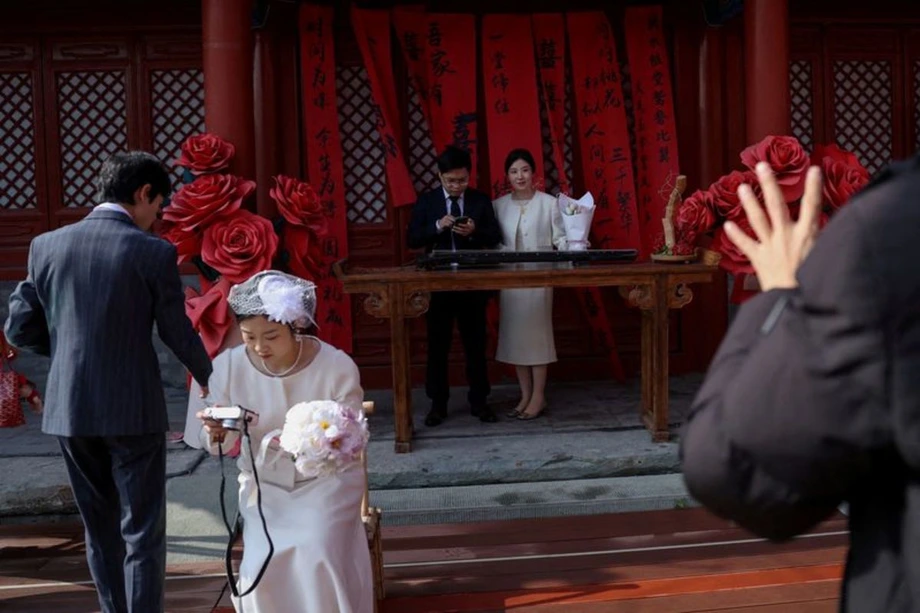
Half a million fewer couples register marriages
China recorded 4.648 million marriage registrations between January and September 2026, a fall of 504,000 couples, or 9.8%, from the same period a year earlier, according to Ministry of Civil Affairs figures. The decline gathered pace during the year, putting a temporary recovery in marriages in 2025 at risk.
Contents
- Half a million fewer couples register marriages
- The decline accelerated through 2026
- A brief recovery gave way to fewer births
- Why marriage matters to the birth figures
- What the national childcare payment provides
- Villages and cities offer cash for weddings
- Reducing the cost of wedding customs
- Women are challenging pressure to marry
- Fewer births meet rising pension and care needs
- Family support and an older workforce
- Key Points
The figures carry particular weight because childbirth in China remains closely associated with marriage. He Yafu, an independent demographer based in Guangdong province, said the latest numbers suggested annual marriage registrations would fall again in 2026, potentially leading to fewer births in 2027.
China is entering that slowdown after a sharp fall in births. The National Bureau of Statistics recorded 7.92 million babies in 2025, down from 9.54 million in 2024. The birth rate fell to 5.63 births per 1,000 people, its lowest level since the founding of the People's Republic in 1949.
National childcare payments, local marriage subsidies and efforts to reduce wedding expenses are now operating alongside changing expectations about marriage. For young adults weighing housing, education and childcare bills, those policies address parts of a financial commitment that lasts many years.
The decline accelerated through 2026
The Ministry of Civil Affairs recorded 1.697 million marriage registrations in the first quarter of 2026, down 6.2% from a year earlier. Registrations during that period were roughly half their level in 2017.
By the end of June, the total had reached 3.275 million, down 264,000, or 7.46%, from 3.539 million in the first half of 2025. The decline then widened to 9.8% across the first nine months.
Subtracting the ministry's first half totals from its figures for January through September gives 1.373 million registrations in the third quarter of 2026, compared with 1.613 million a year earlier. That is a decline of about 14.9%, faster than the reductions recorded in the first quarter or first half.
The annual total for 2026 is not yet known, and there is no numerical forecast for births in 2027. The immediate concern is that fewer couples are entering the stage of family life in which most births in China take place.
A brief recovery gave way to fewer births
China's recent figures show how a recovery in marriages or births can fade within a short period. Marriage registrations rose in 2023 for the first time in nearly a decade. Births increased the following year, before both measures came under renewed pressure.
The main changes unfolded as follows:
- 2023: Marriage registrations rose, while annual births stood at 9.02 million.
- 2024: Marriages fell 20.5% to 6.10 million, the lowest total since 1980. Births rose to 9.54 million.
- 2025: Marriage registrations temporarily recovered, but births fell 17% to 7.92 million.
- January through September 2026: Marriage registrations fell 9.8% to 4.648 million.
The increase in births in 2024 was partly associated with the earlier rise in marriages and the Year of the Dragon, traditionally considered an auspicious year to have a baby. Some parents timed pregnancies in the hope of having a child during that year.
The subsequent fall was larger than the earlier gain. Births increased by 520,000 between 2023 and 2024, then fell by 1.62 million in 2025. The 2025 total was about 12.2% below the number recorded two years earlier.
He Yafu had warned after the 2024 marriage decline that births would fall in 2025 because the vast majority of children in China are born within marriage. His assessment of the 2026 figures points to the same connection between fewer weddings and fewer births in the following year.
Why marriage matters to the birth figures
Chinese couples have traditionally had children after marrying. Cultural expectations help explain that pattern, while administrative rules have in some cases connected birth registration or access to benefits with a marriage certificate.
Marriage registrations therefore give policymakers an early indication of how many couples may soon consider having children. A registration records a legal marriage; a birth is a separate decision, shaped by money, health, age and family preferences.
China also has fewer women of childbearing age, while many young adults are postponing marriage and parenthood. Those two changes work together: a smaller potential parent population is making family decisions later.
Divorce figures show another change in family formation. China recorded 2.82 million divorces in 2024, up 1.1%, even as new marriage registrations fell sharply. For public services, the practical challenge extends from helping people start families to supporting households with different care and financial needs.
What the national childcare payment provides
China's government announced an annual subsidy of 3,600 yuan for each child under three in 2025. That works out to 300 yuan a month, providing a regular contribution toward the earliest years of parenting.
The national childcare subsidy covers first, second and third children, with partial payments also available for eligible children born before 2025. Applied retroactively from January 1, 2025, the programme was expected to benefit more than 20 million families.
The payment followed plans for birth subsidies announced earlier in July 2025. Including firstborn children widened the programme's reach beyond local measures that had often reserved their largest rewards for second or third births.
Beijing has also expanded preschool support and introduced measures aimed at reducing medical expenses associated with childbirth. Together, those policies target several different bills: having a baby, finding childcare and paying for early education.
Housing, education and childcare costs remain central concerns for couples deciding whether to become parents. The national payment provides help during the first three years, while families must plan for expenses continuing well beyond that period.
Villages and cities offer cash for weddings
Sukeng village in Dongguan, Guangdong province, illustrates how local authorities are adding their own rewards. At one event, the village distributed 140,000 yuan to 10 households that had welcomed a second or third child.
Eight households with a second child received 10,000 yuan each. Two households with a third child received 30,000 yuan each. Three newlywed couples also received 3,888 yuan apiece, plus a voucher of the same value for cookies used as return gifts. Couples who met through a village matchmaking event and later registered their marriage received additional travel support.
A village in Foshan's Shunde district offered newlyweds a payment of 2,500 yuan and another 3,000 yuan upon having a child. Preschool children were also eligible for childcare and education subsidies.
Other schemes have different eligibility rules. Lüliang in Shanxi province offers 1,500 yuan to eligible women aged 35 or younger registering a first marriage. Mingxi county in Fujian province offers qualifying couples entering a first marriage 3,000 yuan, subject to conditions including a premarital health screening and residence registration.
Hangzhou, Ningbo and Wuhu have also prepared cash benefits or consumption vouchers for newlyweds. The variation means the support a couple can receive depends partly on where they live and whether they meet local conditions.
Reducing the cost of wedding customs
Sanjiang Dong autonomous county in Guangxi has recommended that ordinary wedding guests, excluding close relatives, give no more than 100 yuan in rural areas and 200 yuan in urban areas. Shangluo in Shaanxi province has recommended the same limits.
Shangluo also proposed average banquet spending limits of 300 yuan per table in rural areas and 600 yuan in cities for weddings and funerals. Local efforts encourage reducing or eliminating caili, the betrothal gift traditionally provided by the groom's family.
These standards are voluntary recommendations, with participation left to residents rather than enforced through legal penalties. Their purpose is to reduce competitive spending and the pressure to measure a relationship by the size of a gift.
Local authorities are also trying to help people find partners. Dali Bai autonomous prefecture in Yunnan announced a task force and dating events aimed at unmarried local men older than 35. Such initiatives put governments directly into an area of life already shaped by strong family expectations.
Women are challenging pressure to marry
Shanghai's People's Park marriage market has operated since 2005. Parents display information about unmarried children, including their age, education, income and apartment ownership, turning private hopes about marriage into a public search for a match.
Unmarried women have also faced the label shengnü, commonly translated as "leftover women." The term has often been directed at educated urban women considered too old for marriage after their late twenties.
Some women now use online discussions to challenge the pressure itself. Terms such as cuihun, meaning repeated family pressure to marry, and konghun, meaning fear or hesitation about marriage, shift attention toward what women experience when relatives urge them to find a spouse.
A social media user writing under the name Ten Yuan Nimei described pressure beginning after university and continuing for seven years. She said moving from Hunan to Beijing largely confined those conversations to telephone calls; she later moved to Spain.
Other users have replaced the Chinese character meaning "leftover" with a character meaning "victorious," which has the same pronunciation. The wordplay presents remaining single as a choice rather than a failure. For marriage policy, the challenge includes personal expectations and independence as well as the cost of a wedding.
Fewer births meet rising pension and care needs
China's population fell by 3.39 million to approximately 1.405 billion in 2025, its fourth consecutive annual decline. At the same time, the country had more than 223 million people aged 65 or older, compared with roughly 213 million children aged 14 and under.
The National Bureau of Statistics figures put the old age dependency ratio at 23.1%, above the child dependency ratio of 22%. These measures compare the number of older people or children with the population of working age. A ratio of 23.1% means about 23 older people for every 100 people of working age.
Stuart Gietel-Basten, a professor of social science and public policy at the Hong Kong University of Science and Technology, described where the financial pressures fall:
The costs of an ageing population fall more heavily on pensions, healthcare and long-term care,
The Chinese Academy of Social Sciences warned in 2019 that the state pension fund risked running out of money by 2035. China is gradually raising retirement ages toward 63 for men, 58 for women in white collar occupations and 55 for women in blue collar occupations.
Beijing expects the silver economy, goods and services designed for older consumers, to reach 30 trillion yuan by 2035. That creates demand for businesses serving older residents while public authorities face growing responsibilities for pensions and care.
Family support and an older workforce
China enforced its policy limiting most families to one child from 1980 to 2015, allowed two children from 2016 and moved to allowing three in 2021. The current subsidies mark a further shift toward helping families pay for children rather than restricting family size.
Marriage and birth policies operate over different timescales from pension policy. Support for a child can help a household immediately, but that child will take many years to enter employment. Retirement changes and investment in existing workers address pressures already facing employers and public finances.
Gietel-Basten explained the economic priorities:
What matters most for China's economy is not the ratio itself but how many people work, how productive they are, and how long they stay healthy,
Xiujian Peng, a senior research fellow at Victoria University's Center of Policy Studies, has pointed to education, training, artificial intelligence and automation as ways to help a smaller workforce produce more. China is pursuing family support while also adapting to a population in which older residents account for a growing share.
Key Points
- China registered 4.648 million marriages in the first nine months of 2026, down 504,000, or 9.8%, from a year earlier.
- The third quarter decline was about 14.9%, calculated from the ministry's cumulative figures.
- Births fell to 7.92 million in 2025, down 17% from 2024, while the population declined for a fourth consecutive year.
- National childcare payments and local marriage rewards aim to reduce family expenses; recommended wedding gift limits are voluntary.
- Changing attitudes toward marriage accompany financial pressures, while an older population increases pension and care needs.