A new evening view of Kolkata
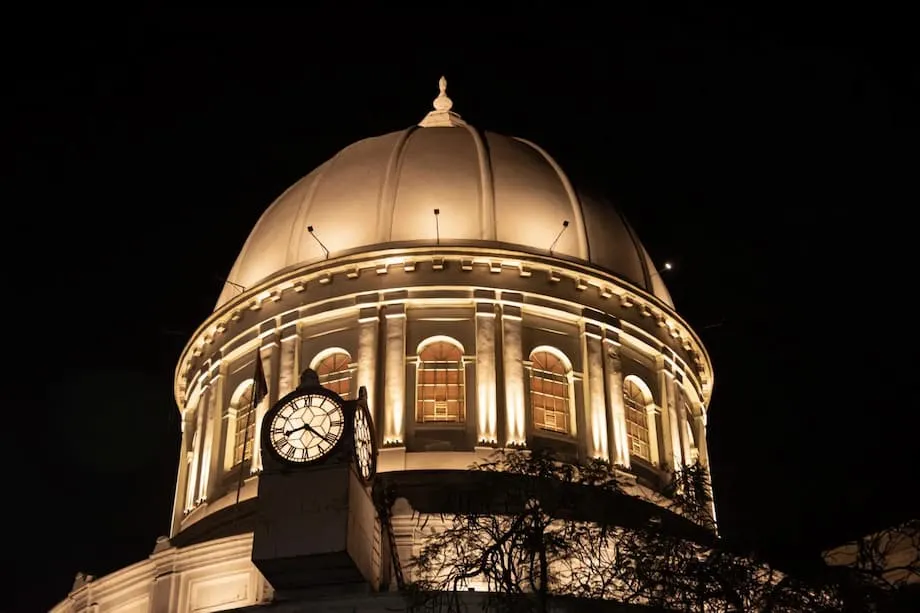
More than 90 heritage facades across Kolkata have been illuminated in under two years through a citizens network that began with one market dome in late 2023. As of September 16, 2025, the effort has reached landmarks including Raj Bhavan, the General Post Office, Maghen David Synagogue and New Market, with a near term ambition to pass 200 sites and a longer horizon of several hundred more over the next several years.
Contents
- A new evening view of Kolkata
- One market dome started the effort
- Which buildings are being illuminated?
- How designers reveal detail without glare
- Small budgets and visible accounts
- Repairs come before the lights
- Evening walks change the city rhythm
- What other cities can learn
- Keeping the glow manageable
- Key Points
The Calcutta Illumination Project has a straightforward arrangement: donations pay for lighting equipment and installation, while building owners cover electricity. Many installations cost between two and three lakh rupees, or 200,000 to 300,000 rupees, and typical monthly power bills range from 2,500 to 3,500 rupees. The lights operate for a limited period each evening.
Kolkata, the capital of British India until 1911, has an architectural landscape mixing neoclassical, Gothic, Art Deco and indigenous styles. Its colonial facades, temple spires, synagogues, cathedrals and markets dating back a century have long attracted visitors by day. Much of that detail disappeared into darkness after shops closed and office workers left.
Now, as daylight fades over the Hooghly, buses and walking groups follow evening routes through Dalhousie, Chowringhee, Esplanade and the old neighborhoods of north Kolkata. Carefully placed beams reveal lintels, domes, colonnades, pediments, cornices and balconies. Residents who have passed these buildings for years say they are noticing details for the first time.
The project is also drawing attention to work beyond lighting. Damaged facades need repairs, public clocks need their missing parts rebuilt, and owners must keep equipment working after the excitement of an inauguration has passed. Making a building visible at night brings its condition into view as well as its beauty.
One market dome started the effort
Writer and businessman Mudar Patherya found the starting point at Maniktala Market in late 2023. Its dome had received a fresh coat of paint, but the improvement vanished from sight after dusk. He collected a modest fund from friends to install lights. Once the dome was illuminated, requests for other buildings began arriving.
Patherya brought supporters together in a WhatsApp group called Kolkata Restorers. It is a network rather than a formal organization. Members identify buildings, raise donations, hire designers and contractors, and keep financial records transparent. The Calcutta Illumination Project grew from that first experiment into work on churches, synagogues, civic headquarters and private residences.
New sites have been switching on every few weeks. The sequence shows how a small local intervention developed into an effort across the city:
- Late 2023: Patherya raised money from friends to illuminate the freshly painted dome of Maniktala Market.
- During the first year: More than 160 donors joined the effort.
- By the second year: The donor count had passed 200.
- By September 16, 2025: More than 90 facades had been illuminated in under two years, with a near term target of more than 200.
The network has not given a fixed date for reaching 200 sites. Its longer ambition is to illuminate several hundred more over the following years, building on the same division of responsibility between donors and property owners.
Patherya, the project founder, described that arrangement in practical terms:
The model is simple. It is your property, my lights. You pay for the electricity and I work out that cost in advance.
Which buildings are being illuminated?
The project combines prominent destinations with buildings that are easily overlooked. Its reach includes government offices, commercial properties, cultural institutions and places of worship, giving evening visitors a route through different parts of Kolkata's history.
Landmarks already illuminated include:
- Raj Bhavan, the former viceroy's residence.
- The General Post Office and the Dead Letter Office.
- St Paul's Cathedral, St James Church and Sacred Heart Church.
- Maghen David Synagogue.
- The Geological Survey of India building and Eastern Railway headquarters.
- Chowringhee Mansions, Stephen Court and the Metropolitan Building.
- The Academy of Fine Arts and Kolkata Municipal Corporation headquarters.
- The Royal Insurance, Standard Life and National Insurance buildings.
- New Market, also known as Hogg Market, including its clock tower.
- The Greek Orthodox Church and other places of worship.
For walking groups, the range matters. An evening circuit can connect a civic building with a church, a synagogue, a market or a residential facade. The lighting reveals architectural features that become difficult to see once daylight has gone, allowing familiar streets to be explored at a different hour.
How designers reveal detail without glare
Lighting designer Suyash Narsaria helped refine the early installations so that the results were efficient and focused on architecture rather than theatrical brightness. The approach depends on where a beam falls and what it picks out, not simply on how much power a fixture uses.
Warm yellow LED lights echo the appearance of older sodium lamps while using energy more efficiently. Their color sits toward the golden end of the spectrum, preserving the appearance of laterite, sandstone and painted stucco. Warm light is also gentler on the eyes than cool white light.
Designers build layers of illumination around columns, capitals, cornices, domes and clock faces. Fixtures are tucked onto plinths, ledges and parapets. Shields and carefully chosen angles keep beams tight, helping prevent light from spilling into windows or the night sky. On more intricate facades, separate tiers of lighting give arches, railings and murals their own accents.
Narsaria explained how adjustments to power and placement improved the early work:
We reduced the wattage to make it more efficient, changed positions, and built layers that highlight columns, railings and murals,
Wattage describes the electrical power a light uses. Reducing it while directing the beam more precisely allows architectural details to remain visible with less electricity. A column can stand out because it receives a carefully aimed light, rather than because the entire wall is flooded with brightness.
Narsaria also described the design lesson in these words:
We reduced wattage, changed positions and layered the light so that details stand out without glare.
Most buildings switch their lights on at dusk and turn them off between 9 pm and 11 pm, depending on the location. Many use timers to keep operation to a few evening hours. The group monitors installations and handles routine maintenance, while owners pay the recurring electricity charges.
Small budgets and visible accounts
Donations cover fixtures, wiring, controls and installation. Building size and architectural complexity determine the budget, but many facades cost two to three lakh rupees each, approximately 2,500 to 3,500 US dollars. Typical monthly electricity bills of 2,500 to 3,500 rupees are roughly 30 to 40 US dollars, helped by LEDs and limited operating hours.
Families, students, companies and supporters with substantial personal wealth have contributed. More than 160 donors participated in the first year, and the count passed 200 by the second. Some supporters began with contributions of only a few hundred rupees and stayed involved as completed installations made progress visible.
An early published target estimated that several dozen facades could be illuminated for a fraction of the price of a single luxury apartment in Kolkata. That comparison was repeated in community meetings to show how relatively small contributions could add up to visible improvements across many buildings.
Kolkata Restorers leaves no plaques and seeks no personal credit. Its operating model includes audited accounts, no salaries and documented payments by cheque. Donors receive receipts and periodic updates on progress and costs. Vendors are invited to submit quotations, bills are paid quickly, and prices are negotiated to keep spending lean without reducing quality.
Those practices connect fundraising to specific, completed work. A donor can see which building has been illuminated, while an owner knows the expected electricity cost before taking it on. The combination of visible results and financial records has helped build trust, speed up execution and attract further support.
The division of costs also makes each installation a continuing commitment. Donors finance the initial equipment, but owners must keep paying for power after the lights are switched on. Timers, restrained wattage and advance cost calculations make that responsibility easier to plan.
Repairs come before the lights
Several buildings needed work before they could be illuminated. Owners had to repair water damage, replace cracked panels or repaint weathered surfaces. The project has consequently redirected attention toward maintenance that had been postponed for years.
Public tower clocks have become a particularly visible part of this restoration effort. Many had been silent for decades. At Hogg Market, the Gothic building known as New Market, roof leaks damaged both the clock mechanism and timber floors. Structural repairs therefore had to come before illumination.
The Hogg Market clock once sounded across New Market every quarter hour. Bringing that sound back requires more than making its face visible at night: damaged mechanisms must be examined, missing components reconstructed and the surrounding structure made sound.
Swapan Dutta, a clock repairer from the fourth generation of his family in the trade, is working on gears, pendulums and chiming mechanisms in churches and markets. His family once worked for a firm dating from British rule. Across Kolkata, he is known as Ghari babu.
Dutta explained the work needed to revive clocks that have been silent for years:
These clocks stopped years ago. We have to examine them, make calculations and reconstruct missing parts,
He identified the Hogg Market clock, with its chime every quarter hour, as the one he most wants to hear again. The repair involves understanding how each mechanism operated and rebuilding the components it has lost.
Dutta also described the patience involved:
We have to examine each mechanism and remake missing parts. It takes time, yet the sound is worth it.
Volunteers associated with the effort have also cleaned more than a thousand tombstones in South Park Street Cemetery, where prominent figures from the city's early history are buried. Reviving a clock or making an old epitaph readable gives residents another way to connect with a past that can otherwise feel distant.
Evening walks change the city rhythm
Heritage guides now extend walks that once ended in the late afternoon into the evening. Groups linger in Dalhousie and around the river, where illuminated facades attract cameras and phones. Retailers near lit buildings say weekend evening footfall has improved.
Families are bringing children to see the landmarks after dark. Communities have also arranged cultural performances for lighting inaugurations, including classical music and small choral ensembles. The buildings become places to gather as well as objects to photograph.
Sujoy Sen, a tour leader who organizes evening circuits through the illuminated city center, described his reaction and his reason for bringing other visitors:
I was stunned. I have seen Paris by night. I did not realize Kolkata could be like that also. I wanted other people to see it as well.
Writer Himanjali Sankar joined one of the first night tours after returning to her hometown. She described the experience this way:
It is like the buildings are coming alive, reclaiming their grandeur.
A facade illuminated until 10 pm also adds gentle light to streets that can feel deserted after office hours. Street lighting remains necessary, while the lit buildings contribute to a sense of care and watchfulness. Police and municipal agencies welcome efforts that encourage people to use public space at reasonable evening hours.
Managing the lights is part of making those visits comfortable. Installations are adjusted to avoid blinding motorists and disturbing nearby residents. Limited operating hours allow people to enjoy the buildings without keeping windows bright late into the night.
What other cities can learn
Kolkata's experience is drawing interest as an approach other Indian cities could adapt. Municipal budgets are stretched, while architectural landmarks often need attention. A network of residents can bring together local pride, donations and practical skills to complete a series of manageable projects.
The method depends on keeping each unit of work small, making progress visible from week to week and maintaining strict financial accountability. Kolkata Restorers combines those elements through its WhatsApp network, audited records and regular installations. The broader ambition is to illuminate a million square feet of masonry at a cost supporters regard as reachable.
Community groups in places such as Indore have experimented with small civic projects supported by local fundraising. Internationally, the High Line in New York and redesigned parks in London have drawn strength from public support. Kolkata's contribution is a locally organized lighting effort whose costs and responsibilities are shared between donors and property owners.
Keeping the glow manageable
Designers must continue controlling where the light goes. Excess brightness can spill into the night sky, and light with a high proportion of blue can disrupt birds and sleep. Warm colors, tight beams, timers and evening cutoffs are central to the project's approach.
Maintenance is another continuing task. Enthusiasm at an inauguration can fade, while fixtures still need repairs and settings may need adjustment. Sustaining the installations means training owners, securing small maintenance funds and cataloging equipment so that parts and lighting settings can be replaced easily.
The project's use of economical fixtures, documentation and active maintenance gives that work a starting point. Its lasting effect will depend on continuing the care that made the first installations possible: keeping electrical equipment working, managing power costs and attending to the buildings themselves.
Kolkata's illuminated facades have already changed the evening experience of familiar streets. The work links a market dome noticed in late 2023 to more than 90 sites, while drawing attention to repairs, silent clocks and cemetery inscriptions along the way.
Key Points
- Kolkata Restorers has illuminated more than 90 heritage facades in under two years, with a near term target of more than 200 and a longer ambition of several hundred more.
- Donations fund equipment and installation; property owners pay electricity bills.
- Many installations cost two to three lakh rupees, with typical monthly power bills of 2,500 to 3,500 rupees.
- The donor count grew from more than 160 in the first year to more than 200 by the second.
- Warm LED lighting, carefully directed beams and timers limit glare, energy use and disturbance to residents.
- Audited accounts, no salaries, donor receipts and documented payments are central to the funding model.
- The effort has encouraged building repairs, public clock restoration, cemetery cleaning and evening heritage visits.
- Continued maintenance and control of excess light remain priorities as the project expands.