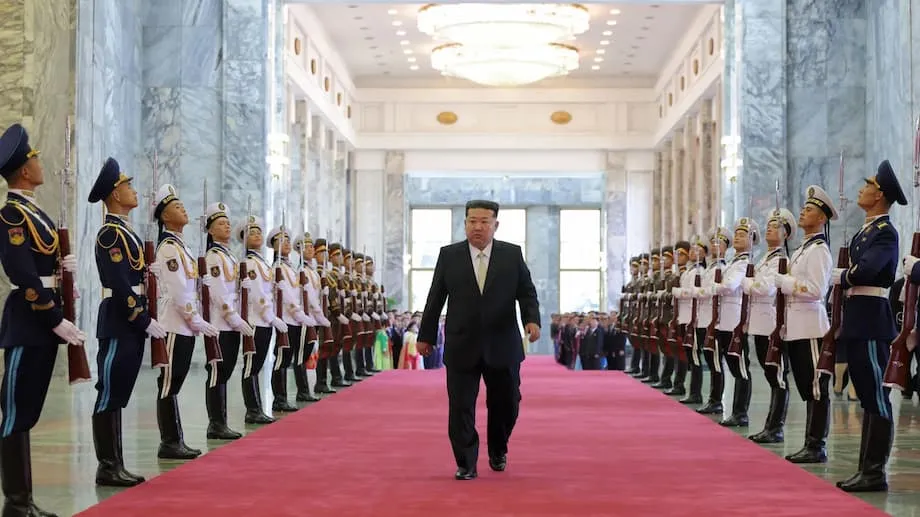
Executions and tighter controls mark a decade of repression
North Korea has expanded its use of the death penalty, including executions for distributing foreign films and television series, while tightening control over food, work, movement and private conversations, according to a review by the United Nations human rights office. Drawing on more than 300 interviews with people who escaped during the past decade, the report describes increasingly severe punishments and surveillance reaching into ordinary family life.
Contents
- Executions and tighter controls mark a decade of repression
- How the crackdown developed
- Foreign films become grounds for the harshest penalties
- Public trials turn punishment into a warning
- Surveillance reaches devices, speech and neighbors
- Children and poor families bear forced labor demands
- Food shortages deepen as markets lose space
- Prison abuse persists despite limited improvements
- International action faces political resistance
- The Bottom Line
At least six new laws adopted since 2015 have widened the grounds for severe punishment, including capital punishment. Witnesses described public executions by firing squad and a sharp increase in cases involving foreign information, particularly South Korean dramas. The harshest penalties have fallen on people who share or sell the material.
The review follows the landmark 2014 UN Commission of Inquiry, which found crimes against humanity, including torture, forced starvation and an extensive network of political prison camps. At least four such camps remain in operation. People held in ordinary prisons also continue to face abuse, forced labor and malnutrition.
Interviewees described a tightening of restrictions that accelerated after 2019 and through the COVID-19 period. Authorities sealed borders, increased ideological instruction and closed channels through which outside news, entertainment and other goods had reached the population. Public trials and executions became instruments for spreading fear and enforcing obedience.
Volker Turk, the UN high commissioner for human rights, warned that continued repression would bring further suffering without strong external pressure and reform inside North Korea. He referred to the country by its official abbreviation, DPRK.
"If the DPRK continues on its current trajectory, the population will be subjected to more suffering, brutal repression and fear," said Volker Turk, the UN human rights chief.
How the crackdown developed
Kim Jong Un took power in 2011 amid pledges to improve living standards. Several interviewees said they initially hoped their lives would get better. Those hopes faded as diplomacy with the United States and other powers stalled from 2019 and the government prioritized weapons development and internal control.
The UN review places the latest restrictions within a longer sequence of legal changes, border controls and harsher enforcement:
- 2011: Kim Jong Un took power, with pledges to improve living standards.
- 2014: A UN Commission of Inquiry found crimes against humanity, including torture, forced starvation and extensive political prison camps.
- Since 2015: At least six new laws expanded the grounds for severe punishment, including the death penalty.
- After 2019: Interviewees described faster tightening of state control as diplomacy stalled.
- From 2020: Witnesses reported a surge in cases involving foreign media and more executions, alongside border closures and heightened inspections.
- 2023: Kang Gyuri, an escapee who described attending a friend's trial over South Korean videos, fled North Korea.
The changes reached beyond criminal punishment. Interviewees described worsening economic rights, fewer opportunities to earn money independently and greater restrictions on expression and personal choices. The UN says North Korea stands apart for the breadth of its controls, extending from what people watch and say to where they work, travel and trade.
Foreign films become grounds for the harshest penalties
North Korea's new laws and enforcement practices criminalize anti state propaganda and the circulation of unauthorized information. Witnesses and experts told UN investigators that authorities have used these provisions to impose prison terms, forced labor and, in some cases, execution.
Legal changes have worked alongside administrative decrees and more intensive policing. Together, they have given authorities greater discretion to classify ordinary behavior as hostile to the state. Watching or possessing foreign entertainment can bring severe punishment; sharing or selling it has drawn the most extreme responses.
The UN says people have been executed for distributing foreign films and television programs, including popular dramas from South Korea. Interviewees described a surge in such cases from 2020, when tighter border restrictions and inspections accompanied the state's treatment of outside media as a direct threat to its control.
Authorities have searched homes, checked computers and phones without warning, and inspected storage devices. Campaigns against what the state calls anti socialist behavior have encouraged people to censor themselves at home, at work and even among friends.
Public trials turn punishment into a warning
Local residents, students and work units have been summoned to attend public trials and executions, according to multiple interviewees. Witnesses described residents standing in rows to watch firing squads after brief proceedings in which guilt was declared and a sentence read aloud.
The UN describes these events as a means of deterring defiance and stopping the circulation of ideas or culture considered hostile. Some are organized alongside larger propaganda campaigns, giving the punishment a wider audience and reinforcing the warning to others.
Kang Gyuri, who escaped in 2023, said she attended the trial of a friend aged 23 who was sentenced to death after being caught with South Korean videos. She described growing fear from 2020 and a system that placed media offenses alongside other crimes carrying the severest punishments.
"He was tried along with drug criminals. These crimes are treated the same now," said escapee Kang Gyuri, adding that fear deepened from 2020.
Several witnesses said executions increased after 2020 for distributing foreign media, drug offenses and certain business offenses. Other accounts described executions involving trafficking, prostitution and some violent crimes. Public trials and execution events returning from the pandemic years reinforced fear across regions and social classes.
Surveillance reaches devices, speech and neighbors
Mobile phones, memory cards and laptops are subject to routine checks, interviewees said. Authorities also monitor communication tools in workplaces and schools. Ordinary people have almost no access to the global internet, while a national intranet is reserved for approved institutions and officials. An intranet is a restricted network, separate from the wider internet.
Digital checks operate alongside social pressure. Citizens are expected to attend weekly self criticism sessions, where they confess faults and denounce neighbors. Witness testimony describes these gatherings as a form of collective surveillance and ideological conditioning.
Expanded powers to search and seize belongings have made private access to music, films, ideas and foreign expressions more dangerous. An anonymous escapee described the purpose of the intensified restrictions as preventing dissatisfaction from taking shape.
"To block the people's eyes and ears, they strengthened the crackdowns. It was a form of control aimed at eliminating even the smallest signs of dissatisfaction or complaint," said one escapee who requested anonymity.
Authorities also target vocabulary and expressions regarded as foreign or ideologically impure. Interviewees described neighborhood checks for slang and speech associated with South Korean popular culture, as well as inspections of radios preset to state stations and televisions set to fixed channels.
The result described by the UN is surveillance that reaches both public activity and private circles. The controls cover the devices people use, the programs they watch, the words they choose and what they say about those around them.
Children and poor families bear forced labor demands
People from poor families are conscripted into groups known as shock brigades for coal mining, road building and construction. The report describes wider use of forced labor across North Korea, with children, including orphans and those from families without resources, drawn into physically demanding work.
Injuries and deaths are common in these brigades, according to the UN account. The office says compulsory participation and hazardous conditions can bring the practices to the threshold of slavery. The central issue is whether people are forced to work under dangerous conditions rather than being free to choose or leave.
James Heenan, who heads the UN human rights office focused on North Korea, said vulnerable children face a particular burden because their families cannot pay bribes to avoid conscription.
"They are often children from the lower level of society, because they are the ones who can't bribe their way out of it, and these shock brigades are engaged in often very hazardous and dangerous work," said James Heenan of the UN human rights office for DPRK.
Interviewees said deaths in the brigades are publicly glorified as sacrifices to the leader instead of prompting safety reforms. Forced labor also continues in prisons and the military, where people work long hours and face exposure to dangerous materials.
The UN says these practices have persisted for years, even as North Korea has adopted some laws that appear on paper to strengthen fair trial guarantees. For those compelled to work, the report describes continued danger, exhaustion and little control over their circumstances.
Food shortages deepen as markets lose space
Most interviewees said three meals a day was a luxury for their families. Many recalled the COVID-19 period as a time of acute shortages, when border closures cut trade routes that had supplemented government food distribution.
Witnesses described neighbors and relatives losing weight rapidly, going for long periods without protein or dying after prolonged hunger. The testimonies connect hardship inside homes with restrictions on the routes and trading activities through which families had obtained food and income.
Informal markets had become a crucial lifeline over the previous two decades. Authorities tightened control over them through crackdowns on small traders, seizures of goods and restrictions on travel between regions. These measures reduced families' ability to make money independently and obtain necessities.
Border defense units were ordered to stop crossings into China. Witnesses said some troops were instructed to shoot people trying to escape. Fewer people were able to flee, while smuggled supplies of food, medicine and foreign media dwindled.
Border restrictions therefore affected several parts of daily life at once. They limited escape, reduced access to essential goods and further narrowed the flow of outside information, while tighter market controls weakened another means of survival.
Prison abuse persists despite limited improvements
At least four political prison camps continue to operate, the UN says. Across the prison system, investigators documented accounts of torture, forced labor and malnutrition. Witnesses described inmates collapsing from exhaustion and disease, with burials taking place without families being notified.
Some interviewees reported modest improvements in particular detention centers, including slightly less violence or fewer beatings by some guards. North Korea has also ratified two more human rights treaties in recent years and introduced some legal provisions that appear to support fair trials.
The UN nevertheless found that practices remain far from international standards. It says positive changes on paper have not produced meaningful protection of rights, while the broader picture is one of worsening restrictions on economic activity, expression and personal autonomy.
The contrast matters for people in custody: limited changes in some guards' behavior exist alongside continuing accounts of hunger, exhausting labor and torture. The political prison camps identified in the review also show the continuing reach of a system central to the 2014 inquiry's findings.
International action faces political resistance
The UN human rights office has called for North Korea's situation to be referred to the International Criminal Court in The Hague. Such a referral would require a vote in the UN Security Council, where permanent members can use a veto to block action.
Efforts to advance accountability measures have encountered resistance, and attempts to increase international pressure on Pyongyang have been blocked repeatedly. The diplomatic challenge has grown as North Korea's relations with China and Russia have become more visible, including Kim Jong Un's recent appearance at a military parade in Beijing alongside Xi Jinping and Vladimir Putin.
North Korea rejects the UN mandates authorizing the investigations and denies human rights violations. The UN continues to call for the abolition of political prison camps, an end to executions and the introduction of human rights education inside the country.
No date is given for a Security Council vote or for North Korea to carry out the reforms sought by the UN. Prospects for immediate change remain constrained by politics inside the country and abroad.
Interviewees, particularly younger escapees, nevertheless expressed a strong desire for changes in how the state treats people and how information circulates. Their accounts describe that desire existing alongside mounting risks, tighter controls and fewer ways to leave.
The Bottom Line
- The UN review draws on more than 300 interviews with people who escaped North Korea during the past decade.
- Witnesses describe increased executions, including for distributing foreign films and South Korean dramas.
- At least six new laws since 2015 have expanded grounds for severe punishment, including capital punishment.
- Device inspections, public punishments and weekly self criticism sessions reinforce state control.
- Children and poor families face dangerous forced labor, while food shortages and market restrictions reduce household options.
- At least four political prison camps remain active, with abuse, forced labor and malnutrition continuing across detention facilities.
- The UN seeks an International Criminal Court referral, but Security Council action faces political resistance.