Factory teams advertised for 12 hours a day
A Russian recruitment website advertised teams of 50 to 100 North Koreans for factory and agricultural work, promising shifts of 12 hours a day for 28 days a month, according to an investigation by Global Rights Compliance (GRC). The Hague organisation identified evidence of workers at production sites including a military rations factory and a pet food manufacturer near Moscow.
Contents
- Factory teams advertised for 12 hours a day
- How investigators traced the recruitment network
- From work brigades to student placements
- Documents, isolation and threats
- Who receives the money?
- Where civilian production meets military supply
- The UN restrictions behind the dispute
- How the partnership developed
- Denials and unanswered questions
- Key Points
The investigation describes a business connecting Russian employers, labour brokers and North Korean officials despite United Nations restrictions on overseas employment of North Koreans. Advertisements presented tight control over workers as a selling point: their documents were held by the North Korean embassy, they were to live separately from other nationalities, and prospective employers were assured they would stay.
Behind those promises, GRC identified allegations of coercion, threats against workers and their families, and wages largely diverted to the North Korean state. The organisation also traced a change in how the labour was marketed, from work brigades to student placements, which it says helped disguise employment as education.
The findings connect everyday production in Russia with a wider partnership involving North Korean weapons and troops, Russian payments and fuel, and cooperation between the two governments. For workers, the central issue is concrete: who controls their documents, their working hours, their pay and their ability to leave.
How investigators traced the recruitment network
GRC examined Russian corporate and procurement records alongside online advertisements, photographs and videos. Investigators also posed as prospective employers to ask how North Korean workers could be recruited and deployed. The investigation used facial recognition technology to help identify North Korean officials.
The network centred on Moscow businessman Vladimir Sokolov, the Black Horse group and the recruitment platform KNDR.su, according to GRC. Investigators identified signs of North Koreans working at KPP Ruscon, a pet food manufacturer in Ramenskoye near Moscow, as well as at a factory producing military rations.
GRC also identified a contract worth $133,800 for arranging the placement of 50 North Koreans at a Russian agricultural company. Dividing the contract value by the number of workers gives $2,676 per placement. The payment concerned arranging their deployment, rather than money each worker would receive.
Those records give the investigation a reach beyond recruitment advertising. They connect an online sales pitch with businesses seeking workers and specific production sites where GRC found evidence of their employment.
From work brigades to student placements
KNDR.su changed its branding between July and August from language describing North Korean labour brigades or a labour corps to language describing student practice or internships. GRC says North Koreans entered Russia on student visas while being supplied to employers for factory work.
A platform representative told investigators posing as customers that the North Koreans studied remotely while working factory shifts. Another explanation offered by a representative was that students were not employees and therefore were not subject to labour laws.
A student visa is permission to enter a country for education. GRC alleges that, in this network, educational status was used as a cover for organised employment. The combination of remote study, long factory shifts and recruitment fees describes how that arrangement was presented to potential customers.
Businesses implicated in the recruitment denied using student status to evade employment restrictions and said they complied with Russian law. Their response places the legal status of these placements at the centre of the dispute: GRC describes disguised labour, while the businesses reject that allegation.
Documents, isolation and threats
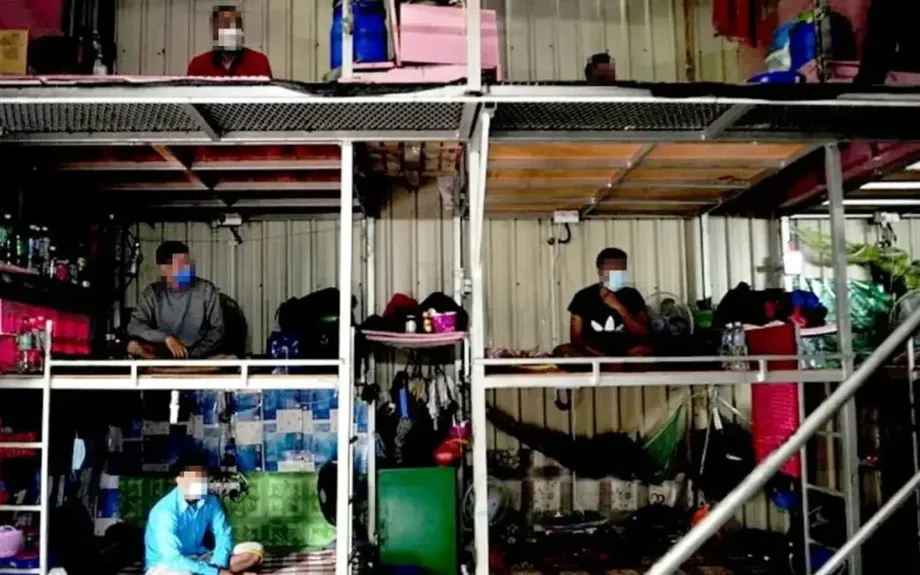
The recruitment advertisements said the North Korean embassy controlled documents such as passports and required or recommended accommodation separate from workers of other nationalities. GRC also identified embassy officials inspecting potential workplaces in Russia.
Passport control matters because a worker without access to identity and travel documents faces practical barriers to changing jobs or returning home. Separate accommodation can also restrict contact with people outside the work group. GRC describes these controls alongside threats of punishment against workers and their families.
The advertised schedule of 12 hours a day for 28 days amounts to 336 working hours in a month. Other advertisements described only two days off each month. GRC also described working conditions reaching 18 hours a day for six or seven days a week, a broader account of conditions than the schedule in the recruitment pitch.
GRC legal adviser Elise Lauriot Prevost connected the alleged treatment of workers with the priorities of the two governments. She described the investigation's finding in these terms:
This investigation exposes a dangerous convergence between two states' military ambitions.
GRC's concern is that pressure to supply labour and raise state revenue leaves workers with little control over their lives. Forced labour means work extracted through coercion or threats, rather than work a person can freely refuse or leave.
Who receives the money?
Recruitment brokers charged between 100,000 and 150,000 rubles per North Korean worker, according to GRC. The upper figure was reported as about $1,860. Employers therefore paid substantial sums to obtain access to the workforce before considering the wages earned through production.
GRC said workers surrendered as much as 90% of their earnings to the North Korean authorities. Shreyas Reddy of Korea Risk Group gave a broader estimate, saying workers directly received only 10% to 25%, with the remainder going to North Korean state companies and authorities.
For a worker earning the equivalent of $100, those estimates mean keeping about $10 under GRC's figure or $10 to $25 under Reddy's range. Both descriptions place most of the income outside the worker's control.
The Multilateral Sanctions Monitoring Team (MSMT), a group of 11 countries tracking sanctions violations, estimated in a September report that 35,600 to 101,280 North Koreans worked across 12 countries. It put annual revenue from overseas labour at $450 million to $800 million. Those figures concern the international workforce, while its estimate for Russia alone was 15,000 to 30,000 workers at the end of 2024.
Where civilian production meets military supply
Black Horse described its activities as including supplies of machinery ordered by Russia's defence ministry and exports of agricultural products to North Korea. Its businesses also imported Chinese and European manufacturing equipment, and GRC identified at least two sites connected with Russia's military industry.
The military rations factory provides a direct example of work supporting the armed forces. Rations are packaged food for troops. Pet food manufacturing and agriculture show that the alleged recruitment system also extended into civilian production.
European Union sanctions were imposed on Sokolov in October over his role in commercial and industrial cooperation with North Korea. GRC's investigation places his machinery, agricultural and labour businesses within the same wider commercial network.
Lara Strangeways, GRC's head of business and human rights, described how the organisation connects the work in Russia with revenue for Pyongyang:
North Korean labor is sustaining Russian industries related to the war in Ukraine, and the wages earned by North Korean workers are used to fund North Korea's military programs.
Her assessment identifies two benefits for the governments involved: Russia obtains workers for production, while North Korea receives income taken from overseas earnings. Workers occupy the middle of that exchange while retaining only a small share of their pay, according to the estimates.
The UN restrictions behind the dispute
The UN Security Council tightened restrictions on North Korean overseas labour in 2017 after Pyongyang's sixth nuclear test. The measures prohibited new work permits and required countries to send home North Koreans earning income abroad by December 2019.
The restrictions sought to cut revenue available to North Korea's nuclear and weapons programmes. Russia and China, both permanent members of the Security Council, voted for the measures. South Korea and Western governments have since accused both countries of failing to comply.
Student placements are central to the alleged workaround because they give factory workers an educational label. GRC argues that the actual activities, including organised shifts and contracts supplying teams to businesses, amount to employment covered by the restrictions.
Russia also changed the international monitoring environment in 2024 by vetoing the extension of the UN Panel of Experts mandate. The panel had monitored sanctions implementation since 2009. The MSMT was formed that year by 11 countries, including South Korea, Japan and the United States, to continue tracking violations outside that UN panel.
How the partnership developed
Russia's full invasion of Ukraine in 2022 was followed by deeper military and economic cooperation with North Korea. GRC describes an exchange in which Pyongyang supplied weapons and personnel while Moscow provided cash and fuel.
South Korea's intelligence agency said North Korea had sent more than 10,000 troops to fight alongside Russian forces since 2024. Other reported deployment estimates range from 11,000 to 25,000. Those military personnel are separate from the civilian labour estimates used to describe workers in Russian factories and farms.
The main milestones show how the labour allegations fit into a relationship that has expanded over several years:
- 2017: The UN Security Council tightened restrictions on overseas North Korean employment following the country's sixth nuclear test.
- December 2019: The deadline arrived for repatriating North Koreans earning income abroad under the UN measures.
- 2022: Russia launched its full invasion of Ukraine, followed by deeper cooperation with Pyongyang.
- 2023: The Russian and North Korean leaders pledged renewed cooperation at a summit.
- 2024: Vladimir Putin and Kim Jong Un signed a partnership treaty containing a mutual defence commitment. Russia also blocked renewal of the UN sanctions panel's mandate.
- End of 2024: The MSMT estimated that 15,000 to 30,000 North Korean workers were in Russia.
The treaty commits the two countries to aid each other in the event of armed conflict. Labour recruitment adds an economic component to a partnership already involving military supplies, troop deployments and formal security commitments.
Denials and unanswered questions
GRC contacted two Russians identified as key figures in the network. One replied and denied the accusation. Businesses involved also said they followed Russian law and rejected allegations that student status was used to get around employment restrictions.
Russia's foreign ministry and the North Korean embassy in Moscow did not respond to requests for comment. The investigation alleges embassy involvement through document control and workplace inspections, making the embassy's role a central part of the account.
The exact current number of North Koreans working through this network, the full list of employers and the amount of revenue it has transferred to Pyongyang remain unknown. The estimate of 15,000 to 30,000 workers in Russia refers to the end of 2024, while the $450 million to $800 million annual revenue estimate covers overseas labour across 12 countries.
For Russian employers, the investigation exposes potential involvement in a recruitment system operating against UN restrictions. For North Korean workers, it describes a more immediate set of conditions: exceptionally long shifts, controlled documents, restricted contact and earnings largely taken by the state.
Key Points
- GRC traced a Russian network advertising teams of 50 to 100 North Korean workers for factories and agriculture.
- The advertised schedule of 12 hours a day for 28 days equals 336 working hours a month.
- Investigators identified evidence of work at sites including a military rations factory and a pet food manufacturer near Moscow.
- GRC alleges student visas disguised employment and workers faced document controls and threats against their families.
- Brokers charged up to 150,000 rubles per worker, while estimates indicate workers retained only a small share of their earnings.
- Businesses denied evading employment restrictions and said they complied with Russian law.
- UN measures required the return of North Koreans earning income abroad by December 2019.