Hundreds of large lizards share Bangkok's busiest green spaces
About 400 Asian water monitor lizards live in Bangkok's Lumpini Park, where runners, tai chi groups and people using the outdoor gym share the grounds with reptiles that can reach about two meters long. Across the capital, more than 1,600 khlongs, or canals, connect the ponds, parks and river backwaters that help these animals move through the city.
Contents
- Hundreds of large lizards share Bangkok's busiest green spaces
- Why Bangkok provides room for a growing population
- What park surveys reveal about food and numbers
- How monitors fit their day around city life
- What DNA research adds to the picture
- Where the risks to residents arise
- Authorities favor targeted management over eradication
- Commercial breeding introduces a new set of controls
- An animal associated with insults becomes a tourist draw
- Practical steps for sharing parks and canals
- The Bottom Line
As of September 15, 2025, Bangkok faces several connected decisions: how to manage crowded wildlife hotspots, protect people from avoidable encounters and preserve an animal that also clears away carcasses and attracts tourists. Thailand has approved a regulated route into commercial breeding, with authorized breeding stock priced at 500 baht per animal and rules requiring individual microchips.
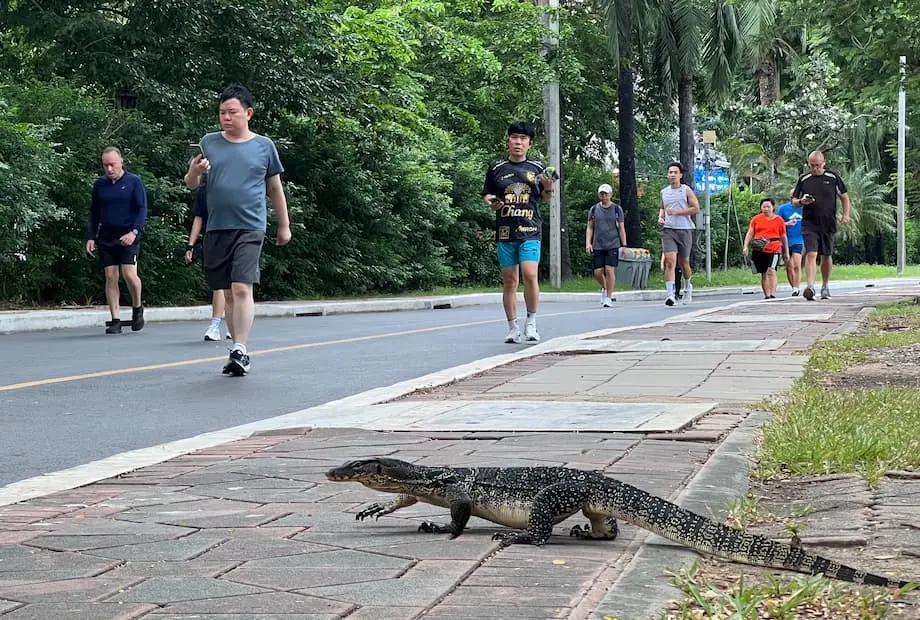
Lumpini Park makes the situation easy to see. Shortly after dawn, monitors slip into canals, climb trees to bask and cross footpaths looking for warm concrete. Some are the size of a small surfboard. Their movements overlap with morning exercise routines, making wildlife encounters an ordinary part of visiting one of Bangkok's best known green spaces.
A Bangkok resident who regularly runs in the park described the risk of stumbling over a lizard, particularly a smaller animal moving quickly across a path.
The big ones are usually fine because they move quite slowly and you can kind of hop over. The small ones can be quite fast. There have been a few times I've almost tripped over one.
The city's approach combines targeted removals, cleaner canals and advice on keeping a respectful distance. Monitors remain protected wildlife, even as Thailand prepares a controlled breeding program intended to turn some animals already in government care into a source of income.
Why Bangkok provides room for a growing population
The Asian water monitor is the world's second largest lizard after the Komodo dragon. Its range extends across Southeast Asia and into parts of India and southern China. Bangkok's extensive waterways provide a particularly suitable urban habitat, with places to feed, shelter and travel between patches of greenery.
No precise census exists for the whole city. Lumpini Park is the best tracked location, with its population generally put at around 400 and a management target of keeping numbers below that level. The park covers about 57.6 hectares and contains the wetland habitat that supports the animals.
Bangkok's monitors face few urban predators. Females can lay around 20 eggs in a clutch, and survival is high where food is plentiful. Those conditions help explain why populations have rebounded after removals: taking animals away leaves habitat and food available for the monitors that remain and their young.
In 2016, authorities removed nearly 100 monitors from Lumpini Park to reduce crowding, damage to landscaping and accident risks. Teams used ropes and baited snares, and many captured animals went to a government breeding and holding center in Ratchaburi Province. Visitors continue to see monitors daily.
The main developments span an earlier removal effort and the management choices in place by September 2025:
- 2016: Authorities removed nearly 100 water monitors from Lumpini Park and sent them to a state breeding center.
- By September 15, 2025: Lumpini's population was again generally estimated at around 400, while officials pursued targeted management and public education.
- By September 15, 2025: Thailand had approved limited commercial breeding licenses, with trading to begin after publication of the pricing resolution in the Royal Gazette.
What park surveys reveal about food and numbers
Field research in Lumpini Park recorded roughly 52 to 55 individual monitors in view during structured survey sessions in rainy and cool months. The research also reported snapshot densities of about 3.9 to 4.7 observed individuals per hectare. Those counts describe animals visible during observation, while the estimate of around 400 concerns the park's population, including animals out of sight.
Researchers described a versatile omnivore that scavenges and hunts opportunistically. In practical terms, monitors can take available prey or eat animal remains, helping them find food in a changing urban environment. Canals serve as sheltered routes between feeding and resting places.
The recorded diet was varied, with the following shares by frequency:
- Eel: about 36 percent.
- Arthropod insects: 28 percent.
- Carp: 20 percent.
- Tilapia: 8 percent.
- Turtles: 4 percent.
- Assorted animal remains: 4 percent.
Eel and carp together made up 56 percent of the recorded diet items, using the study's figures of 36 percent and 20 percent. The wider menu helps explain why parks and connected waterways can sustain so many monitors.
Fish kills, bird carcasses and other organic waste provide food for these scavengers. By consuming decaying material, monitors help clear matter that can attract pests or spread disease. Their predation on rats and other small animals can also reduce vermin pressure around waterways and markets.
The same food supply creates a management problem when people leave fish scraps or kitchen waste beside canals. Keeping waterways clean reduces material that draws scavengers close to paths, buildings and homes, while allowing monitors to continue their role in the urban ecosystem.
How monitors fit their day around city life
Bangkok's water monitors adjust their daily routines to a landscape shared with people. They bask to warm their bodies before moving along canal edges, lawns and footpaths. Pavement that reflects heat offers another place to warm up.
Tracking in the city indicates that many individuals stay close to water. During busy hours, they use the cover of canal banks, culverts and spaces behind buildings. Activity increases again when traffic and pedestrian movement ease.
Monitors tolerate people at relatively short distances, but they often avoid direct contact by slipping into water or under vegetation. This combination of tolerance and caution helps them occupy parks, zoos and canal embankments across central Bangkok.
For park users, the result is a changing pattern of encounters rather than a fixed viewing spot. A monitor may be visible on a sunny bank, then disappear into a canal as people approach. Keeping its route to water clear gives it room to move away.
What DNA research adds to the picture
Genetic monitoring at Bang Kachao, a large green peninsula in the Chao Phraya River south of central Bangkok, found high genetic diversity in the local subspecies, Varanus salvator macromaculatus. Researchers also found signs of a recent population expansion.
Patterns in mitochondrial and nuclear DNA suggested that this expansion was likely linked to urban changes that created new aquatic edges and food sources. These are two forms of genetic information used to examine ancestry and population relationships. The findings help describe how monitors are responding to a city divided by roads and buildings.
Evidence of dispersal by females helps explain movement through the patchwork of canals and parks, even where males occupy small home ranges. Research describes expansion in some urban zones and the maintenance of genetic diversity despite fragmented habitat.
For wildlife managers, those results matter when animals are held in captivity or moved elsewhere. Comparing the DNA of wild and captive groups before transfers helps preserve local genetic profiles, avoid mixing distinct lineages and support monitoring over time. Bangkok already uses captive holding and relocation to address conflict, so decisions about where animals go have a practical conservation role.
Where the risks to residents arise
Asian water monitors are far less dangerous than Komodo dragons and do not have venom that is medically significant for humans. Bites are rare and usually happen when someone corners an animal or tries to catch it. Data from Thailand's Zoological Park Organization indicates that monitors are not dangerous to people unless provoked.
Runners and cyclists face a more immediate risk from surprise. Swerving around an animal or trying to step over it can cause a fall. Smaller monitors may move quickly, while a large animal and its tail can occupy a substantial part of a path.
Small dogs and backyard chickens can be vulnerable near monitor habitat. Curious lizards sometimes enter storage areas on the ground floor, fish ponds or kitchens beside canals. These visits can cause panic even when nobody is hurt.
Hygiene is another concern. Like many reptiles, monitors can carry bacteria such as Salmonella. Feeding or touching them increases risk, making distance and clean surroundings central to safe coexistence.
Residents can reduce encounters by securing rubbish and pet food and keeping fish guts and kitchen waste away from waterways. Clear sightlines along canal paths help people spot animals before they get close. Simple signs explaining how to behave around wildlife can prevent many problems.
Authorities favor targeted management over eradication
The Bangkok Metropolitan Administration has signaled an approach with two parts: keep numbers in balance at hotspots and teach the public how to coexist safely. City departments have discussed measures with national wildlife authorities, including targeted removals where monitors repeatedly cause conflict.
Cleaning campaigns along major canals address the food waste that attracts scavengers. Public messages also advise people to avoid close contact, give monitors right of way and seek help when a lizard repeatedly enters a home or school.
The 2016 Lumpini operation illustrates both the use and limits of capture. Removing nearly 100 animals relieved pressure at the park, but the habitat continued to support hundreds. Births and high survival where food is abundant helped numbers recover.
Officials point to reasons for moderation rather than eradication. Monitors consume carcasses, reduce rats and form part of the city's wildlife. Their usefulness sits alongside the need to protect landscaping, reduce accidents and respond to repeated intrusions.
The animals remain protected under the Wild Animal Conservation and Protection Act BE 2562. Hunting, trading, possession and harm without permits are prohibited. Violations of protected wildlife rules can bring prison terms of up to 10 years and fines of up to 1 million baht.
Commercial breeding introduces a new set of controls
Thailand's Wildlife Conservation and Protection Committee has approved limited licenses for commercial breeding of Asian water monitors, citing rising urban numbers and frequent nuisance calls. The Department of National Parks, Wildlife and Plant Conservation has set a price of 500 baht per animal for authorized breeding stock.
Only animals obtained from state or licensed wildlife stations can enter the program. Breeders must microchip every monitor and record births and transfers. The microchip gives each animal an individual identifier, while the records allow officials to follow changes in a breeder's stock.
Those requirements are intended to stop wild animals from being passed off as legally obtained breeding stock. The rollout begins at Khao Son Wildlife Breeding Station in Ratchaburi, which already houses hundreds of monitors captured following nuisance complaints.
The ministry has said trading will begin once the pricing resolution is published in the Royal Gazette. No calendar date was given for that start. Early interest from farms and tanneries is high, linking the breeding initiative to demand for hides.
Water monitors are listed under Appendix II of CITES, the Convention on International Trade in Endangered Species. That framework allows international trade with controls, making accurate stock records and farm audits important to the program.
Supporters say regulated breeding could provide income for rural breeders and reduce illegal imports. Critics worry that commercial demand could encourage poachers to take wild lizards. Microchipping, inventory checks and transparent inspections will determine how effectively the program protects wildlife while addressing urban conflict.
An animal associated with insults becomes a tourist draw
Bangkok's monitors occupy an unusual place in local culture. The Thai word hia refers to the monitor lizard and is also a common insult. Folklore gives the animal associations with both menace and good fortune.
Tawee Somnamee, a caretaker at Lumpini Park, described that mixture of belief and visitor interest when explaining why some monitors should remain in the grounds.
If a hia goes into someone's room, they will become rich. There should be some left for foreigners to see.
Viral videos have helped change perceptions, including a clip of a monitor climbing the shelves of a convenience store. City leaders have responded to that interest by installing an oversized monitor statue at Lumpini Park to celebrate Bangkok's biodiversity.
The nickname Bangkok Dragon has given the species a friendlier public identity. Visitors now come to parks to watch monitors bask near fountains or swim through lakes, turning an animal long associated with an insult into an unlikely city mascot.
Guides advise visitors to keep a few meters away, avoid feeding or touching monitors and refrain from crowding them for photographs. Main lakeshores in late morning, when the animals warm themselves in the sun, and later periods when traffic eases tend to provide good viewing opportunities. Respecting space, disposing of food waste correctly and following posted guidance help keep wildlife tourism safe.
Practical steps for sharing parks and canals
Park visitors can reduce accident risks by stopping and letting a monitor cross rather than trying to step over its body or tail. Runners and cyclists should slow down near blind corners beside water, where an animal may appear with little warning.
Families and residents have several practical ways to reduce unwanted encounters:
- Give monitors room to pass and keep a respectful distance.
- Do not feed them. Feeding encourages animals to approach paths and homes.
- Keep rubbish bins closed and off the ground near canals, and secure fish scraps and pet food.
- Watch small pets and backyard poultry, especially near water.
- Teach children to look for monitors along paths and never chase or touch them.
- Report repeated building intrusions to local authorities so trained teams can respond.
- Support canal cleanups and park rules that keep shorelines clear and sightlines open.
Bangkok's challenge is to manage places where encounters become a problem while retaining the benefits of wildlife in its green spaces. Targeted capture addresses immediate conflict, cleaner waterways reduce food that draws animals close to people, and careful behavior makes everyday park visits safer.
The Bottom Line
- Lumpini Park supports about 400 Asian water monitors. Bangkok has more than 1,600 canals, but no precise citywide monitor census.
- Authorities removed nearly 100 monitors from Lumpini in 2016. The population rebounded where habitat, food and breeding conditions remained favorable.
- Monitors consume fish, insects, animal remains and other prey, helping clear decaying material and reduce rats.
- Research records flexible urban activity, high genetic diversity at Bang Kachao and signs of recent expansion in some areas.
- Bites are rare and usually involve provocation. Falls, encounters involving small pets and bacterial exposure are practical concerns.
- Thai law protects monitors. Unauthorized activities can bring penalties of up to 10 years in prison and fines of up to 1 million baht.
- Approved commercial breeding requires authorized stock, microchips and records of births and transfers. Trading awaits publication of the pricing resolution in the Royal Gazette.
- Bangkok is combining targeted removals, canal cleaning and public education while monitors gain popularity as the Bangkok Dragon.