A final rush for rewards before October
Donations through Rakuten's hometown tax portal doubled in the first 25 days of August compared with a year earlier, as Japan prepares to ban reward points tied to the program from October 2025. The surge is driving promotional events, lotteries and a legal fight over how much of each donation should reach local communities.
Contents
- A final rush for rewards before October
- How donations become tax relief
- The rule change and its timetable
- Why points have become a policy dispute
- Fairs and lotteries bring the countdown into view
- Why some gifts now require larger donations
- Local budgets face an uncertain adjustment
- What donors need to check before contributing
- Rakuten's challenge and the choices after October
- Key Points
As of September 13, intermediary websites are competing to attract donors before the restriction takes effect. Rakuten plans a two day showcase at Tokyo Big Sight featuring more than 170 municipalities. Amazon Japan recently held a similar event in Tokyo, while LY, the company behind Line and Yahoo Japan, is offering new users a lottery with points worth 100 percent of their donation amount.
Digital marketing firm i Mobile has launched a comparable campaign. Internal affairs minister Seiichiro Murakami has warned operators against escalating point giveaways in the final weeks before the change.
Rakuten has also sued the government to challenge the ban. The company argues that rewards attract donors and send money into regional economies. The government wants a greater share of donations to remain available for town budgets instead of circulating through commissions and marketing incentives.
For municipalities, the immediate opportunity is a burst of donations before October. The concern is what happens afterward: local officials expect the disappearance of points to reduce traffic to donation portals, potentially affecting funding for community projects and everyday services.
How donations become tax relief
Japan launched furusato nozei, commonly called the hometown tax program, in 2008. It allows taxpayers to direct part of their income and residence taxes toward municipalities they choose. The aim was to support regional development and give people living in cities a way to help hometowns and rural communities facing population decline.
Donors receive local gifts, including specialty foods, crafts and travel experiences, while their tax bills are reduced the following year. Most people donate through large websites that display thousands of items from towns across Japan and handle payments, shipping and documentation.
The typical annual cost to a donor is 2,000 yen. The rest of the donation is returned through tax credits, provided the donor stays within an annual limit determined by income and household circumstances. A tax credit reduces the tax a person must pay, so the donation and the later reduction need to be considered together.
The annual limit matters because the 2,000 yen figure applies when donations remain within it. Donors therefore need to estimate their income and check their household circumstances before deciding how much to contribute.
Municipalities generally keep gift value at around 30 percent of the donation amount because rules cap what they can offer. The limit is intended to prevent towns from competing through increasingly lavish rewards. Local food, crafts and experiences remain part of the program; the October restriction concerns reward points awarded by intermediary portals.
Foreign residents who pay income and residence taxes in Japan can also participate. Eligibility for the tax benefit depends on tax circumstances, including whether the donor will still be resident when the following year's residence tax position is determined.
The rule change and its timetable
From October 2025, intermediary portals will be prohibited from awarding reward points tied to hometown tax donations. Regulators have also tightened controls on advertising that promotes points returned to donors. The stated goal is to leave more donation money in municipal budgets.
The point ban follows an earlier tightening of expense rules. Since October 2023, municipalities have had to keep the combined cost of gifts, shipping, administrative processing and portal fees below 50 percent of each donation. The gift ceiling of around 30 percent remains within that total spending limit.
Administrative expenses now explicitly include work on the one stop exception, a simplified way to claim the tax benefit, and the issuance of donation certificates. Portal fees count in full, even when they are described as system management charges. Renaming a fee therefore leaves it inside the expense calculation.
The key dates show how the program has moved from expansion to tighter controls:
- 2008: Japan introduced furusato nozei to support regional development.
- Fiscal 2022: Donations approached 1 trillion yen, and about 9 million people used the program.
- October 2023: Stricter accounting rules took effect for gifts, shipping, administration and portal fees.
- August 1 to 25, 2025: Rakuten says donations through its portal were twice those in the same period a year earlier.
- September 13, 2025: Platforms are promoting donations before the October restriction, and Rakuten has filed a legal challenge.
- October 2025: The prohibition on portal reward points is due to begin.
- January 10: The annual deadline applies to applications for the one stop exception.
Why points have become a policy dispute
Municipalities pay intermediary websites to list gifts and handle donations. When those commissions help finance reward points, some money intended to support local services returns to donors through private marketing campaigns. Regulators argue that this weakens the program's purpose.
The ministry wants to cool competition over incentives and encourage portals to lower commissions. Its objective is to increase the share available to communities after the costs of attracting and processing donations have been paid.
Fiscal 2022 donations of nearly 1 trillion yen, involving about 9 million users, show the scale of the system. Its growth has also brought disputes about gifts and the distribution of benefits among municipalities.
Past controversies included towns offering expensive consumer electronics. Those offers intensified competition through products with little connection to promoting the region. Contractors handling gifts for local governments have also mislabeled the origin of meat and seafood.
Donations continue to cluster around famous branded foods, including premium beef and crab. Towns associated with popular specialties can draw substantial revenue, while municipalities without similarly recognizable products struggle to compete.
Urban wards are among the places that lose tax revenue when residents direct contributions elsewhere. The program therefore affects both the community receiving a donation and the municipality where the donor lives. The government's concern extends beyond the size of individual rewards to how money is distributed between places.
Fairs and lotteries bring the countdown into view
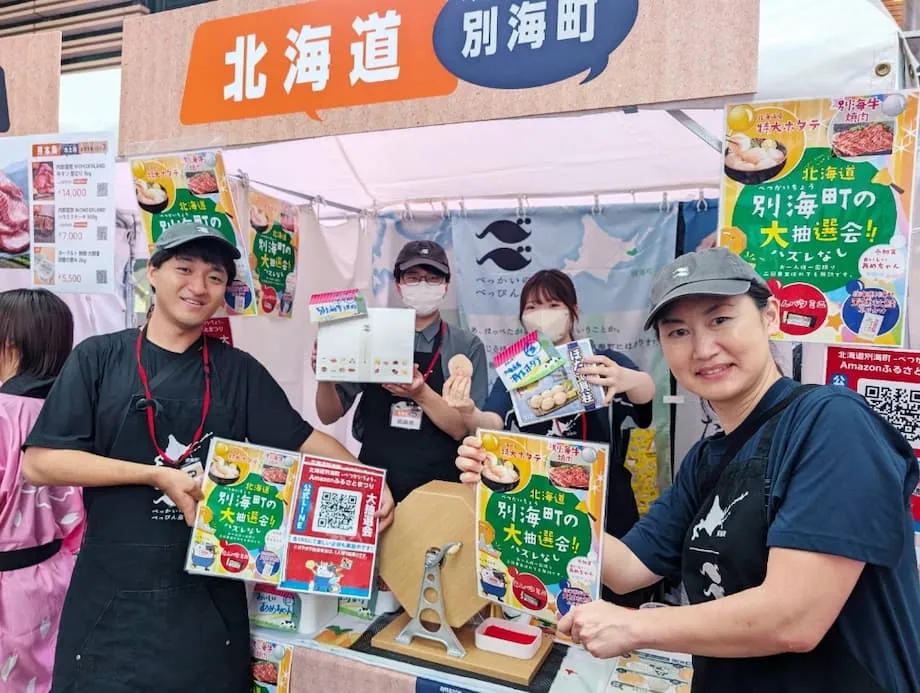
Rakuten's planned fair at Tokyo Big Sight will bring together more than 170 municipalities for two days. Visitors will be able to taste food, inspect crafts, explore experiences and speak directly with local officials about what their towns offer.
Amazon Japan recently used a similar event in Tokyo to encourage donations toward the end of the quarter. These gatherings bring the portal experience into a physical venue, allowing prospective donors to see products and meet representatives before choosing where to contribute.
A municipal official helping coordinate one of the weekend events said towns needed to use the remaining weeks to secure funding for local projects. The official described the concern about donations after points disappear:
We need to appeal now as the ban on points is expected to lead to a decrease in donations.
LY's campaign this month offers first time users the chance to win points equal to their entire donation amount. The reward is awarded by lottery, rather than to every participant. i Mobile is running a similar promotion to attract new donors.
Murakami has cautioned operators against inflating giveaways during the final sprint. The government says it will watch for campaigns that distort donation behavior before the new rules begin. That warning places the current promotional push inside the wider dispute over whether rewards serve regional development or draw too much money into competition between platforms.
Why some gifts now require larger donations
The expense ceiling introduced in October 2023 has already changed municipal gift catalogs. Towns must fit gifts, delivery, administrative work and portal charges within the same budget, while retaining the separate limit on gift value.
Many municipalities have responded by raising the donation amount needed for popular gifts or reducing what donors receive. Aomori Prefecture increased amounts by about 30 percent in some categories as shipping and raw material costs rose.
For a donor, a higher listed amount means using more of the annual donation allowance to obtain the same type of gift. Smaller packages offer another way for municipalities to control costs without removing a product from their catalogs.
Other municipalities are moving from heavy gourmet items toward travel vouchers and tickets to local events. These gifts can highlight local culture while avoiding some of the expense of shipping bulky products. The change also gives donors a reason to visit the community rather than receive everything at home.
Fujiyoshida, in Yamanashi Prefecture, has kept expenses under the 50 percent ceiling and therefore expects fewer catalog changes. An official there said the broad purpose of regulation was understood, but frequent changes had made everyday administration difficult:
The purpose of regulation is understood, but the system is too complicated.
The official also called for more attention to intermediary fee structures so that a larger share of donations goes directly to local governments. For towns already managing their costs within the limit, the next concern is how portal charges affect the money left for public purposes.
Local budgets face an uncertain adjustment
Municipalities use hometown tax donations for childcare subsidies, local roads, disaster preparedness, tourism campaigns and other everyday services. A fall in donations after October could leave towns with less money for those activities, especially where they depend heavily on portal traffic.
Budget planners are preparing for a possible dip and considering how to protect priority projects. Municipalities are also reviewing gift bundles, procurement contracts and delivery arrangements. Consolidating logistics is one option for reducing costs alongside changes to the gifts themselves.
Satofull has introduced a plan that discounts some commissions when a municipality outsources full management of its hometown tax program. The offer is presented as a way to lower costs while retaining visibility on a large donation portal.
Portal access remains valuable because it brings towns into contact with donors across Japan and handles much of the transaction. Municipalities are weighing that reach against the fees they pay and the amount remaining for local services.
The immediate donation surge may help towns collect money before the restriction begins. Their longer adjustment involves finding ways to attract support without relying on points, while continuing to meet the expense rules already in force.
What donors need to check before contributing
Donors considering a contribution before October should check their annual limit with a reliable calculator using estimated income and household circumstances. A promotional reward does not change how much tax relief their circumstances allow.
Shipping schedules and stock availability also matter. Promotions around the end of the year can put pressure on producers, so donors should check when gifts are expected to arrive and whether the selected items remain available.
People who want to spread their support can balance popular gifts with contributions to specific community projects or disaster recovery funds. Many municipalities list these options on portal pages, allowing donors to choose a purpose as well as a product.
Salaried workers who donate to five or fewer municipalities and are not otherwise required to file a tax return can use the one stop exception. They must request it for each donation and submit the application by January 10. This route lets eligible donors claim the benefit without filing a regular tax return.
Anyone who does not meet those conditions, including people donating to six or more municipalities, needs to file a regular tax return and attach donation receipts. Keeping receipts, donation records and delivery notices organized makes it easier to check the tax credit later.
Gifts received through furusato nozei count as temporary income for tax purposes, with an annual exemption of up to 500,000 yen. Very large donations, or other temporary income received in the same year, can push a donor above that threshold and lead to tax on the gifts.
Residence tax for a given year depends on the person's status on January 1 of the following year. People leaving Japan before December 31 will not owe residence tax for that year and should not use the program. Anyone expecting to leave needs to consider that timing before making a donation.
Rakuten's challenge and the choices after October
Rakuten's lawsuit brings the disagreement over reward points into court. The company says rewards help attract donors and direct money into regional economies. The government's position is that the system should retain more money for local budgets and reduce competition built around incentives.
No court hearing date or ruling is given as of September 13. Platforms and municipalities are preparing for the October restriction while the legal challenge adds uncertainty to that transition.
After points end, portals may compete through services that help donors find suitable gifts and understand town projects. Possible changes include better discovery tools, more carefully selected content and closer connections between donors and the communities receiving their money.
Municipalities may also invest in their own donation pages or build relationships with smaller portals to reduce fees. These are potential responses to the new rules, alongside the catalog and cost adjustments already taking place.
For donors, fewer reward promotions could put more attention on the gift, the municipality and how contributions support local services and jobs. The coming months will show how donation volumes adjust without points and how quickly towns and platforms change their approach.
Key Points
- Japan will prohibit intermediary portals from awarding points tied to hometown tax donations from October 2025.
- Rakuten says donations through its portal doubled in the first 25 days of August compared with a year earlier.
- Rakuten plans a two day fair with more than 170 municipalities; Amazon Japan recently held a similar event in Tokyo.
- LY is offering new users a lottery for points worth 100 percent of their donation amount, and i Mobile has a comparable campaign.
- Internal affairs minister Seiichiro Murakami has warned against escalating point giveaways before the ban.
- Rakuten has sued the government, arguing that rewards attract donors and support regional economies.
- Since October 2023, gifts, shipping, administration and portal fees must remain below 50 percent of each donation, with gift value generally capped around 30 percent.
- Municipalities are adjusting gifts, delivery arrangements and fees while preparing for a possible fall in donations.
- The typical annual donor cost is 2,000 yen within the applicable limit; eligible one stop applications are due by January 10.
- Donors should check income limits, retain receipts and consider gift taxation and their residence status before contributing.