Cash withdrawals and transfers resume after hours of disruption
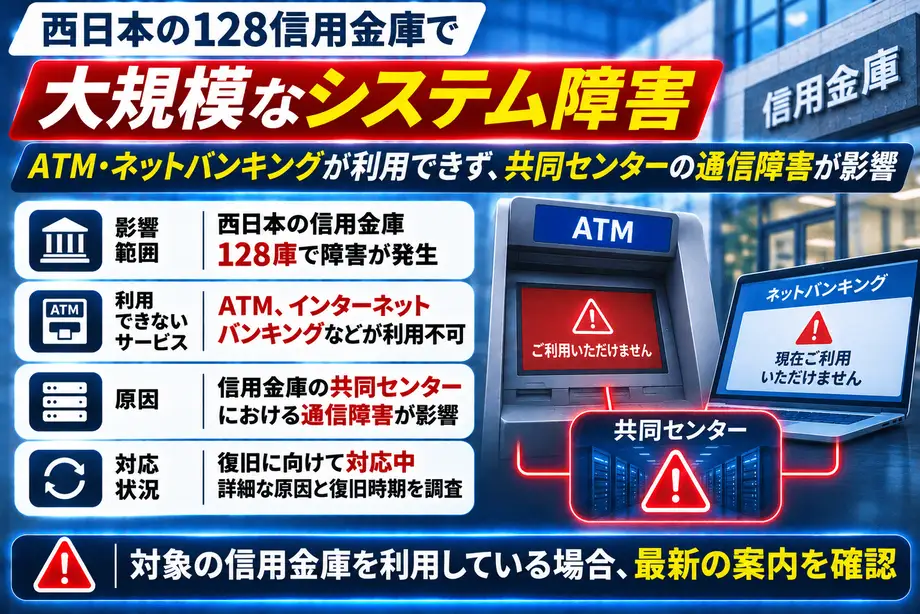
A failure in shared banking equipment in Kobe, Hyogo Prefecture, interrupted services at 128 Japanese shinkin banks on November 6, 2026, stopping cash withdrawals, deposits, branch transactions and internet banking. Most services returned by 6 p.m., but transfers to other financial institutions remained unavailable until full restoration at about 7:05 p.m.
Contents
- Cash withdrawals and transfers resume after hours of disruption
- One shared system connected a wide area
- What failed inside the banking network?
- How the afternoon unfolded
- Customers could not always switch to another ATM
- Branch staff also faced unfinished work
- Malaysia faced a different kind of incident
- France reported stolen funds, while Europe faced retail attacks
- Key Points
Shinkin Central Bank and Shinkin Kyodo Center, which operates the shared network, attributed the disruption to equipment failure. They said a cyberattack was not responsible. The outage began at about 1:30 p.m. Japan time and lasted roughly five and a half hours.
The incident occurred on Friday, November 6, 2026.
Customers across Tokai, Hokuriku and western Japan lost access to several ways of moving money at once. Services at 3,430 branches were affected. Some customers could not use their bank cards even at convenience store ATMs or machines operated by partner institutions.
The restoration ended the immediate interruption, while the banks and their shared service operator faced the task of explaining how a communications equipment failure spread across so many institutions. Shinkin Central Bank, Shinkin Kyodo Center and the National Association of Shinkin Banks announced the recovery. Shinkin Central Bank and Shinkin Kyodo Center issued a statement deeply apologizing for the incident.
One shared system connected a wide area
Shinkin banks are cooperative financial institutions serving local communities and businesses. Although customers deal with individual banks, many of those institutions rely on common technology to process their transactions.
Shinkin Kyodo Center divides participating institutions into two regional groups. The failure occurred at its West Japan Centre, whose system is located in Kobe. Shinkin banks in eastern Japan continued operating normally.
The affected area included Tokai, Hokuriku, Kinki, Chugoku, Shikoku and Kyushu. Named institutions included Okazaki Shinkin Bank in Aichi Prefecture, Osaka City Shinkin Bank in Osaka Prefecture and Hiroshima Shinkin Bank in Hiroshima Prefecture. Seto Shinkin Bank, Gifu Shinkin Bank, Osaka Shoko Shinkin Bank, Osaka Shinkin Bank and Kita Osaka Shinkin Bank also announced service interruptions.
The common link was the shared system. A fault at the centre interrupted connections used by many banks, spreading the disruption across a large geographical area rather than confining it to one institution or branch.
What failed inside the banking network?
Shinkin Kyodo Center said communications stopped working in the core banking system. This is the central system that processes transactions such as deposits, withdrawals and transfers. Branch counters, ATMs and online services all need access to it to complete those requests.
Communications equipment at the West Japan Centre was identified as the source of the failure. Shinkin Kyodo Center said communications equipment and other equipment had likely malfunctioned during a system update for western Japan carried out in mid-October. Shinkin Central Bank and Shinkin Kyodo Center described an equipment malfunction and said the incident was not caused by a cyberattack. The initial account also said no unauthorized access had been detected.
The organizations pledged to make utmost efforts to prevent a recurrence, but did not disclose the precise equipment involved or specific preventive measures. Those details matter because customers need dependable access through both physical locations and digital services, which were interrupted together in this incident.
How the afternoon unfolded
Recovery happened in stages. Most services resumed before transfers to other financial institutions, leaving customers with different levels of access during the evening.
- About 1:30 p.m.: A failure at the West Japan Centre interrupted transactions at 128 shinkin banks.
- By 3:30 p.m.: Several affected banks had published notices about unavailable ATMs, branch transactions and digital services.
- By 6 p.m.: Most services had resumed, while transfers to other financial institutions remained unavailable.
- About 7:05 p.m.: Services were fully restored, according to Shinkin Central Bank, Shinkin Kyodo Center and the National Association of Shinkin Banks.
During the afternoon, the operator had no firm restoration time to give customers. The evening recovery announcements replaced that uncertainty with confirmation that services had returned.
Customers could not always switch to another ATM
Seto Shinkin Bank described a particularly broad interruption. Its cash cards could not be used at partner financial institutions or convenience store ATMs, while some automatic account debits were delayed or put on hold.
A convenience store ATM provides another place to access a bank account, but the machine still needs a working connection to the systems serving that account. Customers affected by this failure could therefore find that walking to a different ATM did not restore access to their money.
Automatic debits created another concern. These are payments taken directly from an account under an existing arrangement. Seto said some were delayed or held, showing that the disruption reached beyond transactions customers were actively trying to make during the outage.
Osaka City Shinkin Bank and other affected institutions advised customers needing urgent transfers to use financial institutions outside the shinkin network or consult their usual branch. For people with access to another account, that offered a possible alternative while the shared system was unavailable.
Branch staff also faced unfinished work
Some branches could not complete their closing procedures because the system was unavailable. In certain cases, managers were instructed to remain on standby until service returned.
Closing a branch involves more than shutting its doors. Staff must finish processing the day's activity and check transaction records. The disruption therefore continued to affect branch operations even after the usual period for serving customers at counters.
The staged restoration also mattered for businesses and households waiting to send money elsewhere. By 6 p.m., most banking functions had returned, but transfers to other financial institutions remained unavailable for roughly another hour. Customers waiting for those transfers needed the final recovery announcement, rather than the earlier return of most services.
Malaysia faced a different kind of incident
Malaysia's Bank Rakyat also faced a technology incident, but the reported problem involved a website attack. Communications Minister Fahmi Fadzil, who also serves as government spokesman, said the hacking attempts detected had not caused data theft or disrupted online banking operations.
Fahmi said the Bank Rakyat attack changed the appearance of a website managed by a third party. Such an attack is commonly called website defacement: someone alters what visitors see on a page.
Bank Rakyat blocked access to the affected server and redirected users to i-Rakyat, which the bank fully owns. The response focused on separating customers from the affected website while providing access through another service.
The Japanese and Malaysian incidents required different responses. In Japan, the operator worked to restore communications supporting transactions across many banks. In Malaysia, Bank Rakyat restricted access to a compromised server and redirected visitors. Fahmi's account placed the damage at the website level, with online banking continuing to operate.
France reported stolen funds, while Europe faced retail attacks
In France, a cyberattack on Credit Mutuel Arkea involved more than €100 million transferred out of the bank's systems, according to a senior official. Some of the money was recovered, and customer funds were untouched.
Daniel Baal, president of the Confederation Nationale du Credit Mutuel, said a specialist French unit responsible for investigating cybercrime was examining the attack. The theft was disclosed on a Wednesday, although the information accompanying that disclosure did not specify a calendar date.
Cyberattacks also targeted supermarkets in at least nine European countries during the same week. The European Union warned of deliberate efforts to disrupt food supplies. Russia, which has faced longstanding accusations of cyberattacks against European countries, denied involvement.
Together, the incidents show several concrete ways essential services can be interrupted: broken communications can stop transactions, a compromised website can require visitors to be redirected, and unauthorized transfers can remove money from an institution. The Japanese banks identified equipment failure as the cause of their outage, while the Malaysian and French cases involved reported cyberattacks.
Key Points
- A shared system failure interrupted services at 128 shinkin banks across Tokai, Hokuriku and western Japan.
- The outage began at about 1:30 p.m.; most services resumed by 6 p.m., with full restoration at about 7:05 p.m.
- Branch transactions, ATMs, internet banking and transfers were affected. Seto Shinkin Bank also reported delayed or suspended automatic debits.
- The operators attributed the disruption to equipment failure at the West Japan Centre in Kobe and ruled out a cyberattack. Shinkin Kyodo Center said communications equipment and other equipment had likely malfunctioned during a mid-October system update for western Japan.
- Eastern Japan's shinkin banks continued operating normally.
- The incident occurred on Friday, November 6, 2026.
- Shinkin Central Bank and Shinkin Kyodo Center deeply apologized and pledged to make utmost efforts to prevent a recurrence, but disclosed no specific preventive measures.
- Separate incidents in Malaysia and France involved website defacement and stolen institutional funds, respectively.