From Jakarta to Kathmandu, a familiar skull carries new demands
A black flag bearing a toothy skull in a straw hat has linked protests over overloaded trucks in Indonesia, censorship in Nepal and corruption in the Philippines. By September 13, 2025, the emblem of the Straw Hat Pirates from One Piece had also appeared in France, where some marchers wore straw hats and carried versions drawn by hand.
Contents
- From Jakarta to Kathmandu, a familiar skull carries new demands
- Why the Straw Hat Pirates became a reference point
- Indonesia's truck protests opened the way
- National pride and the rules for displaying flags
- Nepal's protests brought deadly stakes
- Flood projects fuel anger in the Philippines
- How a simple image helps people act together
- Phones, fan networks and the spread of dissent
- Officials disagree over the boundaries of expression
- At a Glance
Jakarta crowds raised the flag in July, when many officials did not recognize the cartoon image. Young Indonesians did. An emblem familiar from posters, fan shirts, manga and anime was becoming a public demand for freedom, carried by a generation frustrated with corruption, censorship and policing that uses excessive force.
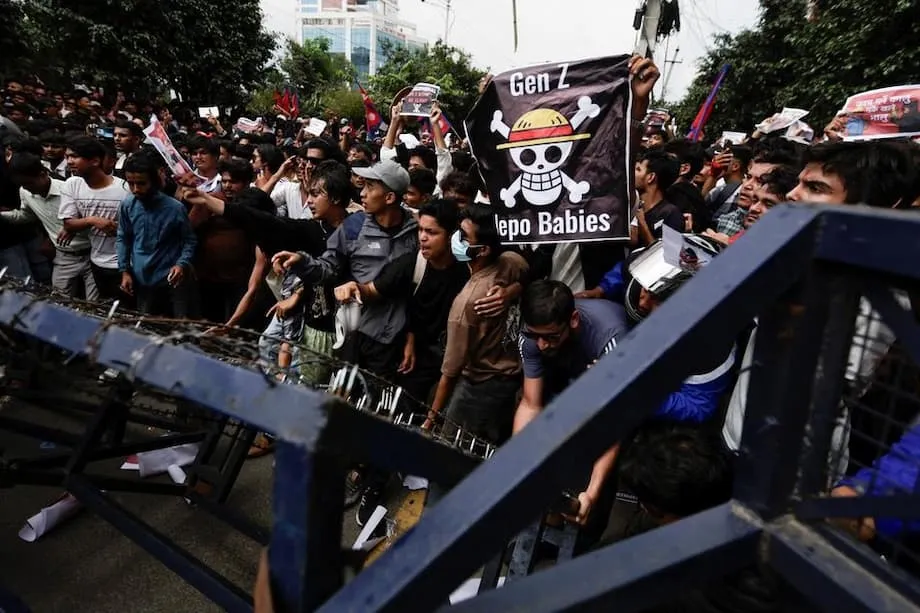
The flag gained further force after a police tactical vehicle crushed and killed a motorcycle taxi rider aged 21 during unrest near Jakarta demonstrations on August 28. In Nepal, it appeared during protests following a government move to block 26 social media platforms. At least 19 people died in clashes, and Prime Minister K. P. Sharma Oli resigned as anger spread.
University students in the Philippines raised the same skull during an anti corruption run involving more than 1,000 people. Their grievances concerned alleged theft from flood control projects, while protesters in France were angry about planned spending cuts and elite politics.
The countries shared an image, while their immediate demands reflected local problems. For young people accustomed to communicating through memes, hashtags and fictional characters, the skull offered a common language without the baggage of a political party. It was easy to recognize, reproduce and carry as a peaceful expression of dissent.
Why the Straw Hat Pirates became a reference point
One Piece follows Monkey D. Luffy, a young pirate who builds a crew around loyalty, freedom and a shared dream. The Straw Hat Pirates confront a powerful world government that controls information and punishes dissent. Their flag, known as a Jolly Roger, marks their identity, friendship and determination to pursue a goal that seems beyond reach.
Pirate flags historically aimed to frighten people. One Piece gives the skull a different meaning: friendship, freedom and the pursuit of dreams against a rigid system. Protesters can use that familiar story to express demands for fairness, dignity and the right to speak without fear.
The franchise has an enormous audience. Since the manga began in 1997, it has sold more than 500 million copies worldwide. The anime began airing in 1999 and now runs beyond 1,100 episodes. A live action series released in 2023 brought another wave of viewers through major streaming platforms, helping make One Piece one of the most streamed franchises in recent years.
Many teenagers and people in their twenties in Indonesia, Nepal and the Philippines grew up with the story. For viewers fluent in anime references and online humor, the skull is both familiar and unthreatening. Even someone who has never watched an episode can recognize its defiant tone.
The image compresses a complicated message into something simple. A protester can draw it on cardboard, print it on a shirt or fly it from a motorbike. Its meaning travels across languages, allowing entertainment imagery to become a shared expression of civic resistance.
Indonesia's truck protests opened the way
Indonesia's first wave of sightings began with truckers opposing new limits on overloaded vehicles. Students soon joined, and the flag moved from a dispute over transport rules into a wider expression of dissatisfaction with those in power.
President Prabowo Subianto had urged Indonesians to display the national red and white flag ahead of Independence Day on August 17. He linked its colors to the country's struggle for independence in a widely quoted appeal.
Raise the red and white flag wherever you are. Red represents the blood shed for our independence, white represents the purity of our souls.
Some citizens chose the Straw Hat flag instead. Online shops reported a surge in orders as the image spread, with sellers describing a wave of purchases in the run up to Independence Day. Fans also shared instructions for painting their own versions.
The August 28 death of the motorcycle taxi rider during chaos near demonstrations intensified public anger. The rider was crushed by a police tactical vehicle, and outrage spread quickly. Authorities seized banners in several provinces, while officials condemned displays of the skull beside the national flag.
The main developments unfolded over several weeks:
- July: The Straw Hat skull appeared above a crowd in Jakarta as its use spread from truckers to students.
- Before August 17: Prabowo urged citizens to raise the national flag ahead of Independence Day, while orders for Straw Hat flags surged.
- August 28: A police tactical vehicle killed a motorcycle taxi rider aged 21 near Jakarta demonstrations, adding to public anger.
- Early September: The emblem appeared in Kathmandu during protests against censorship and corruption.
- By September 13: The flag had also surfaced at a university event in the Philippines and among protesters in France.
National pride and the rules for displaying flags
Indonesian law does not ban fictional flags on their own. It does require the national flag to fly higher when displayed with other banners. Those rules became central to a public argument over whether the Straw Hat skull expressed criticism of government or disrespect for the country.
Police in Jakarta said they would monitor symbols considered contrary to the spirit of nationalism. The warning unsettled some fans and advocates of free speech. Police seized banners in some provinces and questioned vendors, bringing the dispute into shops and communities as well as demonstrations.
Prasetyo Hadi, Indonesia's state secretary minister, said the president had no objection to creative expression, while insisting that the national flag must not be diminished. His office explained that position in a statement.
"The flag can be a form of creative expression. However, it should not be used to challenge or diminish the significance of the red and white flag. The two should not be placed side by side in a way that invites comparison or conflict," his office said.
Some lawmakers called the skull divisive. One suggested that displaying it next to the red and white could approach treason, meaning betrayal of the state. Critics argued that the image undermined unity; supporters described it as a creative form of protest.
Many Indonesians displaying the skull said they were criticizing officials and policies rather than rejecting their country. Their argument was that patriotism could include objections to how the country was governed. A fan emblem had become part of a national debate about identity, pride and the limits of dissent.
Nepal's protests brought deadly stakes
Kathmandu protesters raised the Straw Hat flag in early September after the government moved to block 26 social media platforms. Young people saw the restrictions as censorship, and demonstrations widened into nationwide unrest over graft and nepotism. Graft means corruption involving public power; nepotism means favoring relatives when distributing jobs or advantages.
At least 19 people died in clashes. Prime Minister K. P. Sharma Oli resigned as anger grew and state buildings were set ablaze. Troops moved into key areas, while an interim arrangement for governing the country was discussed. That arrangement was still under discussion at the time.
Nepal's Gen Z accounts for a large share of its population. Young people have lived through years of unstable governing coalitions and limited job prospects. In the streets, the Straw Hat skull appeared beside placards reading "The Time is Now" and "#WakeUpNepal."
Rohan Rai, a student aged 19 in Kathmandu, said images from Indonesia had inspired his peers. He described the flag as an expression of shared opposition to corruption and restrictions on speech.
"It represents freedom, loyalty and defiance against injustice. We saw Indonesians use it, and we felt the same thing here. It tells everyone we will not accept corruption and censorship," he said.
The emblem traveled through phones and social media feeds before appearing at rallies and neighborhood vigils. Young people who felt ignored by political elites could recognize a shared grievance in images from another country, then adapt the symbol to their own demands.
Flood projects fuel anger in the Philippines
Students at the University of the Philippines Diliman carried the Straw Hat skull during an anti corruption run that drew more than 1,000 participants. Images circulated through fan forums and campus networks, connecting an established anime audience with a public protest.
The event took place as the Philippines faced revelations about ghost flood control projects during a season of heavy rains. A ghost project is presented as a public works project even though the promised work is absent. Anger also focused on displays of wealth by the children of contractors and officials.
Environmental activist Jonila Castro described the contrast between people living in flooded neighborhoods and those accused of profiting from public money. Her words spread beyond activist circles.
While we are sinking in floodwater and mud, they are drowning in money they stole from the people.
The protest connected corruption to a concrete daily experience: floodwater and mud surrounding residents while money intended for protection was allegedly taken. The Straw Hat flag gave students another way to express anger at unfairness and the privileges of people with powerful connections.
In France, marchers opposing planned spending cuts and elite politics were photographed wearing straw hats and carrying skull flags drawn by hand. The same image served as a statement of defiance without requiring a party label, extending its reach beyond Asia.
How a simple image helps people act together
Natalie Pang, head of the communications and new media department at the National University of Singapore, said One Piece had changed the emotional meaning of the pirate flag. She explained why a simple image can help people express shared demands and gather around them.
"While pirate flags were historically used to intimidate and instill fear, One Piece has reimagined them as symbols of freedom, friendship and the pursuit of dreams. Symbols like the Jolly Roger resonate across cultures because they distill complex ideas into visuals that are simple and striking. They can be effective for collective expression and mobilization," she said.
The flag carries a story as well as a design. Viewers familiar with One Piece recall a crew that stands together and refuses to bow to a distant authority. That association can give strangers a shared reference point before they have exchanged a word.
Edbert Gani Suryahudaya, a researcher at the Centre for Strategic and International Studies in Jakarta, linked the flag's spread to the way people watch protests in other countries and to the place of Japanese culture in young people's lives.
"International influence in social movements is not new. Almost all large scale social movements involve a spread of ideas across borders. The flag's growing adoption reflects how Japanese culture is deeply rooted among the young and has inspired them to take action," he said.
For these protesters, the mix of humor and resolve provides an accessible way to express serious grievances. A teenager in Kathmandu and a student in Quezon City can use the same fictional emblem while directing their demands at different governments and local problems.
Phones, fan networks and the spread of dissent
Images from Jakarta traveled through TikTok, Instagram and Reddit into Nepal and the Philippines. Young people already connected by anime and games began sharing a protest vocabulary as well. Social media accelerated the movement of an image that was already familiar to millions.
A skull flag is inexpensive to reproduce. Small shops can print it on shirts, fans can paint it, and supporters can place it in windows or on motorbikes. Each display makes the image more recognizable. The same design can circulate as fan art online and appear as a declaration in the street.
Older protest symbols may carry strong ideological associations or belong to a particular party. The Straw Hat skull offers a different entry point, rooted in a story that many young people already know. Its broad audience, built through manga, anime and the live action series, helps it travel quickly.
D. Nicky Fahrizal, also a researcher at CSIS, said resistance can take shape outside formal political spaces. He connected the use of popular culture to grievances over injustice, corruption and state violence, alongside digital networks that reduce the cost of organizing.
"The issues are clear. Experiences of social injustice, corruption and state violence are the main driving forces. Strategies of resistance do not always appear in formal arenas. At times, they emerge through the channels of popular culture," he said.
Attempts to restrict the flag also drew attention to it. As authorities challenged displays, the skull appeared in new places. The argument over a fictional symbol became another channel through which people discussed their treatment by the state.
Officials disagree over the boundaries of expression
Deputy Home Affairs Minister Bima Arya Sugiarto described the Straw Hat skull as a means of expressing civic expectations. His position differed from warnings that the image threatened national unity.
"They are a way for people to convey their expectations. Such a form of expression is a natural phenomenon in a democracy," he said.
Deddy Yevri Sitorus, from the Democratic Party of Struggle, also defended symbolic expression. He argued that using imagery could provide an outlet that helps prevent confrontation.
"This kind of symbolic action is better than street protests that could turn violent," he said.
Human rights groups urged Indonesian officials to address the causes of anger, including corruption and policing that uses excessive force, rather than focus on banning symbols. The dispute placed national pride and civil liberties in the same public conversation. Civil liberties are basic freedoms, including the ability to express opinions.
The Straw Hat flag's appeal rests on that ability to turn a familiar story into a visible demand. Across the countries where it appeared, protesters used it to express freedom, loyalty and resistance to injustice. In Indonesia, the rules for displaying the national flag remained part of the debate; in Nepal and the Philippines, censorship and corruption gave the skull its immediate political meaning.
At a Glance
- By September 13, 2025, One Piece's Straw Hat flag had appeared in protests in Indonesia, Nepal, the Philippines and France.
- Its Indonesian spread began with truckers opposing new limits on overloaded vehicles, followed by students.
- A motorcycle taxi rider aged 21 died after being crushed by a police tactical vehicle near Jakarta demonstrations on August 28.
- Indonesian law requires the national flag to fly higher when displayed with other banners and does not ban fictional flags on their own.
- Nepal's protests followed a move to block 26 social media platforms, widened into anger over corruption and nepotism, and left at least 19 people dead in clashes.
- Nepal's prime minister, K. P. Sharma Oli, resigned, troops entered key areas and an interim governing arrangement was discussed.
- More than 1,000 people joined an anti corruption run at the University of the Philippines Diliman, where students carried the skull flag.
- French protesters opposing planned spending cuts and elite politics also displayed the emblem.
- One Piece's reach includes more than 500 million manga copies sold, over 1,100 anime episodes and a live action series released in 2023.
- The flag combines a familiar story of freedom and friendship with an image that is easy to make, share and carry.