Tokyo shares rebound as energy fears ease
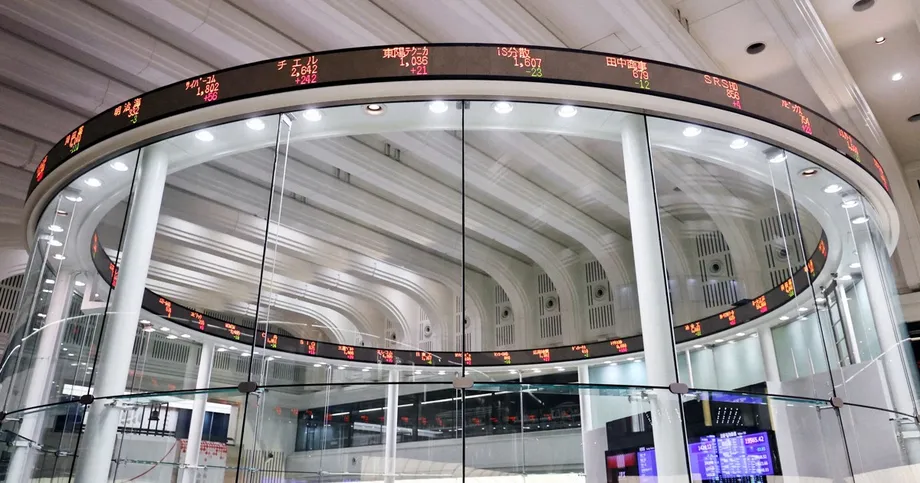
Japan's Nikkei Stock Average climbed 1,684.08 points, or 2.87%, to close at 60,459.58 on Tuesday, November 10, 2026, as falling oil prices and renewed buying of artificial intelligence and semiconductor shares extended a recovery from last week's selloff.
Contents
- Tokyo shares rebound as energy fears ease
- How the rally unfolded
- Three technology stocks supplied half the morning gain
- Why cheaper oil encouraged stock buyers
- Energy relief has limits for households
- Company results still separated winners from losers
- The rebound spread across global markets
- The yen held steady while Japanese bond yields rose
- US inflation was the next scheduled test
- Key Points
The index briefly gained more than 1,900 points and finished above 60,000 for the first time in three trading days. The broader Topix rose 75.55 points, or 1.98%, to 3,893.71, while trading value on the Tokyo Stock Exchange's Prime Market reached 9,155,554 million yen, or approximately 9.16 trillion yen.
SoftBank Group, Tokyo Electron and Advantest were central to the advance. By the morning close, those three companies had contributed a combined 885.20 points, about 52% of the Nikkei's 1,700.28 point gain at that stage. The figures show how strongly a small group of technology companies shaped the benchmark's recovery, even as buying spread across much of the market.
Crude oil provided the other major lift. OANDA Securities' November 10 oil analysis put its West Texas Intermediate price at $86.966 at the previous session's close, down 4.56%, after an intraday low of $85.602. Hopes for progress in negotiations between the United States and Iran reduced concern about disruptions to energy supplies.
Investors were buying shares after sharp losses rather than responding to a completed diplomatic agreement or a settled outlook for AI regulation. US inflation figures, due later Tuesday, and technology company earnings were the next scheduled tests for the recovery. The rally brought relief to shareholders, while Japan's weak household spending and rising government bond yields showed that pressure elsewhere in the economy continued.
How the rally unfolded
The Nikkei opened at 59,372.28, already 596.78 points above Monday's close, after a strong session in New York. Buyers quickly pushed it through 60,000, with technology shares attracting particular interest after their recent declines.
At the morning close, the Nikkei stood at 60,475.78, up 2.89%, and Topix was at 3,902.85, up 2.22%. Both finished the full session slightly below those levels, although the Nikkei made another push higher during afternoon trading and briefly reached the 60,700 range.
The main developments across the two markets followed this sequence:
- November 8: President Donald Trump said renewed US military action against Iran was unlikely if negotiations progressed.
- November 9: Oil prices fell and US stocks rebounded. The Dow Jones Industrial Average gained 1,104.02 points, or 2.15%, to 52,389.75.
- November 10, morning: The Nikkei recovered above 60,000 and ended the morning session at 60,475.78.
- November 10, close: The Nikkei finished at 60,459.58, extending Monday's recovery.
- November 10, 10:30 p.m. Japan time: October US consumer price figures were scheduled for release.
The 60,000 level matters mainly as a milestone watched by investors. Crossing it can attract attention and fresh orders, but company profits, financing costs and expectations about future growth determine whether investors keep buying.
Three technology stocks supplied half the morning gain
SoftBank Group added 400.48 points to the Nikkei by 11:30 a.m. Tokyo Electron contributed 245.24 points and Advantest added 239.48. Together, their 885.20 point contribution accounted for just over half of the morning's net advance.
The Nikkei gives greater influence to shares with higher adjusted prices. A large movement in a few influential companies can therefore move the index substantially. Topix, which weights companies mainly by the market value of shares available for trading, provides a broader view. Its smaller percentage gain on Tuesday reflected a less concentrated advance.
Buying still extended well beyond the leading three stocks. At the morning close, 167 of the Nikkei's 225 constituents had risen, 57 had fallen and one was unchanged. Estimated morning trading volume was about 1.304 billion shares.
Fast Retailing, Ibiden, TDK, Fanuc and Shin-Etsu Chemical were also among the gainers. Textiles and apparel, machinery and electrical appliances led sector advances at the close. Food companies were weaker, with Kikkoman subtracting 39.02 points from the Nikkei in morning trading and Ajinomoto subtracting 19.48 points.
Why cheaper oil encouraged stock buyers
Oil prices fell after Trump's comments encouraged hopes that negotiations could reduce the threat of renewed fighting and disruption to shipping. Japan imports much of its energy, so lower crude prices can reduce costs for businesses and ease pressure on household budgets.
Trump, the US president, described renewed military action against Iran as conditional on the progress of talks. In an interview, he said it was:
highly unlikely
OANDA's analysis also noted a more cautious assessment from US Secretary of State Marco Rubio, who said a breakthrough was not close. Attacks on vessels near the Strait of Hormuz continued, leaving traders sensitive to developments around a major route for energy shipments.
Saxo Bank's November 10 market update placed Brent crude near $92, around 22% below its late October peak above $117. Brent subsequently briefly traded below $90 during Tuesday's global session.
WTI and Brent are different benchmarks for crude oil, so their prices need not match. Both were moving lower as traders reduced the extra amount they were willing to pay because of the conflict. For stocks, cheaper energy improved expectations for company costs and reduced some concern about inflation.
Energy relief has limits for households
Lower crude prices can take time to reach petrol stations, electricity bills and goods transported over long distances. Currency movements, contracts, taxes and processing costs all affect the final price paid by a household or business.
Saxo said crude flows had almost returned to levels before the war, while supplies of liquefied natural gas and refined fuels remained constrained. European diesel was still trading around $175 per barrel, illustrating how a fall in crude can coexist with expensive finished fuel.
Japan's September real household spending fell 6.8% from a year earlier. The official Family Income and Expenditure Survey release, published on November 10, 2026, put average monthly consumption expenditures for households with two or more people at 289,536 yen, down 4.5% in nominal terms from a year earlier. Saxo described it as the tenth consecutive annual decline and the steepest since September 2020. Spending also dropped 2.8% from the previous month after seasonal adjustments.
Real spending measures purchases after accounting for price changes. The decline therefore indicates that households were buying less, rather than simply paying different prices for the same amount. Tuesday's stock rally offered a brighter picture for shareholders, while those consumption figures showed continued strain on family budgets.
Company results still separated winners from losers
Mitsui Ocean Development surged during the afternoon after raising its outlook and announcing plans to repurchase and cancel shares. A repurchase means the company buys its own shares; cancellation removes those shares permanently, reducing the number across which future profits are divided.
Taiheiyo Cement moved sharply in the opposite direction after lowering its outlook. The contrasting reactions showed investors responding to company forecasts alongside the broader changes in oil prices and sentiment.
AI shares faced a larger earnings test. Maki Sawada, a strategist in Nomura Securities' Investment Content Department, said a full market recovery depended on a clearer outlook for AI data centre construction and on earnings from AI and semiconductor companies dispelling uncertainty.
AI data centres require substantial spending on chips, buildings, electricity and cooling. Investors are watching whether that spending produces enough revenue and profit to support current share prices. Last week's Democratic sweep in the US midterm elections had also prompted concern about tighter AI regulation, adding political uncertainty to those financial calculations.
The rebound spread across global markets
Wall Street supplied a strong lead for Tokyo. Alongside the Dow's 2.15% advance on Monday, the Nasdaq Composite rose 673.72 points, or 2.74%, to 25,253.14. The Philadelphia Semiconductor Index jumped 6.85%, giving Japanese chip stocks a particularly strong signal.
South Korea's KOSPI rose about 4.4% on Tuesday, while Taiwan's Taiex advanced nearly 3%. MSCI's broad index of Asia Pacific shares gained about 2%, recovering further from the lowest level in seven months reached the previous week.
Samsung Electronics and SK Hynix helped lead South Korea's advance. Saxo's update put their gains at about 5% and 6.7%, respectively, in late morning trading. European shares also rose, with the STOXX 600 gaining 0.9% during Tuesday's session.
The pattern linked markets with large technology sectors to the same two forces: renewed buying after heavy losses and relief over energy costs. Earnings remained important, with SoftBank Group and Infineon scheduled to report Tuesday, followed by companies including Cisco Systems and Applied Materials on Thursday. Nvidia was due to report the following week.
The yen held steady while Japanese bond yields rose
The dollar traded close to 158 yen as currency investors waited for US inflation figures. At 5 p.m. in Tokyo, it fetched 158.01 to 158.02 yen, compared with 157.95 to 157.96 yen at the same time Monday.
The euro strengthened to $1.1240 to $1.1242 and 177.61 to 177.65 yen. On Monday afternoon in Tokyo, it had traded at $1.1171 to $1.1172 and 176.45 to 176.49 yen.
Japan's benchmark government bond yield rose 0.025 percentage point to 2.690%. Selling followed a Finance Ministry auction of new government bonds maturing in 30 years that attracted weaker demand than expected.
Bond prices and yields move in opposite directions. When investors sell bonds and prices fall, the return available to a new buyer rises. Higher government yields can feed into borrowing costs elsewhere in the economy, creating another factor for companies and investors to weigh alongside cheaper energy.
US inflation was the next scheduled test
October US consumer price index figures were due at 8:30 a.m. Eastern time, or 10:30 p.m. in Japan. OANDA listed forecasts for a monthly rise of 0.3% in the headline index and 0.2% in the core index, which excludes food and energy. The previous monthly increases were 0.6% and 0.3%.
The release was expected to omit the annual comparison because the October 2025 index had not been compiled during a US government shutdown. Readers would instead receive the index level and monthly changes.
Federal Reserve Governor Christopher Waller advocated an interest rate increase in December and said a larger increase of half a percentage point should be considered if inflation worsened. Traders moved toward fully pricing a December increase of a quarter percentage point, compared with a 74% probability a week earlier.
Higher interest rates make borrowing more expensive and can reduce what investors are willing to pay for profits expected far into the future. That matters particularly for technology companies valued on rapid growth. Tuesday's recovery would next face fresh information about both inflation and the returns companies were earning from AI investment.
Key Points
- The Nikkei rose 2.87% to 60,459.58, closing above 60,000 for the first time in three trading days.
- Topix gained 1.98%, and Prime Market trading value reached approximately 9.16 trillion yen.
- SoftBank Group, Tokyo Electron and Advantest supplied about 52% of the Nikkei's morning gain.
- Falling oil prices and hopes for US talks with Iran helped support a global stock rebound.
- Japan's real household spending fell 6.8% in September from a year earlier.
- US inflation figures and technology earnings were the next scheduled tests for investors.