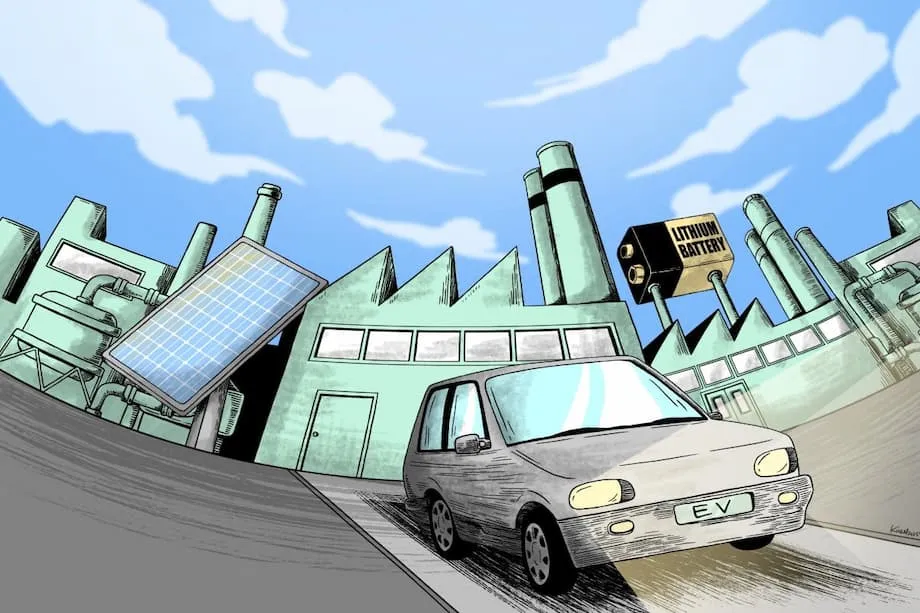
Cleaner air and water after two decades of change
China's environmental turnaround can be seen in two figures: more than 90 percent of nationally monitored water sections now receive grades of excellent, good, or fair, while the country's annual average concentration of PM2.5 fell by about 35.6 percent between 2015 and 2022. Behind those improvements is a combination of tougher rules, wider public access to pollution data, and factories producing clean technologies at enormous scale.
Contents
- Cleaner air and water after two decades of change
- How rules, monitoring, and investment came together
- What the tax and city programs achieved
- Factories supplying the global energy transition
- Batteries, electric transport, and cleaner factories
- Why the quality of innovation matters
- Where progress spreads, and where pollution moves
- How the water cleanup changed rivers and cities
- Coal, heavy industry, and the cost of making clean equipment
- What China's changes mean for other countries
- Key Points
In 2006, Ma Jun, founder of the Institute of Public and Environmental Affairs in Beijing, documented a much harsher situation. Around 28 percent of monitored water sources were severely polluted, and nearly 300 million people lacked sufficient safe drinking water. Two decades of fieldwork, investment, and policy changes trace a shift from managing environmental crises toward repairing damage across large areas.
PM2.5 consists of fine particles that can travel deep into the lungs and enter the bloodstream, increasing the risk of heart and respiratory disease. Sustained reductions mean fewer hospital admissions, longer life expectancy, and measurable improvements in productivity. China's decline from 2015 to 2022 was comparable in scale to improvements the United States achieved over roughly three decades under the Clean Air Act.
China's cleaner air came alongside industrial expansion, rather than through closing factories en masse. Tighter standards, continuous monitoring, and rapid adoption of cleaner equipment helped many regions increase output while reducing emissions and other pollutants. Some small plants with heavy pollution did close or change their operations, particularly during the water cleanup.
Manufacturing became part of the environmental response. Companies expanded production of solar panels, wind turbines, batteries, advanced motors, and waste treatment systems. Research across Chinese cities and provinces describes a process in which stronger regulation directed money into research and development, public databases increased pressure to comply, and new equipment lowered the cost of reducing emissions for each unit of production.
How rules, monitoring, and investment came together
China's progress rests on three connected changes. Regulators tightened pollution standards and introduced financial penalties. Monitoring networks made emissions more visible to officials, companies, and the public. Industry invested in cleaner processes and products, drawing on domestic innovation and the scale of its supply chains.
Power plants and industries with smokestacks gained dense networks of equipment that continuously measure emissions. City air quality stations and national water monitoring points extended that scrutiny beyond individual factories. Public pollution maps and disclosure platforms allowed residents, investors, and companies buying from suppliers to examine factory performance.
Satellite observations and audits reinforced this system. Public data made violations harder to hide and compliant operators easier to identify. For many manufacturers, documenting environmental performance became part of meeting the requirements of buyers in China and overseas.
Inspections guided by data can identify unusual emissions quickly, while automated controls shut down illegal discharges. Provinces compare results using measures such as days with good air quality and wastewater compliance rates. Cleaner equipment can therefore help a company meet the rules while also saving money.
Several dates show how the policy and industrial changes developed:
- 2006: Ma Jun documented severe water pollution affecting monitored sources and access to sufficient safe drinking water.
- 2013: A new wave of air and water policies established binding targets and funded cleaner energy and pollution control.
- 2018: A nationwide environmental protection tax replaced pollution fees.
- 2015 to 2022: Annual average PM2.5 concentrations nationwide fell by about 35.6 percent.
- 2023: China commissioned as much solar capacity as the entire world had installed in the previous year and delivered roughly three quarters of global wind farm installations.
What the tax and city programs achieved
China's environmental protection tax gave pollution control a stronger financial incentive from 2018. A study covering 287 cities estimated that the tax produced a 5.63 percent reduction in regional carbon emissions, alongside reductions in conventional air pollutants and improvements in well being.
Researchers used a difference in differences approach, which compares changes over time between groups affected differently by a policy. Their findings linked the reduction to greater investment in green research and development, improved energy efficiency, and industrial upgrading. Gains were most evident in eastern regions and areas with intensive energy use, where enforcement and financial capacity were stronger.
City demonstration programs added another route to change. An evaluation of the energy saving and emission reduction demonstration city policy treated the program as a quasi natural experiment, using the policy's introduction to examine its effects. It found that the program increased urban green technology innovation during 2006 to 2019.
Cities with stricter environmental goals achieved the strongest effects, as did places that increased public financial support for science and technology. Innovation then contributed to lower carbon emissions and better air quality through cleaner energy use and changes in the mix of industries.
The Yangtze River Economic Belt shows how cooperation across provinces can support the same goals. Policies aligning standards and sharing technology and practical knowledge accelerated combined progress in pollution control and carbon reduction. They worked by moving local industry toward cleaner activities, speeding the change in energy sources, and spreading technologies that reduce carbon emissions through networks of cities and firms.
Factories supplying the global energy transition
China's factories have become a major source of the equipment used to expand clean energy around the world. Recent market analyses put China's share of the global electric vehicle battery market at about 60 percent. Its solar installations in 2023 matched the capacity installed worldwide in 2022, while its wind farm installations represented roughly three quarters of the global total in 2023.
Those production volumes helped lower the cost of green technologies and made them more accessible across Asia, Africa, and the Americas. New Zealand sourced about 89 percent of its solar photovoltaic equipment from China in 2023. Photovoltaic equipment converts sunlight into electricity.
Large additions of solar and wind capacity are changing China's electricity mix. Solar parks have expanded across deserts and rooftops, while offshore turbines have risen along the coast. Equipment costs have fallen, construction times have shortened, and rules requiring local content have helped develop domestic suppliers across every major component.
Electricity networks remain a constraint. Transmission bottlenecks and limited flexibility in regions dependent on coal can leave clean electricity unused during hours of high production. This is called curtailment: wind or solar generation is reduced because the system cannot take all the available power.
Investment in transmission over long distances, pumped hydro storage, batteries, and smarter decisions about which generators supply electricity is easing those constraints. Pumped hydro stores energy by moving water uphill for later release through turbines. These investments help connect rising clean electricity output with the places and times where power is needed.
Batteries, electric transport, and cleaner factories
Battery capacity is changing transport and buildings. Chinese cities operate large fleets of electric buses and taxis, while domestic manufacturers export compact electric cars, trucks, and buses to markets ranging from Southeast Asia to Latin America.
Industrial facilities are also changing their own operations. In Sichuan, a showcase factory described as producing zero carbon emissions uses sensors and artificial intelligence to improve energy use, cutting emissions by hundreds of thousands of tons a year. Digital controls help bring cleaner production methods into the same industrial system that makes equipment for other users.
Hydrogen projects are expanding as well. China hosts one of the largest green hydrogen facilities and a substantial share of the world's hydrogen refueling stations. Green hydrogen is made using electricity from renewable sources, allowing it to serve as an energy source for processes that are difficult to run directly on electricity.
These developments connect domestic pollution control with export industries. Cleaner power, transport, and factory operations support China's own environmental goals, while the equipment produced supplies clean energy projects elsewhere.
Why the quality of innovation matters
Research using data covering 2008 to 2021 finds that green technology innovation in industry promotes cleaner development by helping change industrial structure. Innovations in production processes and products are the strongest drivers. They reduce conventional pollution and carbon intensity together by changing how companies operate and what they make, although the effects vary across regions.
Carbon intensity means the amount of carbon emitted for a given amount of output. A factory can reduce that measure by using energy more efficiently or switching to cleaner energy. Studies of China's industrial change connect these improvements with the wider move toward cleaner production.
A study of 272 cities using data through 2022 found that green technology innovation reduces urban carbon emissions. Environmental regulation and the structure of energy consumption act as links between innovation and lower emissions. They can also work in sequence, with stronger rules and cleaner energy reinforcing each other.
Eastern cities, larger cities, and cities whose economies are less dependent on natural resources showed the strongest effects. Their greater capacity to carry out complex policies helps explain why similar technologies and rules can produce different results across the country.
Research comparing the Yangtze and Yellow River basins separates the number of green patents from their quality, measured through the share of patents considered to have high value. Both affect PM2.5 and PM10, but the relationships differ by pollutant and region and are nonlinear. In practical terms, a given increase in innovation does not always produce the same reduction in pollution.
PM10 covers larger particles than PM2.5. The research found that PM10 often falls sooner as innovation increases. PM2.5 improves more slowly and benefits most when a larger share of patents have high value. Better inventions, rather than simply more inventions, matter especially for the finest particles associated with serious health risks.
Where progress spreads, and where pollution moves
Chinese provinces increased their capacity to reduce carbon emissions between 2006 and 2021. Eastern provinces led, central regions improved, and western regions made progress in catching up. Green innovation had direct benefits and positive spillovers into neighboring provinces.
Spillovers are effects that cross a local boundary. A technology developed in one province can benefit another when companies, knowledge, or equipment spread. The provincial research found that benefits grew stronger after certain thresholds were reached, suggesting that enough innovation capacity can make the effect larger.
Earlier air pollution research also identified effects across neighboring areas and thresholds linked to the strength of environmental regulation. Together, these findings describe greater benefits when rules are firm and clear and a network of cities has built sufficient technical capability.
Eastern cities generally moved faster because they combined stronger enforcement, deeper scientific and engineering expertise, and better access to finance. Institutional openness reinforced those advantages. Cities designated as free trade pilot zones achieved greater combined improvements in air quality and carbon reduction through industrial upgrading, more efficient energy use, and innovation.
Administrative efficiency and public environmental awareness increased the impact of those zones. Some neighboring cities, however, experienced negative spillovers when firms or investment shifted across boundaries. Pollution could move with economic activity, offsetting part of the improvement in the original location.
Coordination across local borders is therefore part of maintaining progress. In the Yangtze River Economic Belt, shared standards and joint programs have improved results over time by treating cleaner industry as a common project. Cooperation helps address the risk that one city's gains come alongside greater pollution nearby.
How the water cleanup changed rivers and cities
China's water improvements followed years of investment and enforcement. Cities expanded wastewater treatment, added equipment to remove nitrogen and phosphorus, and improved the handling of sludge left behind by treatment. Industrial clusters moved into parks with centralized treatment and closer supervision.
Small plants producing heavy pollution closed or changed their equipment and processes. Monitoring expanded across river basins, from headwaters to major control sections. National water quality grades became part of assessments of local government performance.
More than nine in ten monitored sections now meet at least a fair standard. That marks a major change from the severe contamination documented in the middle of the 2000s, when access to sufficient safe drinking water was a problem for nearly 300 million people.
Air and water programs have developed together since the policy wave of 2013. Binding targets and funding for cleaner energy and pollution control supported both efforts. The Yellow River Basin, long more polluted than the Yangtze, has experienced declines in particulate pollution and wider wastewater treatment coverage.
Industrial structure and winter heating continue to create difficulties in the Yellow River Basin. Continued investment, public reporting, and tighter permits for discharges and emissions remain central to preserving improvements in both water and air.
Coal, heavy industry, and the cost of making clean equipment
China's energy system still depends on coal for reliability, particularly during periods of peak demand and dry seasons. Using more wind and solar requires flexible generation, storage that can hold energy for longer periods, better coordination of regional electricity supply, and management of demand in factories and buildings.
Those changes can reduce wasted renewable electricity and allow clean generation to replace fossil fuel generation while maintaining reliable supply. Grid investment is therefore closely connected to how much pollution the expansion of solar and wind can actually remove.
Steel, cement, and chemicals present another challenge. They rely on very high temperatures and chemical reactions that release carbon. Pilot projects are testing green hydrogen in steelmaking, electric kilns, carbon capture at cement plants, and efficient equipment powered by electricity.
Reducing the cost of these approaches will require larger demonstrations, standardized designs, and dependable clean electricity. Carbon capture collects emissions from industrial processes, while electrified equipment shifts energy use toward power that can come from cleaner sources.
Solar panels, batteries, and wind components also have environmental costs during mining and manufacturing. Studies following their life cycles show continuing emissions and resource use. Factories using cleaner electricity, recycling more materials, and improving efficiency are moving those impacts downward.
Enforcement must also address places where weaker rules could attract polluting activity. Measures to manage harmful effects across city boundaries and safeguards for data quality remain necessary. Communities and markets depend on trustworthy monitoring to have confidence that measured environmental improvements are real.
What China's changes mean for other countries
Chinese solar panels power rural schools in Zimbabwe, while inexpensive panels also supply electricity to clinics and schools in African villages beyond the grid. Affordable electric vehicles are appearing on streets from Bangkok to Mexico City. Imports of Chinese solar equipment have helped countries such as New Zealand expand clean power quickly.
China's manufacturing scale has lowered global clean energy costs and accelerated adoption. Countries buying the equipment can combine accessible prices with strong standards, verification, and transparency. Clear procurement rules and disclosure of factory emissions can help connect purchases with climate and air quality goals.
Capital markets are changing alongside the industrial shift. Analysts expect investment strategies aligned with environmental, social, and governance considerations to reach tens of trillions of dollars by 2030. These considerations examine environmental performance, social responsibilities, and how companies are managed.
Exchanges are updating listing rules and expanding green finance products to connect investors with manufacturers of batteries, solar materials, and other technologies supporting cleaner energy. Commodity markets are also updating responsible sourcing rules for metals used in these products.
Developing economies can draw practical lessons from China's experience: pair clear standards with investment in monitoring, support local innovation, and coordinate across regions to limit pollution relocation. China's record combines measurable environmental gains with continuing challenges in coal use, heavy industry, manufacturing impacts, and the uneven distribution of progress.
Key Points
- More than 90 percent of nationally monitored water sections now receive grades of excellent, good, or fair.
- Annual average PM2.5 concentrations fell by about 35.6 percent between 2015 and 2022.
- Stronger rules, continuous monitoring, public disclosure, and cleaner technology supported improvements alongside industrial expansion.
- A study of 287 cities estimated that the environmental protection tax reduced regional carbon emissions by 5.63 percent.
- City demonstration programs encouraged green innovation, especially where environmental goals and public science funding were stronger.
- China supplied about 60 percent of the global electric vehicle battery market and delivered roughly three quarters of global wind farm installations in 2023.
- Research links better green inventions and stronger regulation with lower pollution, while cooperation helps spread benefits across regions.
- Coal dependence, emissions from heavy industry, pollution relocation, and the environmental costs of manufacturing clean equipment remain challenges.