A fuel change that reaches far beyond the ship
Shanghai Port handled nearly 40,000 tonnes of green methanol bunkering in 2026, according to figures presented at the North Bund International Shipping Forum. Its bonded liquefied natural gas bunkering reached 771,000 cubic metres in 2025. Meanwhile, diesel fell from 47% of the energy used at its container terminals in 2015 to 13% by the end of 2025.
Contents
- A fuel change that reaches far beyond the ship
- What the global targets actually require
- How the timetable changed
- How the proposed fuel rules would work
- Why a fuel's production matters
- Shanghai combines shore power with new fuel services
- Green corridors link both ends of a voyage
- Shipyards face several fuel choices at once
- Existing ships and workers need investment too
- Key Points
Those figures show how cutting shipping emissions is changing several industries at once. Ships need different engines and fuel tanks. Ports need electricity connections, storage facilities and equipment to transfer new fuels safely. Energy suppliers need customers willing to buy cleaner fuels, while crews need training to use them.
The stakes extend to the goods people buy every day. More than 80% of world trade by volume travels by sea, including household products, electronics and vehicle parts. Changes to the ships carrying those goods reach into the factories, ports and energy networks serving international trade.
Shanghai offers a practical example of that shift while governments continue negotiating global rules. The International Maritime Organization, or IMO, approved a proposed Net Zero Framework in April 2025, but its formal adoption was delayed when an October 2025 meeting adjourned for a year. Investment in ships and port facilities is continuing alongside that unfinished process.
What the global targets actually require
The IMO adopted its 2023 emissions strategy in July 2023. It calls for international shipping emissions to peak as soon as possible and reach net zero by or around 2050, taking different national circumstances into account.
The strategy also sets nearer checkpoints. Annual greenhouse gas emissions should fall at least 20% by 2030, with an ambition of 30%, compared with 2008. By 2040, the corresponding reductions are at least 70%, with an ambition of 80%.
Two other 2030 targets measure different things. Average carbon intensity should fall at least 40% from 2008, meaning less carbon dioxide for each unit of transport work, such as moving a tonne of cargo over a given distance. Technologies, fuels or energy sources producing zero or nearly zero greenhouse gas emissions should supply at least 5% of international shipping energy, with an ambition of 10%.
Total emissions measure the industry's climate footprint. Carbon intensity measures how efficiently cargo moves. Shipping therefore needs both more efficient operations and cleaner energy as trade volumes change.
How the timetable changed
The Shanghai Maritime Safety Administration's July 2023 explanation records how much negotiation lay behind the strategy. The United States, Britain and Canada had urged reductions of 36% by 2030 and 96% by 2040. The European Union proposed 29% and 83%, respectively.
The adopted checkpoints were less demanding, combining minimum reductions with higher ambitions. The administration's explanation also described a plan to adopt measures in 2025 and bring them into effect in 2027. The later postponement changed that schedule.
- 2018: The IMO adopted an initial strategy seeking at least a 50% reduction in annual greenhouse gas emissions by 2050 compared with 2008.
- July 2023: Its Marine Environment Protection Committee adopted the revised strategy and the goal of net zero by or around 2050.
- April 2025: The committee approved the proposed Net Zero Framework for circulation before formal adoption.
- October 14 to 17, 2025: A special committee session adjourned for one year, moving adoption discussions into 2026.
- 2030 and 2040: The strategy's emissions checkpoints remain the benchmarks for progress.
The IMO says the framework would normally enter into force 16 months after adoption. Its effective date therefore depends on completion of that legal process.
How the proposed fuel rules would work
The IMO's Net Zero Framework FAQ describes two connected measures: a global fuel standard and a mechanism that puts a price on greenhouse gas emissions. Together, they would make progressively cleaner energy a financial consideration for shipowners.
The proposal covers oceangoing ships above 5,000 gross tonnage, a measure of enclosed ship volume. These vessels account for more than 85% of global shipping emissions. Officials are also discussing possible future inclusion of vessels between 400 and 5,000 gross tonnage.
Each covered ship would report its greenhouse gas fuel intensity annually. Ships exceeding the applicable limits would have to balance their compliance deficits through permitted surplus units or payments to an IMO Net Zero Fund. Ships performing better than specified thresholds could bank or transfer surplus units, while qualifying zero or nearly zero emission technologies could receive financial rewards.
The fund would support cleaner shipping, infrastructure, research, training and transition assistance for developing countries. A proposed digital registry would track calculations and compliance units. National governments would enforce the rules through their responsibilities for registered ships and inspections of foreign vessels visiting their ports.
Formal adoption of the treaty amendments requires support from two thirds of the relevant treaty parties present and voting. The IMO lists 108 parties to the applicable MARPOL protocol, representing more than 97% of the world's merchant fleet by tonnage.
Why a fuel's production matters
The proposed rules measure emissions across a fuel's whole life, from extraction or production through transport to its use aboard a ship. This approach is called well to wake. It includes carbon dioxide and other greenhouse gases, including methane and nitrous oxide, expressed in a common measure called carbon dioxide equivalent.
A fuel's production method therefore matters alongside the engine burning it. Electricity used to manufacture a fuel, emissions during processing and losses along the supply chain all enter the calculation. Under the framework, recognised sustainable fuel certification schemes would independently verify emissions and sustainability information.
The IMO gives a general threshold of no more than 19.0 grams of carbon dioxide equivalent per megajoule of energy for zero or nearly zero emission fuels and technologies. Its cited current average is 93.3 grams. The threshold is roughly 80% below that average.
The same accounting principle connects a port's electricity supply to its climate performance. Renewable electricity can increase the benefit of plugging a ship into shore power. For alternative fuels, verified production records become part of the service a supplier must provide alongside reliable delivery.
Shanghai combines shore power with new fuel services
China Ports and Harbours Association president Gu Jinshan said shore power facilities now cover more than 90% of ports nationally and more than 98% in the Yangtze River Economic Belt. The scale of shore power use by visiting ships has quadrupled since 2020, with a corridor connecting Chongqing and Shanghai.
Shore power lets a berthed vessel draw electricity from land instead of running its own fuel powered generators. It cuts fuel use and associated exhaust during a port stay. Ocean voyages require further changes to propulsion, fuel supply and operating efficiency.
Shanghai's container terminals have also shifted their own energy use. The fall in diesel's share from 47% to 13% represents a reduction of 34 percentage points over a decade, reflecting a move towards electricity and other energy sources.
During China's 2021 to 2025 planning period, Shanghai became one of the relatively few ports able to provide both bonded LNG and green methanol through transfers between vessels. Bunkering is the shipping term for supplying fuel; transferring it from a supply vessel gives ports another way to serve ships.
The forum figures put green methanol bunkering near 40,000 tonnes in 2026 and forecast bonded LNG deliveries above the 2025 volume of 771,000 cubic metres. That creates work for fuel suppliers, storage operators, equipment makers and safety services as well as the port itself.
Green corridors link both ends of a voyage
Shanghai is working with Los Angeles, Long Beach, Hamburg and Melbourne on green shipping corridors. These partnerships seek to coordinate ships, fuel supplies, port infrastructure and services along particular trade routes.
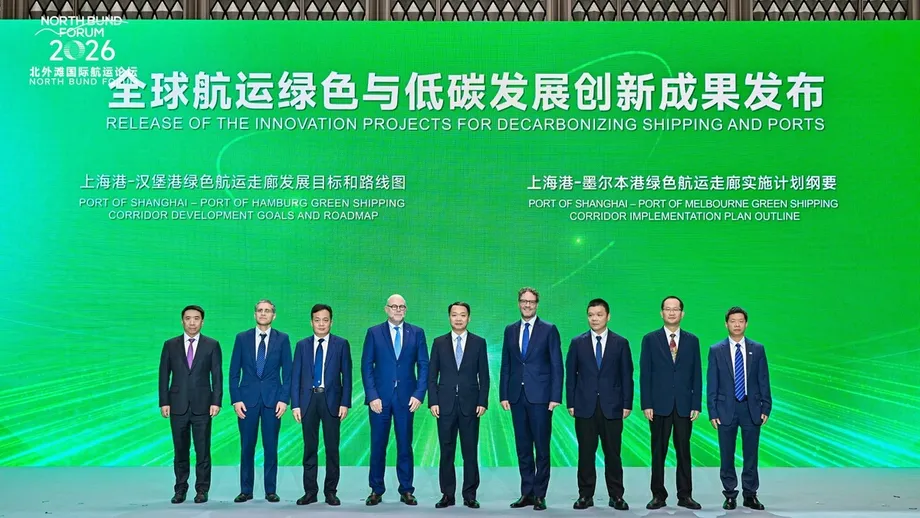
Cooperation results for the Shanghai, Los Angeles and Long Beach corridor were released at the 2025 North Bund forum. In 2026, Shanghai presented development goals and a roadmap with Hamburg, alongside an outline implementation plan with Melbourne.
A shipowner choosing a new fuel needs confidence that it will be available where the vessel operates. Coordinating ports and suppliers along a route gives investments in ships and fuel infrastructure a shared operating plan.
Port of Los Angeles executive director Gene Seroka highlighted the scale of the trade involved. Figures presented at the forum put the port's third quarter throughput near 3 million twenty foot equivalent units, the standard measure of container traffic. China accounted for more than 40% of its business and was more than twice the size of its second largest trading partner.
Seroka also said that cutting emissions from vessels travelling between Shanghai and Los Angeles by 10% would equal an entire year's pollution at the Port of Los Angeles. His comparison illustrates why the corridor's work extends beyond equipment operating within either port.
Shipyards face several fuel choices at once
Cao Rongrui, Communist Party secretary of Shanghai Maritime University, said the share of the global fleet capable of using alternative fuels rose from 2.9% at the start of 2018 to 9.7% in 2026. That is an increase of 6.8 percentage points, or more than threefold.
Shipbuilders are responding to several energy choices, including LNG, methanol, ammonia, hydrogen and batteries. Different fuels require different engines, tanks, piping, ventilation and safety arrangements. Designers must consider where a vessel will obtain fuel and how crews will operate and maintain its equipment.
Wang Kunhui, general manager of COSCO Shipping Development, said the company's owned fleet and order book together included more than 100 ships using dual fuel systems, representing 14 million deadweight tonnes. Deadweight measures a vessel's carrying capacity, including cargo, fuel and supplies. The company's choices include methanol and LNG.
For yards and equipment makers, competition increasingly includes integrating propulsion systems, improving energy efficiency and providing maintenance. Cao described the wider challenge as connecting technology with rules, services and people. Fuel availability and compatible certification arrangements become practical operating needs once a ship leaves the yard.
Existing ships and workers need investment too
Brian Mikkelsen, director general of the Danish Maritime Authority, described a bulk carrier built in 2009 that achieved annual fuel savings of 1,806 tonnes after an assessment of its operations and technology options followed by efficiency improvements. The savings represented about 17.5% of its previous consumption and roughly $1 million in annual fuel costs, before compliance benefits.
That example gives owners of existing vessels another route to lower emissions. Better speed and route planning, equipment improvements and operating management can reduce fuel demand while the supply of cleaner fuels develops. The IMO also identifies better coordination of arrival times as a way to reduce hours or days spent waiting outside ports with engines running.
Investment must also reach workers and less wealthy shipping economies. Liberia Maritime Authority commissioner and chief executive Neto Zarzar Lighe highlighted the need for affordable finance, technical assistance and training, alongside spending on bunkering facilities, energy systems and maritime supply chains.
Philippa Charlton, chief marketing officer of Lloyd's Register, pointed to the need for supporting infrastructure, safe operating procedures and stronger engine maintenance skills. Jobs at sea and ashore will require updated knowledge as fuels and equipment change.
The IMO's existing support includes GreenVoyage2050, GHG-SMART, CARES and the global network of Maritime Technology Cooperation Centres. Its strategy asks governments to consider transport costs, food security and market access when assessing new measures, with particular attention to small island developing states and least developed countries.
Shanghai's experience brings those needs together: ships require fuel, ports require infrastructure, and both require trained people. The next stage depends on matching those investments with verified cleaner energy and the completion of global rules.
Key Points
- Shanghai reported nearly 40,000 tonnes of green methanol bunkering in 2026 and 771,000 cubic metres of bonded LNG bunkering in 2025.
- Diesel's share of energy use at Shanghai container terminals fell from 47% in 2015 to 13% by the end of 2025.
- The IMO strategy seeks net zero international shipping emissions by or around 2050, with reduction checkpoints in 2030 and 2040.
- The proposed Net Zero Framework combines fuel standards with emissions pricing. Adoption discussions were postponed from October 2025 into 2026.
- Fuel certification, coordinated port services, vessel efficiency and worker training are central to making cleaner shipping operate reliably.