Fukuoka puts a new source of renewable electricity to work
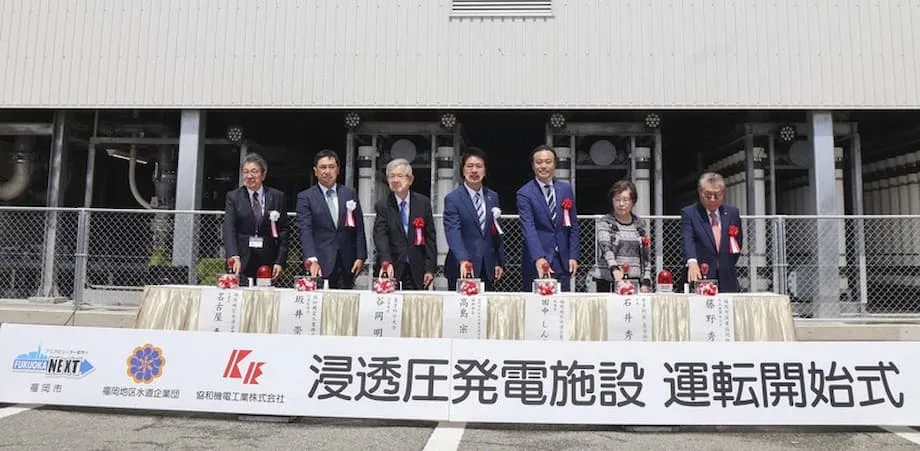
Japan's first osmotic power plant began operating in Fukuoka Prefecture in early August 2025, using the difference in salt concentration between two streams of water to generate electricity. Operated by the Fukuoka District Waterworks Agency, the facility is designed to produce 880,000 kilowatt-hours of electricity a year, enough to supply around 300 households.
Contents
- Fukuoka puts a new source of renewable electricity to work
- How water moving through a membrane produces power
- Why Fukuoka's water infrastructure matters
- What 880,000 kilowatt-hours means for local users
- The membrane is at the heart of the technology
- How the technology moved beyond early experiments
- Denmark's deployment preceded Japan's opening
- A steady source of power amid climate pressures
- Treated wastewater becomes an energy resource
- What wider adoption will require
- Key Points
The electricity will primarily support a local desalination facility, which removes salt from seawater to provide fresh water to Fukuoka City and neighbouring areas. The project brings electricity generation into the same network of infrastructure that treats wastewater and supplies drinking water.
The agency invested approximately 700 million yen in construction. Japan is now the second country to put osmotic power into practical use at this scale, following Denmark's deployment in 2023. The opening represents a step toward a more varied supply of renewable energy, with a technology that can operate regardless of daylight or weather.
Osmotic power, also called salinity gradient power, draws energy from the natural mixing of water with different salt concentrations. Fukuoka's plant combines treated water from a sewage treatment facility with concentrated seawater, using a special membrane and a turbine to turn that difference into electricity.
The plant's projected annual production gives the project a concrete local purpose: supplying energy for water infrastructure. At the same time, its practical operation provides an example of how coastal communities could recover useful energy from water streams already moving through treatment facilities.
How water moving through a membrane produces power
Osmosis is the movement of water through a membrane from a less concentrated solution toward a more concentrated one. In this case, water moves from the freshwater side toward the saltier seawater side. A semipermeable membrane acts as a selective barrier, allowing water molecules through while blocking salts and impurities.
Fukuoka's plant uses pressure retarded osmosis, known as PRO. The movement of freshwater through the membrane increases pressure on the seawater side. That pressure is used to turn a turbine, and the turbine drives a generator that produces electricity.
The process is physical: it relies on water movement and pressure, rather than combustion or a chemical reaction. Electricity generation through this process releases no carbon dioxide or other greenhouse gases, making it a source of renewable power that contributes to Japan's decarbonisation goals.
The salt difference is central to the system. A greater difference in concentration creates more potential energy to recover. The membrane must let enough water pass through while keeping the two streams sufficiently separated for the process to work efficiently.
Solar panels need sunlight, and wind turbines need moving air. Osmotic power instead depends on the availability of water streams with different salt concentrations. Its ability to generate consistently, without depending on the time of day or weather, gives it a different role alongside those established renewable sources.
Why Fukuoka's water infrastructure matters
Fukuoka, on Japan's southwestern coast, has access to seawater and ample supplies of treated freshwater. Its existing sewage treatment and desalination facilities provided the foundation for installing the new plant.
The desalination facility supplies concentrated seawater, while the sewage treatment facility provides treated water with a much lower salt concentration. Bringing these streams together gives the osmotic system the contrast it needs to generate electricity.
The plant is located alongside the desalination facility. This arrangement connects power generation with an operation that needs electricity to produce fresh water, allowing the output to support local water supply rather than serving only as a demonstration of a new technology.
Using existing treatment infrastructure can also reduce the cost of introducing osmotic power. Water supplies, treatment processes and nearby facilities become part of the same operating system, making better use of resources that are already available.
The investment of approximately 700 million yen reflects local commitment and national interest in developing renewable energy options. Fukuoka's combination of coastal geography and established water infrastructure makes it a practical location for testing how the technology performs in everyday service.
What 880,000 kilowatt-hours means for local users
The annual target of 880,000 kilowatt-hours describes the amount of electrical energy the plant is designed to produce over a year. A kilowatt-hour is a measure of energy use or production, such as the electricity consumed by equipment drawing one kilowatt for one hour.
The comparison with around 300 households helps make that figure easier to understand. The planned use, however, is primarily to support the local desalination facility and its role in maintaining fresh water supplies for Fukuoka City and surrounding areas.
Continuous, predictable generation is one of the plant's main attractions. Water infrastructure needs power to operate, and a renewable source that does not depend on sunshine or wind can provide a steady contribution to those needs.
As of August 18, 2025, the 880,000 kilowatt-hour figure is the plant's designed annual production; a measured total for a full year of operation is not yet available. Its opening in early August marks the start of practical operation, while the annual figure describes the intended scale of that operation.
The membrane is at the heart of the technology
Researchers have studied the possibility of producing electricity from the mixing of freshwater and seawater for decades. Two prominent approaches are pressure retarded osmosis and reverse electrodialysis, known as RED. Fukuoka uses PRO, an approach particularly suited to places where large volumes of freshwater and seawater are available close together.
PRO performance depends heavily on the membrane. It must allow water to move through while blocking salts and impurities. Better membrane materials and designs have been crucial in making practical operation possible.
The difference in salt concentration also affects performance. A larger osmotic pressure gradient, meaning a stronger difference in the tendency of water to move between the two streams, increases the potential energy available to the system.
Temperature is another factor. Studies of closed loop PRO systems have shown that higher temperatures can increase water flux, the amount of water passing through a membrane, and power density, the amount of power produced for a given membrane area.
A membrane performance study describes power densities exceeding 20 watts per square metre under optimal conditions. Continued improvements in membrane materials and system design are expected to improve performance further.
Those measurements help explain why membrane development matters so much. A membrane that moves water effectively while maintaining separation can extract more power from the available streams, making the equipment more useful at a practical site.
How the technology moved beyond early experiments
Early efforts to develop osmotic power faced low power densities, expensive materials and membrane fouling. Fouling occurs when material accumulates on a membrane, interfering with the passage of water and reducing performance.
Modern membranes are more selective, more durable and more resistant to fouling. Those improvements allow longer operating lifespans and greater efficiency, helping address problems that previously restricted the technology to experiments and small demonstrations.
Integration with water treatment and desalination facilities offers another advantage. Operators can use infrastructure already in place, reducing costs and connecting the electricity output to nearby demand.
Fukuoka's projected production of 880,000 kilowatt-hours a year shows the scale of the contribution planned for its local water operations. Pairing generation with water supply gives the project an immediate use for the energy it recovers.
Osmotic power is still in the early stages of commercialisation. Expanding to larger facilities and connecting generation to national grids will require continued investment, research and policy support. Practical operation in Fukuoka is a step in that process, while cost reduction and expansion remain central tasks.
Denmark's deployment preceded Japan's opening
Denmark put osmotic power into practical use in 2023, demonstrating the feasibility of the technology. Japan's entry in August 2025 adds another country to its practical deployment and places Fukuoka among the early operating examples.
The sequence of these developments is short but important to understanding the technology's progress:
- 2023: Denmark deployed osmotic power on a practical scale.
- Early August 2025: The Fukuoka District Waterworks Agency began operating Japan's first osmotic power plant.
Akihiko Tanioka, a professor emeritus at the Institute of Science Tokyo and a leading expert in osmotic power, expressed his reaction to the technology reaching practical use and his hope for wider adoption.
I feel overwhelmed that we have been able to put this into practical use. I hope it spreads not just in Japan, but across the world.
Engineers and policymakers also see osmotic power as a promising addition to the renewable energy mix. Its ability to operate continuously makes it attractive for regions with plentiful water supplies and substantial energy demand.
Investment in research and pilot projects in more countries is expected to improve costs and efficiency. Fukuoka's launch positions Japan as a leader in practical application and could encourage similar developments elsewhere.
A steady source of power amid climate pressures
The Fukuoka opening comes as countries face the combined challenges of climate change and energy security. Expanding the range of renewable sources can help reduce reliance on energy systems with different environmental impacts and operating vulnerabilities.
Fossil fuel generation and nuclear power face scrutiny over their environmental effects and their vulnerability to extreme weather. Thermal power stations often depend on river water for cooling, creating difficulties when water temperatures rise.
European heatwaves exposed those limits during the summer of 2025. In France, high temperatures reduced the efficiency of thermal generation and forced shutdowns, illustrating how weather can affect electricity supplies even when a plant has fuel available.
Solar and wind generation face a different form of variability: their output changes with sunshine and wind conditions. Osmotic power provides a steady, predictable source that can complement them where suitable water supplies are available.
For coastal regions with the right infrastructure, energy recovered from the mixing of freshwater and seawater offers a way to strengthen local energy resilience and reduce dependence on sources that produce carbon emissions.
Treated wastewater becomes an energy resource
Fukuoka's use of treated sewage water connects electricity generation with the management of water that has already passed through a treatment process. Rather than considering the water only as an output to manage, the plant uses its low salt concentration as a resource.
The arrangement illustrates the water and energy nexus: water systems need energy, while the movement and treatment of water can also create opportunities to recover energy. Fukuoka brings those needs and opportunities together at neighbouring facilities.
A wastewater energy review describes how wastewater treatment plants could become net energy producers by adopting technologies including anaerobic digestion, salinity gradient energy recovery and fuel cells.
A net energy producer generates more energy than it consumes. Anaerobic digestion uses the breakdown of organic material without oxygen to recover energy, while salinity gradient systems recover energy from differences in salt concentration.
Recovering energy from treated effluent and increasing renewable generation at a treatment site can reduce its carbon footprint. Fukuoka provides a practical example of a circular economy approach, turning a waste stream into a useful energy resource and directing electricity toward another water service.
What wider adoption will require
Geography limits where osmotic power can be installed. The technology needs large quantities of both freshwater and seawater, making coastal locations with suitable water infrastructure particularly relevant.
Membrane costs and durability remain important concerns. Membranes capable of high performance are still relatively expensive, and their ability to last under real operating conditions remains an active area of research.
Expansion from pilot plants to facilities producing electricity on a much larger scale will require substantial investment. Operators will also need to fit new generation into existing water systems and electricity networks.
Government incentives, research funding and supportive regulation will be essential to continued innovation and commercialisation. Cooperation among researchers, industry and government will help address the technical and financial requirements of wider deployment.
Fukuoka's plant shows that practical operation is possible. Its immediate contribution is local: recovering energy from treated water and concentrated seawater to support fresh water production. Broader adoption will depend on improving costs, membrane performance and integration while finding other places with the necessary supplies.
Key Points
- Japan's first osmotic power plant began operating in Fukuoka Prefecture in early August 2025, following Denmark's practical deployment in 2023.
- The Fukuoka District Waterworks Agency invested approximately 700 million yen in construction.
- The plant is designed to produce 880,000 kilowatt-hours annually, equivalent to the needs of around 300 households, primarily for a local desalination facility.
- Pressure retarded osmosis uses a membrane, treated sewage water and concentrated seawater to create pressure that drives a turbine and generator.
- The physical generation process produces no greenhouse gas emissions and can operate regardless of weather or daylight.
- Membrane costs, durability, suitable locations and the investment needed for larger facilities remain central challenges.
- The project connects wastewater treatment, renewable electricity generation and fresh water supplies for Fukuoka City and neighbouring areas.