A small deer spreads beyond Chiba's containment line
An estimated 90,000 Reeves's muntjacs now live in Japan's Chiba Prefecture, and sightings across the Tone River in six Ibaraki municipalities have brought the campaign to contain the invasive deer into new territory. In Koga, roughly 80 kilometres from Chiba's containment line, an adult male was captured at an agricultural facility on May 31, 2026.
Contents
- A small deer spreads beyond Chiba's containment line
- What animal is causing the damage?
- Why captures have not stopped population growth
- How the deer reached Ibaraki
- The first capture and the warning signs before it
- Why researchers are listening for calls
- Farm losses extend beyond eaten crops
- What rewards and fences can achieve
- How far north could they spread?
- Key Points
Chiba's estimated population has grown from 12,600 in fiscal 2006 to about 86,000 in fiscal 2023, reaching approximately 90,000 by 2025. Established populations, recorded in five municipalities in 2004, are now confirmed in 18 cities and towns. Capturing more than 10,000 animals in a year has still left authorities struggling to keep pace with reproduction.
Ibaraki faces a different stage of the problem. Every animal whose sex researchers have confirmed there has been male. Takahiro Morozawa, a researcher at Tokyo University of Agriculture and Technology, considers local breeding unlikely at present. Finding females would change that assessment and increase the urgency of removing animals before a breeding population becomes established.
Research announced in September 2026 suggests suitable habitat could extend as far north as Fukushima Prefecture. The immediate concern is therefore larger than crop damage in Chiba: authorities are trying to stop scattered arrivals from becoming another expanding population.
What animal is causing the damage?
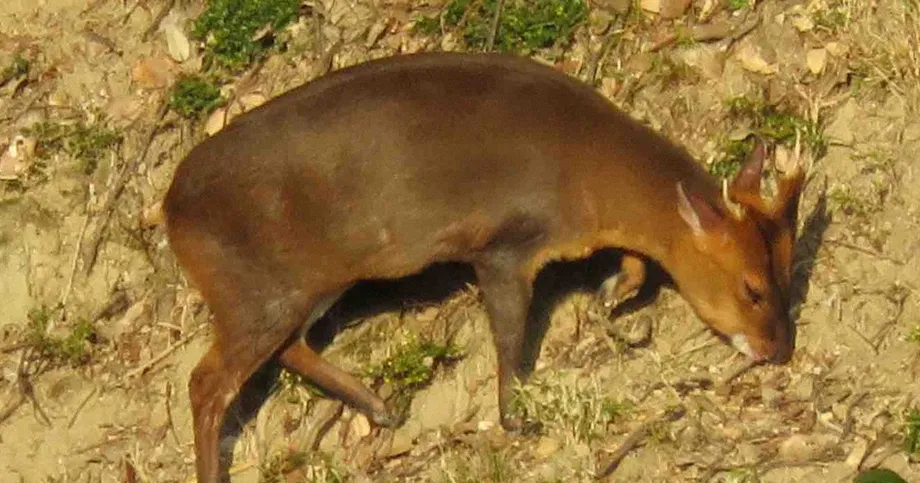
Reeves's muntjac, known in Japan as kyon, is a small deer native to China and Taiwan. Adults generally measure about 70 to 100 centimetres in body length, making them closer in size to a medium dog than to the large deer many people picture. Males have short antlers and tusks on their upper jaws.
The National Institute for Environmental Studies identifies the animal as Muntiacus reevesi in its invasive species database. The entry records deliberate introduction for a zoo or exhibition, dates its Japanese presence to the 1980s, and lists harm to vegetation and crops. Importing, transporting and keeping the species are legally restricted in Japan.
Chiba's wild population is believed to descend from animals that escaped a tourism facility in Katsuura. Accounts place those escapes between around 1960 and 1980, while the original account places them in the 1980s. The institute's database lists Chiba and Izu as the Japanese range; the more recent observations in Ibaraki show how the geography of the problem is expanding.
Why captures have not stopped population growth
Chiba's rise from 12,600 muntjacs in fiscal 2006 to 86,000 in fiscal 2023 represents an increase of nearly seven times. The prefecture captured just over 10,000 in fiscal 2023, yet the estimated annual natural increase rate is between 18% and 34%.
Chihiro Kase, a lecturer in animal behavior management at Azabu University and a member of Chiba's environmental council, says reproduction is outpacing hunting. At the upper end of that growth range, she estimates that more than 20,000 animals would need to be removed in a year simply to prevent further growth.
Female muntjacs can give birth from as early as six months old. Chiba's warm Boso Peninsula also supplies abundant food, including crops and nutritious flowers. Kase identifies those conditions as reasons the animals have multiplied so successfully.
Chiba's objective is complete eradication. Reaching it requires reducing the large population in established areas while also catching animals where they remain scarce. Kase recommends more captures in both places: dense populations continue producing dispersing animals, while small groups can become the starting point for further expansion.
How the deer reached Ibaraki
Ibaraki's first reported sighting dates to 2017. Three sightings followed in Chikusei and other locations during 2022 and 2023. The May 2026 capture in Koga added a physical specimen to years of observations and recovered remains.
Yusuke Goto, deputy chief curator at the Ibaraki Nature Museum, says young males often travel considerable distances as they leave their original range and seek somewhere to live. He considers bridges a likely route across the Tone River, also known as the Tonegawa.
Goto described the suspected movement from southern Chiba into Ibaraki:
It seems that muntjacs proliferating in southern Chiba Prefecture have migrated northward, crossing the bridges over the Tonegawa river to enter Ibaraki Prefecture.
Male muntjacs have reached Chikusei near the Tochigi border, and a possible sighting has also been reported in Saitama. Chiba's containment boundary is a line for concentrating control work, rather than a physical barrier. Captures along it have not prevented animals from appearing much farther north.
The first capture and the warning signs before it
Koga officials said the animal captured on May 31 was an adult male measuring about 70 to 80 centimetres long. Local hunting association members, called in at the city's request, caught it in a box trap at an agricultural facility in Shimoono. It was subsequently killed, and its remains were transferred to the Ibaraki Nature Museum.
Farmers Toyokazu and Yuko Tsukada first found the animal. Sightings in Koga had begun on May 24, and officials considered them likely to involve the same deer. The animal may also have been the one seen on April 27 in neighbouring Sakai. No crop damage had been identified in connection with the capture.
The sequence shows how the warning signs accumulated before an animal was caught:
- 2017: Ibaraki records its first reported muntjac sighting.
- 2022 to 2023: Three sightings occur in Chikusei and elsewhere.
- 2024: Ibaraki introduces payments for useful sighting evidence and captures.
- April 27, 2026: A muntjac is seen in Sakai.
- May 24, 2026: Sightings begin in Koga.
- May 31, 2026: An adult male is captured in Koga.
- September 2026: Researchers announce that suitable habitat could extend to Fukushima.
By October 2026, sightings had been recorded in six Ibaraki municipalities. The growing spread of observations has made locating animals before they reproduce a central task.
Why researchers are listening for calls
Morozawa has spent more than a year recording muntjacs with cameras and sound equipment in Chiba. In woodland in Katsuura, cameras fixed to trees help document animals and identify their sex. Males usually have visible antlers, giving researchers one clue when the images are clear enough.
A camera records only an animal that passes within its field of view. A muntjac's distinctive call can be detected across a radius of several hundred metres, allowing researchers to listen over a much larger area. Calls can recur at intervals of about five seconds and have been described as resembling a person retching or shrieking.
Morozawa's team is also investigating whether recordings can distinguish males from females. A reliable method would help researchers search for the animals that matter most to the immediate breeding risk without depending entirely on a clear camera image.
Morozawa explains that males generally expand into new territory first, followed by females. All animals whose sex has been established in Ibaraki so far have been male. Whether females are present but undetected remains unknown, making continued monitoring important to the prefecture's response.
Farm losses extend beyond eaten crops
Chiba recorded 8.9 million yen in agricultural damage attributed to muntjacs in fiscal 2023. The animals eat crops including Japanese radish leaves, as well as flowers and other nutritious vegetation. Their feeding can affect both cultivated land and surrounding plant life.
Masako Ochi, who runs a strawberry farm in Onjuku, found that a muntjac had entered her greenhouse and eaten seedlings. Replacing the damaged entrance and glass door would have cost around 100,000 yen, so she repaired the existing door instead.
Ochi described how nearby growers were responding:
Many people around me have set up tall mesh fences to keep muntjacs out.
She said others had stopped growing vegetables or other crops. For farmers, the cost therefore includes damaged structures, fencing and decisions about whether cultivation remains worthwhile, alongside the value of plants eaten.
Isumi Railway recorded 44 incidents involving muntjacs and wild boar along its tracks in fiscal 2023. The operator has been installing equipment that produces high frequency sound to drive animals away. Those incidents add railway operations to the list of local activities affected by wildlife spreading through the Boso Peninsula.
What rewards and fences can achieve
Ibaraki introduced its reward scheme in 2024, paying 2,000 yen for qualifying photographs or videos taken within the prefecture and 30,000 yen for a successful capture. The programme seeks both better information about where muntjacs are moving and the removal of animals that have arrived.
Chiba offers up to 6,000 yen per capture, including a state subsidy of 1,000 yen paid to municipal governments. Ibaraki's capture payment is five times that maximum. The prefectures face different practical tasks: Chiba is confronting a large established population, while Ibaraki is seeking to intercept a smaller number of scattered animals.
Kase recommends protecting fields as well as increasing captures. Muntjacs can jump about 80 centimetres, so fences must be designed to keep them out. Tall fencing and electric fences can reduce access to crops.
Keeping animals away from nutritious farm plants may also help reduce reproduction, according to Kase. That connects crop protection with population control: a fence can protect a harvest while limiting the food supply that supports population growth. Goto says capture remains the viable immediate approach while other methods, including vaccines to control reproduction, are studied.
How far north could they spread?
Morozawa's research team announced in September 2026 that areas capable of supporting muntjacs could reach Fukushima. He points to the Pacific coast, where relatively limited snowfall may allow the animals to move north through suitable conditions.
A Forestry and Forest Products Research Institute expert also warns that muntjacs tolerate heat and cold well. Establishment in Ibaraki could open the way to wider expansion across Honshu, Japan's largest main island.
Fukushima is therefore a warning about habitat the species could occupy. The confirmed observations described here extend through Ibaraki, with a possible sighting in Saitama. Researchers are concentrating on detecting movement and determining whether females have followed the males.
Chiba's experience gives that work urgency. Its established range grew from five municipalities in 2004 to 18, while annual captures numbering more than 10,000 failed to halt population growth. Morozawa says the speed of expansion appears to have increased in recent years.
For Ibaraki, the practical priority is to find and remove animals before a reproducing population takes hold. For Chiba, reducing the established population and protecting crops remain linked tasks. Both depend on knowing where animals are, rather than waiting for damage to reveal their presence.
Key Points
- Chiba's estimated muntjac population reached about 90,000 by 2025, up from 12,600 in fiscal 2006.
- Sightings have spread to six Ibaraki municipalities. An adult male was captured in Koga on May 31, 2026.
- All animals whose sex has been confirmed in Ibaraki have been male; researchers consider local breeding unlikely at present.
- Ibaraki offers 2,000 yen for qualifying photographic or video evidence and 30,000 yen for a capture.
- Chiba recorded 8.9 million yen in agricultural damage in fiscal 2023 despite capturing more than 10,000 muntjacs that year.
- Researchers are testing acoustic monitoring and warn that suitable habitat could extend north to Fukushima.