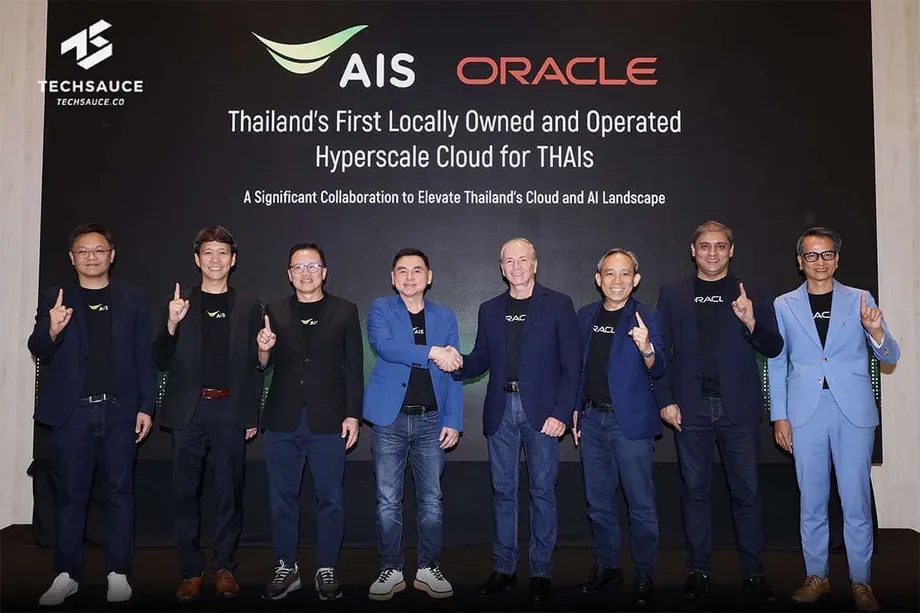
A Thai Cloud Platform Built Around Local Control
Advanced Info Service (AIS), Thailand's largest telecommunications provider, has launched what it describes as the country's first hyperscale cloud owned and operated entirely by a Thai company. The platform, AIS Cloud powered by Oracle Cloud Infrastructure, starts with an investment of 4 billion baht, with plans to increase that to 8 billion baht by 2030 as demand grows.
Contents
- A Thai Cloud Platform Built Around Local Control
- What Makes This a Hyperscale Cloud?
- How Oracle Alloy Makes the Partnership Work
- Why Keeping Data in Thailand Matters
- What the dSURE 3-Star Certification Covers
- Thai Contracts, Baht Billing and Local Support
- Computing Capacity for Thailand's AI Ambitions
- How the Launch Fits the Government's Cloud First Policy
- AIS Adds Network as a Service
- A 4 Billion Baht Start in a Growing Market
- What the Launch Changes for Thailand
- Key Points
The partnership with Oracle gives Thai businesses and government agencies access to more than 100 Oracle Cloud Infrastructure (OCI) services, including artificial intelligence capabilities. Its central promise is local control: customer data is stored and processed in Thailand, governed by Thai law and supported by Thai professionals.
The launch brings together several priorities for Thailand's digital economy: stronger control over sensitive information, more computing capacity for AI, and infrastructure that helps public agencies and businesses modernize their services. Thai language contracts, billing in baht and local support are also intended to make the platform easier for domestic customers to use.
AIS is entering a market forecast to grow by 23% annually through 2027. Its investment also reflects a broader change in the company's ambitions, as it seeks to build a technology business beyond its telecommunications operations.
What Makes This a Hyperscale Cloud?
A hyperscale cloud is a large computing environment designed to handle huge quantities of information and many computing tasks at once. Organizations use its processing power and storage instead of having to provide all that capacity through their own equipment.
AIS Cloud is designed to increase or reduce computing resources automatically as demand changes. That matters when an organization needs extra capacity for a busy period or a demanding task, without keeping the same amount of capacity running all the time.
The platform also offers high availability and disaster recovery within Thailand. High availability means designing services to remain accessible when equipment or systems encounter problems. Disaster recovery provides a way to restore data and operations after a serious disruption.
These capabilities support AI, machine learning and analysis of large datasets. Until this launch, most hyperscale cloud services in Thailand were operated by foreign providers, creating concerns about where information was held, compliance with Thai law and transfers of data across national borders.
How Oracle Alloy Makes the Partnership Work
Oracle Alloy is the infrastructure platform behind AIS Cloud. It enables partners such as AIS to operate as cloud providers, offering Oracle technology through their own services. AIS can therefore provide more than 100 OCI services while operating the platform locally.
Somchai Lertsutiwong, chief executive officer of AIS, described Oracle Alloy as the foundation for the company's move into locally operated hyperscale computing:
Cloud technology plays a pivotal role in supporting the IT infrastructure modernization and innovation for organizations in Thailand, and Oracle Alloy has made it possible for AIS to become a locally owned and operated hyperscale cloud provider in the country.
Garrett Ilg, Oracle's executive vice president and general manager for Japan and Asia Pacific, said the partnership gives AIS the ability to develop services and deliver cloud and AI capabilities under a model focused on national control:
It empowers AIS to become a hyperscale cloud provider, enabling them to build new services faster while delivering sovereign cloud and AI capabilities for its Thai customers.
The arrangement combines Oracle's cloud infrastructure technology with AIS ownership, operations and customer support in Thailand. It gives domestic organizations access to a broad technology platform through a Thai provider.
Why Keeping Data in Thailand Matters
Data sovereignty means that information is subject to the laws and governance of the country where it is held. For AIS Cloud customers, the service is designed around storing and processing data inside Thailand, with Thai jurisdiction and local operational support.
Thailand's Personal Data Protection Act (PDPA) and Cybersecurity Act form part of the regulatory setting for organizations handling sensitive information. AIS presents local storage, security controls and disaster recovery within the country as ways to address data residency and compliance requirements.
Data residency describes the physical location where information is stored. Sovereignty adds the question of which country's rules govern it. Those issues become more pressing as businesses and public agencies use larger datasets and AI systems.
AIS Cloud's approach brings storage, processing and recovery arrangements within national borders. For organizations concerned about transfers abroad, that creates a domestic option for keeping customer information and important operational data in Thailand.
What the dSURE 3-Star Certification Covers
AIS Business has received dSURE 3-Star Cloud certification, the highest level of the cloud certification framework described by the Digital Economy Promotion Agency (depa). It is the first service provider in Thailand to receive that level.
Dr. Passakon Prathombutr, senior executive vice president and chief technology officer at depa, explained that the framework assesses providers across service capabilities, environmental responsibility and local data control:
This framework certifies cloud providers based on criteria ranging from fundamental service capabilities to environmental responsibility through Green Technology, up to the highest level — dSURE 3-Star Cloud — which ensures data sovereignty and secure local data storage with no cross-border transfers. AIS Business is currently the very first service provider in Thailand to be awarded this dSURE 3-Star certification.
The framework therefore covers more than the location of servers. Its criteria extend from basic service capability to environmental responsibility through Green Technology, while the highest tier addresses sovereignty and secure storage without transfers across borders.
For Thai organizations choosing a cloud provider, the certification provides a national reference point alongside the platform's technical services, local operations and support arrangements.
Thai Contracts, Baht Billing and Local Support
AIS Cloud includes contracts in Thai, billing in Thai baht and support from Thai speaking professionals around the clock. These practical details affect how organizations purchase services, manage costs and resolve problems.
Billing in baht removes exposure to foreign exchange movements in the cloud bill. Thai language contracts and support allow customers to discuss commercial terms and technical issues in their own language, helping teams communicate clearly with their provider.
Local assistance is available 24 hours a day, seven days a week. That gives organizations access to support outside normal office hours when an interruption or technical problem needs attention.
These arrangements sit alongside the platform's regulatory focus. AIS is offering domestic customers a package that combines computing services with local contracting, payment and operational support.
Computing Capacity for Thailand's AI Ambitions
AI applications require substantial computing power and large amounts of data. AIS Cloud is designed to support that demand through AI development, machine learning and big data analytics, which means examining large datasets to find useful patterns.
Phupa Akavipat, chief enterprise business officer at AIS, connected the platform to Thailand's ability to develop and operate its own AI capabilities:
We firmly believe that Thailand must have its own AI capabilities to ensure long-term technological sovereignty and resilience. Digital infrastructure owned and operated by Thais is the cornerstone of national development in the digital era.
The platform also supports hybrid cloud and the use of multiple clouds. A hybrid approach combines an organization's own computing systems with cloud services, while using multiple clouds allows it to work with more than one cloud environment.
Fully integrated Application Programming Interfaces (APIs) are another part of the service. APIs allow software systems to exchange information and instructions, helping organizations connect applications as they modernize their technology.
Together, these capabilities give customers different ways to update existing systems, develop AI applications and adjust computing resources as their needs change. AIS is positioning that flexibility as a way for organizations to respond more quickly to changing market conditions.
How the Launch Fits the Government's Cloud First Policy
Thailand's government has backed the launch as part of its wider push to improve digital infrastructure and economic growth. Wisit Wisitsora-at, permanent secretary of the Ministry of Digital Economy and Society, praised the initiative for supporting the national cloud policy and highlighted cooperation between the public and private sectors.
The government's Cloud First policy aims to modernize public sector technology, improve service delivery and keep critical data within Thailand. AIS Cloud is positioned as infrastructure for that effort, including applications whose continued operation is essential to an agency's work.
For government bodies, the platform brings scalable computing, local governance and recovery capacity within the country into a single service. Those features connect the policy's focus on modernization with its concern for the location and security of important information.
The launch also supports the wider goal of making public services more resilient. Keeping recovery capabilities in Thailand gives agencies a domestic arrangement for restoring operations when systems are disrupted.
AIS Adds Network as a Service
AIS has also introduced Network as a Service (NaaS), which allows enterprises to manage network configurations themselves through a service portal. The service integrates with AIS Cloud, linking the company's cloud expansion to its connectivity business.
NaaS offers connections through fiber optic and 5G networks, with support for expanding networks both within Thailand and internationally. AIS describes the service as flexible, secure and reliable, backed by specialists available around the clock.
Phupa Akavipat, AIS chief enterprise business officer, explained how customers can use it to change their connections and the locations or devices those connections serve:
This brings added convenience for expanding or modifying network connections and endpoints both domestically and internationally. The service offers high flexibility and enhanced security, supported by a team of experts available 24/7.
For enterprises, this adds a way to manage the network connections that carry information to and from cloud services. Customers can adjust those connections through the portal as their operations expand or change.
A 4 Billion Baht Start in a Growing Market
AIS is investing an initial 4 billion baht in the cloud platform and plans to scale that investment to 8 billion baht by 2030 as demand grows. The planned total is twice the initial amount.
The company typically invests 25 billion to 30 billion baht annually across its infrastructure. That wider investment base places the cloud initiative within an established program of spending on the systems and networks supporting its business.
Thailand's cloud market is forecast to grow at 23% a year through 2027, reflecting demand for digital modernization and AI capacity. Across Asia Pacific, industry analysts expect spending on sovereign cloud services to grow at a compound annual rate of more than 30%, driven by compliance needs and operational resilience.
A compound annual growth rate describes the steady yearly pace that would produce a given increase over a period, with each year's growth building on the previous year's larger amount. The Thai market forecast and the regional sovereign cloud forecast describe different markets, both pointing to expanding demand.
Somchai Lertsutiwong, AIS chief executive officer, described the Oracle partnership as part of a broader business transformation:
This strategic collaboration between Oracle and AIS will not only accelerate AIS's transformation from a telecom operator to a tech company, but will also unlock the immense potential for digital transformation and AI innovation for all organizations.
What the Launch Changes for Thailand
Thai organizations now have a locally owned and operated hyperscale option that combines Oracle services with domestic data storage, local support and baht billing. For AIS, the launch creates another potential source of growth beyond traditional telecommunications services.
The initiative connects data governance with economic ambitions. Greater domestic control over digital assets and critical infrastructure is intended to support public sector modernization, local startups and efforts to attract foreign investment.
Thailand is also participating in a wider move toward sovereign cloud services. Similar initiatives have been launched in New Zealand, Japan, the United Arab Emirates and across Europe as countries seek to protect sensitive information and support national interests.
AIS Cloud strengthens Thailand's position in that shift and supports its ambition to become a regional center for digital technology and innovation. Its combination of AI services, local operations and connectivity gives businesses and public agencies another way to modernize while keeping important data within the country.
The timetable outlined for the business runs through these milestones:
- June 26, 2025: AIS Cloud is presented as Thailand's first locally owned and operated hyperscale cloud, with an initial investment of 4 billion baht.
- Through 2027: Thailand's cloud market is forecast to grow by 23% annually.
- By 2030: AIS plans to increase cloud investment to 8 billion baht as demand grows.
Key Points
- AIS has launched a locally owned and operated hyperscale cloud using Oracle Alloy and Oracle Cloud Infrastructure.
- The platform offers more than 100 OCI services, including AI capabilities, with customer data stored and processed in Thailand.
- AIS Business is Thailand's first provider awarded dSURE 3-Star Cloud certification.
- Customers receive Thai language contracts and support, billing in baht and local assistance available 24 hours a day.
- The service supports AI, machine learning, big data analytics, hybrid cloud, multiple clouds and integrated APIs.
- Network as a Service adds configurable connectivity through fiber optic and 5G networks.
- The launch supports the government's Cloud First policy and public sector modernization.
- AIS plans to double its initial 4 billion baht cloud investment to 8 billion baht by 2030 as demand grows.