An 86 million year old predator connects small hunters to giants
Two partial dinosaur skeletons collected in southeastern Mongolia in the early 1970s have changed the story of how tyrannosaurs became some of the largest predators ever to walk on land. Identified as Khankhuuluu mongoliensis, meaning the "Dragon Prince," the animal lived about 86 million years ago, roughly 20 million years before Tyrannosaurus rex.
Contents
- An 86 million year old predator connects small hunters to giants
- Fossils collected in the 1970s get a new identity
- A hunter built for slicing bites and speed
- Where the Dragon Prince fits in the family tree
- A few migrations reshaped two continents
- The dates behind the discovery and the migrations
- Why Pinocchio rexes were a specialised branch
- From distant relatives to the kings of the Cretaceous
- Older fossils and museum collections remain central
- Key Points
Khankhuuluu measured about 4 meters, or 13 feet, long and weighed around 750 kilograms, or 1,650 pounds. That made it roughly the size of a large horse. Its importance lies in its place between the early, small and agile members of the tyrannosaur lineage and the enormous predators that later dominated parts of North America and Asia.
The discovery, published in a Nature study, identifies Khankhuuluu as the closest known ancestor to the giant tyrannosaurs. Its relationship to T. rex stretches across nearly 20 million years and more than a dozen intervening tyrannosaur species. The researchers describe that connection both as distant ancestry and, more informally, as something like a great uncle.
The fossils also help reconstruct a journey across continents. The new family tree suggests that an animal like Khankhuuluu moved from Asia to North America, where later tyrannosaurs diversified and became larger. Descendants subsequently returned to Asia, and a giant lineage eventually crossed into North America again, leading to T. rex.
Khankhuuluu's discovery brings together three parts of that history: a species hidden for decades under another dinosaur's name, the anatomy of an intermediate predator, and evidence that a few migrations helped shape the rise of the tyrannosaurs.
Fossils collected in the 1970s get a new identity
Paleontologist Altangerel Perle excavated the fossils from the Bayanshiree Formation in southeastern Mongolia in the early 1970s. The partial skeletons included skull bones, vertebrae, hips and limb bones. For approximately half a century, they remained in museum collections, identified as Alectrosaurus, another early tyrannosaur.
Jared Voris, a doctoral student at the University of Calgary, reexamined the specimens in 2023. He noticed features that distinguished them from previously known species, including a hollow nasal bone and subtle differences in the bones around the eyes. CT scans and comparisons with other tyrannosaur fossils helped confirm the identification of a new species.
Darla Zelenitsky, a paleontologist at the University of Calgary and a coauthor of the study, described the team's conclusion:
There's no doubt this is a new species. There's also no doubt that it's the ancestor to these large apex predator tyrannosaurs.
Steve Brusatte, a paleontologist at the University of Edinburgh, said the specimens had long been recognised as potentially important within the research community:
So many of us in the paleontology community knew that these Mongolian fossils were lurking in museum drawers, waiting to be studied properly, and apt to tell their own important part of the tyrannosaur story.
The discovery came from looking again at an existing collection, with fresh observations and modern technology. Bones gathered decades earlier could answer new questions once researchers examined their anatomy in greater detail.
A hunter built for slicing bites and speed
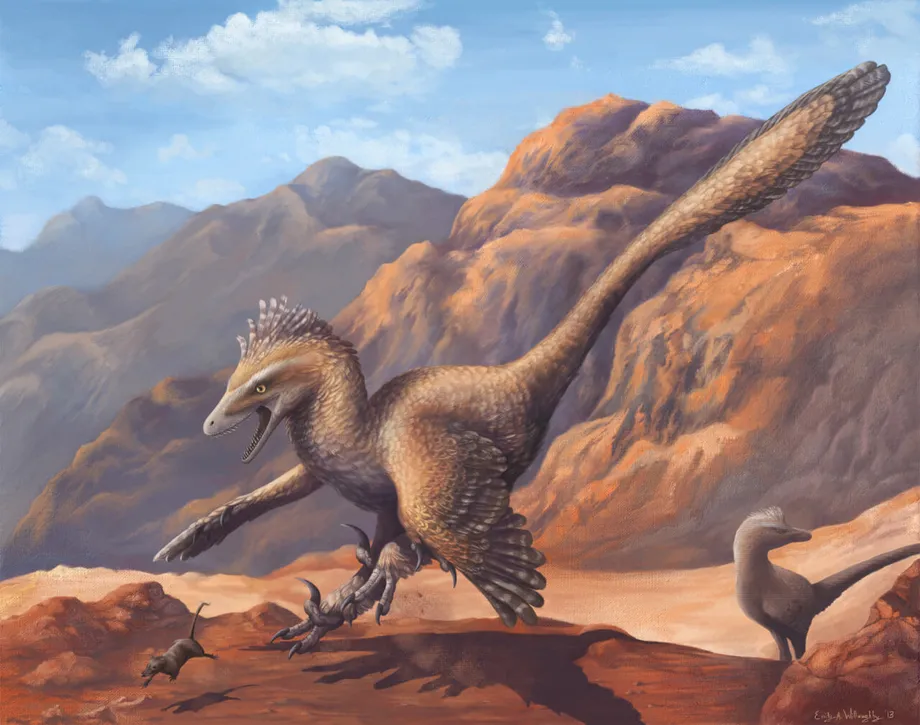
Khankhuuluu had a long, shallow snout, slender jaws and teeth shaped like blades. Its serrated teeth resembled steak knives, suited to slicing flesh rather than crushing bones. That anatomy contrasts with the massive jaws and powerful biting apparatus of T. rex.
Smaller dinosaurs, including oviraptorosaurs and ornithomimosaurs, were likely prey. Its body suggests a hunting style based on speed and agility rather than the brute force associated with later giant tyrannosaurs. At around 750 kilograms, it was smaller than those descendants but still a formidable predator.
Voris described what an encounter with such an animal might have meant:
You would have been the thing that it would hunt down, and it would have been faster than you. I would much rather run into an adult T. rex than run into Khankhuuluu.
Khankhuuluu also had tiny horns above its eyes. Similar features became more pronounced in later tyrannosaurs such as Albertosaurus and Gorgosaurus. The horns may have served in display or intimidation, suggesting that their appearance could have mattered in interactions between animals.
The dinosaur occupied the role of a mesopredator, a hunter positioned between the largest predators and smaller carnivores in an ecosystem. The comparison is to a coyote in a modern ecosystem: an active hunter with its own place in the food web, rather than the dominant predator at the very top.
Where the Dragon Prince fits in the family tree
The researchers' analysis places Khankhuuluu just outside Eutyrannosauria. That group includes the massive tyrannosaurs with deep snouts, such as T. rex and Tarbosaurus, as well as the smaller, slender Alioramini, sometimes called "Pinocchio rexes" because of their long snouts.
A phylogenetic analysis is a reconstruction of evolutionary relationships based on shared and differing features. In this case, comparing dinosaur anatomy helped the researchers place Khankhuuluu near the point preceding the later diversification of those tyrannosaurs.
The fossil record had left a substantial gap between early small predators and the later giants. Khankhuuluu provides an intermediate stage: larger than the earliest small hunters, yet still relatively modest beside the enormous tyrannosaurs that followed.
Brusatte explained why the age of the specimens matters:
What makes the specimens so important is their age. They are about 86 million years old, a good 20 million years older than T. rex. It shows that tyrannosaurs were still relatively small at this time, and only later did they become colossal.
Thomas Holtz, a vertebrate paleontologist at the University of Maryland, described the discovery's contribution:
It's a nice new discovery giving us a better sense of what this intermediate phase of tyrannosaur history is like.
Cassius Morrison, a doctoral student at University College London, also highlighted the species' position in that history:
It is a pivotal species in understanding the evolutionary success of T. rex and its relatives.
A few migrations reshaped two continents
Khankhuuluu, or a closely related species, is thought to have moved from Asia to North America around 85 million years ago. A land bridge connecting Siberia and Alaska offered a route between the continents. The animal's identity at that crossing remains uncertain: the proposed migration involves either Khankhuuluu itself or a close relative.
North America then became a setting for the evolution of true tyrannosaurs. Over the following several million years, the group diversified and increased in size, eventually producing the apex predators that dominated ecosystems during the late Cretaceous Period. An apex predator sits at the top of its food web.
Some tyrannosaur lineages later moved back to Asia. There, they split into gigantic forms with deep skulls, including Tarbosaurus, and slender forms with long snouts, the Alioramini. A giant tyrannosaur species subsequently crossed back into North America, leading to the emergence of T. rex.
The new reconstruction suggests that movement between the continents was less frequent, but more consequential, than previously thought. A small number of crossings could open new opportunities for animals to spread, change and occupy different places in the food web.
Zelenitsky explained how the team connects migration with the success of the group:
The success and diversity of tyrannosaurs is thanks to a few migrations between the two continents, starting with Khankhuuluu. Tyrannosaurs were in the right place at the right time. They were able to take advantage of moving between continents, likely encountering open niche spaces, and quickly evolving to become large, efficient killing machines.
An ecological niche is an animal's role in its surroundings, including what it eats and how it lives alongside other species. Moving into a place with open niches could give a predator opportunities that were less available where it had previously lived.
The dates behind the discovery and the migrations
The story combines ancient evolutionary events with a much more recent scientific rediscovery. The key dates show how long the bones existed before their identity was recognised, and how much time separated Khankhuuluu from T. rex.
- About 86 million years ago: Khankhuuluu lived in what is now Mongolia during the Cretaceous Period.
- Around 85 million years ago: Khankhuuluu or a close relative is thought to have crossed from Asia to North America through the connection between Siberia and Alaska.
- Over the following several million years: Tyrannosaurs diversified and grew larger in North America. Later migrations carried lineages back to Asia and eventually returned a giant lineage to North America.
- The early 1970s: Altangerel Perle excavated the partial skeletons from Mongolia's Bayanshiree Formation.
- 2023: Jared Voris reexamined the fossils and recognised anatomical differences that led to the new species identification.
- June 26, 2025: The discovery described in this article had revealed a new reconstruction of tyrannosaur ancestry and movement between continents.
The roughly 20 million years between Khankhuuluu and T. rex contained more than a dozen evolving tyrannosaur species. The connection therefore covers a long sequence of changes in size, anatomy and geographic distribution.
Why Pinocchio rexes were a specialised branch
The new analysis also changes the interpretation of Alioramini, the slender tyrannosaurs with long snouts. Qianzhousaurus, nicknamed "Pinocchio rex," belongs to this group. Paleontologists had debated whether these animals represented the ancestral form from which other tyrannosaurs developed.
The reconstructed family tree instead places them as a specialised offshoot within a lineage otherwise dominated by giants. Their smaller size and distinctive features evolved independently, giving them a different role from their larger relatives.
The researchers connect this difference to heterochrony, meaning changes in the timing of development. An animal's adult form can change over evolutionary time when growth happens faster, continues differently or preserves features associated with younger animals.
Giant forms such as T. rex evolved through accelerated growth, a process called peramorphosis. Alioramini followed a different route called paedomorphosis, retaining juvenile characteristics into adulthood. These contrasting patterns help explain how closely related predators could develop very different bodies.
The smaller, slender animals could occupy ecological niches different from those of the giants. Their specialised anatomy allowed them to coexist with larger relatives rather than simply representing an earlier step toward the same enormous adult form.
From distant relatives to the kings of the Cretaceous
Khankhuuluu captures an important stage in the rise of tyrannosaurs from modest, agile hunters to dominant predators. Its anatomy connects the earlier style of hunting with the later changes that produced some of the largest and most formidable land predators in Earth's history.
Zelenitsky described the long family relationship in deliberately familiar terms:
Khankhuuluu was where it all started, but it was still only a distant ancestor of T. rex, at nearly 20 million years older. Over a dozen tyrannosaur species evolved in the time between them. It was a great-great-great uncle, sort of.
The migrations also form part of a broader story of biogeography, the study of where living things occur and how their distributions change. Ancient land bridges allowed movement between Asia and North America, bringing opportunities for the exchange of genetic material, occupation of new ecological niches and rapid evolution of new forms.
Similar processes have shaped other animal groups, including mammals and humans. Joseph Sertich of the Smithsonian Tropical Research Institute described the wider relevance of reconstructing these ancient movements:
The patterns of evolution we are uncovering are revealing a complex story of evolution that goes far beyond tyrant dinosaurs and has bearing on the origins of the modern ecosystems of the Northern Hemisphere.
The Dragon Prince therefore helps connect the history of a famous dinosaur group with the changing geography of the continents where its members lived.
Older fossils and museum collections remain central
Scientists now want to investigate earlier stages of the tyrannosaur lineage and find more fossils from the period between 90 million and 80 million years ago. Discoveries from that interval could clarify the group's origins and the conditions that helped drive its evolutionary success.
Museum collections offer another route to discoveries. Khankhuuluu's bones had already been excavated, but their full importance emerged only after researchers returned to them with new questions, detailed comparisons and modern scanning techniques.
Thomas Carr of Carthage College described the value of returning to historical material:
A lot of these historical specimens are definitely worth their weight in gold for a second look.
Khankhuuluu's story shows how a new species can be recognised long after its excavation. Further field discoveries and renewed study of existing specimens could help fill the remaining gaps between the small early tyrannosaurs, this intermediate predator and the later giants.
Key Points
- Khankhuuluu mongoliensis, the Dragon Prince, lived in Mongolia about 86 million years ago, roughly 20 million years before T. rex.
- It measured about 4 meters long and weighed around 750 kilograms, with slender jaws, slicing teeth and a build suited to speed.
- Altangerel Perle collected the fossils in the early 1970s. Jared Voris reexamined them in 2023 after decades of identification as Alectrosaurus.
- The new species helps connect early small tyrannosaurs with later giant predators and sits just outside Eutyrannosauria.
- The revised family tree links tyrannosaur diversification to a few migrations between Asia and North America.
- Alioramini, including Qianzhousaurus, emerge as a specialised branch whose adults retained juvenile characteristics.
- Fossils from 90 million to 80 million years ago and renewed examination of museum collections could further clarify tyrannosaur origins.