Galaxy phones gain transit access across Bangkok
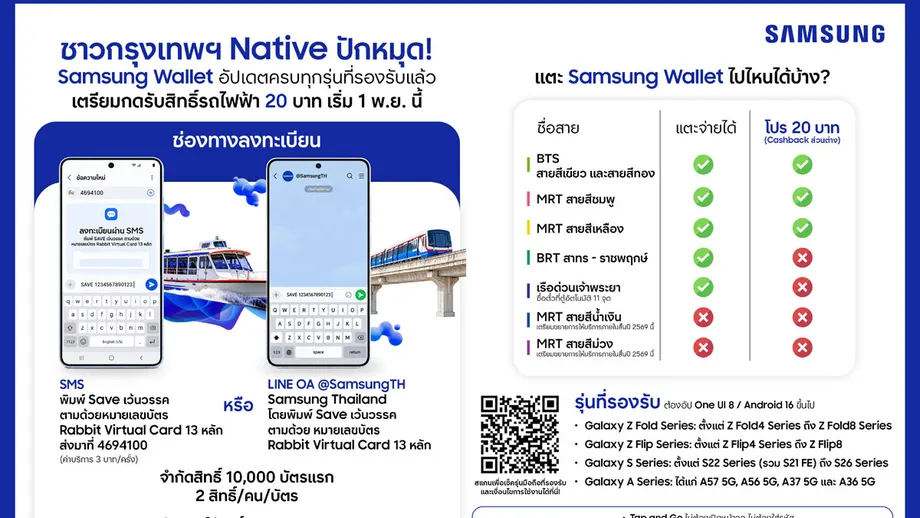
Samsung is bringing Rabbit Virtual Card payments to compatible Galaxy phones in Thailand, with a software rollout scheduled for October 20 to 26, 2026, and a fare cashback promotion opening on November 1. The service covers the BTS Sukhumvit, Silom and Gold lines, MRT Pink and Yellow lines, BRT buses and designated Chao Phraya boat ticket kiosks.
Contents
- Galaxy phones gain transit access across Bangkok
- Where the virtual card works
- Boat payments happen at ticket kiosks
- How the 20 baht cashback works
- Registration and the dates to remember
- Which Galaxy phones qualify?
- Setting up Rabbit Wallet and the card
- Why Samsung is focusing on commuting
- More transport links and digital keys are planned
- Key Points
The promotion gives the first 10,000 registered cards access to eligible rail journeys costing 20 baht after cashback, with two benefits per person per card. Passengers must pay the normal fare first. The difference between that fare and 20 baht goes into the linked Rabbit Wallet on the day after travel.
For everyday journeys, Samsung says passengers can tap their phones without waking the screen or entering a passcode. A power reserve feature also allows transit taps when the phone battery is depleted. The first Rabbit Virtual Card has its issuance fee waived.
The immediate change is a new way to carry and use a Rabbit card. Riders can leave the physical card behind on supported services, although access depends on their phone model, software and account setup. Samsung plans to add further rail networks and Bangkok Mass Transit Authority buses by the end of 2026.
Where the virtual card works
Samsung's official Wallet page lists the BTS Sukhumvit, Silom and Gold lines, MRT Pink and Yellow lines, BRT, 11 boat ticket kiosks and shops accepting Rabbit payments. These are the services and payment locations supported at launch.
The Sukhumvit route runs from Kheha to Khu Khot, the Silomvit route from Bang Wa to National Stadium, and the Gold route from Krung Thon Buri to Khlong San. The two Green Line routes, Sukhumvit and Silom, therefore sit alongside the Gold Line in the initial BTS coverage.
MRT coverage includes the Yellow Line from Lat Phrao to Samrong and the Pink Line from Nonthaburi Civic Center to Min Buri. BRT coverage runs between Sathorn station, connecting with BTS Chong Nonsi, and Ratchaphruek station, connecting with BTS Talat Phlu.
For passengers changing between these networks, the same virtual card can handle payments wherever it is accepted. Each journey still follows the relevant fare rules, while the limited cashback offer applies only to the specified rail lines.
Boat payments happen at ticket kiosks
River passengers use Rabbit Virtual Card at automatic ticket machines. Samsung's official list names 11 locations: Sathorn-1, Sathorn-2, Ratchawong, Rajinee, Tha Chang-1, Tha Chang-2, Tha Maharaj, Prannok, Phra Arthit, BTS Saphan Taksin and Tha Tien.
The launch announcement listed 10 locations, omitting BTS Saphan Taksin; Samsung's official Wallet page includes that location and gives a total of 11. Riders should look for the supported ticket kiosk at their departure point.
The boat services named in the launch details include the Chao Phraya Tourist Boat with the Blue Flag and Chao Phraya Express Boat services with Orange, Yellow, Yellow-Green and Red flags. Payment takes place when buying a ticket at the machine, rather than by tapping the phone at a rail style gate.
BRT and boat ticket purchases are part of the payment rollout. The 20 baht cashback promotion covers BTS Sukhumvit, Silom and Gold journeys and MRT Pink and Yellow journeys.
How the 20 baht cashback works
Registration opens on November 1, 2026. Samsung's detailed launch terms set the registration and benefit period at November 1 through December 31, or until the benefits run out. A shorter launch description gave the duration as one month, while the detailed campaign information specifies the December 31 closing date.
The offer is limited to the first 10,000 cards, with two benefits per person per card, covering the first two eligible trips per card. Riders need to register before travelling and have enough money available to pay the actual fare at the time of the journey.
Cashback means money returned after a purchase. Here, the fare is charged normally, then the amount above 20 baht is returned to the Rabbit Wallet linked to the virtual card the following day. The advertised price is therefore the cost after that return, rather than the amount taken at the gate.
For example, if an eligible journey costs 45 baht, the passenger pays 45 baht first and receives 25 baht back the next day. That leaves a net fare of 20 baht for the qualifying journey. This example illustrates the calculation, rather than a quoted fare for a particular route.
The two benefits limit makes this a small number of discounted journeys for each participant. Commuters planning their travel budgets should account for normal fares once those benefits have been used.
Registration and the dates to remember
Passengers can register by sending an SMS containing SAVE, followed by a space and the 13 digit Rabbit Virtual Card number, to 4694100. Each SMS costs 3 baht. Registration is also available through Samsung Thailand's LINE Official Account, @SamsungTH, using the same message format.
The registration number belongs to the Rabbit Virtual Card. Users should complete the card setup first so that the correct card can be linked to the promotion and its associated Rabbit Wallet can receive the cashback.
The rollout and campaign follow this schedule:
- October 20, 2026: The staged Samsung Wallet update begins in Thailand.
- October 26, 2026: The rollout is scheduled to reach all compatible models. A Team Galaxy event featuring Pim-Pimprapa Tangprabhaporn demonstrates transit tapping and Digital Car Key.
- November 1, 2026: Registration and use of the rail cashback benefits begin.
- December 31, 2026: The detailed campaign terms give this as the closing date, unless benefits run out earlier.
- By the end of 2026: Samsung targets support for additional rail lines, Airport Rail Link and BMTA buses.
The October update and November promotion are separate steps. Updating the phone and adding a card prepare it for transit payments; registering for the campaign is the additional step needed to seek the cashback benefits.
Which Galaxy phones qualify?
Samsung Wallet transit support requires One UI 8.0 or Android 16 or later on eligible Galaxy devices. The Thailand rollout is restricted to supported phones bought in Thailand because of regional software limitations, according to the launch details.
Samsung's official compatibility list names specific models rather than every phone in a product family. The listed devices are:
- Galaxy Z Fold: Z Fold8 Ultra, Z Fold8, Z Fold7, Z Fold6, Z Fold5 and Z Fold4.
- Galaxy Z Flip: Z Flip8, Z Flip7 FE, Z Flip7, Z Flip6, Z Flip5 and Z Flip4.
- Galaxy S: S26 Ultra, S26+, S26 FE and S26; S25 Ultra, S25+, S25 FE and S25; S24 Ultra, S24+, S24 FE and S24; S23 Ultra, S23+, S23 FE and S23; S22 Ultra, S22+ and S22; and S21 FE.
- Galaxy A: A57 5G, A56 5G, A37 5G and A36 5G.
The regional restriction matters for visitors and residents using imported phones. Owning a model on the list is only one part of eligibility: the phone also needs the supported regional software and required system version.
Setting up Rabbit Wallet and the card
Samsung's official instructions begin with My Rabbit for new users. They must create an account, choose the option to activate Rabbit Wallet, prepare an identity card and complete identity checks, including a facial scan. The launch details specify a Thai ID card for this process.
After verification, users select Samsung Wallet X Rabbit in My Rabbit, choose to purchase a Rabbit Virtual Card, accept the service terms and personal data consent, and select a card design. The final step is Add to Samsung Wallet.
Existing My Rabbit users can begin in Samsung Wallet by choosing Add card, then Transit card and Rabbit Virtual Card. They enter their My Rabbit PIN, complete the terms and consent steps, choose a design and add the card.
Samsung's general setup instructions include a card issuance fee payment step, while the launch offer waives the fee for the first virtual card. Users should check the amount shown during setup, particularly if they are obtaining another card.
The Thai ID requirement is a practical limit for people hoping to use the service during a short visit. Account verification, a compatible local handset and sufficient funds all need to be in place before the phone is ready for travel.
Why Samsung is focusing on commuting
Greater Bangkok has approximately 11 million registered and unregistered residents and more than 4.5 million public passenger trips each day, according to figures cited in the launch announcement. Urban rail accounts for about 1.43 million daily trips, while water transport carries about 70,000 passengers a day.
Those figures put daily rail use at roughly 20 times the stated water transport volume. Both matter to the payment rollout: rail brings a large number of repeat journeys, while river kiosks extend the phone payment option to a different part of the transport network.
Sitthichoke Nopchinabutr, president of the Mobile Experience Division at Thai Samsung Electronics, described commuters spending 10 to 20 minutes queuing for single journey tickets. Samsung developed the transit integration with Bangkok Smartcard System, the Rabbit Card company within BTS Group Holdings.
Explaining Samsung's wider aim, Sitthichoke said:
Smartphones are with us throughout the day, and at Samsung, we believe they should do much more than communicate.
The company's approach puts an existing payment card inside a device passengers already carry. The immediate convenience is fewer physical items to manage and direct access to supported gates and ticket machines.
More transport links and digital keys are planned
Samsung targets the MRT Purple and Blue lines, the Red Line, Airport Rail Link and BMTA buses for expansion by the end of 2026. No individual opening dates were given for those additions. Riders on those networks will need to wait for confirmation that support has started.
Samsung Wallet also stores boarding passes and supports Digital Car Key and Smart Living access. The launch details name Thai Airways and 14 other airlines for boarding passes, including gate and schedule updates. Supported car brands include BMW, MINI, Mercedes-Benz, Volvo, Lotus, Denza and BYD.
Digital keys use technologies such as near field communication, which exchanges information over a very short distance, and ultra wideband, which can determine proximity more precisely. Availability depends on the phone, vehicle or access system. Smart Living functions similarly depend on compatible doors and building equipment.
Samsung says its Knox security system protects sensitive information through encryption and a separate protected environment, with fingerprint authentication among the Wallet's safeguards. Transit tapping has its own convenience feature: passengers can use it without opening the screen or entering a passcode.
The power reserve feature extends transit tapping when the battery is depleted. Samsung did not specify how long that reserve lasts, so passengers whose journeys depend on the phone should keep it charged.
Key Points
- Samsung Wallet's Thailand transit rollout runs from October 20 to 26, 2026, for eligible Galaxy phones.
- Initial coverage includes BTS Sukhumvit, Silom and Gold, MRT Pink and Yellow, BRT and 11 officially listed boat ticket kiosks.
- The 20 baht rail offer works through cashback paid to the linked Rabbit Wallet the next day.
- Registration opens November 1 for the first 10,000 cards, with two benefits per person per card covering the first two eligible trips.
- The detailed campaign period ends December 31, 2026, or earlier if benefits run out.
- Setup requires a compatible Thailand purchased phone and Rabbit Wallet identity verification using a Thai ID card.
- Further rail networks, Airport Rail Link and BMTA buses are targeted for support by the end of 2026.