A rice shortage opens Japan to new suppliers
A 500 ton shipment of Vietnamese rice sent to Japan on June 5, 2025, captures a change in one of Asia's most closely guarded food markets. Trung An High-Tech Agriculture Joint Stock Company exported the first consignment of Vietnam Green Low-Emission Rice at $820 per ton, a price comparable to Thailand's premium Hom Mali rice and well above the average for Vietnamese rice sold elsewhere.
Contents
- A rice shortage opens Japan to new suppliers
- Why Japanese buyers are looking abroad
- Vietnam builds a premium rice business
- What lower emissions mean on the farm
- Thailand expands rice suited to Japanese meals
- Government support and Thailand's export strategy
- How prices and Japan's import rules shape the trade
- India's restrictions reshape the wider market
- Who gains, and where the pressure falls
- Key Points
Japan, long associated with rice self-sufficiency and pride in its domestic crop, is turning more often to foreign suppliers as shortages push prices higher. Vietnam and Thailand, two of the world's three largest rice exporters, see an opportunity to sell more rice and establish a stronger position in a market that demands high quality.
Japanese shoppers are already seeing a difference. In Kanagawa, near Tokyo, a 5 kilogram bag of Vietnamese rice cost about 3,200 yen ($22.40) in May 2025, roughly 20% below the average retail price of Japanese rice. For households buying a staple food repeatedly, that gap can make imported rice an attractive choice.
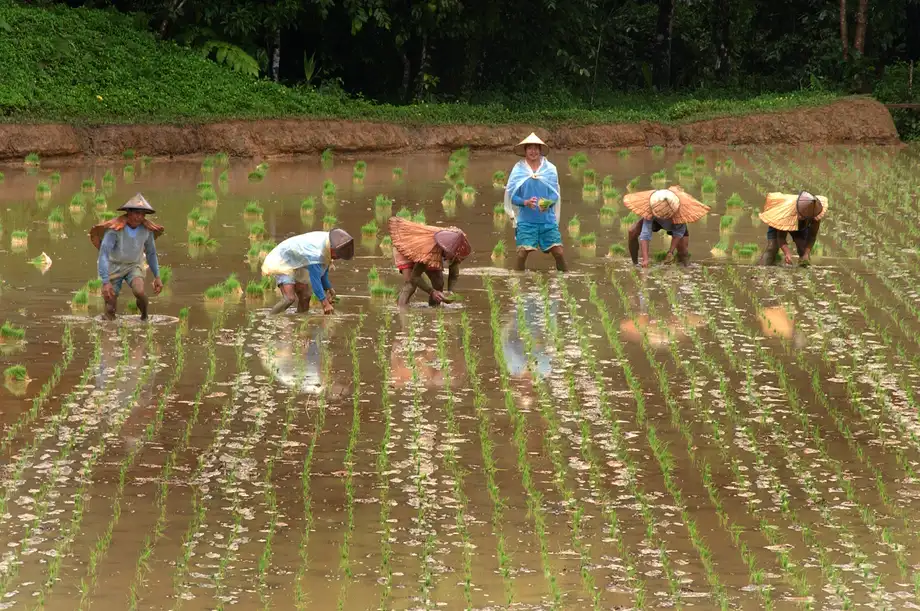
The opportunity extends beyond a temporary increase in shipments. Both Southeast Asian countries have expanded production of japonica, the rice variety favored in Japan, while developing products that can command higher prices. Vietnam is building a brand around quality and lower greenhouse gas emissions. Thailand is drawing on adaptable farmers, established export networks and government support.
For Japan, cheaper imports offer relief to consumers and restaurants. Domestic farmers face a different calculation: they must compete with lower prices while carrying higher production costs and stricter regulations.
Why Japanese buyers are looking abroad
Japan's rice shortage reflects several pressures arriving together. Adverse weather has tightened supplies, rural populations are declining, and agricultural policies are changing. With domestic rice becoming more expensive, importers, retailers and consumers have stronger reasons to consider alternatives.
Vietnam and Thailand have traditionally been associated with long grain indica rice. Their growing production of japonica gives them a product better suited to Japanese preferences. The worldwide popularity of washoku, or Japanese cuisine, has also increased demand for Japanese style rice, both within Japan and in other countries.
Restaurants have a particular interest in that shift. Rice is a recurring expense, and rising prices can squeeze the money left after paying for ingredients and other costs. Access to less expensive imported rice helps businesses maintain profitability while continuing to serve Japanese dishes.
Retailers including Aeon and Seiyu are responding with blends of Japanese and imported rice, alongside japonica grown abroad. Those products give shoppers choices beyond paying the full price of rice produced in Japan.
Vietnam builds a premium rice business
Trung An's June 5 shipment was produced under Vietnam's One Million Hectare High-Quality, Low-Emission Rice Project. The exported japonica rice brought together three aims: meeting demanding quality standards, reducing the environmental impact of cultivation and earning more from each ton sold.
The project promotes sustainable farming, reduced greenhouse gas emissions and strict quality control. Its broader purpose is to make Vietnamese rice more competitive internationally while addressing climate change and protecting food security.
The $820 per ton price matters because farmers and businesses need a financial reason to change how they produce and handle rice. A premium above the average price in other markets can reward investment in better cultivation, monitoring and processing. Matching the price of Thailand's premium Hom Mali also places the shipment in a more valuable part of the rice trade.
Vietnam's ambitions extend beyond this consignment. Its premium varieties, including ST24, ST25 and Jasmine, have won international awards and gained recognition for taste and resilience. The push into Japan adds another route for building the reputation of Vietnamese rice in markets where buyers expect reliable quality.
Bui Ba Bong, chairman of the Vietnam Rice Industry Association, described the opening for exporters:
Japan's current rice shortage is a good opportunity for Vietnam-made rice to enter the high-end market.
What lower emissions mean on the farm
Vietnam's Green Vietnamese Rice, Low Emissions brand is part of a government strategy that connects agricultural production, environmental goals and export value. The changes reach from fertilizer and irrigation to harvesting and the records that follow rice through the supply chain.
Pham Thai Binh, chairman of Trung An, described the scope of that work:
Low-emission rice production is not just about changing cultivation methods, but transforming the entire value chain: including reducing fertilizer use, promoting biological agents, implementing precision irrigation, adopting environmentally friendly harvesting techniques, and especially using digital technologies for full-process traceability monitoring.
Traceability means keeping records that allow a product to be followed through its production and handling. For buyers in a demanding market such as Japan, those records form part of Vietnam's effort to meet strict food safety and quality standards.
Vietnam is also piloting a Measurement, Reporting, and Verification system, known as MRV, to quantify emissions and help establish a carbon credit market. In simple terms, the system measures emissions, records the results and checks them. Full implementation is expected by 2028.
Advanced breeding, precision farming and digital traceability are central to the wider project. Vietnam aims to balance productive farming with environmental protection, while green branding and possible carbon credit trading create additional opportunities. Maintaining that effort requires investment and coordination among farmers, businesses and government agencies.
Thailand expands rice suited to Japanese meals
Thailand, the world's second largest rice exporter, is pursuing the Japanese opportunity through a growing supply of japonica. Thai farmers traditionally concentrated on long grain indica, but the popularity of Japanese cuisine has encouraged cultivation of varieties associated with Japanese meals.
Bangkok supermarkets now widely sell locally grown japonica, including Sasanishiki and Akitakomachi. Prices can be a fraction of those in Japan. Thai japonica has been sold for as little as 230 to 275 baht ($7 to $8), about a quarter of the price in Japan.
Farmers also see reasons to grow it. One Thai farmer said japonica could sell for twice the price of indica. Thailand's warm climate offers the additional advantage of allowing up to three harvests a year.
Yukihisa Yamada of the Norinchukin Research Institute described the role of local authorities in encouraging more valuable crops:
Local governments seem to be encouraging planting of high-value-added rice such as japonica in search of export opportunities.
Thai rice exports to Japan were worth $183 million in 2024, 1.3 times their value a decade earlier. That amounts to growth of about 30% over the period, giving Thailand an established trade relationship on which to build as Japanese buyers seek cheaper supplies.
Government support and Thailand's export strategy
Thai Commerce Minister Pichai Naripthaphan has said Thailand aims to pursue markets where its rice can command premium prices, including Japan. The strategy seeks higher returns from exports while supporting the incomes of farmers.
Thailand's Department of Foreign Trade recently hosted the Thailand Rice Convention, bringing together international buyers and showing the country's intention to retain a major role in global rice trade. The government is also exploring alliances with India and Vietnam to stabilize global rice prices and support farmers.
Production provides another part of the strategy. Despite challenges including occasional floods, Thailand's rice output was expected to reach 33 million to 34 million tons in 2024, compared with 32 million tons the previous year.
Thailand's Hom Mali remains a global benchmark for fragrant rice. Alongside its expansion into japonica, the country is investing in new varieties and sustainable practices to maintain its competitive position.
Thai policymakers and exporters must balance the interests of farmers, businesses and consumers as they diversify agricultural exports and adapt to climate change. A market that rewards higher quality can help growers earn more, while changing global prices can still affect the return on their harvests.
How prices and Japan's import rules shape the trade
Japan's import system includes a tariff free quota known as minimum access, allowing up to 100,000 tons of rice for direct consumption without tariffs. Rice imported beyond that quota faces a tariff of 341 yen per kilogram.
A tariff is a charge on an imported product. At 341 yen per kilogram, the charge adds 1,705 yen to 5 kilograms of rice imported outside the quota. That makes the difference between production costs in Japan and Southeast Asia especially important to traders deciding whether a shipment can sell at a competitive price.
Japanese trading companies are increasing purchases from Southeast Asia because prices remain attractive even after tariffs. The Vietnamese rice sold in Kanagawa for 3,200 yen per 5 kilogram bag shows the lower retail prices available to shoppers, with its price roughly one fifth below the Japanese average.
Bangkok's prices for Thai japonica show another large gap, although those sales take place in Thailand. The 230 to 275 baht range, equivalent to $7 to $8, is about a quarter of the price in Japan. Japanese importers must also work within the country's tariff and quality requirements.
Quality remains central to both countries' plans. Vietnam is promoting its premium varieties and environmentally focused production, while Thailand combines its Hom Mali reputation with investment in other rice varieties. For Japanese retailers, imported japonica and blends offer ways to provide affordable products that suit familiar meals.
India's restrictions reshape the wider market
India accounts for about 40% of global rice exports. Its export restrictions, imposed in 2023, tightened international supplies, pushed prices higher and encouraged importing countries to seek other sellers.
Vietnam and Thailand responded by increasing production and exports. Japan is part of that opportunity, alongside major markets including Indonesia, the Philippines and countries in Africa.
Vietnam exported a record 9 million tons of rice in 2024, earning $5.8 billion. Thailand shipped 4.06 million tons in the first five months of 2024 alone. Those figures show the scale of the export industries now seeking to capture more valuable business in Japan.
The main developments span several years:
- 2023: India imposed rice export restrictions, tightening global supply and pushing importers to seek alternatives.
- 2024: Vietnam's rice exports reached a record 9 million tons, generating $5.8 billion.
- 2024: Thai rice exports to Japan reached $183 million, 1.3 times their value a decade earlier.
- May 2025: Vietnamese rice sold in Kanagawa for about 3,200 yen per 5 kilogram bag, roughly 20% below the average Japanese retail price.
- June 5, 2025: Trung An exported its first 500 tons of Vietnam Green Low-Emission Rice to Japan at $820 per ton.
- 2028: Vietnam expects full implementation of its emissions measurement, reporting and verification system.
India's possible relaxation of export restrictions is a risk for Southeast Asian sellers. More rice entering international trade could increase supply and drive prices down. Weather, government policy and shifting demand also leave export earnings exposed to sudden changes.
Who gains, and where the pressure falls
Vietnamese and Thai exporters gain access to Japanese buyers seeking both affordability and quality. Vietnam's sustainability strategy can help it build a premium brand, while Thailand's flexible production and government support can strengthen an existing export business.
Japanese consumers gain more affordable choices. Restaurants gain a way to control ingredient costs, and a reliable supply of suitable imported rice can help sustain demand for Japanese cuisine at home and internationally.
Japanese farmers face greater competitive pressure. Their higher costs and stricter regulations make cheaper imports a challenge, particularly if the price gap grows further. A wider gap could threaten farm livelihoods and intensify political debate about agricultural policy and food security.
Japan's government must balance affordable food with the protection of domestic agriculture. Growing reliance on imported rice brings rural revitalization and food security into the same debate: households need reasonably priced food, while farming communities need a viable future.
Vietnam and Thailand also have work to sustain their gains. Vietnam needs continued investment, effective branding and close cooperation throughout production and distribution. Thailand must balance the interests of growers, exporters and consumers. Both countries are investing in research, quality improvements and sustainable practices as buyers demand quality, safety and environmental responsibility.
The scale and duration of the current opportunity are still uncertain. Japan's domestic prices, weather conditions and changes in India's export policy will all affect how competitive Southeast Asian rice remains. As of June 17, 2025, the strongest opening is for suppliers able to combine a lower price with the quality Japanese buyers expect.
Key Points
- High prices and tight domestic supplies are pushing Japanese buyers toward rice from Vietnam and Thailand.
- Trung An exported 500 tons of Vietnamese rice produced under a lower emissions project to Japan on June 5, 2025, at $820 per ton.
- Both countries are expanding japonica production to serve demand for Japanese style rice.
- Vietnamese rice sold in Kanagawa in May cost about 3,200 yen per 5 kilogram bag, roughly 20% below the Japanese retail average.
- Thai rice exports to Japan reached $183 million in 2024, about 30% above their value a decade earlier.
- Japan's tariff outside its minimum access quota is 341 yen per kilogram, yet traders still see opportunities for competitive imports.
- Cheaper rice helps Japanese households and restaurants while increasing pressure on domestic farmers.
- Vietnam expects full implementation of its emissions measurement, reporting and verification system by 2028.
- Weather, changing demand and any relaxation of India's export restrictions could alter prices and export returns.