Two Artificial Islands, One Continuing Challenge
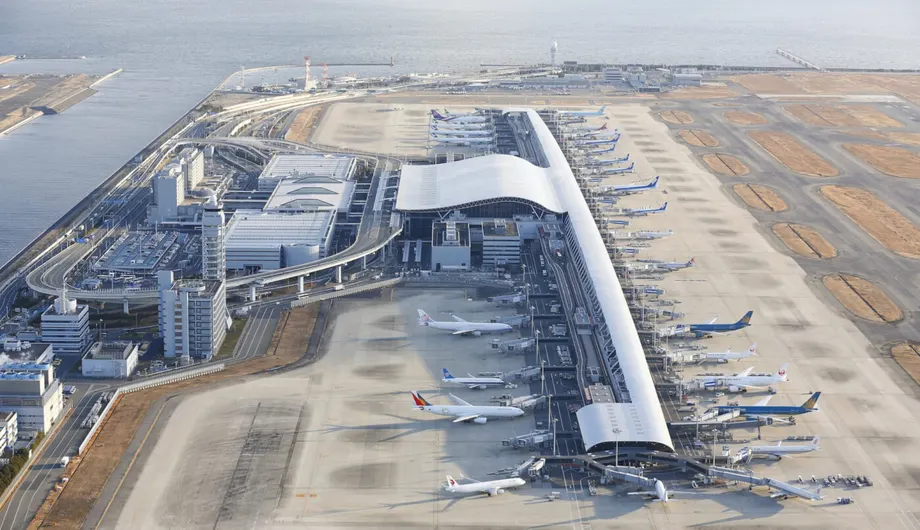
Kansai International Airport has sunk approximately 38 feet, or 11.5 meters, since opening in 1994. On parts of its second artificial island, the ground has dropped more than 57 feet, or 17.5 meters, since landfill began. The airport remains a vital gateway to western Japan, but keeping its terminals, runways and sea defenses working requires constant attention to the ground beneath them.
Contents
- Two Artificial Islands, One Continuing Challenge
- Why Osaka Chose to Build Offshore
- How Engineers Created Land in Osaka Bay
- Why the Islands Keep Sinking
- How Far Has Kansai Settled?
- The Work Required to Keep the Airport Level
- What the Earthquake and Typhoon Revealed
- Why Keeping Kansai Open Matters
- What Engineers Can Do Next
- Lessons for Other Airports Built on Reclaimed Land
- Key Points
Built on two artificial islands in Osaka Bay, Kansai was intended to solve a problem that Osaka could not easily address on land: how to expand air travel without placing more aircraft noise and construction pressure on densely populated neighborhoods. The result became one of the most ambitious and expensive civil engineering projects of the late 20th century.
The airport, known by its code KIX, has earned international recognition for its architecture, efficiency and baggage handling. It handled more than 30 million passengers in 2024 and is expected to play a key role in bringing visitors to Osaka Expo 2025. Its importance makes the engineering challenge more than a question of protecting an unusual building.
The rate of sinking has slowed to an average of less than 10 centimeters, or about 4 inches, a year. Yet the islands do not settle evenly. Engineers must manage changes across the airport while protecting it from storms, earthquakes and rising seas.
Some engineers predict that sections could reach sea level by 2056 if current trends continue without further intervention. That forecast makes continued maintenance central to the airport's future: its height above the water depends on both the movement of the ground and the work done to protect it.
Why Osaka Chose to Build Offshore
Osaka's rapid growth during the 1960s left little space for a larger airport. Its existing airport, Itami, was hemmed in by dense development and mountains. Expanding air services there would have increased pressure on nearby communities already affected by aircraft noise.
An offshore airport offered room for construction and the possibility of operating around the clock without disturbing city residents. It also avoided the need to relocate residents or compensate them for noise pollution, while giving designers space to develop a new airport without the restrictions of an established urban site.
Hiroo Ichikawa, professor emeritus of urban planning and policy at Meiji University, explained why planners selected Osaka Bay:
When it came to building a second airport for Osaka, there were few good options. There was very limited space on the mainland for a large construction project and nearby residents would have been affected by noise and late-night flights, so it was decided to build offshore.
After two decades of planning, construction began in 1987. The project required two massive artificial islands, protection from an 11-kilometer seawall and a bridge to the mainland costing $1 billion.
The total cost reached $14 billion at the time. With expansions and inflation included, the equivalent figure is nearly $40 billion. Kansai gained space for aviation, but creating that space meant placing an enormous weight on a seabed made of soft clay and silt.
How Engineers Created Land in Osaka Bay
Engineers began by laying five feet of sand over the clay seabed. Beneath the future airport, the waterlogged ground needed to compress and release water before it could provide a more stable foundation.
About 2.2 million vertical pipes filled with sand, each nearly 16 inches in diameter, were installed to help that process. Known as sand drains, they gave water routes out of the clay as the weight above squeezed it. Faster drainage allowed the soil to become more compact sooner.
More than 200 million cubic meters of material went into the islands. The fill included soil dredged from the bay, quarried rock and earth brought from elsewhere. The seawall used 48,000 concrete blocks and rubble, anchored in steel chambers weighing hundreds of tons.
Construction proceeded in stages. After layers of fill were added, work paused to let the new material settle and the ground below compact. The intended result was land that would stabilize at least 13 feet above sea level, the minimum elevation considered necessary to prevent flooding if the seawall was breached.
The main terminal, designed by architect Renzo Piano, was built to accommodate movement. It rests on 900 hydraulic jacks that can be adjusted when different parts of the ground sink by different amounts. Hydraulic systems use pressurized fluid to apply the force needed to lift and adjust heavy structures.
Runways were paved with flexible asphalt so they could absorb shifts without cracking. Together, the adjustable supports and flexible pavement made movement something the airport could manage through maintenance, even though they could not stop the seabed from compressing.
Why the Islands Keep Sinking
The clay and silt beneath Kansai behave like a saturated sponge under pressure. When the artificial islands were placed on top, their weight squeezed water out of the seabed. As water escaped, the clay occupied less space and the land above moved downward.
Engineers call this process consolidation. The sand drains accelerated it, but the clay had not fully consolidated when construction began. Compression therefore continued as the airport developed and entered service.
The immense weight of the fill is the main load pressing on the seabed. It is far greater than the weight of the terminals, aircraft and other airport structures. The problem begins with the land itself, rather than simply with what has been built on it.
Early engineering models underestimated settlement. Natural compaction of the seabed is also expected to continue for decades or even centuries, creating a maintenance obligation that extends far beyond the airport's opening.
Uneven settlement adds another difficulty. If every part of an island descended at the same speed, buildings and runways would retain their relative levels. At Kansai, some sections sink faster than others, requiring repeated adjustments. The center of the terminal is believed to be descending more rapidly than its outer edges.
How Far Has Kansai Settled?
Engineers initially predicted that the islands would settle about eight meters, or 26 feet, over 50 years. By 1990, before the airport opened, the first island had already sunk 27 feet.
Since the airport opened in 1994, settlement has totaled approximately 38 feet, or 11.5 meters. Some parts of the second island have dropped more than 57 feet, or 17.5 meters, measured from the beginning of landfill work. Those figures describe different locations and starting dates, both of which matter when following the airport's changing elevation.
The latest average rate is below 10 centimeters a year, slower than before. Engineers still need measurements from individual locations because an airport-wide average cannot tell maintenance teams which floor, runway section or stretch of seawall needs attention.
Kansai's development and major tests have unfolded over several decades:
- 1960s: Osaka's rapid urban growth leaves little room to expand its existing airport.
- 1987: Construction begins after two decades of planning.
- 1990: The first island has already settled by 27 feet.
- 1994: Kansai International Airport opens.
- 1995: The airport survives the Kobe earthquake with minimal damage.
- September 2018: Typhoon Jebi floods the airport and forces a shutdown lasting two weeks.
- 2024: Kansai handles more than 30 million passengers.
- 2025: The airport is expected to serve as a key gateway for millions of additional visitors associated with Osaka Expo.
- 2056: Some engineers identify this as a possible point when sections could reach sea level without further intervention.
The Work Required to Keep the Airport Level
Maintenance at Kansai involves checking both the height of structures and their position relative to one another. Hydraulic jacks beneath the terminal allow engineers to make periodic adjustments so that uneven sinking does not leave floors out of level.
The jacks are checked and adjusted every two years. Runway surfaces can also be resurfaced and brought back to the required level as the ground moves.
Monitoring takes place at dozens of points across both islands. Those measurements help engineers identify differences in settlement and decide where adjustments are needed. The work is continuous because the ground keeps changing after any individual repair.
More than $150 million has been spent raising and reinforcing the seawall. Following major flooding events, it has been raised by an additional 2.7 meters. Protecting the airport requires attention to its outer defenses as well as the structures inside them.
The cost and complexity are substantial. Raising a building support addresses uneven settlement at that location; maintaining the seawall addresses the water around the airport. Both tasks must continue as the islands descend and their exposure to flooding changes.
What the Earthquake and Typhoon Revealed
Kansai's offshore position exposes it to seismic hazards and extreme weather. In 1995, the airport survived the devastating Kobe earthquake with minimal damage, demonstrating the strength of its design under a major earthquake.
September 2018 brought a different test. Typhoon Jebi, the strongest typhoon to hit Japan in 25 years, overwhelmed the seawall and flooded a runway. About 5,000 people were stranded, and the airport shut down for two weeks.
The flooding exposed a serious weakness in the placement of essential equipment. The disaster response center and an electrical substation were in the basement, where water quickly inundated them. Facilities needed to manage an emergency were themselves exposed to the flood.
Authorities subsequently invested further in raising the seawall and improving emergency preparedness. Staff also take part in regular earthquake and tsunami drills.
The 2018 disruption showed the practical consequences of flooding at an airport serving a major region. Water on a runway can stop aircraft movements, while flooded electrical and emergency facilities make restoring service more difficult. Protective structures and the location of critical equipment therefore have to be considered together.
Future storms remain a concern, alongside rising sea levels driven by climate change. As the land sinks and the sea rises, the space between airport surfaces and surrounding water becomes harder to maintain without further work.
Why Keeping Kansai Open Matters
Kansai connects Osaka with 91 cities in 25 countries. It serves as a base for major airlines including All Nippon Airways, Japan Airlines and Nippon Cargo Airlines, supporting passenger travel and freight connections.
More than 30 million passengers used the airport in 2024. Its role in tourism, business and logistics makes continued operation important across western Japan, rather than only within the airport itself.
Osaka Expo 2025 is expected to bring millions of additional visitors to the region, with Kansai playing a key part in their journeys. Reliable airport operations are therefore closely tied to the region's ability to receive travelers.
The airport's success has also helped inspire other projects using reclaimed land, including airports in Hong Kong, Singapore and Dubai. Creating new land can provide room where existing cities cannot, but Kansai shows how that choice can carry engineering responsibilities for decades.
What Engineers Can Do Next
Engineers and airport authorities remain cautiously optimistic. Slower settlement, continued maintenance and investment in infrastructure have kept Kansai operational and safe, even as the underlying ground continues to move.
Plans for the future include further reinforcement of the seawall and foundation, upgrades to hydraulic stabilization systems and exploration of techniques to strengthen the seabed. Expansion or improvements at nearby airports are also being considered as contingency options.
Each approach carries financial and logistical challenges. Work must address an airport built on a moving foundation while preserving the transport connections that make it valuable.
The longer financial question is whether the cost of keeping Kansai above water could eventually outweigh its benefits. Climate change increases that pressure by adding the risk of more extreme weather and rising seas to the existing settlement problem.
The 2056 projection gives urgency to that discussion, while continued intervention remains central to the airport's operation. Engineers are already altering structures and defenses rather than leaving the islands to settle without a response.
Lessons for Other Airports Built on Reclaimed Land
Kansai's experience points to several practical lessons for future reclamation projects. Allowing longer periods for soil to settle before construction can reduce later subsidence. Better modeling and continued measurements can help planners anticipate where the ground will move unevenly.
Flood planning also extends beyond the height of a seawall. Emergency infrastructure needs protection from the water it is intended to help manage, including placement above ground level where appropriate. The flooding of Kansai's basement facilities made that issue concrete.
Ichikawa has reflected that mistakes were made at Kansai while the project also provided valuable lessons for later developments. Chubu Centrair Airport near Nagoya has experienced fewer subsidence problems thanks to improved engineering techniques.
Airports in Hong Kong, Singapore and the Maldives face similar challenges associated with reclaimed land. Kansai's experience is increasingly relevant as cities seek space offshore and climate change increases pressure on coastal infrastructure.
For travelers and airlines, the practical need is contingency planning and infrastructure that can withstand disruption. For engineers and policymakers, the task is to account for both natural processes and the effects of construction from the beginning, then fund the monitoring and repairs needed over the following decades.
Kansai remains both an important transport hub and a continuing engineering project. Its future depends on sustained monitoring, engineering innovation and substantial investment in the systems that keep buildings level, runways usable and seawater outside.
Key Points
- Kansai International Airport opened in 1994 on two artificial islands in Osaka Bay to relieve pressure on Itami Airport and reduce noise affecting residents.
- The airport has settled approximately 38 feet, or 11.5 meters, since opening. Parts of the second island have sunk more than 57 feet, or 17.5 meters, since landfill began.
- Settlement is caused mainly by water being squeezed from soft seabed clay under the enormous weight of the artificial islands.
- The average rate of sinking has slowed to less than 10 centimeters a year, but uneven movement requires continuing adjustments.
- Engineers use 900 hydraulic jacks beneath the terminal, runway maintenance, monitoring and reinforced seawalls to manage the effects.
- Typhoon Jebi flooded the airport in September 2018, stranded about 5,000 people and forced a shutdown lasting two weeks.
- Kansai handled more than 30 million passengers in 2024 and remains important for western Japan's tourism, business and logistics.
- Some engineers predict sections could reach sea level by 2056 without further intervention, making continued protection and investment essential to its operation.