Europe's rush to rearm brings major orders to Seoul
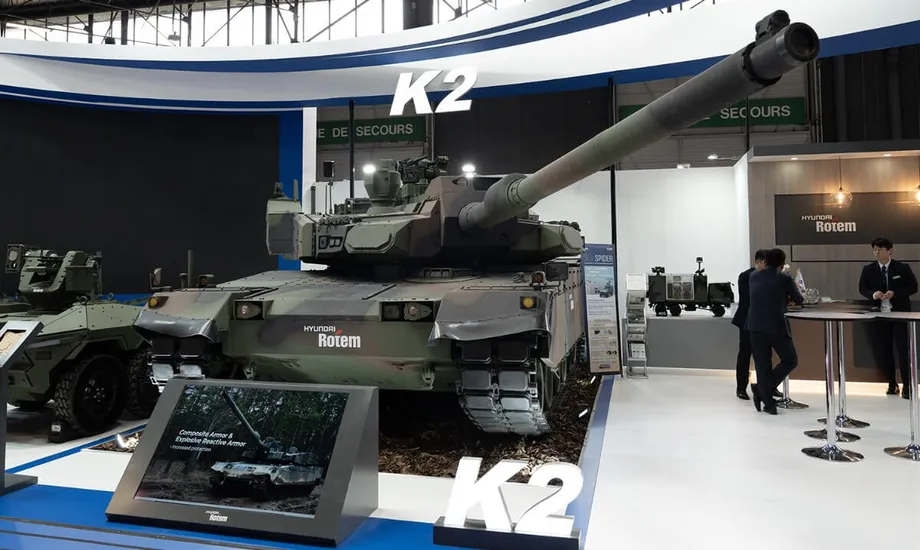
South Korea's defense manufacturers are pursuing a new wave of European orders as NATO considers raising its military spending target from 2% to 5% of gross domestic product. A proposed $6 billion purchase of 180 additional K2 tanks by Poland shows the scale of the opportunity, with production planned in both countries.
Contents
- Europe's rush to rearm brings major orders to Seoul
- Why NATO is considering a much larger spending target
- Canada and other allies reconsider their needs
- Poland shows why delivery speed matters
- What makes Korean weapons attractive to European buyers?
- Security concerns are changing supplier choices
- Competition and worker shortages could slow expansion
- Seoul is seeking customers beyond Europe
- A larger market brings larger spending choices
- Key Points
As of June 13, 2025, Hyundai Rotem and the Polish government are finalizing that agreement. Under the proposed arrangement, 117 tanks would be manufactured in South Korea and 63 in Poland. The purchase would become South Korea's largest single arms export deal to date.
The negotiations build on Poland's $44.2 billion agreement in 2022 for South Korean weapons, including K2 main battle tanks, Hanwha Aerospace's K9 self-propelled howitzers and Korea Aerospace Industries' FA-50 light combat aircraft. A self-propelled howitzer is a large artillery gun mounted on a vehicle, allowing it to move between firing positions.
South Korea became the world's 10th largest arms exporter in 2023, recording $14 billion in defense exports to 12 countries. Seoul wants to reach fourth place by 2027. European demand is helping that ambition, as governments seek weapons that can arrive quickly, operate alongside NATO equipment and support production within their own borders.
The expansion also brings difficult choices. Korean companies must find enough skilled workers, keep deliveries moving and compete with governments that want more military equipment built at home. Their success depends on turning urgent orders into lasting industrial partnerships.
Why NATO is considering a much larger spending target
NATO Secretary-General Mark Rutte has warned that the alliance needs a major increase in its ability to defend itself. His warning centers on Russia's accelerated rearmament, the war in Ukraine and China's rapid military modernization.
Rutte described the potential timetable for a Russian threat to the alliance:
Russia could be ready to use military force against NATO within five years.
Rutte also called for a "quantum leap" in collective defense. His remarks ahead of NATO's June summit in The Hague helped frame the debate over a higher spending target.
The proposal, strongly backed by U.S. President Donald Trump, would raise the minimum commitment from 2% to 5% of GDP. GDP measures the value of goods and services produced by an economy. A spending target expressed as a share of GDP links a country's defense commitment to the size of its economy.
The proposed 5% would have two parts: 3.5% for core military needs and 1.5% for infrastructure and industrial investment. The first portion would support armed forces and their equipment. The second would address the wider capacity needed to produce weapons and support military operations.
European defense spending rose by a reported 11.7% in 2024 to $457 billion. Spending could reach $800 billion if the proposed target is adopted. Using those figures, that would mean another $343 billion, an increase of about 75%.
Russia's production of thousands of tanks and missiles has strengthened the argument that NATO needs sustained investment. China's growing military assertiveness is also shaping the debate. As of June 13, the 5% goal remains a proposal, with adoption still to be decided.
Canada and other allies reconsider their needs
Canada has pledged to reach the existing 2% target this year and is preparing for further increases. Prime Minister Mark Carney has linked the change to Canadian sovereignty and a desire to reduce reliance on U.S. military support.
Carney described the current period for Canadian security as a:
hinge moment
Canada is considering a wider range of defense partners, including potential submarine purchases from South Korea and Europe. It also wants to invest in domestic production capabilities, connecting military purchases with the ability to build and maintain equipment at home.
Poland, Germany and the Nordic countries are also sharply increasing their military budgets and seeking suppliers that can modernize their arsenals quickly. For South Korean manufacturers, those decisions create opportunities across several markets rather than through a single customer.
Poland shows why delivery speed matters
Poland has become the clearest example of South Korea's appeal to NATO buyers. Its 2022 agreement covered several kinds of equipment at once, from heavy tanks and artillery to light combat aircraft.
Polish President Andrzej Duda praised Korean manufacturers for responding quickly after Russia's invasion of Ukraine. He said they could:
supply wonderful modern weapons within just a few months
Fast delivery matters when a government wants to strengthen its forces immediately. A purchase agreement sets out what a country expects to receive, but the military benefit depends on when that equipment reaches its forces. South Korean firms have made delivery in months, rather than years, a central attraction.
The proposed follow-on purchase of 180 K2 tanks adds another element: a larger role for Polish manufacturing. The plan to build 63 tanks locally would put 35% of that order in Poland, while the remaining 117 would come from South Korea.
Local production and technology transfer allow a buyer to gain manufacturing knowledge alongside equipment. For the seller, they can help establish a continuing industrial relationship beyond the delivery of the first vehicles.
Several dates show how the business has developed:
- 2022: Poland signed a $44.2 billion agreement for South Korean weapons, including K2 tanks, K9 howitzers and FA-50 aircraft.
- 2023: South Korea recorded $14 billion in defense exports to 12 countries and became the world's 10th largest arms exporter.
- July 2024: Romania confirmed a $920 million purchase of 54 K9 howitzers and 36 K10 resupply vehicles.
- June 13, 2025: Hyundai Rotem and Poland are finalizing a proposed $6 billion agreement for another 180 K2 tanks.
- 2027: Seoul aims to become the world's fourth largest arms exporter.
What makes Korean weapons attractive to European buyers?
South Korea's manufacturers combine competitive prices, modern equipment and a willingness to share production. Those strengths appeal to governments trying to expand their forces while managing pressure on public budgets.
Korean systems designed to meet NATO standards can operate alongside equipment used by alliance members. This compatibility matters because allied forces need their weapons and supporting systems to work together during joint operations.
Production limits in the United States and Europe are another factor. Manufacturing lines for important systems, including HIMARS and Patriot interceptors, are already at capacity as demand rises. European buyers seeking rapid deliveries are therefore looking beyond their usual suppliers.
Norway, Finland and Romania have turned to South Korea for military equipment. European demand includes artillery, armored vehicles and air defense systems. Romania's order for 54 K9 howitzers and 36 K10 resupply vehicles illustrates how buyers can purchase both weapons and the vehicles needed to keep them supplied.
Political support in Seoul has also helped exporters. Liberal and conservative governments have both prioritized defense sales, giving the industry continuity in policy and diplomatic backing. Buyers considering a lengthy production partnership have an interest in that continuity.
South Korean companies are consequently selling more than individual weapons. Their packages can combine delivery schedules, maintenance relationships, technology sharing and local manufacturing, addressing several priorities within one negotiation.
Security concerns are changing supplier choices
European concerns about the reliability of U.S. security guarantees, particularly under Trump, have encouraged governments to diversify their arms suppliers. The question for buyers extends beyond the quality of an aircraft or missile system to the political relationship supporting its use over many years.
A Danish lawmaker, speaking after the purchase of U.S.-made F-35 aircraft, expressed that concern directly. The lawmaker was not named:
Buying American weapons is a security risk we cannot run.
Some European officials are increasingly dissatisfied with the unpredictability of U.S. foreign policy. Seeking additional suppliers gives their governments more options while they continue to equip their armed forces.
South Korea's alignment with Western security interests strengthens its position. North Korea has supported Russia with munitions and troops. South Korea has sided with the West, provided humanitarian aid to Ukraine and supplied important military systems to NATO allies.
South Korea and European countries also share economic and political features relevant to cooperation. They are democratic economies with substantial export industries, and they face security pressure from authoritarian neighbors. Their potential cooperation extends from conventional weapons to cybersecurity and advanced technologies.
For Seoul, these relationships connect commercial contracts with wider security ties. For European buyers, they offer another route to acquiring equipment and building industrial capacity.
Competition and worker shortages could slow expansion
South Korea faces growing competition even as orders increase. Japan is easing restrictions on arms exports, potentially bringing more competition into international markets. Within Europe, French President Emmanuel Macron is pushing for greater defense autonomy, including stronger European industrial capabilities.
European efforts to build more equipment at home could reduce demand for imported Korean weapons. Agreements that include local production may help Korean manufacturers compete for that business, although they also require companies to share technology and coordinate manufacturing across borders.
South Korean defense firms are already experiencing shortages of skilled research and development personnel. These workers are needed to create new systems and improve existing ones. A shortage could constrain both innovation and the ability to satisfy future demand.
The industry's exposure to political decisions is another risk. U.S. presidential politics and election outcomes can affect security commitments and purchasing choices. The course of the war in Ukraine could also change the pace and composition of European military spending.
A conclusion to the war or a shift in European priorities could reduce demand sharply. Korean companies are responding by seeking customers in more regions, pursuing joint production agreements and investing in overseas operations.
The government is also being urged to provide stronger leadership and coordination for the industry's international ambitions. Export growth requires manufacturers, financing arrangements and diplomacy to support the same agreements over time.
Seoul is seeking customers beyond Europe
South Korea is expanding its defense business in Latin America, the Middle East and Southeast Asia. Recent activity includes shipbuilding contracts with Peru, major arms sales to the United Arab Emirates, Egypt and Saudi Arabia, and technology transfer agreements with regional partners.
Military donations have played a role in building those relationships. Over the past decade, Seoul has donated corvettes and patrol vessels to Colombia, Ecuador, Peru and Uruguay, hoping those connections will lead to later purchases of more advanced systems.
That approach links an initial transfer of equipment with the prospect of future business. It gives South Korea a way to develop relationships in markets where it wants a larger presence.
Korean companies are also drawing on the country's wider manufacturing capabilities. Package deals can include civilian products, such as trams alongside tanks, allowing a negotiation to address transport and defense needs together.
These strategies spread the industry's exposure across more customers and types of business. Europe remains a major opportunity, but Seoul's ambitions also depend on contracts in regions with different security requirements and purchasing priorities.
A larger market brings larger spending choices
World military spending reached a record $2.7 trillion in 2024, with the steepest annual increase since the end of the Cold War. South Korea's expansion is taking place within that wider rise in spending.
The United States, France, Russia, China and Germany remain dominant arms exporters. South Korea, India, Turkey and Israel are increasing their shares, making competition for contracts more intense.
Technology is a growing part of that competition. Governments are investing in drones, hypersonic missiles, artificial intelligence and cyber capabilities. Manufacturers must therefore keep developing new systems while meeting demand for equipment already in production.
South Korea's current advantages, including delivery speed, competitive pricing and production partnerships, support its export push. Sustaining those advantages will require enough skilled workers and manufacturing capacity to meet orders without slowing development.
Higher military spending also creates choices for governments. Money committed to defense competes with resources for social spending and economic development. Expanding arms production brings concerns about arms control, political stability and the potential for further conflict.
For South Korea, the immediate opportunity is substantial: NATO members want more equipment, often quickly, and several are willing to buy from outside their traditional supply networks. The central commercial task is to convert that demand into completed deliveries and durable partnerships while preparing for changes in spending priorities.
Key Points
- NATO is considering a defense spending target of 5% of GDP, divided between 3.5% for core military needs and 1.5% for infrastructure and industrial investment.
- European defense spending rose 11.7% to $457 billion in 2024 and could reach $800 billion under the proposed target.
- South Korea recorded $14 billion in defense exports to 12 countries in 2023 and aims to become the fourth largest arms exporter by 2027.
- Hyundai Rotem and Poland are finalizing a proposed $6 billion purchase of 180 K2 tanks, with 117 to be produced in South Korea and 63 in Poland.
- Fast deliveries, competitive prices, NATO compatibility and technology sharing are helping Korean manufacturers win orders.
- Competition, shortages of skilled personnel and changing political priorities pose risks to continued growth.
- South Korea is pursuing customers beyond Europe through arms sales, shipbuilding, donations and joint production arrangements.