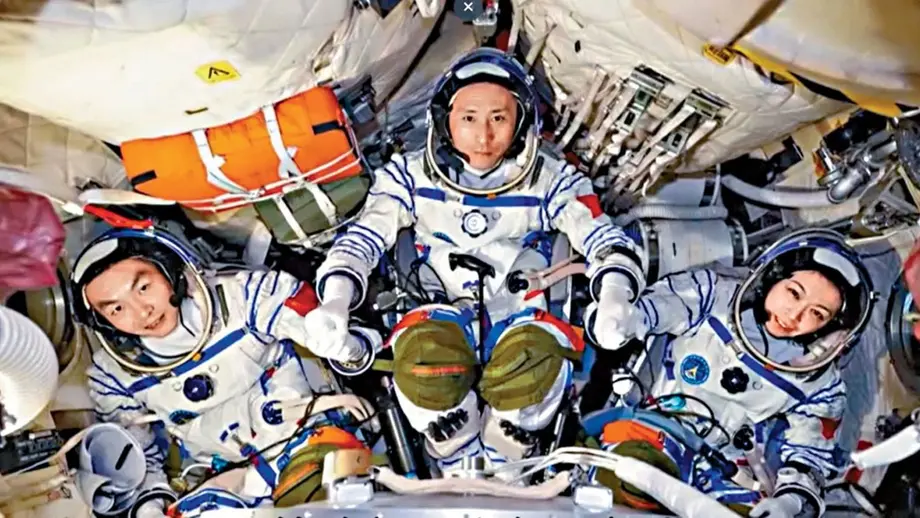
Lai Ka-ying and Crew Undock from Tiangong Station
China's Shenzhou-23 crewed spacecraft undocked from the Tiangong space station at 11:42 pm on Sunday, beginning the final leg of its journey back to Earth. The capsule carries Hong Kong's first astronaut Lai Ka-ying, mission commander Zhang Zhiyuan, and Pakistan's first astronaut in orbit Muhammad Zeeshan Ali. The undocking marks the end of an approximately 190-day mission for Lai, who set a new single-flight endurance record for a Chinese female astronaut. Before separating, the crew completed essential pre-departure procedures. These included configuring the space station complex, transmitting experimental data to ground control, and transferring supplies. The China Mapped Space Agency confirmed that these tasks were executed smoothly under the guidance of ground personnel.
Contents
The separation occurred during a critical window for the station's operations. Shenzhou-23 and Shenzhou-24 crews held an in-orbit handover ceremony on Saturday. During this event, the incoming crew presented Lai with a special Tiangong gift named Happiness, carrying wishes for Hong Kong's prosperity and well-being. Lai described the gift as a precious keepsake from space. Following the handover, astronaut Zhu Yangzhu remains in orbit to undertake a one-year residency mission alongside Shenzhou-24 commander Tang Hongbo and crewmate Wu Yi.
The Shenzhou-23 crew will follow a three-orbit fast-return profile. This method allows the spacecraft to fly independently for about 4.5 hours before initiating a 50-minute re-entry and landing sequence. The team will touch down early Monday morning at the Dongfeng Landing Site in Inner Mongolia. Recovery teams have prepared for the challenging conditions. They conducted full-system drills and deployed drones equipped with aerial lighting systems to illuminate the landing zone. This ensures a safe exit for the capsule and its occupants despite the sub-zero temperatures and darkness of the Gobi Desert.
Taiwanese Names and International Cooperation
Lai Ka-ying, a Hong Kong resident of Taiwanese descent, concludes her mission with significant personal and professional milestones. Her alma maters, Tsuen Wan Public Ho Chuen Yiu Memorial College and the University of Hong Kong, expressed pride in her achievement. They said they look forward to welcoming her back to share her experiences with students and staff. Lai's journey reflects the deepening ties between Hong Kong, Taiwan, and the Chinese space program. Her presence on the mission highlights the inclusive nature of China's manned spaceflight efforts.
The return also features a historic moment for Pakistan. Muhammad Zeeshan Ali became the first foreign astronaut to visit China's space station. He arrived aboard Shenzhou-24 on November 25 for a five-day mission under a longstanding China-Pakistan space partnership. As a payload specialist, Ali conducted four joint experiments in life sciences and materials science during his stay. His participation underscores the strategic diplomatic and scientific relations between the two nations. The China-Pakistan friendship, often described as higher than the Himalayas, now extends to the limits of space.
Preparations at the Dongfeng Landing Site
The Dongfeng Landing Site has undergone extensive preparations to ensure a successful recovery. The site is equipped to handle the unique challenges of night landings in winter. Recovery teams organized multiple communication joint matching training sessions. These drills tested the coordination between the spacecraft, ground control, and recovery units. The command center also conducted air-ground cooperative search and rescue training to ensure efficient handling of the capsule.
Five helicopters are deployed for the aerial recovery mission. These include one command helicopter, one communication helicopter, one medical monitoring and healthcare helicopter, and two medical rescue helicopters. The aerial team is led by Officer Li Wei, who oversees the deployment. The helicopters form a 'kou' character layout, with two positioned in the north and three in the south. This formation covers a 1300 square kilometer area around the landing zone. It allows the team to monitor the capsule from multiple angles, ensuring it remains in the center of the array.
Technical Challenges and Recovery Procedures
Technicians faced specific challenges due to the winter environment. The sand and cold temperatures of the Gobi Desert require meticulous maintenance of the recovery equipment. After each flight, technicians inspect the engine blades, rotors, and tail rotors. They also maintain the hydraulic systems and starting devices in low temperatures. These steps are crucial for ensuring the helicopters can operate effectively during the critical first moments after landing.
The recovery process follows a basic timeline. It begins with night search operations, moves to dawn handling, and concludes with daylight wrap-up. Drones play a key role in this process. They provide aerial lighting and real-time imaging to guide the ground teams. The ground teams are positioned to extract the astronauts quickly once the capsule lands. This efficiency is vital for the health and comfort of the crew, especially after the long-duration flight.
Scientific Achievements and Legacy
Lai Ka-ying's 190-day mission set a new benchmark for Chinese female astronauts. Her endurance record demonstrates the capability of Chinese women in long-duration spaceflight. The mission also advanced scientific research in microgravity. The crew conducted various experiments in materials science and life sciences. These studies contribute to future long-term space habitation and resource utilization.
Looking Ahead
The return of Shenzhou-23 marks a successful completion of a complex mission. It sets the stage for continued exploration of the Tiangong space station. The one-year residency mission of Zhu Yangzhu and the Shenzhou-24 crew will build on the foundation laid by Lai and her crewmates. Future missions may see more international participation, as evidenced by Ali's presence. The cooperation between China and its partners continues to grow, fostering a new era of space exploration.
Key Points
- Lai Ka-ying undocked from Tiangong on Sunday at 11:42 pm, ending her 190-day mission.
- The Shenzhou-23 crew includes commander Zhang Zhiyuan and Pakistani astronaut Muhammad Zeeshan Ali.
- Landing is scheduled for early Monday at the Dongfeng Landing Site in Inner Mongolia.
- Recovery teams prepared with drones, helicopters, and full-system drills for sub-zero night conditions.
- Lai set a new single-flight endurance record for a Chinese female astronaut.
- Muhammad Zeeshan Ali completed a five-day mission, conducting four joint experiments.