A Frozen Tank, Two Trapped Foxes and a 140 km Drive
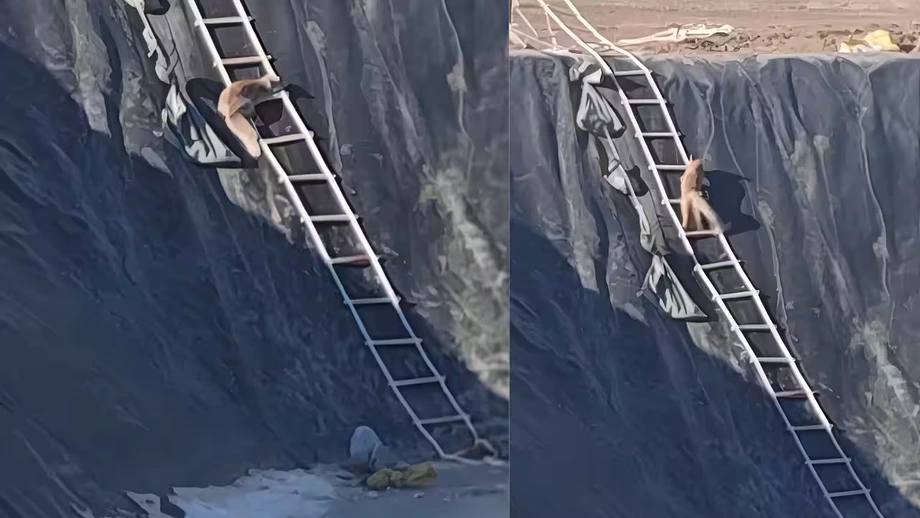
Wang, a resident of Baotou in China's Inner Mongolia Autonomous Region, was passing through a remote stretch of wilderness when he saw two foxes at the bottom of a water reservoir. The tank was more than 10 metres deep. Its walls were steep and covered with a plastic liner that offers an animal nothing to grip. The pair had climbed down, most likely looking for water, and could not get back out.
Contents
- A Frozen Tank, Two Trapped Foxes and a 140 km Drive
- A Basin Built to Hold Water, Not to Release Animals
- Food First, Then a Long Trip to the City
- The First Attempt, at Dusk
- One Fox Up, the Other Still Wary
- Reverence for Life, in Wang's Own Words
- A Simple Idea That Saved Two Lives
- What Is Still Unclear
- Key Points
Their escape took two days, a meal Wang threw down so the animals could recover some strength, one failed attempt at dusk, and a round trip of 140 km to the city, where he bought a rope ladder for a little more than 100 yuan (about S$19). On the second morning the larger fox climbed the ladder to the rim. The smaller one followed only after Wang walked to the opposite bank to give it room. Both ran back into the wild.
Video of the rescue reached social media within days. An account using the name iQinghai posted the footage on X on 28 November 2026 with a caption that put the distance in perspective: "140 km... But there was no way we could leave that little fox out there to freeze."
Reservoirs of this kind are built to hold water through the dry months, not to let animals in or out. The plastic sheeting that keeps the stored water from seeping into the soil also turns the walls into something close to glass. For a fox that has jumped or slid down for a drink, the way back up does not exist.
A Basin Built to Hold Water, Not to Release Animals
Wang reckoned the two animals had been down there for some time before he arrived. He reasoned that they had gone down in search of water and been unable to climb back up the steep sides, which are covered with a plastic cloth used to stop leaks. Left alone, he judged, they would have died of cold or hunger.
The design of the reservoir explains the trap. Water storage pits in dry parts of northern China are dug deep so a large volume can be kept in a small footprint, and the walls are lined with sheeting so that water does not drain away into the surrounding soil. Steep sides and a smooth liner are exactly the features that make such a tank useful for farmers and villages, and exactly the features that leave a wild animal stranded once it is inside. Ice at the bottom of the basin removed the last chance of a foothold.
The spot Wang stopped at sits in open country far from towns, which shaped everything that followed. There were no tools at hand, no other people nearby and no quick way to call for equipment. A rescue that would take minutes with a ramp beside a town reservoir became a two day operation in the wilderness.
Foxes are among the animals most often seen around human water sources in this part of China, and a tank holding open water in freezing weather draws them in. Once inside, the animals had nothing to climb. The larger fox was the bolder of the two and the quicker to trust the ladder. The smaller one kept its distance for a full day longer.
Food First, Then a Long Trip to the City
Wang's first move was not a rescue but a meal. He fed the foxes where they stood, so that animals weakened by cold and hunger would have the strength to climb if a way out appeared. Only after that did he deal with the problem of equipment.
Because the site was remote and he carried nothing suitable, he drove 140 km to the city and back, and paid a little over 100 yuan for a rope ladder, roughly S$19. The tool is described in some places as a rope ladder lowered into the tank, and in others as ropes that Wang used to pull the animals up. Either way, the principle was the same: a textured line from the ice to the rim, dropped in by a man who stayed on solid ground.
The price is worth pausing on. The full rescue, including the fuel for 280 km of driving, cost a private citizen a sum that would not buy a meal for two in many cities, spent on two wild animals that belonged to nobody and carried no financial value for him.
Wang returned to the reservoir that same evening, ladder in hand, expecting the job to be over quickly. It was not.
The First Attempt, at Dusk
Wild foxes that have spent days trapped in a hole are not waiting at the top of a ladder for a human being. When Wang approached the edge of the tank that evening, the two animals panicked. They darted across the ice in different directions, keeping as far from him as the basin allowed. He could not get them to come near the ladder at all.
That first night ended without a rescue. Wang left, and the foxes stayed where they were. The failure says something about why rescues of wild animals take patience rather than equipment: an animal that reads a person as a threat will avoid the thing that person is offering, even when that thing is the only way out.
Wang came back the next day with a different plan. He fixed the ladder at the edge of the reservoir and then did as little as possible, letting the animals work out for themselves what it was for.
One Fox Up, the Other Still Wary
The second day went in stages. The larger fox made the decision first, climbing the rope ladder from the ice to the shore. The smaller fox would not go near it. Every time Wang moved, it retreated.
His solution was distance. Wang walked around to the opposite side of the reservoir, leaving the ladder standing alone and the gap between himself and the remaining animal as wide as the basin allowed. With the person gone from its side of the tank, the smaller fox slowly dropped its guard and made several attempts at the ladder. It climbed out, reached the rim and ran off into the hills.
The sequence, as described in the Chinese account of the rescue, ran like this:
- Day one: Wang finds the foxes in the reservoir, throws down food and drives 140 km to the city to buy a rope ladder for more than 100 yuan.
- Day one, evening: he returns and tries to bring the foxes to the ladder. They scatter whenever he comes near, and the attempt fails.
- Day two: the ladder is set up at the edge of the tank. The larger fox climbs out.
- Day two, later: the smaller fox refuses to approach. Wang moves to the far bank, and after several tries the smaller fox climbs out and runs back into the wild.
Nobody stepped onto the ice. That was the practical value of the ladder and the reason the rescue worked at all: the route out was provided from a safe distance, without a person or a vehicle testing a frozen surface of unknown thickness.
Reverence for Life, in Wang's Own Words
Asked why he had spent a day and a round trip of 140 km on two foxes, Wang gave an answer that has travelled with the video. He spoke of respect for life, a phrase in Chinese, jingwei shengming, that carries a sense of awe rather than duty, and of not being able to watch two small creatures die in the cold.
This place is remote. If nobody took care of them, they would surely freeze to death."
"The rescue had no other aim than respect for life. I could not bear to watch two small creatures die in the cold of winter.
The reasoning is practical as well as emotional. The tank sits far from any settlement, so no owner, no patrol and no wildlife officer was going to find the foxes. Wang's estimate was that without his intervention the animals would have stayed on the ice until they died, and the plastic walls guaranteed that they could not solve the problem themselves.
He asked for nothing in return, and there is no suggestion that he expected the rescue to be filmed. The footage appears to have been recorded by people at the scene as the second attempt unfolded.
A Simple Idea That Saved Two Lives
Footage of the rescue spread widely after it was posted on 28 November 2026, drawing responses from animal lovers far outside Inner Mongolia. What viewers responded to was the absence of drama: no helicopter, no team of specialists, no risk taken on thin ice. A man bought a ladder, put it where the animals could reach it and then had the patience to wait.
The video shows the foxes struggling for traction on the slippery surface, then finding the rope and using it. Comments posted beneath the clip picked out the same details again and again:
- "This is the kind of content the internet needs more of."
- "Kudos to the rescuers for helping the animals."
- "The foxes looked so relieved once they got out."
- "A simple idea that saved two lives."
- "The rope ladder was a brilliant solution."
- "Glad both animals were rescued safely."
Much of the praise landed on the method. A ladder dropped from the rim solved a problem that muscle and goodwill could not, and it did so without putting anyone on ice that might give way. Viewers also noted the second, quieter skill on display: Wang's retreat to the far bank, which let a frightened animal make its own decision.
For readers who have never handled a wild animal, that last point matters more than it looks. Wild foxes that are cornered will run, bite or exhaust themselves, and a rescuer who crowds them can turn a workable rescue into a failed one. The smaller fox climbed out only once the person stopped trying to make it happen.
What Is Still Unclear
The exact site has not been identified. All accounts place the reservoir in the Inner Mongolia Autonomous Region and identify Wang as a Baotou resident, and none names the banner or county where the tank stands. The date Wang found the foxes is not given either. A Chinese account of the rescue was published on 27 November 2026 and the video was posted the following day, but neither fixes the day the animals were discovered or how long they had been in the tank before that.
No forestry, grassland or wildlife protection authority in Inner Mongolia has issued a statement on the rescue, and none has said whether the reservoir will be fitted with a ramp, an escape slope or a warning barrier. There is also no word on the condition of the two foxes after they ran off, or on how they fared in the days that followed their release.
What is known is the shape of the problem the tank presented, and the fact that it was solved for about 100 yuan and a day of driving. Other reservoirs of the same design sit across the same countryside, and most of them have nobody driving past when an animal falls in.
Key Points
- Wang, a Baotou resident, found two foxes trapped in a water reservoir more than 10 metres deep in a remote part of China's Inner Mongolia Autonomous Region.
- The basin has steep walls covered with a plastic liner that stops water seeping away, leaving the foxes with no way to climb out after going down for water.
- He fed the animals first, then drove 140 km to the city and back and spent more than 100 yuan (about S$19) on a rope ladder.
- A first attempt at dusk failed when the foxes panicked at his approach.
- The next day the larger fox climbed out; the smaller one followed after Wang moved to the opposite bank and gave it space.
- Both animals returned to the wild, and no rescuer had to step onto the ice.
- Wang said he acted out of respect for life and could not bear to leave the animals to freeze.
- Video of the rescue was posted on X on 28 November 2026 and drew wide praise online.
- The exact location of the reservoir and the date the foxes were found have not been disclosed, and no authority has commented on the case.