A 92.3 Percent Progress Rate, and a New Way of Working
China's National Forestry and Grassland Administration is reorganizing restoration work across the country's vast northern green barrier into 14 priority zones. The plan, reported on November 26, 2026, responds to a basic problem: a desert, a mountain slope and a grassland may all need protection, but they cannot support the same vegetation or use water in the same way. The administration said the new approach would move the Three-North program from expanding its scale toward giving equal weight to quality and results.
Contents
- A 92.3 Percent Progress Rate, and a New Way of Working
- Three Flagship Campaigns, One Zoning System
- Where the 14 Zones Are Located
- What Three Years of Intensive Work Have Changed
- Why Grass Improvement and Livestock Farms Matter
- Key Dates for a Project Running to 2050
- Why Water Is Central to the New Strategy
- What Decades of Restoration Have Already Changed
- Can Solar Panels Help Hold Down the Sand?
- A Restoration Challenge That Crosses Borders
- What to Know
The announcement came with substantial progress figures for 2026. Central government investment reached 27.7 billion yuan for 328 key projects. Their construction target was 74.48 million mu, of which 68.74 million mu had been completed, giving the stated progress rate of 92.3 percent. The remaining area was 5.74 million mu. One mu is one fifteenth of a hectare, so the completed area equals about 4.58 million hectares, while the full target is nearly 5 million hectares.
The Three-North Shelter Forest Program is widely known as China's Great Green Wall. Its name refers to the north, northeast and northwest, and its work includes shelterbelts, which are bands of vegetation that slow wind and protect land behind them. It also includes grassland restoration and the stabilization of moving sand. The new zoning system will govern how planting, tending, management and ecological repair are arranged across that varied landscape.
Three Flagship Campaigns, One Zoning System
Three flagship campaign areas provide the framework. One covers the great bend of the Yellow River. Another concentrates on the Horqin and Hunshandake sandy lands. The third runs along the Hexi Corridor and the edge of the Taklamakan Desert, where the objective is to check advancing sand. The 14 zones divide these enormous campaign areas into units with more coherent climates, geography and restoration needs.
County units form the building blocks of the plan. The administration connected them with 68 key projects in the program's sixth phase, taking account of climate, physical geography and the division between core campaign areas and places where supporting work must proceed alongside them. Those 68 projects are the planning framework for the sixth phase, while the 328 projects cited for 2026 describe the year's implementation program.
The practical change is the freedom to assign different combinations of work. Establishing new vegetation may suit one county, while another may need to concentrate on tending young plants, managing existing shelterbelts or repairing damaged grassland. The announcement ties those choices to local water and heat conditions rather than imposing a single method across the whole project region.
Where the 14 Zones Are Located
The zones are divided into four in the east, four in the centre and six in the west:
- Eastern area: Horqin sandy land, including the Songnen Plain; Hunshandake sandy land, including the Xilin Gol grassland; the sandy lands of the Hulunbuir grassland; and the Yanshan and Taihang mountain areas.
- Central area: the central and western Yin Mountains, including the Hetao Plain; the Kubuqi Desert and Mu Us sandy land; the Loess Plateau; and the Helan Mountains and Liupan Mountains.
- Western area: the Tengger and Badain Jaran deserts; the Hexi Corridor; the Qaidam Basin, including the Gonghe Basin; the Qinghai alpine grassland; the Junggar Basin; and the Taklamakan Desert.
The list deliberately places river plains, basins, grasslands, mountains and deserts within one national program. A target expressed only as area planted can obscure whether vegetation has enough water to survive or whether it protects farms and pasture. County level planning gives officials a way to measure survival, condition and ecological results alongside the area treated.
What Three Years of Intensive Work Have Changed
The current intensive campaign began three years before the zoning announcement. During that period, more than 80 million mu of various construction tasks were completed each year, according to the forestry administration. That annual figure covers the campaign's broader construction workload, while the 74.48 million mu target for 2026 belongs specifically to the year's 328 key projects.
The administration also said the sixth phase had passed the halfway point in both time and tasks. Its next stated milestones are more demanding: over 70 percent of tasks were to be completed by 2027, with all construction in the phase finished by 2030. Differentiated governance is therefore arriving while managers must still deliver a large remaining workload.
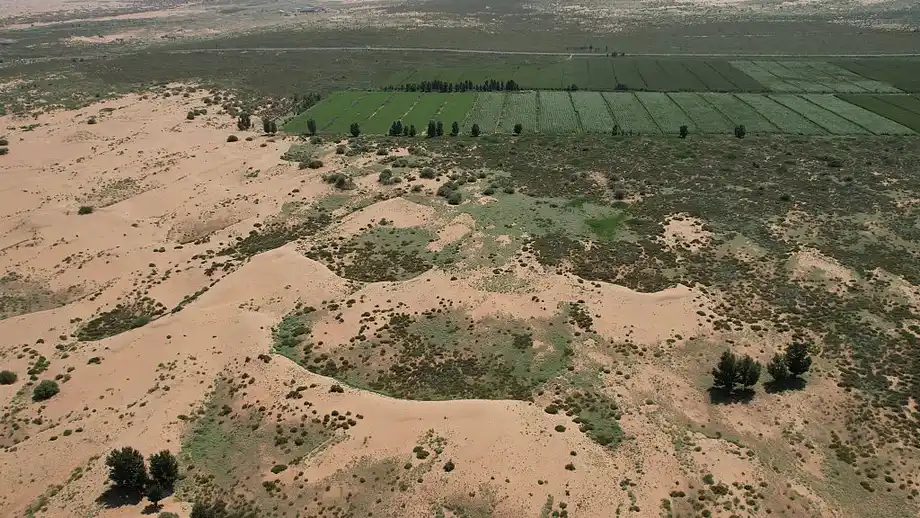
The wider program began in 1978 and is planned to continue until around 2050. Its completed design has been described as a green barrier about 4,828 kilometres long and, in some places, up to 1,448 kilometres wide, encompassing roughly 88 million acres of forest. The work on the ground is more varied than the image of a continuous wall suggests, particularly where grass or shrubs are more suitable than dense tree cover.
Why Grass Improvement and Livestock Farms Matter
Grassland improvement aimed at controlling sand will now be included within the Three-North program's support framework. Ten ecological grassland and livestock farms are due to begin construction in 2027, starting in Xinjiang and Inner Mongolia among other places. This brings pasture management more visibly into a program often associated mainly with planting trees.
The farms connect vegetation restoration with livestock production. Grass can protect soil in places where tree cover would place heavy demands on water, while forage production and grazing arrangements affect the pressure animals put on recovering land. For herding communities, the practical issue is how to maintain livelihoods without stripping away the vegetation that keeps soil in place.
The administration has not yet provided exact sites or budgets for the 10 farms. It also gave no date for publishing detailed treatment rules for each of the 14 zones. The clearest fixed dates are the start of farm construction in 2027, the sixth phase targets for 2027 and 2030, and the wider program's planned completion around 2050.
Key Dates for a Project Running to 2050
The zoning decision sits within a much longer sequence of planting, consolidation and changing environmental conditions:
- 1978: China launched the Three-North Shelter Forest Program to resist desert expansion, protect farmland and reduce the damage caused by sand and dust storms.
- 2023: The current intensive campaign began, beginning the three year period in which annual completion exceeded 80 million mu.
- November 2024: China announced completion of a roughly 3,000 kilometre green belt around the Taklamakan Desert.
- 2026: The program supported 328 key projects with 27.7 billion yuan in central investment, and the sixth phase passed the halfway point in time and tasks.
- November 26, 2026: The plan for differentiated management across 14 priority zones was reported.
- 2027: Work is due to start on 10 ecological grassland and livestock farms, and the sixth phase aims to pass 70 percent completion of its tasks.
- 2030 and 2050: All sixth phase construction is due by 2030, while the wider Three-North program is planned to run until about 2050.
This timetable explains why maintenance matters as much as new construction. Vegetation established during the current phase will need to survive through later phases if the treated area is to provide lasting protection.
Why Water Is Central to the New Strategy
Drought, water scarcity and soil degradation remain the strongest environmental constraints identified in scientific assessments of the program. Trees need water while their roots develop, and dense plantations can increase water loss through evaporation from the ground and moisture released by leaves. In dry regions, groundwater depletion can turn an apparently successful planting campaign into a burden on farms, grasslands and neighbouring ecosystems.
A Chinese Academy of Sciences assessment in 2026 called for closer coordination among water resources, land use, population and industrial development. It also urged joint prevention and control across regional boundaries and management throughout the full life cycle of restoration projects. In plain terms, planners need to consider water supply and maintenance before work begins, then monitor the site for years rather than counting only the area initially treated.
Earlier experience shows why that distinction matters. Winter storms in 2008 destroyed 10 percent of new forest stock, leading the World Bank to advise greater attention to the quality and choice of stock rather than quantity alone. Concerns have also included plantations dominated by one species, which can be vulnerable to pests or weather extremes, and low survival rates. A study published in January 2023 found that only about one tenth of the planted forests it examined remained alive after 40 years.
The 14 zones do not remove those risks, but they provide a structure for responding to them. A county with limited water can be assessed differently from a wetter mountain area, and money can be directed toward tending or repair when survival is a greater problem than the lack of new planting. Joint work across regions also matters because rivers, groundwater and moving sand do not stop at administrative boundaries.
What Decades of Restoration Have Already Changed
There have been measurable gains alongside the failures. The desert share of China's territory was reported to have fallen from 27.2 percent to 26.8 percent over the preceding decade, a decline of 0.4 percentage point. By 2022, the Gobi Desert was reported to be shrinking by more than 2,000 square kilometres a year, compared with expansion of about 10,000 square kilometres a year during the 1980s.
National forest coverage rose from about 10 percent in 1949 to 25 percent in 2024 under a range of forestry and land policies that included Three-North. Thousands of acres of shifting dunes have been stabilized, and the nationwide frequency of sandstorms fell especially sharply between 2009 and 2014. The belt completed around the Taklamakan in 2024 added a geographically specific achievement to those national measures.
Individual efforts have also left lasting marks. Yin Yuzhen planted trees to restore damaged land in Uxin Banner, while Li Yunsheng worked to reforest the area around Matou Mountain in Youyu county, Shanxi. Youyu now has a forest containing more than 130 million trees. These examples show the persistence required, but the new national plan places greater weight on whether methods suit each location.
Can Solar Panels Help Hold Down the Sand?
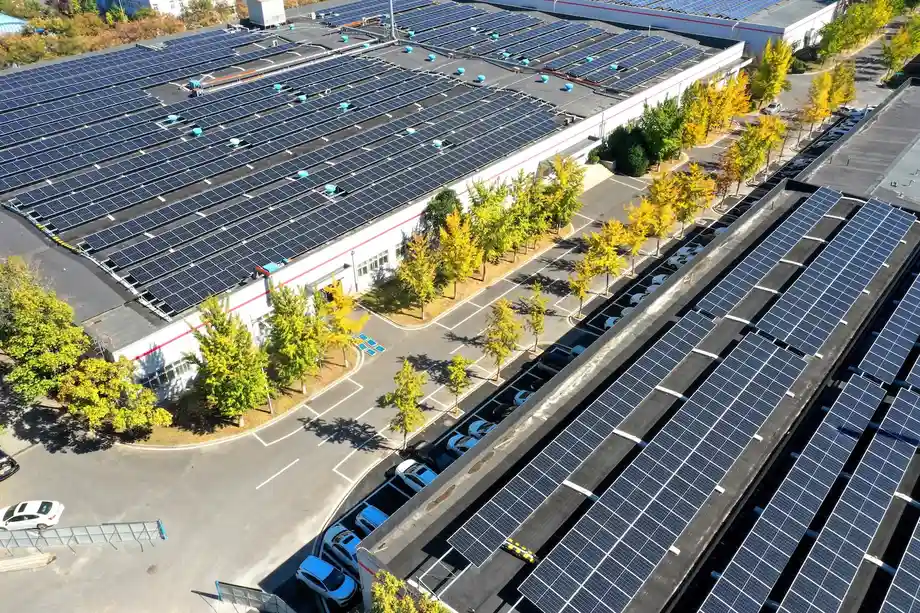
Solar power has become another restoration tool in desert areas, including the Kubuqi Desert. China included the combination of solar generation and sand control in its renewable energy plan for 2021 to 2025 and began promoting the approach more actively around 2023. Panels produce electricity while their supports and arrays help stabilize the surface beneath them.
Shade reduces the direct force of the sun on soil, and panels can lower wind speed near the ground, limiting the movement of sand and dust. Grass has begun growing beneath some installations. Liquorice is especially useful because it draws nitrogen from the air into the soil and adds organic matter, gradually improving fertility. More advanced installations raise panels high enough for farming underneath, sometimes in irrigated greenhouses producing crops such as tomatoes and melons.
Sand accumulating on panels and the cost of carrying electricity from remote deserts remain practical obstacles. Analysis of Landsat satellite data nevertheless indicates that solar projects have contributed to greener desert landscapes in parts of China. For the zoned restoration plan, this offers another possible combination of energy, vegetation and land management rather than a universal substitute for planting.
A Restoration Challenge That Crosses Borders
The Gobi Desert stretches across China and Mongolia, and dust raised from damaged ground can travel far beyond either country. In August 2025, the two governments were exploring expanding the Great Green Wall across their shared border. No timetable had been set, although scientific cooperation was already supported by the China and Mongolia Desertification Prevention and Control Cooperation Centre.
Mongolia brought an urgent need to that discussion, with nearly 80 percent of its territory already degraded. Its One Billion Tree movement, launched in 2021, aims to plant a billion trees by 2030. China brought decades of experience with shelterbelts, grassland restoration and dune stabilization.
Both sides face the same balancing act now visible in China's 14 zones. Trees require water, grasslands support livestock, and communities depend on access to land. Restoration across a border would need to account for overgrazing, climate pressures and unsustainable land use while matching vegetation to local conditions.
What to Know
- China's Three-North restoration program will use differentiated methods across 14 priority zones in eastern, central and western areas.
- The zones are based on county units and connected with 68 key projects in the program's sixth phase.
- In 2026, 27.7 billion yuan supported 328 projects; 68.74 million mu of a 74.48 million mu target had been completed, or 92.3 percent.
- Ten ecological grassland and livestock farms are due to begin construction in 2027, starting in places including Xinjiang and Inner Mongolia.
- The sixth phase aims to exceed 70 percent task completion by 2027 and finish construction by 2030; the wider program runs to about 2050.
- Water scarcity, groundwater depletion, soil degradation and poor survival explain the shift toward quality, maintenance and management throughout a project's life.
- Desert stabilization, rising forest coverage and solar projects show progress, while detailed zone rules and the farms' exact locations and budgets remain unannounced.