A larger wild population, but no new habitat
A survey completed in December 2024 counted 3,300 wild Xinjiang salamanders across 2,800 square kilometers of western Wenquan County in China, excluding animals produced through artificial incubation or other intervention. Researchers recorded an increase of 300 animals, but found no new natural habitat for the critically endangered amphibian.
Contents
- A larger wild population, but no new habitat
- What the population figures show
- How researchers searched the mountain waterways
- A recovery built over decades
- Why restoring springs matters
- Helping eggs survive their most vulnerable stage
- More salamanders still share a narrow genetic base
- A small amphibian with a distinctive identity
- Monitoring and the next search
- Key Points
The findings bring a more precise measure of progress for Ranodon sibiricus, a small mountain salamander whose population had fallen to around 1,700 in 2015. Protection of springs, restrictions on grazing and human access, and breeding work have helped its numbers rise. Its survival still depends on a small network of isolated habitats threatened by falling groundwater and a warming climate.
The Xinjiang Forestry and Grassland Administration's January 2025 account identifies Yuan Liang, an associate professor at Xinjiang Normal University's School of Life Sciences, as the survey leader. Yuan had spent 21 years studying the species and worked with seven other researchers.
Young salamanders discovered at the Wenquan Xinjiang Salamander National Nature Reserve during a July field visit offered another encouraging sign: animals were reproducing in their protected surroundings. The completed census adds a broader finding, showing that the wild population has grown within its existing range.
What the population figures show
The reserve put the population at around 1,700 in 2015 and more than 3,000 by August 2022. The December 2024 census recorded 3,300 wild animals, with Yuan describing the latest increase as 300. Compared with the approximate 2015 figure, the latest count is about 94% higher, or close to twice as large.
The recent change is more modest than that longer comparison. An increase of 300 from a baseline of roughly 3,000 amounts to about 10%. Both comparisons help explain the recovery: a substantial rise over several years, followed by further growth from an already larger population.
Ji Xiaowei, an official at the reserve management station, said a survey in 2006 had recorded just over 2,000 animals. That effort lasted six months and covered only places researchers could reach with the time and equipment available. The newer census searched a much wider area using satellite information alongside fieldwork, so the figures come from surveys with different coverage.
The latest count applies to wild salamanders in Wenquan County. Its explicit exclusion of artificially incubated and intervention animals gives conservation managers a separate measure from the results of their breeding facilities.
How researchers searched the mountain waterways
Yuan's team combined satellite remote sensing with field investigations and local inquiries. Satellite images helped identify places where salamanders might live; visits on the ground allowed researchers to investigate those waterways and surrounding habitats.
The search covered the Bortala, Otuoksai'er, Arishate and Miliqige rivers and their tributaries. Researchers also examined wetlands, mountains and lakes in southern Wenquan County. Snowmelt feeds many of these mountain water systems, making them potential places to search for an amphibian dependent on water.
The administration's October 2023 survey announcement described the countywide census as newly launched, while the completed survey account dates the team's work to June 2023. The announcement expected completion in summer 2024; the final account places completion at the end of December 2024.
The resulting Wenquan County Xinjiang Salamander Natural Population Resources Census Report has been completed. Its central finding is encouraging but geographically narrow: more animals were recorded, while the search added no new natural habitat to the known network.
A recovery built over decades
Protection in Wenquan developed through several stages, from rediscovery and reserve designation to habitat restrictions and dedicated breeding facilities. The main milestones show how long the effort has taken.
- 1866: Russian scholar Kessler documented the species in the Alatau Mountains near the border between eastern Kazakhstan and Xinjiang.
- 1989: Xinjiang Normal University professor Wang Xiuling rediscovered the salamander in Wenquan County, where six natural habitats were subsequently identified.
- 1997: A nature reserve covering 700 hectares was established in Wenquan County.
- 2015: The population was reported at around 1,700.
- 2016: A research and education center opened, including facilities for artificial incubation.
- 2017: The reserve gained national status, with grazing restrictions and controls on human access.
- July 17, 2024: A new rescue and breeding center opened in Wenquan County.
- December 2024: The wider survey concluded with a count of 3,300 wild animals.
The reserve's 700 hectares equal seven square kilometers. The census covered 2,800 square kilometers, a search area 400 times larger. Researchers were looking well beyond the reserve itself for additional populations and suitable habitat.
Why restoring springs matters
Mountain springs and streams provide the water the salamanders need to live and reproduce. Reserve officials identify falling groundwater at high elevations and the drying of some springs as causes of shrinking habitat. Weak migration ability makes it difficult for the animals to reach another suitable water source when one disappears.
Authorities have invested more than 30 million yuan in conservation infrastructure and management capacity. Measures include water pipelines intended to restore spring supplies, improved reserve facilities, and monitoring equipment. Grazing restrictions and controlled entry aim to reduce disturbance around the remaining habitats.
Restoration has also included returning grazing land to grassland and wetland. These measures address the places where the animals live, alongside the separate effort to help eggs hatch and young salamanders survive.
The absence of newly discovered habitat makes the existing sites especially valuable. A larger population still relies on the same small collection of mountain refuges, where maintaining water supplies remains a practical conservation priority.
Helping eggs survive their most vulnerable stage
Xinjiang salamanders lay eggs that are fertilized in water and remain attached to rocks. Hatching takes about 40 to 46 days, and natural hatching success is low. Young salamanders also face the risk of being eaten by adults.
Researchers collect eggs for artificial incubation and raise young salamanders until they are about one year old before releasing them into the wild. This gives the animals protection during an early period when many would otherwise die.
The rescue and breeding center opened on July 17, 2024, covers 500 square meters. It contains indoor and outdoor artificial incubation pools and a breeding laboratory, providing space and equipment for rescue, reproduction studies and monitoring.
At the time of its opening, the reserve reported that more than 200 salamanders had been artificially hatched, with an incubation success rate of 99% and a survival rate above 90%. The earlier research center had reported 139 hatchlings during 2022. These breeding results are tracked separately from the latest wild census.
More salamanders still share a narrow genetic base
A 2012 genetic study published in PLOS ONE explains another difficulty facing the species. Researchers examined 123 samples collected between May and August 2006 from all six known Chinese populations and found extremely little genetic variation.
The team identified only three mitochondrial haplotypes, meaning three versions of the inherited DNA pattern they examined. Mitochondrial DNA is genetic material usually passed from mothers to their offspring. The study recorded nucleotide diversity of 0.00064, a measure showing how little those DNA sequences differed.
A second method examined repeated stretches of DNA known as microsatellites. Among 70 sequences containing these repeats, only two locations showed variation. Both methods pointed to a population with a very narrow genetic base.
Genetic variety gives a species a wider range of inherited traits. When that variety is scarce, individuals may share similar weaknesses, making adaptation to changing conditions harder. Reserve officials also report that the habitats are far apart, limiting breeding between groups.
The study's statistical reconstruction suggested that the surviving populations separated from an ancestral population approximately 120 years before the analysis. Its authors linked the recent isolation to human activity and climatic changes and concluded that the species had suffered dramatic population declines. Increasing animal numbers and maintaining genetic variety therefore remain connected conservation tasks.
A small amphibian with a distinctive identity
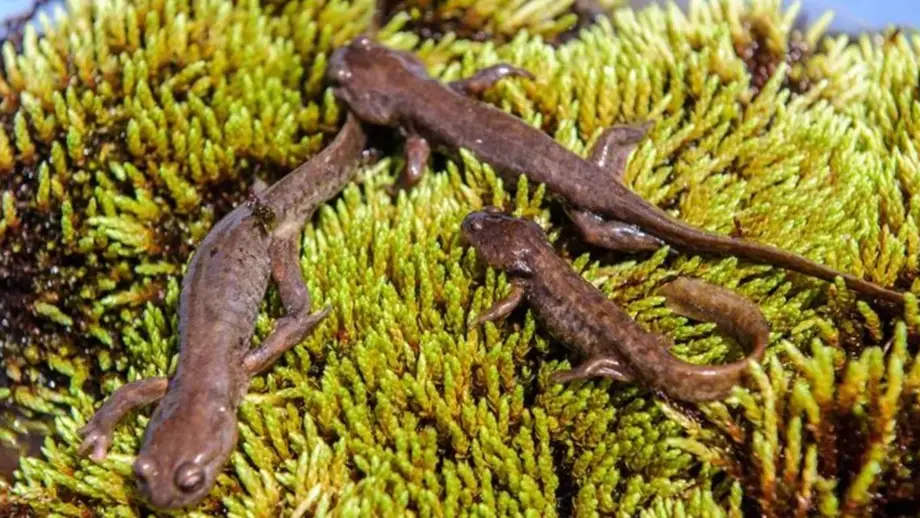
Ranodon sibiricus, also called the Siberian salamander in scientific literature, is Xinjiang's only surviving tailed amphibian. Amphibians include frogs and salamanders; this species keeps its tail as an adult and depends closely on mountain water habitats.
Adults generally measure six to 20 centimeters. Distinctive features include short teeth on the roof of the mouth arranged in separate V patterns, 12 or 13 grooves along each side of the body, and a semicircular fold around the lip.
The species belongs to an ancient salamander lineage associated with diversification during the Jurassic Period. Its surviving populations occupy scattered mountain habitats, including tributaries in the upper Bortala River system. The immediate conservation task is to keep those living populations reproducing in places with reliable water.
Monitoring and the next search
The reserve uses an integrated information management platform and infrared cameras to monitor conditions and salamander activity. Ji has credited habitat restoration, remote monitoring and patrols with helping the population grow.
Si Ya'e, deputy head of the reserve management station, reported when the breeding center opened that the six natural habitats held more than 3,000 salamanders. She attributed the gradual increase to a combination of habitat repair, monitoring, artificial breeding and conservation education.
Researchers and relevant departments plan further population surveys in Bole, Alashankou, Jinghe County and around Sayram Lake. No completion date was given for those searches. Their findings could expand knowledge of where the species survives and help direct protection to additional sites if populations are found.
Wenquan's immediate result is concrete: 3,300 wild salamanders were counted, while the six known habitats remain the foundation of local protection. Continued work must keep those waterways suitable for breeding while addressing the isolation and low genetic variety documented by researchers.
Key Points
- A census completed in December 2024 recorded 3,300 wild Xinjiang salamanders in western Wenquan County.
- The count excluded artificially incubated and intervention animals, and researchers reported an increase of 300.
- The search covered 2,800 square kilometers but found no new natural habitat.
- Habitat restoration, grazing restrictions, monitoring and breeding programs have supported the recovery.
- A rescue and breeding center opened on July 17, 2024, with indoor and outdoor incubation pools.
- Drying springs, isolated habitats and extremely low genetic diversity remain major conservation concerns.
- Further surveys are planned in nearby areas, including Bole, Alashankou, Jinghe County and Sayram Lake.