A server rack 700 kilometres up, now open for business
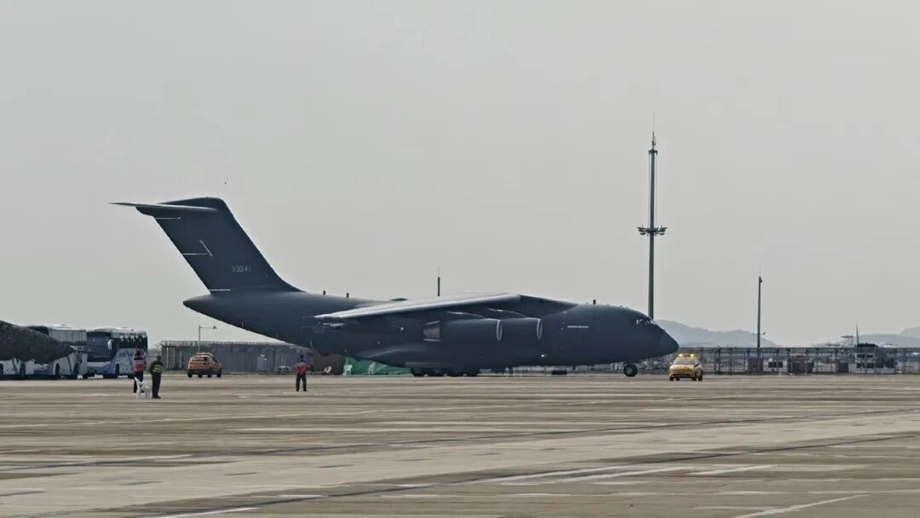
At 07:33 on July 24, 2026, a Lijian-1 Y15 rocket lifted off from the Dongfeng Commercial Aerospace Innovation Test Zone and placed five satellites into their planned orbits in a single flight. One of them, a spacecraft named Chenguang-1, carries domestically built computing hardware rated at about 25,000 TOPS, or 25 trillion operations per second, roughly 700 kilometres above the ground.
Contents
- A server rack 700 kilometres up, now open for business
- Why put servers above the atmosphere
- Three walls: power, heat and radiation
- The gamble on a first of its kind
- A consortium that grew from 24 to 54
- One big computer room or many small ones
- An engine that reads satellite photographs
- Adaspace's three records and the race it leads
- What Beijing counts so far
- How the project got here
- What is not yet settled
- Key Points
The satellite belongs to the Beijing Star Space Future Space Technology Research Institute, known as the Star Space Institute. Engineers there say it has now spent more than four months in orbit and completed 66 tests in space. An ordinary remote sensing satellite takes pictures and sends them down. Chenguang-1 has a server on board that can work on the pictures before they leave.
On November 27, 2026, at a conference in Beijing on building the space data centre, the institute said the platform built on the satellite had formally gone online. Universities, research institutes and companies can now apply for time on its processors to test artificial intelligence models and equipment carried into orbit. The same event brought the first public look at the Earth Large Model Engine V0.1, a tool for teaching AI systems to read satellite images.
A TOPS is one trillion operations per second, the unit used to rate the kind of arithmetic that runs many AI workloads. Chenguang-1's 25,000 TOPS is a modest figure next to the fastest machines on the ground, and it runs on the power a satellite can gather rather than a city grid. The achievement is not raw speed. It is proof that a data centre can survive and work in orbit.
Why put servers above the atmosphere
Ground data centres are held back by three things space does not charge for: land, electricity and cooling. A large facility needs hectares of floor space, a grid connection measured in megawatts and water or chillers to carry heat away. A satellite in a dawn-dusk orbit, which follows the line between day and night across the planet, stays in near-continuous sunlight, so its solar panels avoid the long dark stretch that most low orbit spacecraft face on every pass.
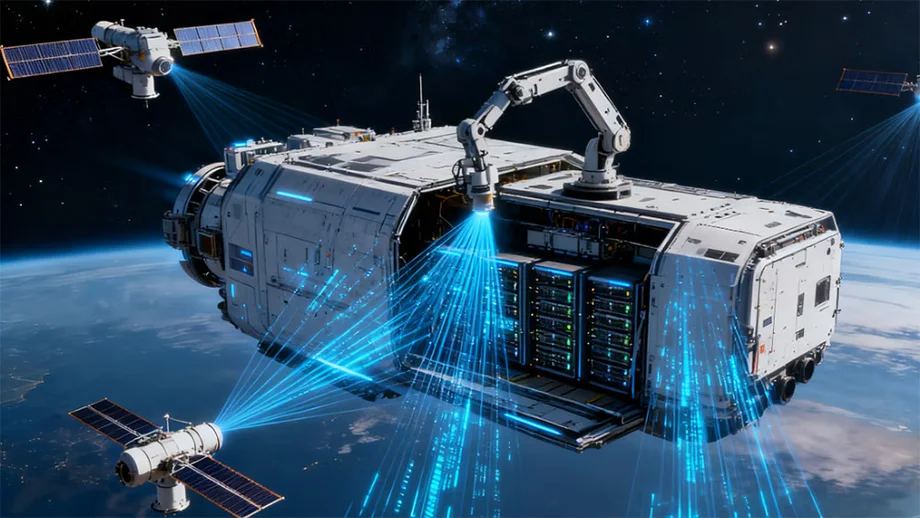
A strategic plan released on November 27, 2025, by the Beijing Municipal Commission of Science and Technology and the Zhongguancun Science City management committee set out the target in numbers. The centres would orbit at 700 to 800 kilometres, each delivering more than 1 gigawatt of computing power and supporting clusters of a million accelerator cards. A single unit is expected to weigh several tons and measure more than 10 metres long, at an estimated cost of 500 million yuan, about $70 million. The architecture has three parts: orbital computing, relay transmission and ground control.
Construction runs in three stages. From 2025 to 2027 the work covers breakthroughs in energy and heat, the launch of test satellites and a 200 kilowatt constellation rated at 1,000 POPS, where one POPS equals 1,000 TOPS, so a million trillion operations per second. From 2028 to 2030 the plan calls for assembly in orbit, lower costs and a second constellation that links Earth, data and sky. From 2031 to 2035 the aim is mass production of satellites and a grid of orbital data centres. That first stage target of 1,000 POPS is 40 times the 25,000 TOPS now flying on Chenguang-1.
Three walls: power, heat and radiation
Star Space Institute engineers describe three obstacles to lifting a large server into space: energy, computing and heat. Energy decides whether the satellite works at all. Chenguang-1 uses a 270 volt bus, the highest voltage flown on a Chinese spacecraft, paired with a newly developed concentrator type solar array. A failure in the first flight of that design would have left the satellite without any power supply.
Heat is the harder problem. There is no air in a vacuum to carry warmth away by convection, so the waste heat from a heavy computing load can only leave as infrared radiation. Chenguang-1 wears what the team calls a heat dissipation coat: a large flexible radiator made of graphene, developed with the Beijing Graphene Research Institute, covering about 40 percent of the satellite's surface and carrying off all the heat produced on board. It is the first use of graphene for cooling a spacecraft.
Radiation is the third check. High energy particles trapped in orbit can flip bits and damage electronics, so the server was hardened against them before launch. Testing started at 10 percent of the computing load and climbed to 100 percent while engineers watched power, computing and cooling together. The 270 volt bus took power at the first attempt, the server ran stably across multiple load conditions and the cooling system met its 6,000 watt target.
The gamble on a first of its kind
Xiao Ru, director of the Space Mission Engineering Center at Star Space Institute, spent the hours after launch watching data come down from 700 kilometres. She describes Chenguang-1 as the first piece of the Beijing Space Data Center and the decision to send a full server into orbit as a risk nobody in China had taken.
No one has tried this before in China, so we must be the first to eat the crab.
The phrase is a Chinese idiom for being the first to try something and accepting the consequences. When the untested power design worked on the first attempt, she said the mood across the ground team lifted.
Success at one time. I was really excited, and everyone was greatly encouraged.
With the hardware proved, the institute ran general and industry specific models on the server. Four professional models and two general large models completed inference in orbit, work that Beijing's science authorities count toward a wider tally of 10 models deployed and verified across two orbital test platforms.
A consortium that grew from 24 to 54
Behind the satellite sits an alliance Star Space Institute leads, assembled with backing from the Beijing Municipal Commission of Science and Technology and the Zhongguancun Management Committee. Those bodies have run open calls for technical proposals around the computing constellation for three consecutive years, a system in China known as posting a challenge and appointing the best team to solve it. Membership went from 24 organisations to 54 within a year, drawing in satellite builders, launchers, operators and battery makers.
Guoke Huanyu, one member, took on the core modules: the liquid cooled space server and its reinforcement, the 270 volt high power supply system and a radiator panel built around a fluid loop. Its general manager Zhang Dongwei said the pairing of universities, which bring research capacity, with companies, which bring engineering, is what shortens development.
The innovation consortium achieves a strong combination. Universities and research institutes have R&D strength, while enterprises have engineering capability. The joint mechanism can play their respective advantages and accelerate the R&D process.
Weilan New Energy, which makes hybrid solid state and all solid state lithium batteries, joined later. Chen Liye, assistant to the chairman, said the safety and wide operating temperature of its cells suit the conditions a space data centre will face.
The safety and wide temperature range of solid state batteries will play an important role in the construction of the space data center.
One big computer room or many small ones
Two technical routes compete in Chinese space computing, and the choice between them shapes everything that follows. Most teams are building distributed constellations of small computing satellites. Star Space Institute wants one integrated platform, with a single unit of at least 100 kilowatts, ending in a gigawatt class computer room in the sky. Xiao Ru set out the difference.
Most teams are tackling the direction of distributed computing power satellites, but what we want to build is an integrated large-scale platform of the space data center, solving the problems of in-orbit reasoning and training of large models, and finally building a gigawatt-class space computer room.
Zhang Shancong, president of the institute, drew the central conclusion from four months of testing.
After more than four months of in orbit testing, one of the most important conclusions is that centralized space data center construction is preliminarily feasible.
The plan names three stages for the project: computing data in space, sending data up from Earth for processing, and finally making space the main computing base. The build uses modular, standardised parts, joined by docking in orbit into a spacecraft measured in square kilometres and sized for training and running very large models.
An engine that reads satellite photographs
The Earth Large Model Engine V0.1, also called SUICE V0.1, made its debut at the conference. It is a tool that lets a general language model answer questions about satellite images, maps and changes over time, which is aimed at making remote sensing data usable by people who are not image specialists. Wen Jun, who leads the Earth model research, explained what the software looks for.
An optical remote sensing picture is just a photo to the naked eye, but the Earth large model can discover a large amount of information in it, such as changes in the same area in different seasons or topographic information of a building.
Satellites collect far more imagery than they can send to the ground, because the radio link to a ground station carries a limited amount of data. Wen Jun said that constraint leaves valuable observations sitting unused.
Current satellite remote sensing data is limited by the return capacity, and a lot of it is sleeping in orbit. If the satellite has strong brain power, more valuable data can be discovered and used.
Yan Zhaoyu, who leads space intelligent business solutions at Baidu Intelligent Cloud, said the approach matters beyond remote sensing.
The Earth large model engine developed by Star Space Institute has opened up a new road for remote sensing to empower artificial intelligence.
Development is at an early stage. The plan is to move from V0.1 to a V1.0 version with working applications, lowering the barrier for industries that want to use satellite data in disaster response, city management and natural resources. Wen Jun wants it running on the satellite itself, so that images can be screened, recognised and reduced to useful facts before they are sent down, which would cut the time needed to react to floods, fires or other fast moving events.
Adaspace's three records and the race it leads
Beijing is not working alone. Adaspace, a Chinese space AI company that listed on the Hong Kong main board as 06935.HK on November 13, 2026, has published results from the first independent tests of its in orbit computing satellites, carried out by the China Academy of Information and Communications Technology. The company claims three world marks: the highest computing power on a single satellite in orbit, the largest AI model fully trained in orbit and the longest stretch of continuous full parameter training inside one orbit.
Its satellite, named Libra, reached a nominal 32 PFLOPS at FP8 precision. PFLOPS measure floating point math and cannot be set directly against the integer TOPS figures used for Chenguang-1. Libra carried out full parameter training and inference of Alibaba's Qwen3-32B model on board, with a single run lasting 45 minutes and 33 seconds while training loss fell steadily. Google has disclosed a test in which a prototype space processor ran at full power for about 15 minutes, limited mainly by heat.
After a second batch of satellites launched from Jiuquan on October 14, 2026, the project's total capacity in orbit reached 50 POPS, equal to 50,000 TOPS and about twice Chenguang-1's rating. A third batch left the production line in November and awaits launch. The long term plan lists 2,800 satellites, 2,400 for inference and 400 for training, targeting about 100,000 P of inference capacity and 1 million P of training capacity.
Money is following the hardware. Revenue from Adaspace's AI computing satellites rose from 78 million yuan in 2024 to 225 million yuan in 2025 and reached 125 million yuan in the first half of 2026, while the segment's gross margin climbed from 7.6 percent to 55.4 percent. As of October 2026 the company held orders for 114 AI satellites worth 3.475 billion yuan. SpaceX and Nvidia are working on the Starmind computing satellite constellation, whose first AI1 satellite is expected in the fourth quarter of 2027, and Adaspace puts its own lead at about 18 months to two years.
What Beijing counts so far
Beijing's tally is wider than one spacecraft. The municipal science commission and the Zhongguancun committee count 39 satellites with intelligent computing capacity in orbit that the city operates or helped develop. Two orbital test platforms for space computing have together carried and verified 10 large models and opened test services to more than 100 users.
The city has placed the space data centre among the priority directions of its 15th Five Year Plan for the Beijing Tianjin Hebei international science and technology innovation centre, and treats it as a lever for commercial aerospace and artificial intelligence. The Beijing Satellite Town, part of a city layout known as South Rocket, North Star, is to be built around the computing constellation. Cai Yongxiang, director of the materials and manufacturing division at the commission, described the next steps.
Beijing will continue to tackle core technologies, strengthen platform coordination, expand aerospace application scenarios, and improve the full-chain innovation ecosystem to provide technical support for space data centre development.
The commission says the city will rely on a national key research and development programme on commercial aerospace technology to support large scale deployment of the constellation, work on guarantees for radio frequency and orbit resources, and build an information infrastructure that combines sensing, communication, computing and intelligence.
How the project got here
- November 27, 2025: Beijing publishes its space data centre plan, with the first test satellite expected to fly by early 2026.
- July 24, 2026, 07:33: Chenguang-1 reaches orbit on a Lijian-1 Y15 rocket with four other satellites from the Dongfeng test zone.
- October 14, 2026: Adaspace's second computing batch launches from Jiuquan and takes its constellation to 50 POPS.
- November 13, 2026: Adaspace lists on the Hong Kong main board.
- November 27, 2026: the orbital test platform opens to outside users, the Earth Large Model Engine V0.1 is shown, and the consortium is confirmed at 54 members.
- 2027: work begins on a follow-on test satellite and on energy, cooling and assembly in orbit.
Beijing's commercial space sector has produced other firsts this year. In January 2026, a humanoid robot in the city carried out [a satellite linked delivery](/news/12291/) at an industrial park, moving a certificate from a driverless vehicle to a building while sending video through a GalaxySpace satellite instead of a mobile network.
What is not yet settled
Star Space Institute has not said when a second satellite will fly or how much computing power it will carry. Zhang Shancong set out the workload for the coming year.
In 2027, the institute will work with consortium members to accelerate development of the second-generation test satellite and research key technologies including energy, heat dissipation, and in-orbit assembly and construction.
No date has been given for the 200 kilowatt constellation that the 2025 plan placed inside the 2025 to 2027 window, and no price has been published for time on the Chenguang-1 platform. The Earth model engine is at version 0.1, with a working V1.0 described as a later step rather than a scheduled release.
Key Points
- Chenguang-1 launched on July 24, 2026 on a Lijian-1 Y15 rocket and has run more than four months in a 700 kilometre dawn-dusk orbit.
- The satellite carries about 25,000 TOPS of Chinese built computing power, the first large server flown by a Chinese team.
- Its 270 volt bus, graphene radiator covering 40 percent of the surface and 6,000 watt cooling system passed testing, along with 66 in orbit test projects.
- The orbital test platform opened to universities, institutes and companies on November 27, 2026, alongside the Earth Large Model Engine V0.1.
- The innovation consortium behind the work grew from 24 to 54 members in a year.
- Beijing counts 39 satellites with intelligent computing capacity, 10 models verified in orbit and more than 100 users served.
- Adaspace reported training Alibaba's Qwen3-32B in orbit for 45 minutes and 33 seconds, with 50 POPS across its constellation.
- Beijing's plan targets 1,000 POPS by 2027 and a gigawatt class orbital computer room by the mid 2030s.