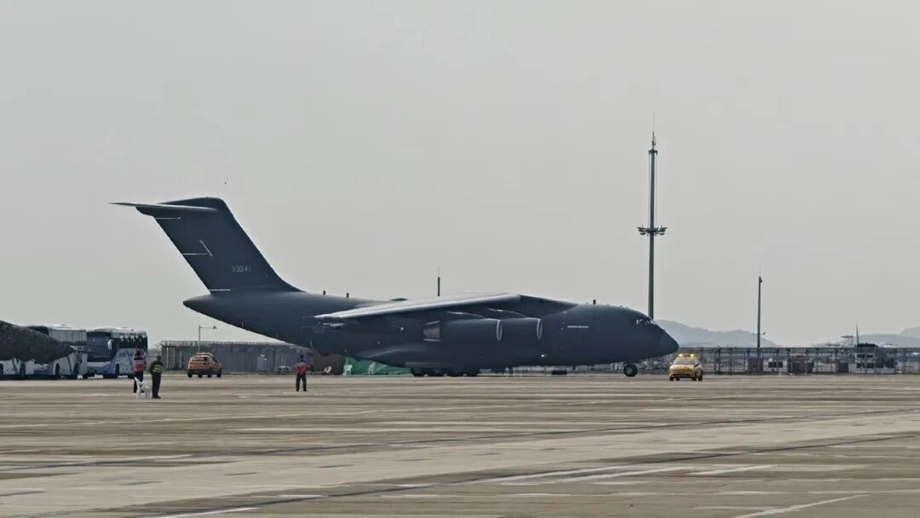
Two Kunpeng transports and their tankers reach Zhuhai
Four aircraft of China's largest homegrown transport family landed at Zhuhai Jinwan Airport on the morning of November 29, 2026: two Y-20B transports and two YY-20A tankers. The airport sits beside the site of the 16th China International Aviation and Aerospace Exhibition, which opens on December 7 and runs to December 13.
Contents
- Two Kunpeng transports and their tankers reach Zhuhai
- What a new engine does for a heavy lifter
- The cargo hold that carries tanks or paratroopers
- A veteran unit returns for a third show
- Radar planes and a workhorse arrive with the transports
- An electronic warfare specialist on its fourth visit
- A navy helicopter makes its public debut
- Stealth fighters and a full carrier air wing
- A bigger show, and the aircraft that stay hidden
- Key Points
For the Y-20B the visit is a debut in three parts. It is the first time the type has appeared at the show, the first time it will fly before an airshow crowd, and the first time its cargo hold will be opened to visitors. The aircraft is the re-engined version of the Y-20A, the heavy lifter that gave the Air Force its first large strategic transport and now carries much of its long distance freight and troop movement.
Chinese aviation followers call the family Fat Girl, a nickname that has followed the aircraft since the first Y-20 flew, and its formal name comes from the Kunpeng, a giant bird of Chinese myth. The Air Force is bringing 33 types and more than 60 pieces of equipment to this year's show, split between flying displays and ground exhibits. Of the two Y-20B aircraft that arrived, one will fly and one will stand on static display, the same arrangement used for the tankers.
Strategic airlift means moving troops, vehicles and supplies across continents without depending on ports or roads. Aircraft that can do it give a government the ability to reinforce distant forces, deliver disaster relief or carry out evacuations at short notice, which is why heavy transports are watched as closely as fighters.
What a new engine does for a heavy lifter
The change that defines the Y-20B sits in the engine pods. Earlier aircraft flew with Russian engines, and the B model replaces them with a Chinese turbofan identified in Chinese reporting as the WS-20.
Bypass ratio compares the air that flows around an engine's hot core with the air driven through it. Engines with a large ratio move more air at lower speed, which usually brings better fuel economy and stronger thrust at the speeds a transport actually flies. The WS-20's higher ratio and improved fuel burn are credited with raising the Y-20B's maximum takeoff weight and maximum range, giving the aircraft the mix of long range, heavy payload and higher cruising speed that strategic delivery work requires.
No thrust, payload or range figures have been published for the Y-20B, and no date has been given for releasing them.
Visitors will be able to tell the models apart by eye. Military commentator Du Wenlong offered what he called the simplest test: park a Y-20 and a Y-20B side by side, and the aircraft with the visibly wider engine nacelles, the casings around the engines, is the newer one.
Chinese aviation has spent two decades trying to end its reliance on imported powerplants for large aircraft. A transport that flies on domestic engines can be built, maintained and upgraded without waiting on a foreign supplier, and its engine can be developed further for civilian freighters and other large aircraft.
The YY-20A tankers that landed alongside the transports serve a different purpose. Refuelling in the air extends how long fighters and bombers can stay on station and how far they can reach, because an aircraft can take off with less fuel and top up once airborne. The YY-20A can also carry out the same strategic delivery tasks as the plain Y-20, so a single airframe covers two roles.
The cargo hold that carries tanks or paratroopers
The Y-20B's hold measures roughly 400 to 500 cubic metres, room enough to swallow a formed unit of tanks and infantry fighting vehicles rather than a few vehicles at a time. The hold is built to change shape. Freight, paratrooper and two level layouts let a crew load vehicles on the lower deck and people above, which raises the amount of equipment that can travel in a single sortie.
On the ground, the Air Force will display the transport in configurations for moving personnel and for parachute drops. In the air, the routine has been built around combat practice, with a climb at a steep angle and steeply banked turns, manoeuvres that show how quickly a very large aircraft can gain height and change direction when it arrives over a drop zone or a short runway.
Zhao Yingkun, a Y-20B pilot with the Air Force aviation unit taking part, described what the public will see.
At this airshow the Y-20B and the YY-20A appear on the same stage. The Y-20B is taking part for the first time, making its first public flight display and opening its cargo hold for display for the first time. The static display will present several configurations, including personnel transport and parachute drop, and the flight display is designed close to real operations.
A veteran unit returns for a third show
The unit that sent the aircraft to Zhuhai is the first transport aviation unit raised by the People's Liberation Army Air Force, and this is its third appearance at the China Airshow. Its aircraft have flown missions that include bringing home the remains of Chinese People's Volunteers soldiers from South Korea, airlift work abroad and flypasts for national parades.
The Air Force says the unit's aircraft, known by the phrase Iron Wing Kunpeng, have reached dozens of countries across Asia, Africa, Europe and Oceania and have landed at more than 100 airports at home and abroad.
Zhao framed the display as a message about confidence in the aircraft and the people who fly it.
Through the China Airshow we want the public to understand the People's Air Force and the Y-20 better. We will prove with actions that when the people put the aircraft in our hands, we can fly with confidence, with responsibility and with combat power.
The crew will fly one training session to adjust to local airspace and airport conditions before the show opens, followed by several display sorties.
Radar planes and a workhorse arrive with the transports
A KJ-500A early warning aircraft also flew into Zhuhai on November 29 and will anchor the early warning and air defence section of the static display area. Early warning aircraft carry a large radar high above the battlefield and act as flying command posts, spotting aircraft and ships far beyond the reach of radars on the ground and steering fighters onto them.
The KJ-500A is a medium sized type developed in China, and the Air Force says its performance in early warning command and in operations far out at sea is markedly better than that of the earlier KJ-500, which the new aircraft is meant to succeed in front line service.
A Y-9 transport touched down at about 10am for the ground static display, adding a smaller tactical lifter to the line of aircraft on the tarmac. Together the arrivals sketch out the layers of Chinese air power on show: aircraft that carry, aircraft that refuel, aircraft that watch and aircraft that listen.
An electronic warfare specialist on its fourth visit
The J-16D electronic warfare aircraft landed at Jinwan on the same morning and will take part in the ground static display. It is the fourth time the type has appeared at the China Airshow since it was first shown publicly at the 13th edition in 2021.
Electronic warfare attacks the invisible layer of modern combat: radars, radio links and navigation signals. Jamming can drown an enemy radar in noise, while receivers can locate a transmitter so that it can be attacked or avoided. The J-16D is built on the airframe of the J-16 fighter and is described by the Air Force as combining reconnaissance, attack and defence in one aircraft, able to work against air defence systems assembled from early warning radars, command communications and interceptors.
Xiong Yiyu, a member of the Air Force aviation unit involved, explained the aircraft's role and the decision to show it on the ground rather than in the air.
The J-16D is our country's newest generation of electronic warfare aircraft and plays an important role in modern air combat. Everyone affectionately calls it the air magician. It is mainly a ground static display, and through close contact with audiences at home and abroad it shows the openness and confidence of the Chinese Air Force. We also hope to show the spirit of airmen of the new era, who are devoted to the sky and to winning.
A navy helicopter makes its public debut
The naval branch of the show began early. A Z-20F shipborne anti-submarine helicopter arrived at Zhuhai for its first public appearance, and it will be shown on the ground during the exhibition.
The Z-20F can be carried on destroyers, frigates and other large and medium sized warships. Its tasks include hunting submarines and providing long range target information for the missiles of the ship it flies from, and it can be armed with several types of torpedoes. A helicopter of this kind extends a warship's reach underwater, because a frigate's sonar and torpedoes work over distances far shorter than a helicopter can cover.
Stealth fighters and a full carrier air wing
A J-35A stealth fighter landed in Zhuhai on November 28 and will make its first appearance in a static display, giving visitors a close look at the airframe of a low observable aircraft. Stealth is not invisibility. It is a combination of shape and materials that reduces the radar and infrared signals an aircraft gives off, which makes it harder for defenders to detect and track in time to fire at it.
The J-20A, the upgraded version of China's larger stealth fighter, will make its first flying display at the show, after the type was shown publicly at the Beijing parade in September 2025. The navy's carrier aircraft will fly in formation: the J-35 stealth fighter, the J-15T fighter, the KJ-600 fixed wing early warning aircraft, and the Jiao-15 trainer along with Z-20J and Z-8C helicopters. Their routines include formation flight, airfield pass flights and an exercise simulating an attack on an airfield.
The KJ-600 is the first carrier based fixed wing early warning aircraft developed in China, designed to launch by catapult from the Fujian and recover by arresting wire. It carries a large radar with folding wings and a four fin tail and supplies the carrier group with air warning, a picture of the sea and air situation and long range target information. The J-15T can take off from carriers with catapults or ski jumps, so it can serve on both kinds of ship.
Du Wenlong said grouping the three main carrier aircraft together is intended to show a working system rather than three machines.
This concentrated appearance is meant to show, through the KJ-600, the J-35 and the J-15T, the complete system capability of naval carrier aviation. The KJ-600 can serve as the core of a formation, detecting targets and guiding the formation's attack. The J-35 and the J-15T form a combat pairing, stealth and non stealth combined. If the three main carrier aircraft fly in one formation, the intelligence capability over the sea, the command capability, the anti-ship attack capability, including land attack, and the air control capability all improve qualitatively.
Three aerobatic teams will share the sky: the Chinese Air Force's Bayi team, the Russian Knights of the Russian aerospace forces and the Knights of the United Arab Emirates Air Force.
A bigger show, and the aircraft that stay hidden
Organisers expect more than 1,100 exhibitors from over 50 countries and regions, with more than 3,000 items of equipment on show. About one in ten of those exhibits is being displayed publicly for the first time, and more than 170 aircraft will take part. Indoor exhibition space reaches nearly 150,000 square metres, and the outdoor display and support area has grown to 335,000 square metres.
The exhibition uses a layout organisers describe as one show, three zones: the main hall at the airshow centre, a zone at Lianzhou for unmanned equipment and a coastal zone at Gaolan where real warships are open to visitors. The naval vessels include a Type 055 destroyer, a Type 054A frigate and a Type 075 amphibious assault ship. The Army's ground equipment, among it the VT-4B tank and an uncrewed combat vehicle, fills out the land side of the event.
Two categories that outside observers watch closely will not appear. The H-20 stealth strategic bomber and the tailless demonstrator aircraft that Western reporting has labelled the J-36 and J-50 are absent from the published programme, which leaves the questions of when they will fly in public and when they will enter service open.
- November 23, 2026: the Navy publishes its carrier aircraft lineup.
- November 26: the Air Force announces a programme of 33 types and more than 60 items.
- November 27: the Army sets out its ground equipment.
- November 28: a J-35A stealth fighter lands in Zhuhai for its first static display.
- November 29: two Y-20B transports, two YY-20A tankers, a Y-9, a KJ-500A, a J-16D and a Z-20F arrive.
- November 30: J-16 and J-10C fighters and the Bayi Aerobatic Team are due at Jinwan.
- December 7: the 16th China Airshow opens. It runs to December 13, with public visiting days from December 11 to 13.
Key Points
- Two Y-20B transports and two YY-20A tankers landed at Zhuhai Jinwan Airport on November 29, 2026.
- The Y-20B makes its airshow debut at the 16th China Airshow, with its first public flying display and its cargo hold open to visitors.
- The aircraft swaps Russian engines for the Chinese WS-20, which has a higher bypass ratio, better fuel economy and more thrust.
- Its hold measures about 400 to 500 cubic metres and can be rearranged for freight, paratroopers or two level loads of vehicles and troops.
- Pilot Zhao Yingkun said the flight display is designed close to real operations, with a steep climb and steeply banked turns.
- The J-16D appears at the show for the fourth time since 2021 and will be displayed on the ground.
- The KJ-500A, a Y-9 transport and the naval Z-20F helicopter, making its first public appearance, also arrived on November 29.
- The show runs from December 7 to 13, with more than 1,100 exhibitors, over 170 aircraft and real warships on display.
- The H-20 bomber and tailless demonstrator aircraft are not on the public programme.