Focus becomes the throttle in a Guangzhou classroom
Students at Harrow International School Guangzhou spent the opening day of their new innovation centre driving toy racing cars with their attention. Each wore an EEG headset, a band of electrodes that picks up the faint electrical signals the brain produces, and the car sped up as the wearer held steady focus and slowed when concentration slipped. Another group pulled on sensing gloves and used signals from their own thoughts to open and close a bionic hand.
Contents
- Focus becomes the throttle in a Guangzhou classroom
- Why one sentence was enough for AISL's chief executive
- What students are actually asked to build
- A decade of one product line, and a school group's four pillars
- The balance sheet that arrives with the headsets
- Guangdong puts numbers on the ambition
- Why Huangpu, and why a school inside a technology park
- How large the market is meant to become
- What is still open
- Key Points
The hardware is staying. Asia International School Limited, the group behind Harrow's international schools in Asia, opened its first flagship innovation technology centre, the AISL Future Lab, on the Guangzhou campus and signed a strategic cooperation memorandum with BrainCo, a Chinese company that builds brain-computer interfaces. Headsets, bionic limbs and a curriculum written by both sides are now part of scheduled lessons.
The course is called IDEA, short for Innovation Design and Engineering Application, and it runs from primary school through high school, with tools and tasks matched to each age group. BrainCo describes it as the company's first deep strategic partnership with a school group in the international school sector.
What the launch puts on the table is a question schools rarely answer with equipment. If grades are not the only measure of a child, what else belongs on the timetable? AISL's answer arrives in hardware, in a curriculum, and in a provincial industrial plan that names education among the fields where brain-computer interfaces are meant to spread, alongside elderly care, transport and entertainment.
Why one sentence was enough for AISL's chief executive
Wen Guowei, AISL's group chief executive, came to education after more than 25 years in engineering and finance and does not treat the move as a change of field. The families the group serves are the same Chinese families he worked with before, he said in an interview, and the questions they bring are the same ones about how a child grows up.
His worry about the education market is that academic results have become the only yardstick by which a school is judged.
Academic results are in fact one of the results of whole person character development, not the only outcome we want.
What he wants schools to add is a set of habits: leadership, the capacity to innovate, and the willingness to try something, fail and try again. Knowledge on its own he treats as insufficient.
We need to develop children's leadership, their ability to innovate and their ability to learn from mistakes, so that they dare to use what they have learned to solve problems in society and bring people better lives.
BrainCo entered the picture through that argument rather than through a product catalogue. Its first device was built for people who had lost hand function, and the company says its technology has helped more than 10,000 people with limb disabilities fit prosthetics and recover a measure of independence. Wen's reasoning was that Harrow's pupils will need the same instinct, turning what they learn into answers for real needs.
He remembers the first meeting as unusually short. The opening line, he said, was that the two sides had to work together, and the match of values made the rest quick. He described the rapport as one of meeting too late, with almost no hesitation between agreeing to cooperate and putting a course in front of students.
What students are actually asked to build
The structure separates this deal from the usual arrangement between a school and a technology company, which tends to run through paid activities after lessons finish.
With BrainCo it is a completely different matter. We have integrated it deeply into the curriculum.
Classroom work is organised around projects rather than demonstrations. Students are asked to design adaptations to assistive devices for named users, to use EEG readings to examine how attention and cognition behave, to build working assistive tools, and then to present the results to engineers and to disability rights advocates. The last step matters as much as the first, because it forces a class to argue about human-machine interaction and about the ethics of reading signals from a person's head.
Xu Zhiwen, deputy director of BrainCo's education research institute, framed the ambition in terms of who ends up holding the technology.
We want to train creators of technology, not just its users, and designers of the future, not just its participants.
Wen sets the bar lower for individual pupils. They do not need to become brain specialists, he said. They need the nerve to experiment and the habit of taking a large problem apart, testing one piece of it by hand, and learning from what the test shows.
A decade of one product line, and a school group's four pillars
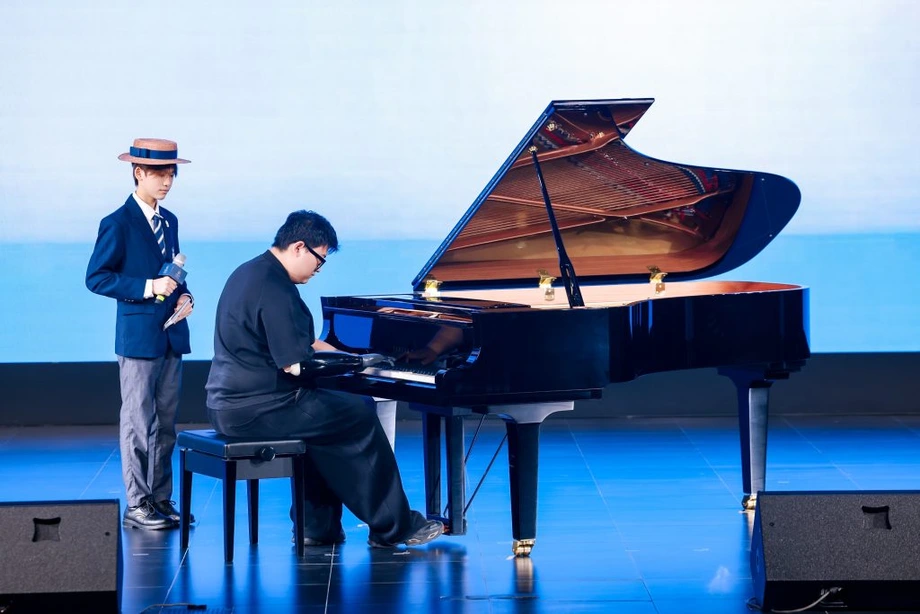
Zhang Shengnan, a vice president and founding member of BrainCo, said the company has done one thing in ten years: carrying brain-computer interfaces out of laboratories and into ordinary life. People who lost their hands now write and play the piano through intention, she said, and children who could not speak gradually begin to.
On the school side, Ahmed Hussain, AISL's chief education officer, treats the lab as a step toward what the group calls Future Ready Education. Education, in his framing, is about the person a student becomes rather than a sheet of results. The group organises that around four dimensions, values and character, character and wellbeing, knowledge and critical thinking, and digital literacy with technical capability, and builds them through academic excellence, individual growth pathways, a programme called Digital Futures and the AISL Harrow Diploma.
Those pillars explain why a school group would buy EEG equipment at all. A diploma that rewards sustained projects needs somewhere for students to run a real one, and a device that turns a mental state into visible data gives a 12 year old something to measure and argue about.
The balance sheet that arrives with the headsets
BrainCo was founded in 2015 and was the first Chinese team selected for Harvard University's innovation laboratory. It became the first unicorn in China's brain-computer interface field. The company has raised $500 million in total, which places it with Neuralink, Elon Musk's company, as one of the two best funded brain-computer interface firms in the world, one leading the non-invasive route and the other the invasive one. It also says it was the first company anywhere to mass produce and sell such devices at scale.
- 2015: BrainCo founded, later the first Chinese team admitted to the Harvard innovation laboratory.
- 2025: revenue of 321 million yuan.
- January 2026: a pre-IPO round of about 2 billion yuan led by IDG and Walden International, with Lens Technology and Will Semiconductor joining as strategic investors, at a valuation of roughly 8 billion yuan.
- June 5, 2026: Guangdong's five year plan for the sector is issued.
- July 2026: the Greater Bay Area brain-computer interface industry alliance is set up in Guangzhou.
- November 3, 2026: registered capital raised to 750 million yuan.
The product line has widened past rehabilitation. BrainCo's smart bionic hand has won market clearance from the US Food and Drug Administration, makers of humanoid robots buy its dexterous hands for embodied intelligence work, and the business now reaches into neuromodulation, health management and factory settings. A 2 billion yuan funding round against 321 million yuan of 2025 revenue puts the January valuation at roughly 25 times sales.
Guangdong puts numbers on the ambition
Policy in Guangzhou has moved in the same direction. The Office of the Science and Technology Commission of the Communist Party of China Guangdong Provincial Committee issued the provincial action plan on June 5, 2026, covering 2026 to 2030, and set out what success should look like by the end of the decade: 100 new brain-computer interface technology companies, a batch of unicorns with real competitiveness, more than 10 hit products in the non-invasive category, several invasive products through clinical trials and holding medical device registration certificates, 200 brain-computer interface wards in hospitals serving more than 500,000 patient visits, and a core industry worth 10 billion yuan with 100 billion yuan of activity across supplier and customer industries.
An earlier checkpoint falls in 2027. By then the province wants breakthroughs in core technology, work on more than five major brain diseases that maps neural circuits and the mechanisms that control them, systems for screening, assessment, intervention and rehabilitation, and at least 10 backbone companies, with clusters in Guangzhou and Shenzhen taking shape.
The plan divides the work by geography. Shenzhen, drawing on the brain analysis and simulation facility at Guangming Science City, is to build a cluster for brain science and brain engineering with a focus on invasive devices and the decoding of neural signals, covering materials, components, systems and integration. Guangzhou, with Haizhu and Tianhe as the two cores of a "Guangzhou Brain Valley" pilot zone, is to concentrate on non-invasive systems and on the chain from clinic to incubation to consumer products. Zhuhai, Dongguan, Foshan and Huizhou are to supply biomedical materials, precision sensors and equipment parts.
Five strands run through the document, labelled in the plan as innovation sources, platform foundations, integrated applications, cluster upgrading and ecosystem support. Two details matter for a school. Education is listed among the sectors for "brain plus" applications, and the plan calls for a working mechanism for ethical review of brain-computer interface research, with mutual recognition of reviews between institutions.
Why Huangpu, and why a school inside a technology park
Harrow's Guangzhou campus sits in Huangpu district, the core of the city's high tech industrial zone, with biomedical and precision manufacturing supply chains around it. Wen treats that address as part of the syllabus.
We put Harrow Guangzhou in the technology park because a large number of technology companies are gathered nearby, and the Huangpu district government has clear ideas about future industries.
Pupils can handle a headset in a classroom and then walk out of the gate into the industry that makes them, he argues, so the wall between lesson and factory thins. Guangzhou has reinforced the surrounding ecosystem this year. The Greater Bay Area alliance formed in July brings universities, hospitals and companies into one body, and the city is assembling a 200 billion yuan science and technology innovation fund aimed at seed stage projects inside the pilot zone, under the label of a Bay Area Brain Valley.
How large the market is meant to become
Independent forecasts give the commercial case a size. Precedence Research estimates the global brain-computer interface market at $2.94 billion in 2025 and expects it to grow at a compound annual rate of 16.77% through 2035. The China Academy of Information and Communications Technology projects that the country's own industry will reach 10 billion to 14 billion yuan by 2030.
Set those figures side by side and Guangdong's target looks large. Its core industry goal of 10 billion yuan by 2030 is roughly the size of the whole Chinese market that the academy forecasts for that year, before the 100 billion yuan of related supplier and customer activity is counted. For a sector still measured in single digit billions worldwide, the province is betting on a steep curve.
What is still open
AISL has not said how many students are in the first cohort, when the IDEA course will reach its other Harrow schools in Asia, or what the lab and the equipment cost. BrainCo has not disclosed which grades take the course as a required subject and which take it as an option. The action plan leaves the medical ethics rules to be written, with reviews to be recognised across institutions, and sets 2027 as the first public checkpoint on the technology targets.
For the pupils in Huangpu, the near term test is simpler than any of that. A headset either holds a child's attention long enough to finish a device a real user can wear, or it does not. The school has made that test part of the timetable, and the province has made the industry around it a target with a date attached.
Key Points
- AISL opened its first AISL Future Lab at Harrow International School Guangzhou and signed a strategic cooperation memorandum with BrainCo, a Chinese brain-computer interface company.
- EEG headsets, bionic hands and a joint curriculum called IDEA now run from primary through high school, integrated into lessons rather than sold as an after school activity.
- AISL chief executive Wen Guowei said academic results are one outcome of character development, not the only measure of a school.
- BrainCo was founded in 2015, has raised $500 million and reached a valuation of about 8 billion yuan in a January 2026 pre-IPO round, on 2025 revenue of 321 million yuan.
- Guangdong's 2026-2030 action plan targets 100 new brain-computer interface companies, 200 hospital wards and a 10 billion yuan core industry by 2030, with Guangzhou leading non-invasive work and Shenzhen invasive devices.
- Precedence Research puts the global market at $2.94 billion in 2025, growing 16.77% a year to 2035, while the China Academy of Information and Communications Technology expects 10 billion to 14 billion yuan of Chinese industry by 2030.
- Student projects include building assistive devices for real users and defending the results to engineers and disability rights advocates.
- Ethics review rules, enrolment numbers and the cost of the lab have not been made public.