A 700 Billion Won Bet on Small Reactor Parts
South Korea's state lender, the Export-Import Bank of Korea, will provide 700 billion won (about $524.8 million) to help Doosan Enerbility build a factory that makes small modular reactors, or SMRs. The bank announced the financing on November 29, 2026. The plant will sit at Doosan's Changwon site in South Gyeongsang Province and will be dedicated to producing SMR equipment.
Contents
- A 700 Billion Won Bet on Small Reactor Parts
- What Is a Small Modular Reactor?
- How the 700 Billion Won Is Split
- What the Changwon Plant Will Do
- Why the NuScale Numbers Are Disputed
- South Korea Changes Its Laws for Small Reactors
- Three Korean Reactor Designs Are Moving Forward
- How the Story Built Up
- What Comes Next and What Is Still Open
- Key Points
Doosan says the new plant, equipped with advanced manufacturing machines, will lift its SMR output from 12 units a year to 20. Total investment in the project will reach 806.8 billion won (about $604.8 million) by June 2031.
The financing arrives as power demand climbs. Artificial intelligence data centers are pulling more electricity from the grid, and governments want power that produces no carbon. The bank's move aims to secure domestic production capacity before competition for SMR orders heats up.
What Is a Small Modular Reactor?
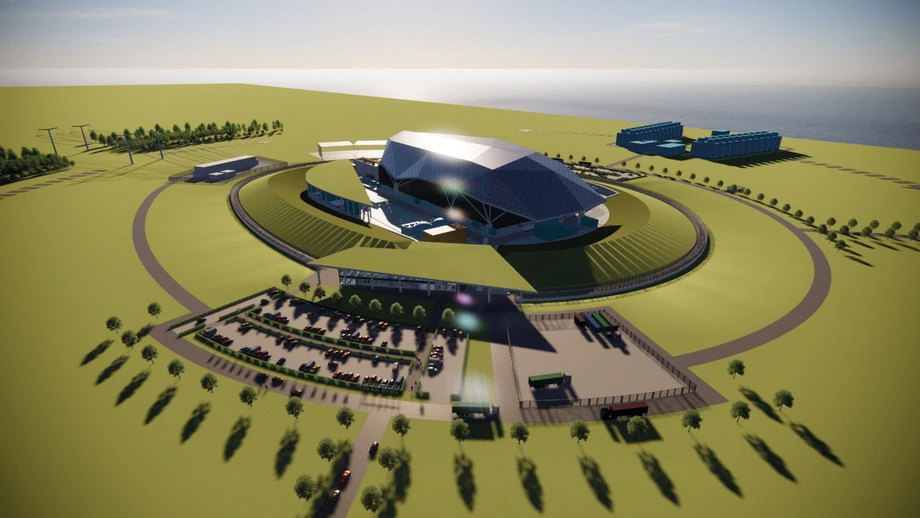
A nuclear reactor makes heat by splitting atoms, and that heat turns water into steam that spins a turbine to generate electricity. An SMR does the same job with less output than a large nuclear plant. Its key feature is modularity: its parts are made in a factory, shipped in modules and assembled on site. That is why a factory producing those modules matters so much.
Demand is driving the interest. The sources name three forces: rising electricity demand, the push for carbon neutrality, and the spread of AI data centers. Market research firm Straits Research projects the global SMR market will rise from $8.18 billion in 2026 to $16.42 billion in 2034, roughly doubling in eight years, an increase of about $8.24 billion.
How the 700 Billion Won Is Split
The financing uses what the bank calls the K-Finance package, which mixes two sources. The bank will supply 120 billion won (about $90.0 million) from its own export financing, about 17 percent of the total. The other 580 billion won (about $434.8 million), roughly 83 percent, comes from the Supply Chain Stabilization Fund that the bank manages.
The government created that fund at the bank in 2024 to respond to the restructuring of global supply chains and other external uncertainties. Supply chains are the networks of factories, suppliers and shipping routes that deliver parts to the maker of a finished product.
The loan also builds on an earlier deal. In April, the bank and Doosan Group signed a memorandum of understanding, an agreement to work together, pledging 5 trillion won (about $3.7 billion) in financing to Doosan Group by the end of 2028. The 700 billion won is about 14 percent of that pledge.
What the Changwon Plant Will Do
Doosan will build a dedicated SMR factory at its Changwon site and install advanced manufacturing equipment. Once the plant is finished, output will rise from 12 units a year to 20, which is eight more units and an increase of more than 66 percent.
The total project cost of 806.8 billion won leaves about 106.8 billion won beyond the bank's 700 billion won, or about 13 percent. The sources do not say where that remaining amount will come from.
Timing will take a while. The sources say the plant and its equipment will take several years to complete, so revenue from the new capacity will come later. Doosan already has overseas links. It has signed contracts to manufacture major SMR components with the US companies NuScale Power, X-energy and TerraPower. In May, it was selected as a strategic partner to produce key components for Rolls-Royce SMR in the United Kingdom.
Why the NuScale Numbers Are Disputed
Doosan's US business is the most contested part of the story. A May 2024 report said Doosan was set to supply $1.46 billion in reactor equipment to NuScale Power, a US developer of SMRs. The same report tied the deal to a larger order, reportedly worth $37 billion, to supply 24 SMRs to Standard Power, a US information technology infrastructure firm. The plan called for 12 SMRs in Ohio and 12 in Pennsylvania. Each site would use 12 of NuScale's 77 MWe units, or 924 MWe per data center, for about 1,848 MWe in all, nearly 2 GWe.
NuScale's spokesperson, speaking in a press statement, challenged the size of the order and the number of reactors. The spokesperson said:
While we do anticipate a substantial order, the precise numbers appear to be based on a vague estimate.
The spokesperson also said a single data center building can house up to 12 SMRs, so two buildings would not automatically hold 24. The sources say it is not clear whether the two companies have agreed on a term sheet, a preliminary outline of deal terms.
Doosan's shares rose more than 16% after the report. The 2024 report expected an announcement of the Standard Power deal within a few weeks, but the sources do not say whether that announcement was made.
Doosan's ties to NuScale go back years. The two companies announced a $44 million strategic cooperation in April 2019. In 2021, Doosan invested another $60 million in NuScale and won an exclusive right to build core SMR equipment for the US firm. According to the 2024 report, Doosan also planned to spend $219 million to expand and upgrade its production facilities by the end of 2025.
South Korea Changes Its Laws for Small Reactors
The government's backing rests on a new law. The National Assembly passed the Special Act on the Promotion and Support of Small Modular Reactor Development, known as the SMR Special Act. The sources do not give the vote date, but they say the bill had been stalled for two years before passage. The law requires the government to write a Basic Plan for SMR System Development every five years, covering research, funding and building an industry ecosystem. A new SMR Development Promotion Committee, placed under the Nuclear Promotion Committee, will review major SMR decisions.
The act also allows SMR Special Zones, where universities, research institutes and other groups can work together to speed up technology development. The Ministry of Science and ICT plans to invest 1.2 trillion won ($831.5 million) by 2030 in core designs for three domestic reactor types. South Korea aims to deploy about 700 MWe of SMR capacity by 2035 under its 11th Basic Power Supply Plan.
Regulation comes next. The Nuclear Safety and Security Commission, or NSSC, announced the same day that it will build a new regulatory framework for SMRs, phased in over five years until 2030. Instead of applying detailed technical rules to every design, the NSSC will focus on core safety functions and requirements.
Professor Jeong Bum-jin of the Department of Nuclear Engineering at Kyung Hee University welcomed the law as proof of the government's commitment to nuclear power. He said that if large reactor rules are applied to small projects, they would take excessive time and money. He also said:
We must acknowledge SMR safety and relax overly stringent regulations.
Three Korean Reactor Designs Are Moving Forward
South Korea is developing three main domestic designs. All three are pressurized water reactors, which keep water under high pressure so it can carry heat from the core without boiling. Their progress varies:
- i-SMR, a 170 MWe integral design led by the Innovative Small Modular Reactor Development Agency with Korea Hydro & Nuclear Power and the Korea Atomic Energy Research Institute, is preparing a Standard Design Approval application to the NSSC. It aims for approval in 2028, construction permits in the early 2030s and commercial operation in 2035.
- SMART100, a 100 to 110 MWe design from the Korea Atomic Energy Research Institute, received NSSC design approval in September 2024. Its export push targets 2029 to 2030 for the first commercial unit in overseas markets, with licensing work for projects in Canada and commercial plans in Saudi Arabia.
- BANDI-60, a 60 MWe block design from KEPCO Engineering & Construction, targets marine systems and remote communities. Its licensing is set for 2027 to 2030, with fabrication starting in 2031.
Doosan, Samsung Heavy Industries and HD Hyundai also help build international designs from NuScale and TerraPower. HD Korea Shipbuilding & Offshore Engineering is developing molten salt reactors for ship propulsion, and Hyundai Engineering & Construction is partnering with the US company Holtec on SMR projects, including the Palisades plant in the US.
How the Story Built Up
- April 2019: Doosan and NuScale announce a $44 million strategic cooperation.
- 2021: Doosan invests another $60 million in NuScale.
- March 2023: The Export-Import Bank of Korea and NuScale sign an MOU on financing SMR deployment.
- October 2023: NuScale announces its 24 SMR project for two US data centers.
- November 2023: NuScale's six-SMR project for UAMPS in Idaho is terminated because costs rose too fast.
- May 2024: A report puts Doosan's equipment deal with NuScale at $1.46 billion, and NuScale disputes its scale.
- 2024: The government sets up the Supply Chain Stabilization Fund at the bank.
- September 2024: SMART100 receives NSSC design approval.
- April 2026: The bank and Doosan Group agree on 5 trillion won in financing through 2028.
- May 2026: Doosan is selected as a strategic partner for Rolls-Royce SMR.
- August 2026: The government lists SMRs among its seven future growth engines, called SEED.
- November 29, 2026: The bank announces 700 billion won for the Changwon plant.
What Comes Next and What Is Still Open
The coming years bring several set dates. BANDI-60 goes through licensing from 2027 to 2030, and the NSSC's regulatory reform is due by 2030. The i-SMR aims for design approval in 2028 and commercial operation in 2035, the same year South Korea targets 700 MWe of SMR capacity. The bank's pledge of 5 trillion won to Doosan Group runs through the end of 2028. The Changwon factory and its total investment are due by June 2031.
Some questions remain open. The sources do not say when the Standard Power order will be signed, whether NRC approval of NuScale's 77 MWe design was granted, or where the remaining 106.8 billion won of the Changwon project will come from.
Key Points
- The Export-Import Bank of Korea will provide 700 billion won for Doosan's Changwon SMR plant, announced November 29, 2026.
- The bank contributes 120 billion won directly, and 580 billion won comes from the Supply Chain Stabilization Fund.
- SMR output at the plant will rise from 12 to 20 units a year, an increase of more than 66 percent.
- Total project investment is 806.8 billion won by June 2031.
- The SMR Special Act passed, with a Basic Plan due every five years and a new NSSC framework until 2030.
- South Korea targets about 700 MWe of SMR capacity by 2035.
- The NuScale deal reported at $1.46 billion is disputed by NuScale, which says the scale is overstated.