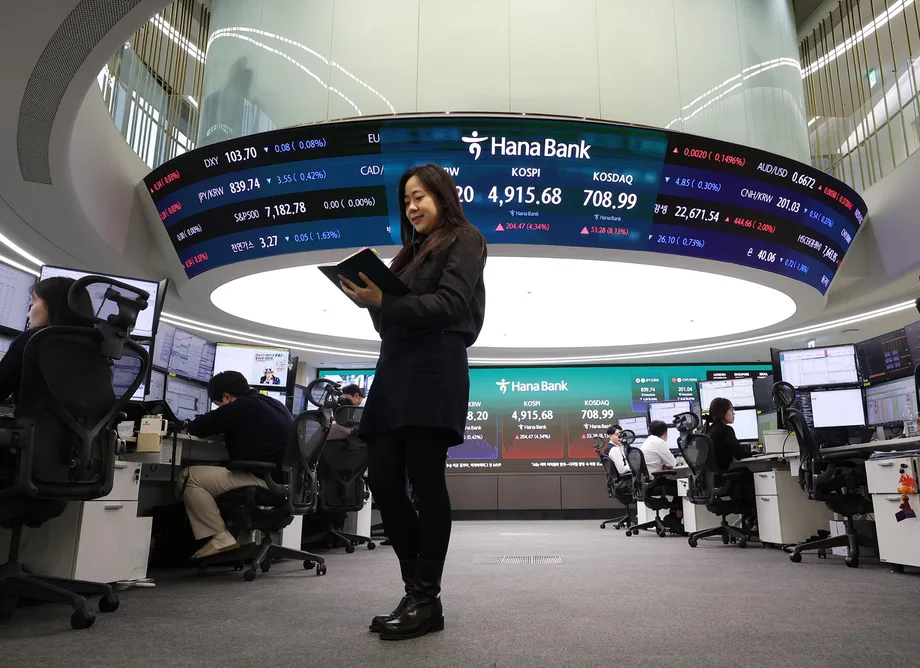
A 14.22% Monthly Fall, 18 Times the G20 Average
South Korea's benchmark Kospi closed at 4,915.68 on Nov. 27, down 815.06 points from 5,730.74 at the end of October, a monthly loss of 14.22%. The average November return across 19 national indexes of Group of 20 economies was a decline of 0.76%, so Seoul's fall was more than 18 times the average. The index would need to rise 16.6% from that close to regain its end-October level.
Contents
- A 14.22% Monthly Fall, 18 Times the G20 Average
- Two Chipmakers Now Fill Almost Half the Index
- What the Bank of England Found in the Weightings
- From 9,385 to 4,672 in Five Months
- The Pension Fund That Rode the Rally Down
- Foreign Selling Meets Thin Buying
- A Market Priced at Three Times Forward Earnings
- Seven in Ten Investors Are Underwater
- Seoul's Answer: A Bigger Stabilization Fund
- Why the AI Question Reaches Beyond Seoul
- Key Points
The ranking has a mirror image. India's Nifty50 gained 11.08% during the month, the only benchmark in the group with a double digit rise, helped by a market where financial companies carry a 37.13% weight. Japan's Nikkei 225 added 7.23%. In the United States, the S&P 500 fell 3.73% and the Nasdaq Composite 5.14%, while Britain's FTSE 100 slipped 0.29%. Outside the G20, Taiwan's TAIEX lost 13.06%.
Then come the swings. The standard deviation of the Kospi's daily percentage moves in November was 3.71%, the highest of the 19 indexes. A standard deviation measures how widely daily results scatter around their average, so a bigger number means larger jumps from one session to the next. Across the full year, the Kospi's figure was 3.81%. The Nikkei 225 delivered almost the same year-to-date return, 16.63% against 16.65%, with a standard deviation of 1.99%.
Two Chipmakers Now Fill Almost Half the Index
Samsung Electronics and SK Hynix, the memory chip makers at the center of the AI supply chain, held about 45% of the Kospi's market capitalization in late November, up from 34% at the end of last year. Their combined weight peaked near 59%, roughly double their share in June last year. Industry estimates attribute nearly 70% of the index's fall from its high to those two stocks.
Concentration turns ordinary sessions into violent ones. On Nov. 25 Samsung fell 9.87% and SK Hynix 11.05% as the Kospi dropped 6.16% to 4,697.51. A day later the pair rose 0.35% to 171,300 won and 2.23% to 1.05 million won, and the index added 0.29% to 4,711.21 on trade worth 16.2 trillion won ($12.1 billion).
Kim Jun-seok, a senior research fellow at the Capital Market Research Institute, measured how much of the turbulence comes from the two shares.
About one third of the increase in Kospi volatility can be assessed as coming from the increased volatility of Samsung Electronics and SK Hynix.
Memory chips hold data for computers, and the high bandwidth memory used in AI servers stacks them so they can feed processors fast enough to train and run models. A worldwide shortage since 2025 lifted prices and profits, and SK Hynix's record profit pushed the Kospi back above 6,000 on Oct. 28, when it closed at 6,012.44. That weight became a channel for losses once investors started to question how long the spending would last.
What the Bank of England Found in the Weightings
The Bank of England's Financial Stability Report, published Nov. 26, compared five stock indexes by the share of market value held by companies tied to AI. The Kospi 200 ranked highest at 63.5%. Taiwan's TAIEX followed at 52.9%, while in Britain's FTSE 100 such companies make up 2.2% and the index lost 0.29% in November.
The report described a route by which a fall in two shares travels through Seoul. Some exchange traded funds track the daily moves of Samsung Electronics and SK Hynix at a fixed multiple, and when the shares drop those funds must trim positions to stay within their stated ratios. The bank said such adjustments, combined with hedge funds cutting borrowed positions, have in past cases added to selling pressure and stretched out a decline.
Hwang San-hae, a researcher at LS Securities, linked the size of the shock to the shape of Korean industry.
In Korea, where the supply chain weight is high, selling concentrated in semiconductors, equipment and materials and power equipment, so the shock appeared larger.
From 9,385 to 4,672 in Five Months
The fall did not arrive all at once. It came in three waves, each with its own trigger and each ending lower than the last.
- April 2025: the Kospi trades near 2,500 before a memory shortage and AI demand begin to lift it.
- June 18, 2026: the index closes above 9,000 for the first time, at 9,063.84.
- June 19 and 22: it touches an intraday record of 9,385.59, then sets an all-time closing high of 9,114.55.
- Late June to July: doubts about AI profitability and rising interest rates set off the first selloff.
- Oct. 28: a rebound to 6,012.44 follows record quarterly results from SK Hynix.
- Late October: Goldman Sachs cuts its 12-month Kospi target to 9,000 from 12,000, a 25% reduction.
- Nov. 9: financial authorities waive, for three months, the 140% collateral ratio required on margin loans.
- Nov. 24: the index jumps 6.32% to 5,006.03, helped by relief over Nvidia's leadership.
- Nov. 25: it falls 6.16% to 4,697.51 and touches 4,672.55 during the session, 50.22% below the June record.
- Nov. 27: it closes at 4,915.68 after foreign investors buy about 1.13 trillion won and institutions about 240 billion won of shares.
The damage has been counted in market value as well as points. Between 3,400 trillion won and 3,900 trillion won ($2.45 trillion to $2.81 trillion) has been erased since the peak. Park Si-dong, an economic commentator, put the total value of every apartment in Seoul at about 2,500 trillion won ($1.8 trillion) to show that more money has left the stock market than the housing stock of the capital is worth. Circuit breakers, which halt trading after sharp falls, have been triggered 11 times this year.
Measured from closing levels, the Kospi was down about 47% from its peak as of late November, against 18% for the Nasdaq and 12% for the S&P 500.
The Pension Fund That Rode the Rally Down
The National Pension Service, one of the largest public funds in the world, held 1,664 trillion won at the end of September, down 202 trillion won from 1,866 trillion won three months earlier, a drop of about 11%. The fund's return for the first nine months of the year was 13.28%, its best for that period in at least eight years, though below the 27.22% recorded at the end of June.
Its domestic equity holdings returned 66.38%, ahead of the Kospi's 62.3% gain over the same nine months. That outperformance came from the same chip stocks that have since led the retreat. Norway's $2.3 trillion sovereign wealth fund returned 8.9% over the period, and Taiwan's Bureau of Labor Funds, which manages NT$9.2 trillion ($280 billion), told savers in its September update that global equity gains were becoming concentrated in a few sectors tied to AI.
Foreign Selling Meets Thin Buying
Overseas investors have sold more than 220 trillion won ($164 billion) of Kospi shares this year. Profit taking and portfolio rebalancing drove much of the early selling, and high volatility has kept money leaving even at valuations that would once have drawn buyers. The VKOSPI, Korea's measure of expected volatility over the next 30 days, averaged 59 through early November, almost triple its average over the previous two decades.
Another number matters as much as the selling. The average correlation between returns of Kospi 200 stocks rose from a historical level of 0.2 to 0.67 in October, which means shares began moving together and left investors with fewer places to shelter. Yoo Myoung-gan, a strategist at Mirae Asset Securities, said the rise in correlation and the concentration of the Korean market contributed heavily to the decline.
Lee Kyoung-min, head of research at Daishin Securities, said the recurring issue was whether AI investment can be sustained, with chip concentration and foreign selling deepening every drop. He also pointed to the market's own thinness as the reason modest flows now move prices so far.
With trading so thin and little buying support at home, even a few hundred billion won in foreign selling can now push the market down.
Daily trading value has run at about 20 trillion won ($14.4 billion), and Park Si-dong estimated that sales of 1 trillion won ($721 million) by foreign investors are enough to send the index sharply lower.
A Market Priced at Three Times Forward Earnings
The gap between prices and forecasts is the clearest measure of what investors now think of the chip boom. From the June peak to late November the Kospi fell nearly 47%, while its forward earnings per share, based on the coming 12 months, rose 35.7%. The forward price-to-earnings ratio, which divides the index by expected earnings, dropped to just over three, roughly half its trough during the 2008 global financial crisis.
Hana Securities counted that 81% of Kospi 200 companies were down at least 40% from their own highs, so the pain reaches well beyond the two chip makers. Lee Jae-man, a strategist at Hana Securities, said the two companies will keep setting the pace for everything else.
With volatility in the two companies' shares likely to dictate volatility across the Kospi, the market's volatility index is unlikely to fall quickly.
Kim Seong-hwan, an analyst at Shinhan Securities, compared the drop with earlier crises. He said technology stocks have found support at exactly this level of deviation from their moving averages many times before, and that the only periods when prices deteriorated further were the bursting of the dot-com bubble and the global financial crisis.
Seven in Ten Investors Are Underwater
A Gallup Korea survey of 1,000 adults, conducted from Nov. 24 to 26 and released on Nov. 27, found that 69% of the 489 respondents who traded or held Korean stocks or exchange traded funds this year had lost money. Only 20% reported gains and 11% said they were flat. In August, gains and losses were almost evenly split at 42% and 40%, so the share reporting losses rose 29 percentage points in just over three months.
Borrowing has made the losses harder to carry. Forced sales linked to unpaid margin loans reached 5.423 trillion won ($3.91 billion) from the start of the year through Nov. 25, according to the Korea Financial Investment Association, and about 39% of that came in June and July, when the index peaked and turned.
Kim Kwang-jin, a singer who once ranked first on returns over five years as a fund manager, told the YouTube channel Ystreet on Nov. 21 that his own portfolio has suffered too.
I am investing, but it isn't going well, so I think I need to start fresh.
Seoul's Answer: A Bigger Stabilization Fund
The government's main tool is the stock market stabilization fund, a pool of money pledged by financial companies and drawn on when markets fall sharply. It stands at 10 trillion won ($7.47 billion), a figure officials have also put at 10.76 trillion won after earlier commitments, and it runs on a capital call basis: members promise money in advance and pay when called. The fund was used in 1990, 2003 and 2008, while preparations made during market turmoil in 2020 and 2022 were never activated.
Authorities are considering raising each financial group's pledged contribution to as much as 2 trillion won, which could take the pool to about 20 trillion won. Representatives of the Korea Development Bank, the five major commercial banks and securities firms met to check whether existing pledges could be paid promptly. The Financial Services Commission scheduled an emergency market stability review meeting for Nov. 30 with major financial holding companies and the Korea Development Bank.
Other measures came faster. The 140% collateral ratio on margin loans was waived for three months from Nov. 9, the daily cap on share buyback orders was eased from Nov. 24, and a joint task force began inspecting illegal short selling. The bourse operator triggered sidecars, which pause program trading, on both the buy and sell sides three times in the final week of November. Authorities have stayed cautious on calls from investors to ban short selling outright.
President Lee Jae-myung, speaking at a capital markets policy meeting at the Korea Exchange in Yeouido on Nov. 13, said debate could arise over how far the state should intervene, and that the right size and running of the fund still needed review. Park Se-ik, chief executive of Chesley Investment Advisory, urged swift activation at the same meeting, arguing that large futures and options trades by foreign investors were behind the swings.
Why the AI Question Reaches Beyond Seoul
The doubts that hit Korean chip stocks began in the financing of AI itself. Nvidia has invested in customers and guaranteed some of their financing, which raises the question of how those buyers would fund further growth if that support weakened. CoreWeave, an AI cloud provider backed by Nvidia, saw its bond yields exceed 15% in October as investors grew wary of data center expansion funded with debt.
Policy has added to the uncertainty. Delays in data center permits during a US Democratic electoral wave, tighter controls on advanced chip exports and the outcomes of US investigations involving Nvidia all bear on demand for the memory that Korea sells.
Ko Eui-young, an analyst at iM Securities, said policy clarity is now the missing ingredient.
Demand concerns are largely driven by policy uncertainty over restrictions on indirect GPU exports and delays in data center projects. Stock prices are unlikely to recover until there is greater clarity on these policy issues.
Korean economic data has held up better than share prices. The Bank of Korea raised its key interest rate to 3.25% to curb inflation and lifted its growth forecast to 3.9% for 2026 and 4.1% for 2027, citing semiconductor exports driven by AI demand. Kim Yeon-ju, head of research at Mirae Asset Securities, said a sustained rebound depends on evidence that AI investments earn returns and on contract memory prices holding up despite weakness in the spot market. Money has started to move toward robotics, automakers and battery makers, which Kang Hye-sung of Sangsangin Securities said are less exposed to the selling that hit the first half leaders.
Key Points
- The Kospi fell 14.22% in November to 4,915.68, the worst return among 19 G20 benchmarks, whose average was a loss of 0.76%.
- Daily price moves had a standard deviation of 3.71%, the highest of the 19 indexes; for the year it was 3.81% against 1.99% for the Nikkei 225.
- Samsung Electronics and SK Hynix hold about 45% of the index, up from 34% at the end of last year.
- The Bank of England's Financial Stability Report put AI companies at 63.5% of Kospi 200 market value, the highest of five indexes compared.
- The index sits 50.22% below its June 19 intraday record of 9,385.59, with 3,400 trillion won to 3,900 trillion won of market value erased.
- The National Pension Service's assets fell 202 trillion won to 1,664 trillion won in the third quarter.
- Foreign investors have sold more than 220 trillion won of Korean shares this year.
- 69% of retail investors surveyed by Gallup Korea reported losses, against 40% in August.
- Authorities may double the stabilization fund to about 20 trillion won and meet on Nov. 30 to review it.