A 9.26 trillion won falcon lands in a shrinking industry
S-OIL finished building the Shaheen complex at its Onsan refinery in Ulsan, the company said on 25 November, closing a construction programme that cost 9.258 trillion won (about $6.9 billion) and stands as the largest single investment in the history of South Korea's petrochemical industry. The plant will add about 3.2 million tonnes of petrochemical production a year and lift chemicals from 12 percent to 25 percent of everything S-OIL makes.
Contents
- A 9.26 trillion won falcon lands in a shrinking industry
- What the money built on 880,000 square metres
- How crude becomes plastic without a refinery detour
- A ceremony with empty seats at the top table
- Aramco's 35 years and the imports the plant replaces
- The restructuring arithmetic that does not work for rivals
- Losses across the sector and a deadline from the minister
- China's coming capacity and a thinner export year
- Washington adds a tariff threat
- Hormuz, Bab el-Mandeb and the crude behind the chemicals
- Ulsan asks Aramco for the next project
- Key Points
Shaheen is Arabic for peregrine falcon. The complex holds the world's largest steam cracker in terms of the capacity of a single unit, able to produce 1.8 million tonnes of ethylene a year, together with a thermal crude to chemicals unit, a propylene fractionator and polymer plants that will turn part of the ethylene into 880,000 tonnes of linear low density polyethylene and 440,000 tonnes of high density polyethylene annually. Commercial operations are due in 2027 after commissioning and test runs.
The celebration lands on an industry moving the other way. Sixteen producers submitted capacity cut plans last December under a national goal of removing 2.7 million to 3.7 million tonnes of ethylene a year, and the projects approved in Daesan and Yeosu will idle about 2.49 million tonnes. Shaheen's 1.8 million tonnes offsets roughly 72 percent of those agreed closures, leaving a net national reduction of 690,000 tonnes.
Kwon Oh-kyu, chairman of S-OIL's board, described the plant as the starting point of a new leap forward built on 50 years of experience and said it had laid the foundation for the company to lead the future energy and chemical industry. Rivals that must shut plants and redeploy workers see the same barrels as capacity returning just as they finish cutting.
What the money built on 880,000 square metres
The site covers 880,000 square metres of the Onsan National Industrial Complex in Ulju county, Ulsan, roughly the area of 123 football pitches. Electrical wiring laid across the plant runs to about 8,300 kilometres, and construction took 6.5 million person visits of labour, with as many as 16,700 people working on a single day at the peak.
Hyundai Engineering & Construction led the consortium that built the cracker and the olefin downstream units, alongside Hyundai Engineering and Lotte Engineering & Construction. The three signed their engineering, procurement and construction contracts at the Korea Chamber of Commerce and Industries in Seoul on 17 November 2022, at a signing attended by then industry minister Lee Chang-yang, Saudi investment minister Khalid Al-Falih and Saudi economy minister Faisal Al-Ibrahim, as Hyundai E&C's contract notice records. Hyundai E&C had been selected in July 2022 as a partner on Aramco's long term growth projects, a status that brought exclusive negotiating rights on new work.
Full rates are planned to yield 1.8 million tonnes of ethylene, 770,000 tonnes of propylene, 200,000 tonnes of butadiene and 280,000 tonnes of benzene a year. Producing that ethylene calls for 20,000 barrels a day of crude, 26,000 barrels a day of heavy oil, 2.5 million tonnes of naphtha a year and 1 million tonnes a year of refinery gas, the uncondensed gas left when crude is distilled or oil products are treated.
How crude becomes plastic without a refinery detour
A conventional naphtha cracker takes a fraction separated at a refinery and breaks it down with heat into ethylene and other basic chemicals, so only part of each barrel ends up in chemicals. The TC2C process that Aramco developed with the US firm Lummus Technology converts crude oil and low value residue directly into cracker feedstock such as naphtha and liquefied petroleum gas, skipping a step that older plants cannot avoid.
Aramco chief executive Amin Nasser put the gain in figures during a meeting with Korean reporters at The Shilla Seoul, his first with domestic media in seven years and five months. He said Shaheen turns 93 percent of its raw materials, crude oil and heavy oil, directly into products, against the lower yields of a standard naphtha cracker. S-OIL supplies 83 percent of the complex's feedstock from its own refinery, which processes 669,000 barrels a day, and Nasser said waste heat recovery and the size of the cracker leave the plant 10 percent more energy efficient than the best operators elsewhere.
By integrating refining and petrochemicals, Shaheen aims to create more value from every barrel and enable more efficient production,' Nasser said at the ceremony. 'It has the capacity to produce up to 3.2 million tons of petrochemicals a year, supporting Korea's core industries, including electric vehicles, semiconductors and digital infrastructure.
The cost of the new technology has yet to be tested at industrial scale, and Nasser said the project was designed from the outset to keep its products competitive once all investment costs are counted. He said energy demand in emerging economies is set to grow more than 60 percent by 2060, which is why Aramco put its largest Korean bet on a site next to an existing refinery.
A ceremony with empty seats at the top table
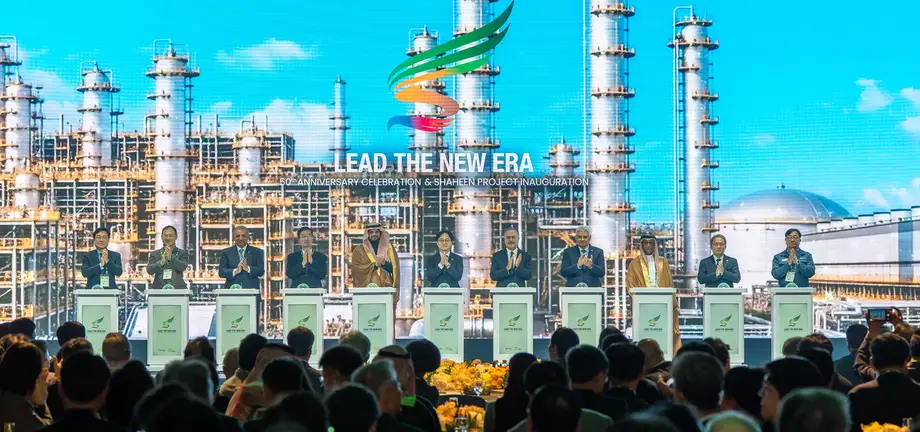
The event ran from 11 a.m. on 25 November in the Dynasty Hall of The Shilla Seoul, with live video links to the TC2C, cracker and polymer units in Ulsan and a start button pressed on stage. About 500 guests attended, among them industry minister Kim Jung-kwan, Saudi assistant energy minister for oil and gas Mohammed bin Abdulrahman Al-Ibrahim, Ulsan mayor Kim Sang-wook, S-OIL chief executive Anwar Al-Hejazi, Aramco downstream president Mohammed Y. Al-Qahtani and Korea National Oil Corporation president Son Ju-seok.
Prime Minister Han Seong-sook had the ceremony on her official schedule and did not appear. The industry ministry sent Kim in her place, and its trade negotiations chief Park Jung-sung also stayed away, with the prime minister's office saying the change reflected diplomatic protocol after a Saudi cancellation. Yasir al-Rumayyan, governor of the Public Investment Fund and chairman of Aramco, dropped his Seoul trip after the fund's headquarters in Riyadh was attacked on 24 November, an assault blamed on Yemen's Houthi rebels.
The project once carried heavier political weight. The investment was finalised during Crown Prince Mohammed bin Salman's visit to Seoul in November 2022 and announced at a summit with then president Yoon Suk-yeol, and Yoon travelled to Ulsan for the groundbreaking in March 2023. When S-OIL completed its 4.8 trillion won residue upgrading and olefin complex in 2018, then president Moon Jae-in attended the opening.
Aramco's 35 years and the imports the plant replaces
Aramco first bought into S-OIL in 1991 and became majority owner in 2015. It holds 63.4 percent through Aramco Overseas Company B.V., a stake behind the biggest investment the Saudi state oil company has made in South Korea. S-OIL has put more than 14 trillion won into its plants over the past decade, including a $4 billion first petrochemical expansion finished in 2018, and the company scaled the plan up from the 7 trillion won it first floated with Aramco in 2019.
The commercial arrangements reach well beyond Ulsan. Overseas sales of polyethylene will run through SABIC, the Aramco affiliate, under a five year contract worth 5.5099 trillion won covering 2026 to 2030. In Korea, S-OIL has laid dedicated pipelines to deliver 760,000 tonnes of basic raw materials a year to neighbouring chemical makers that had been importing them, which the company says cuts freight, storage and handling costs. It estimates the import substitution at about 1 trillion won a year and puts the annual value to the Ulsan economy at about $87 million.
Kim Jung-kwan, the minister of trade, industry and energy, thanked Saudi Arabia for promising to prioritise crude oil and naphtha shipments to Korea during this year's energy disruption, and said the plant would open new paths for an industry at a turning point. Al-Ibrahim said Saudi crude supplied about 40 percent of Korea's oil imports in the first 10 months of this year, up from about 35 percent in 2025, and that Riyadh would keep its promise of stable supply.
The restructuring arithmetic that does not work for rivals
Two days before the ceremony, on 23 November, Kim summoned the heads of 10 petrochemical companies and set the end of the year as the deadline for agreements on which plants close. The Ulsan complex, home to S-OIL, SK Geo Centric and Korea Petrochemical Industrial, has not settled its share, and the three companies remain divided on whether Shaheen's new volume should count in the city's reduction figures. The two smaller firms worry that leaving it out concentrates the burden on them.
Every company must share responsibility for the future of the whole industry rather than immediate gains and losses,' Kim told the executives. 'Please wrap up restructuring talks within this year so that we do not miss the golden time.
The ministry has said it will decide Ulsan's cuts only after confirming that the new units run stably, and no figure has been set. Much of Shaheen's ethylene will feed its own polyethylene lines or be sold abroad, so the output does not land in the domestic market unchanged, though the 1.32 million tonnes of polyethylene capacity overlaps with products that existing Korean makers already sell at home and overseas.
The Bank of Korea's Ulsan branch estimated on 24 November that cracker closures could shrink the city's output by as much as 3.1 percent, and its researchers recommended a shift towards higher value products, noting that Ulsan's crackers are smaller than the new one and tightly tied to the plants around them.
Losses across the sector and a deadline from the minister
Third quarter results show why the closures are urgent. Lotte Chemical posted an operating loss of 281.4 billion won, LG Chem's petrochemical division lost 175.6 billion won, Hanwha Solutions' chemical unit 44.7 billion won and Kumho Petrochemical 20.8 billion won, its first deficit in 42 quarters. S-OIL earned an operating profit of 1.4067 trillion won on revenue of 11.9687 trillion won, helped by refining margins and lubricant base oils, while its own petrochemical business lost 26.4 billion won.
LG Chem told investors on a call that 2027 will still be oversupplied even with some global plant closures, and that Shaheen's start will deepen the glut in basic oils and general purpose polyethylene at home. Kim Min-woo, head of strategic planning at Lotte Chemical, said a sharp recovery is not in sight.
'Even if production capacity reduction proceeds through the integration work in Daesan and Yeosu, the reality is that a dramatic market recovery is difficult to expect as the operation of S-Oil's Shaheen Project is scheduled in Ulsan domestically,' Kim said.
S-OIL answers that TC2C and a plant built from scratch give it costs, energy use and feedstock flexibility that older sites cannot match, and that its high value product mix separates it from commodity suppliers.
China's coming capacity and a thinner export year
The glut has an origin outside Korea. China's ethylene capacity approached 60 million tonnes in 2025 and is set to reach about 86 million tonnes by 2030, according to the consultancy ChemOrbis, and Wood Mackenzie expects Chinese ethylene and polyethylene plants to post returns of minus 11 percent in 2026.
Korean producers have found shelter in higher prices even as volumes slip. Petrochemical exports are projected to rise 9.0 percent to $46.37 billion this year as war driven price gains offset a 9.9 percent drop in volume, according to the Korea Institute for Industrial Economics and Trade, which expects exports to fall 3.0 percent to $44.98 billion next year as lower oil and naphtha prices remove those gains.
Hwang Kyu-won, an analyst at Yuanta Securities, said the average naphtha cracker spread climbed above the $300 a tonne break even level even during the October to November off season, helped by low chemical inventories and falling oil prices. Chang Tae-hun, an associate research fellow at the Korea Energy Economics Institute, said cheaper oil eases cost burdens for every producer alike and is unlikely to widen the cost gap between them, adding that Shaheen's advantage comes from technology that takes a step out of the production process. The International Energy Agency said on 13 November that the oil market would swing back to surplus this quarter.
Washington adds a tariff threat
Hours after the ceremony, the Office of the US Trade Representative proposed tariffs of up to 15 percent on Korean goods after its industrial overcapacity investigation, naming petrochemicals alongside autos and semiconductors among the sectors of concern. The proposal counts existing duties and exemptions so that the combined rate stays inside the 15 percent ceiling agreed by Seoul and Washington. For goods already carrying the 12.5 percent tariff introduced in July over forced labour, it could add 2.5 percentage points. Public hearings begin on 25 January.
Korean petrochemical exports to the United States would meet the new rate just as Shaheen's polyethylene volumes start to move, which puts a second constraint on the sales plans behind the investment.
Hormuz, Bab el-Mandeb and the crude behind the chemicals
Oil supply has run alongside the chemicals story all year. Iran has closed the Strait of Hormuz, and its ambassador in Seoul, Saeed Koozechi, said ships linked to Aramco cannot pass, arguing that the companies of countries that invest in or profit from the United States and Israel fall under sanctions. S-OIL, alone among Korea's four refiners, received Saudi crude by the Red Sea route through the Bab el-Mandeb after the closure, drawing on the fact that more than 90 percent of the crude it imports comes from Saudi Arabia.
Saudi Arabia now sends eastern oil by pipeline to Yanbu on the Red Sea for loading, a longer and smaller route than the Persian Gulf passage. Nasser said Aramco's supply reliability reached 97.8 percent in the third quarter and called the war the most serious energy supply shock of his career, adding that energy security is economic security.
Aramco plans to more than double its 5.3 million barrel joint reserve contract with Korea National Oil Corporation, with talks on expanding storage beyond 11 million barrels. On the possibility of international arbitration over losses from Korea's oil price cap, Nasser stayed cautious.
It is our duty to comply with government regulations in every country we operate,' he said. 'Since no concrete compensation plan has been decided yet, we need to have more discussions with the South Korean government.
Ulsan asks Aramco for the next project
Ulsan mayor Kim Sang-wook used a preview tour of the Onsan plant on 24 November to ask Aramco for a second act, proposing that the company join the second phase of the city's Nam Port energy hub, a project to store and distribute Saudi energy resources for Northeast Asia. Ulsan is also building a name in new marine fuels: the port completed the first commercial green ammonia refuelling in April 2026, moving about 600 tonnes into a ship, and city officials argue that refining, chemicals, ports and logistics together make the case for deeper Saudi involvement.
S-OIL chief executive Anwar Al-Hejazi said the company would keep building on the businesses it already runs. 'We will continue to strengthen synergies across refining, petrochemicals and lube base oil,' he said, 'and drive growth over the next 50 years through sustained innovation and investment.'
Key Points
- S-OIL completed the Shaheen complex in Ulsan, a 9.258 trillion won (about $6.9 billion) project, at a ceremony in Seoul on 25 November that also marked its 50th anniversary.
- The plant holds the world's largest steam cracker by single unit capacity at 1.8 million tonnes of ethylene a year and adds about 3.2 million tonnes of petrochemical output, raising chemicals from 12 percent to 25 percent of production.
- It is the first commercial use of Aramco's TC2C technology, developed with Lummus Technology, which converts crude oil and residue directly into cracker feedstock and turns 93 percent of raw materials into products.
- Aramco owns 63.4 percent of S-OIL through Aramco Overseas Company B.V. and first invested in 1991; the final investment decision came on 17 November 2022 during Crown Prince Mohammed bin Salman's Seoul visit.
- Commercial operations begin in 2027; S-OIL expects to replace about $770 million of imports a year and create roughly $87 million of annual value for Ulsan.
- Shaheen's 1.8 million tonnes offset about 72 percent of the 2.49 million tonnes of ethylene capacity approved for closure in Daesan and Yeosu, leaving a net national cut of 690,000 tonnes.
- Industry minister Kim Jung-kwan set the end of the year as the deadline for Ulsan's restructuring agreement, and the ministry will set the cuts only after the new plant runs stably.
- The US Trade Representative has proposed tariffs of up to 15 percent on Korean goods including petrochemicals, with public hearings from 25 January.
- Prime Minister Han Seong-sook skipped the ceremony, and Aramco chairman Yasir al-Rumayyan cancelled after an attack on the Public Investment Fund headquarters in Riyadh on 24 November.