A Tax Break for Home Built Electric Cars, Delayed at the Last Minute
South Korea's economic ministers were due to meet on Nov. 27 to approve a package built around one idea: pay companies to build electric cars inside the country. The Ministry of Economy and Finance canceled the session the afternoon before, the second time in three days that it had been moved. The central measure, a tax credit worth roughly 2.5 million won ($1,800) for each electric car a manufacturer produces and sells at home, is now promised for next week, with no date fixed.
Contents
- A Tax Break for Home Built Electric Cars, Delayed at the Last Minute
- A Credit for Factories, Not for Buyers
- The Model Y and the Price Gap It Opened
- A Trade Deficit That Nearly Doubled in Ten Months
- Two Ministries, Two Different Answers
- The Battery Inside the Car Becomes the Sticking Point
- Does an Exported Car Count?
- The Suppliers Waiting Behind the Assembly Line
- What Other Countries Did With the Same Problem
- The European Door Closing on Korean Cars
- The Cost Question the Credit Cannot Answer
- What Has Not Been Decided
- Key Points
The delay runs through the National Assembly. The tax subcommittee of the Finance and Economy Planning Committee has held nine sessions without deciding whether finished electric vehicles belong in the domestic production tax credit, a system the government sketched in its August tax revision plan for six areas, including semiconductors, secondary batteries and solar power. Cars were left out. On Oct. 23 the finance ministry told the subcommittee it opposed adding them. The industry ministry, which oversees automotive policy, says the support is needed to keep factories and their suppliers running.
- Oct. 23: The finance ministry tells the tax subcommittee it is against including electric cars in the credit.
- Nov. 25: The emergency economic ministers' meeting is scheduled for the first time.
- Nov. 27: The meeting, already moved once, is canceled the previous afternoon. The package slips to next week.
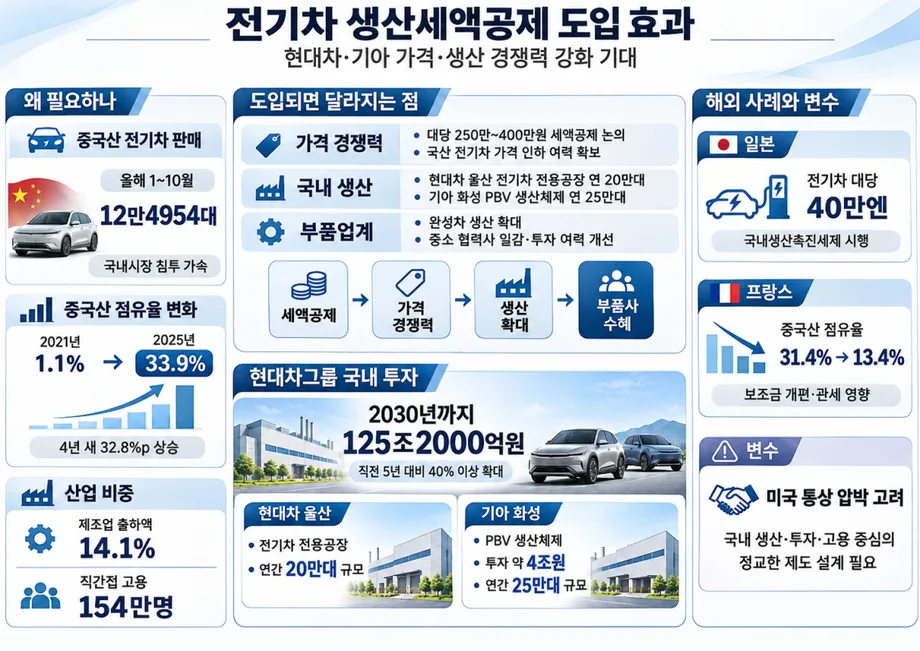
Behind the argument is a market that has changed fast. Vehicles built in China took 43.2 percent of Korea's passenger electric car market between January and October, according to the Korea Automobile and Mobility Association (KAMA), up from 1.1 percent in 2021 and 33.9 percent for the whole of 2025. For the first time, Korean made electric cars fell below half of that segment, at 48.7 percent in the first nine months of the year.
A Credit for Factories, Not for Buyers
The domestic production tax credit works differently from the purchase subsidy Korean buyers already receive. The subsidy goes to the customer and trims the sticker price of any electric car, imported or not. The credit goes to the manufacturer and cuts its income or corporate tax bill in proportion to how much it produces and sells in Korea. The government sets a base amount per unit, multiplies it by volume, and the result is the deduction.
Industry has asked for 4 million won per vehicle. The figure under review inside government is about 2.5 million won. At 100,000 vehicles, the gap is worth between 250 billion and 400 billion won in forgone tax, calculated arithmetically. The real amount depends on whether exported cars count, on each company's tax position and on the base figure that will be written into the enforcement decree of the Special Tax Restriction Act early next year.
Supporters frame the money as room to cut prices. A carmaker that keeps 2.5 million won per unit in tax can pass part of it to buyers without wrecking its margin, or spend it on battery development and new models. The finance ministry's objection is that the benefit may spread too far. At the subcommittee it warned of heavy administrative burden in defining which products and which production costs qualify, and of a support scope that could grow beyond control.
The Model Y and the Price Gap It Opened
Tesla's Model Y explains the shift better than any statistic. The car sold more than 78,000 units in Korea through October, second among all new vehicles and first among electric cars by a wide margin. Its base version lists at 49.99 million won, down from about 57 million won when it arrived in 2023, after three price cuts. The cars sold in Korea are built in China, which is how those cuts were possible.
BYD has since pushed below the 50 million won line with new models and now runs 38 showrooms across the country. Zeekr began delivering its 7X sport utility vehicle in October. Xpeng and Chery are due next year. KAMA figures show 124,954 electric cars made in China were sold in Korea from January through October, equal to 88.4 percent of the 141,290 sold in the nine years from 2017 through last year. American built electric cars took 13 years to reach 80,407 units in Korea; German built cars took 14 years to reach 75,813.
Tesla alone registered 98,313 cars of all models in Korea through October, up 105 percent from a year earlier. Imported passenger car registrations rose 24.6 percent to 310,846 in the same period, and Tesla and BYD accounted for 38.6 percent of that market. BYD has sold 21,731 cars and ranks fourth among imported brands on a cumulative basis less than two years after entering.
Mexico and Brazil show steeper jumps in the share of cars made in China, from zero to 90.7 percent and from 3.8 percent to 85.4 percent since 2021, but both had tiny electric car markets to start with. Among countries with large auto industries built around their own brands, Korea moved furthest: 32.8 percentage points in four years, against 0.9 points in India, 2.3 points in Japan and a fall of 0.2 points in the United States.
A Trade Deficit That Nearly Doubled in Ten Months
The money flows show up in the national accounts. Korea's automobile trade deficit with China reached a record $4.23 billion in the first ten months of the year, up 92.7 percent from $2.2 billion a year earlier, according to the Korea International Trade Association and the Ministry of Trade, Industry and Resources. The country has run an annual car trade deficit with China for ten straight years since 2017, and the gap widened from $161.32 million in 2020 to $2.51 billion last year.
Imports of vehicles from China rose 79.2 percent to a record $4.39 billion, about 26 times the value of Korean car exports to China, which fell 34.9 percent. Imported electric passenger cars made up 51.3 percent of new registrations in the first nine months, with cars built in China at 43.5 percent. Korea charges its standard 8 percent tariff on imported electric cars and adds nothing for Chinese origin, while the United States applies duties of up to 127.5 percent and the European Union up to 45.3 percent.
Two Ministries, Two Different Answers
Lee Hyoung-il, the deputy prime minister and finance minister, set out the cautious position at a briefing for reporters on Oct. 23. He said the government understood the next two to three years as the decisive window for the electric vehicle transition, then tied the credit to conditions.
The introduction of tax credits is a matter to be decided after comprehensively judging the industry's efforts, such as enhancing its own competitiveness and cooperating with parts companies.
Kim Jung-kwan, the trade, industry and energy minister, has argued the other way in public, including at a National Assembly committee session on Nov. 26. He has rejected the charge that the credit is a gift to large companies.
Companies also have a rational direction to use government support in areas that benefit cooperative companies or consumer welfare.
Kim has also said that if Korea had given up on semiconductors three or four years ago it would not be enjoying the present boom in that industry, and that domestic carmakers must convert existing plants and parts supply chains to electric production. The finance ministry's written objections cite charging infrastructure that remains thin, fairness with other industries, and the fact that electric cars already receive purchase subsidies, research support and facility investment aid.
The Battery Inside the Car Becomes the Sticking Point
A tax credit tied to domestic production raises a question the law does not answer by itself: which car counts as Korean. Batteries account for about 40 percent of an electric car's price, and Hyundai Motor Group has doubled its use of batteries made in China within a year. Government officials expect that cars carrying Chinese cells will end up inside the credit if the only test is where the finished vehicle is assembled.
Battery makers want a tighter test. They argue the credit should go only to cars fitted with cells produced in Korea, and that sourcing of cathode materials and other key inputs should be examined too, since a cell assembled at home from imported material delivers little to the domestic supply chain. Officials put the share of non-battery parts arriving from China at more than half, which widens the review. Government officials have said that carmakers receiving the credit should present domestic discount rates alongside it, so the benefit reaches buyers.
Origin is not a technicality here. A car built in China by a Korean company and a car built in Korea with Chinese batteries sit on opposite sides of the rule, and the choice decides which of them is subsidised. Parts industry representatives have said the debate over which vehicles qualify matters as much as the headline amount, because the effect felt by Korean battery and material suppliers depends on how deep the rule reaches.
Does an Exported Car Count?
Two bills in the National Assembly take different approaches to the same question. An amendment to the Special Tax Restriction Act sponsored by Lee Eon-ju of the Democratic Party in September specifies a base amount of 4 million won per electric vehicle and covers cars sold at home or exported. A joint amendment from Yoon Hu-deok of the Democratic Party and Yoon Han-hong of the People Power Party leaves the base amount to the enforcement decree, giving the government more room to set the level later.
The export clause matters to a country that sends most of its cars abroad. Automobile exports were $58.614 billion in the first ten months of the year, down 1.7 percent from a year earlier. Carmakers argue that a credit limited to cars sold in Korea misses the point, since the aim is to hold global price competitiveness. Including exports would raise the fiscal cost sharply, which is why the government's August plan spoke only of vehicles produced and sold domestically.
Whether the ruling party announces the policy on its own or pushes legislation through next year's budget and tax revision bills is still open. The two parties were due to continue talks on Nov. 27 in a smaller closed session involving the tax subcommittee chair and the floor negotiators.
The Suppliers Waiting Behind the Assembly Line
Orders and employment sit with the smaller firms that supply the plants. The automotive industry accounted for 14.1 percent of Korea's manufacturing shipments in 2024 and about 1.54 million direct and indirect jobs across vehicle and parts production, sales, maintenance and logistics. Auto parts exports fell 4.0 percent to $16.98 billion in the first ten months of the year.
Profitability is thin. Combined third quarter sales at three large Daegu based parts makers, SL, Sambo Motors and PHA, rose 6.1 percent while operating profit fell 8.1 percent and net profit swung to a loss. A survey of 213 major parts companies found an average operating margin of 3.62 percent in 2024; among the 94 smaller firms in the group the figure was 2.22 percent. Of 21,049 parts companies counted in a May survey, 578, or 2.7 percent, make components for next generation vehicles, and 1,286, or 6.1 percent, are pursuing or planning a transition. Financing was cited as the main obstacle by 38.8 percent, lack of technology by 29.9 percent and difficulty hiring by 29.3 percent.
Domestic assembly gives these firms their orders. Output rose 0.3 percent in the first ten months, held up by a 3.2 percent increase in exports while domestic sales of Korean made vehicles fell 7.2 percent. Hyundai Motor Group plans to invest 125.2 trillion won in Korea between this year and 2030, with an electric only plant of 200,000 units a year in Ulsan and a 250,000 unit system for purpose built vehicles in Hwaseong for Kia. Those lines need volume to pay back.
What Other Countries Did With the Same Problem
Governments facing the same imports chose different tools, and the results are visible. The United States applies duties of up to 127.5 percent on battery electric passenger cars made in China and will bar, from the 2027 model year, vehicles carrying Chinese developed connectivity or autonomous driving software; limits on covered connectivity hardware begin with the 2030 model year. India charges 70 percent on imported electric cars valued up to $40,000 including freight and insurance and 110 percent above that, with a 15 percent rate as an exception for companies that commit to local investment.
The European Union added countervailing duties to its 10 percent base tariff, reaching 45.3 percent for companies that did not cooperate with its anti-subsidy investigation, 27.0 percent for BYD and 28.8 percent for Geely. Japan introduced a corporate tax credit in 2024 worth up to 400,000 yen per qualifying battery electric vehicle built and sold at home, running for as long as ten years with lower rates in the final three.
France changed the rules of its purchase subsidy instead of taxing imports. The Bonus Écologique was tightened in December 2023 to count emissions produced before a car is driven, including manufacturing and transport, which removed models such as the China built Tesla Model 3 from eligibility. Benchmark Mineral Intelligence data show the share of cars made in China among new vehicles sold in France falling from 31.4 percent in 2023 to 16.4 percent in 2024 and 13.4 percent in 2025, a drop of 18 percentage points, while new vehicle sales rose 9.6 percent to 327,234.
The European Door Closing on Korean Cars
Korea's export markets are narrowing at the same time. The European Union is drafting an Industrial Acceleration Act that would give subsidies and preference to electric cars made in Europe, and an amendment circulated by Ireland, which holds the rotating presidency, does not reflect requests from Korea and Japan to be covered, as reported on Nov. 26. If the law takes effect in 2028 as planned, Korean built cars lose their price advantage in Europe. Assembly inside the bloc using Korean or Japanese parts may still qualify, but that shifts output away from Korean plants.
Hyundai and Kia already build the Kona Electric in Nošovice in the Czech Republic and the EV2 and EV4 in Žilina in Slovakia, while their higher margin electric models are still made in Korea and shipped to Europe. Their combined European market share was 7.1 percent in October, down 0.4 percentage points from September. Renault has said it will consider building its next generation electric car in Busan in 2028 for export to Europe, a plan that now faces the same obstacle.
Lee Ho-geun, a professor of automotive engineering at Daedeok University, has argued that trade friction should be handled through diplomatic and trade channels, including a request to delay the law's application, rather than by dropping the domestic credit. Lee Hang-gu, a specially appointed professor at Namseoul University, has said that qualifying for European subsidies would require more local production on a tight timetable, with union resistance likely, and has proposed shifting tax support toward broad research and development investment instead of a credit that treats companies and sectors unevenly.
The Cost Question the Credit Cannot Answer
Tax relief lowers a bill; it does not lower the cost of building a car. Hyundai's average annual wage is more than 130 million won, over 30 million won higher than the average at Toyota in Japan and far above the national average earned income of under 50 million won. A full strike this summer, the first in a decade, disrupted production the company valued at 2.3 trillion won, and workers secured bonuses equal to 400 percent of monthly base pay plus 12.7 million won each.
Ha Sung-yong, a professor at Joongbu University and president of the Korea Automobile and Mobility Safety Association, has proposed a credit limited to new mass production and real increases in output, paid as a flat amount per vehicle for three years, with a cap for each company and verification through added output, hiring and transaction prices. He has also called for direct support to smaller suppliers for equipment conversion and production validation, and for carmakers to broaden affordable model lines and share parts across vehicles to cut costs while the credit runs. A price cut paid for by a credit that expires is not a cost structure.
What Has Not Been Decided
The base amount, the treatment of exports, the origin rule for batteries and the total cost are all still open. The finance ministry's review also flags the fiscal precedent: officials have noted that if support is extended whenever price competitiveness slips against China, the list of targets will grow in steel and other sectors. Oh Jong-hyun, director general of the Korea Institute for Public Finance, made the point at a meeting of the Fiscal and Economic Planning Committee.
Not only electric vehicles, but also in other industries such as steel, if price competitiveness declines in competition with China, these (support targets) will continue to increase, and fiscal costs will skyrocket.
Trade pressure adds a second constraint. The Office of the United States Trade Representative published findings on Nov. 25 from its Section 301 investigation that took issue with Korean industrial policies aimed at expanding manufacturing capacity. The European Union is preparing safeguard import limits on hybrid vehicles from Korea, China and Japan starting next month. A credit designed so that it does not hinge on the national origin of parts or on export performance would lower the risk of a complaint, which is part of why the government has moved slowly.
Cho Chuel, a specially appointed professor at Korea University's Institute for Future Growth, expects the pressure to grow as more Chinese brands arrive.
If more Chinese companies enter, the share of imported cars in the EV market could exceed 50 percent, and that would be a considerable blow to Korean-made cars.
Kim Pil-soo, a professor of future automotive engineering at Daelim University, has put the case for acting now.
The domestic auto industry needs a range of incentives, including tax credits, to keep it from going into decline.
Key Points
- The Ministry of Economy and Finance canceled a Nov. 27 meeting where a package to strengthen electric vehicle competitiveness was to be unveiled, after an earlier move from Nov. 25. No new date is set.
- The plan centers on a domestic production tax credit of about 2.5 million won per electric car; industry wants 4 million won.
- Cars built in China took 43.2 percent of Korea's passenger electric car market from January to October, up from 1.1 percent in 2021.
- Korea's car trade deficit with China hit a record $4.23 billion in ten months, up 92.7 percent, as imports from China reached $4.39 billion.
- The finance ministry opposes inclusion, citing administrative burden, fairness across industries and thin charging infrastructure; the industry ministry supports it.
- Unresolved points include whether exported cars qualify, whether cars with Chinese batteries qualify, and the base amount, to be set in a decree early next year.
- Suppliers are already strained: parts exports fell 4.0 percent, and only 2.7 percent of 21,049 parts firms make next generation components.
- The United States charges up to 127.5 percent on cars made in China, the EU up to 45.3 percent, Japan offers 400,000 yen per home built electric car and Korea charges 8 percent.