A 20% Line Cuts Through Korean Crypto
Seoul is moving to redraw control of its cryptocurrency exchanges around a single number: 20%. Under the Digital Asset Basic Act draft unveiled by the Financial Services Commission on November 24, 2026, a major shareholder would normally not be allowed to hold more than 20% of a digital asset platform operator. Financial institutions and other eligible entities could seek FSC approval to hold up to 34%, with the detailed test left to a presidential decree.
Contents
- A 20% Line Cuts Through Korean Crypto
- What the Draft Law Actually Says
- Why Regulators Want Spread Ownership
- Who Is Above the 20% Line
- Why Naver and Dunamu Face a Structural Puzzle
- What Mirae Asset Must Unwind at Digital X
- When the Three Year Clock Starts
- The Constitutional Fight in the National Assembly
- Beyond Ownership, a New Licence System
- Stablecoins and Market Makers Move Into Focus
- Key Points
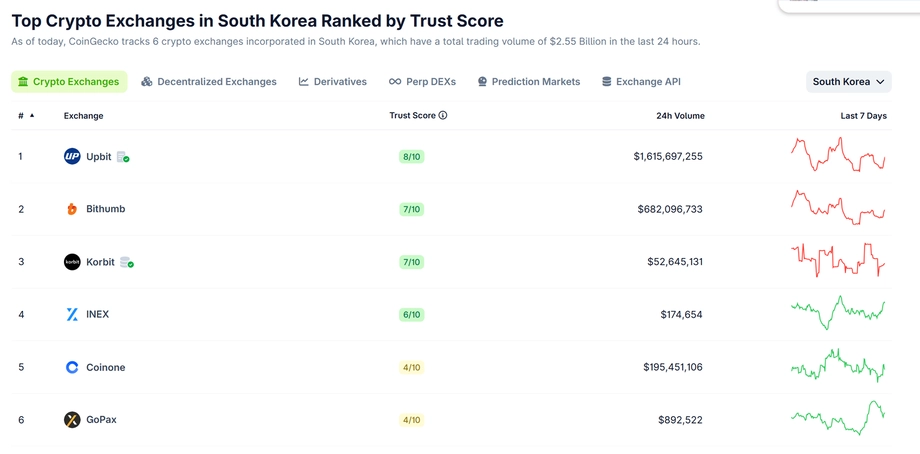
The stakes at issue are not small. Mirae Asset Consulting owns 97.15% of Digital X, formerly Korbit, after buying Korbit for 141.4 billion won in July. Naver Financial is planning a share swap that would make it the direct owner of 100% of Dunamu, operator of Upbit. Binance holds 67.45% of Streami, which runs GOPAX. Bithumb Holdings owns 73.56% of Bithumb. Regulators say these structures must change because exchanges now function like financial utilities.
Share ownership decides who can set listing standards, shape trading surveillance, choose executives and direct how customer assets are protected. The draft would strip voting rights from shares above the limit, but it would not make those shares disappear. An FSC official said at a media briefing that the bill has no forced sale clause, while corrective orders can be issued and companies must fix violations before seeking other business approvals.
For users, the change could affect which coins are listed, how quickly suspicious trading is investigated and how a platform is run if something goes wrong.
What the Draft Law Actually Says
The bill is known as the Digital Asset Basic Act and formally as the Act on Innovation in the Digital Asset Industry and User Protection. The FSC disclosed it after a virtual asset committee meeting on November 24. Yoo Dong-soo, chair of the National Assembly's Political Affairs Committee, introduced the government version on November 26 with 12 co-sponsors.
- November 24, 2026: the FSC disclosed the draft ownership and governance rules.
- November 26: Yoo Dong-soo introduced the government bill in the National Assembly.
- November 27: Rep. Park Min-kyu publicly opposed the ownership limit.
An earlier proposal stage had no National Assembly sponsor chosen, and an earlier political agreement described up to 34% as room for new business owners. The November draft frames the exception as approval for financial institutions and other eligible entities.
The ownership rule applies to a single shareholder and related parties. The FSC has said the enforcement decree may also define which friendly shareholders count. The original draft also requires financial commission clearance for any share transfer exceeding 10%, giving regulators a check on changes in control before they happen.
The bill splits digital asset businesses into trading, brokerage, custody, asset management and platform operator categories. Exchanges would need licences for trading, brokerage and custody, plus separate designation as digital asset platform operators. Governance rules would require outside directors to form a board majority, audit committees and compliance officers. Trade execution, listing reviews and market surveillance would move under formal regulatory oversight.
Why Regulators Want Spread Ownership
Financial Services Commission Chair Lee Eok-won has argued that exchanges are no longer fringe technology businesses. He said regulators are designing diversified ownership because platforms now sit inside the financial system and can affect competition, listed projects and ordinary users.
As [crypto] exchanges are now officially recognised as part of the financial system, we must create a governance structure that befits their status. We are currently discussing measures to diversify [owners'] stakes in crypto exchanges, including regulations on the distribution of shares.
Yoo Young-jun, director general of the FSC's Digital Financial Policy Bureau, gave the clearest official reason for the plan. He pointed to more than 10 million exchange accounts in Korea. Authorities also cite daily trading worth trillions of won. In their view, a platform with that reach needs checks on concentrated power, much as banks and stock exchanges do.
Ownership restrictions are necessary to strengthen exchanges' public accountability and neutrality.
The FSC has described exchanges as public infrastructure, meaning a private company can still perform a public function. Earlier in the policy debate, the commission discussed a 15% to 20% cap for both individuals and companies. The ruling Democratic Party's first Basic Digital Asset Act draft focused mainly on won denominated stablecoins and left the ownership cap out. By November, the FSC and the party's digital asset task force had converged on 20%, setting up a fight over how far the state can reach into private shareholding.
Who Is Above the 20% Line
- Dunamu, operator of Upbit: Chairman Song Chi-hyung holds about 25.5%, above the general cap but below the 34% exception.
- Bithumb: Bithumb Holdings owns 73.56%. DAA, Vidente and BTHMB each hold stakes of up to 31%, while South Korean media outlets and prosecutors have alleged that Vidente owner Kang Jong-hyun is the de facto owner.
- Digital X, formerly Korbit: FSC bill materials list Mirae Asset Consulting at 97.15%, and planned capital injections would lift the stake above 98%.
- Coinone: early proposal figures put founder Cha Myung-hoon at about 53.44%. November bill materials list Chief Executive Cha Myung-hun's side at 30.36% and Com2uS affiliates at 24.54%, while an earlier description gives those affiliates almost 39%.
- GOPAX: Binance holds 67.45% of Streami, the operator. The FSC has said foreign and domestic shareholders face the same ownership standard.
Upbit and Bithumb together control roughly 90% of the local market, so any restructuring at those two firms would touch most Korean crypto trading. Smaller platforms are not exempt. Korbit had earlier been described as more than 60% owned by Nexon, before Mirae Asset's acquisition changed the ownership map.
The 34% number comes from company law. Under the Commercial Act, a holder above 33.3% can block certain shareholder meeting decisions. The exception creates room for an approved owner to keep a blocking stake, but only with FSC permission. Even then, voting rights above 20% would be limited.
Why Naver and Dunamu Face a Structural Puzzle
The Naver Financial and Dunamu deal would join Korea's largest online payment provider with its largest crypto exchange. It has already reached a conditional approval stage at the Fair Trade Commission, after investigators found concerns in 10 of 12 business relationships and recommended clearance with safeguards. The commission aims to decide before the end of 2026. The combined digital financial platform is valued at about 20 trillion won, or $14.9 billion.
Under the proposed comprehensive share swap, Dunamu shareholders would receive about 2.54 Naver Financial shares for each Dunamu share. Naver Financial would then own every Dunamu share. Before the swap, Dunamu Chairman Song Chi-hyung held about 25.5% and Vice Chairman Kim Hyoung-nyon held 13.1%. After the deal, Song, Naver and Kim would each hold between 10% and 19.5% of the combined entity. Another account puts Song at 19.5%, Kim at 10% and Naver at 17%.
Those percentages look spread out, but the cap may be measured at the exchange level. If the rule looks at Dunamu's direct shareholder, Naver Financial's 100% stake would be far above both 20% and 34%. Naver Financial is an electronic finance company, so it may fit the eligible financial entity category, but the direct ownership question remains. FSC materials did not say whether the cap looks through a parent company to its own shareholders or aggregates related party holdings across a group.
Lee Jun-ho, an analyst at Hana Securities, said the companies were more likely to redesign the combined structure than abandon the transaction.
Potential options include combining Naver Financial and Dunamu into a single legal entity and adjusting the scope of voting rights delegated to Naver.
Voting control adds another layer. Naver would own 17% of Naver Financial but control 46.5% of its voting rights, including 29.5 percentage points delegated by Song and Kim. A restructuring could therefore change who actually directs the business, not just the percentages on paper.
What Mirae Asset Must Unwind at Digital X
Mirae Asset Consulting bought Korbit for 141.4 billion won in July and the company became Digital X in August. Its 97.15% stake leaves two paths under the draft. At a 20% cap, it would need to cut 77.15 percentage points, about 79.4% of its current holding. At the approved 34% level, it would still need to cut 63.15 percentage points.
Mirae Asset Consulting is an affiliate of Mirae Asset Financial Group, but it is not itself a financial company. That matters because the 34% exception is written for financial institutions and other eligible entities. Digital X may also seek treatment as an innovative business operator, a category tied to smaller market share that could offer a six year grace period.
The FSC declined to comment on specific companies. It is not yet clear whether Mirae Asset Consulting qualifies for the exception or whether the exchange could rely on the longer schedule. A gradual reduction through share sales and new share issuance is one route discussed in the industry, but no company plan has been announced.
When the Three Year Clock Starts
The grace period is easy to misread. The FSC says the three year clock starts when an exchange is designated as a digital asset platform operator, not when the law takes effect. Smaller exchanges may receive another three years, giving them up to six years to comply.
That designation comes after a company obtains licences for trading, brokerage and custody and meets other conditions to be set by decree. The government proposal allows one year between promulgation and entry into force. Seoul National University law professor Lee Jung-soo said new businesses may not actually begin until 2029 once legislation, licensing and transition time are counted.
Yoo Young-jun, director general of the Digital Financial Policy Bureau, said in a press briefing that regulators would not leave excess holdings unresolved.
Any excess stake must be brought into compliance.
This is why a voting right restriction can still force a business decision. A shareholder might keep legal title to excess stock, yet lose the power to vote it and face obstacles at the next licence or approval. The bill leaves no forced sale clause, but it directs corrective orders at exchange operators and requires companies to rectify violations before pursuing other businesses or permits.
The Constitutional Fight in the National Assembly
Rep. Park Min-kyu of the Democratic Party, a member of the bill review subcommittee, attacked the ownership limit on November 27. He said the state was changing the rules after owners had lawfully invested.
Limiting major shareholders' equity stakes constitutes ex post facto regulation of existing operators and carries a high risk of being unconstitutional due to infringements on property rights.
Park also questioned the FSC's legal work. He said materials sent to his office on August 30 showed no legal review or outside advice on the ownership restriction at that time, and he said the commission had not later supplied supporting documents. He argued that voting rights restrictions, administrative fines, operating suspension and licence revocation could combine to push an owner out of the market.
The National Assembly Research Service warned in March that forcing sales of lawfully acquired stakes could be unconstitutional because of property rights and freedom of business activity. More than a dozen competing bills have been introduced. Park and two other ruling party members on the first bill review subcommittee are not among the 12 sponsors of the government bill.
Hwang Suk-jin, a professor at Dongguk University's Graduate School of International Affairs and Information Security, said regulators need evidence before accepting a uniform cap.
Regulators need to provide objective evidence of why a 20 percent ownership cap is necessary and whether alternative regulatory measures have been considered.
The next formal step is the National Assembly process. Park said corrections would come after a public hearing and during preparation of a consolidated bill in the legislative subcommittee. No date for that hearing was given in the material released this week.
Beyond Ownership, a New Licence System
The ownership cap sits inside a larger rewrite of who may run digital asset businesses. Existing virtual asset service providers would have to apply for licences suited to the activities they conduct. Late in January, the National Assembly approved stricter entry rules that let authorities examine executives and major shareholders for drug trafficking, tax evasion, fair trade breaches and serious economic crimes.
In February, Democratic Party lawmaker Kim Seung-won announced plans to amend the Capital Market and Financial Investment Business Act and the Act on the Protection of Virtual Asset Users so that people giving investment advice or encouraging trades in financial products or virtual assets would face disclosure rules.
Capital is the other pressure point. The general minimum equity capital for a digital asset business would be 2 billion won. The exchange specific amount is left to a presidential decree. For comparison, a regular stock exchange under capital market law needs 100 billion won. If that same figure were applied to crypto exchanges, three of the five major won exchanges would face added fundraising pressure.
Coinone ended last year with 81.9 billion won in equity capital. It raised about 54.8 billion won this year from Korea Investment Securities and OKX Ventures, and its capital is estimated to be just above 100 billion won. Digital X ended last year with 38 billion won, raised 50 billion won in August and plans a further 30.5 billion won in kind contribution in January. It also posted a 15.8 billion won net loss last year.
Streami, the GOPAX operator, ended last year with negative 218.5 billion won in equity capital, meaning its liabilities exceeded its assets. Dunamu and Bithumb are relatively better placed. The FSC also said the Digital Asset Exchange Alliance's self regulation rules may become exchange operating rules, while it was too early to say whether the alliance becomes a statutory association.
Stablecoins and Market Makers Move Into Focus
The bill also opens a path for won denominated stablecoins, digital tokens designed to keep a steady value against the won. Issuance would begin through consortia in which banks hold a majority stake. Technology companies such as fintech firms could still be the largest single shareholder in a consortium, and the FSC said no separate ownership cap applies to technology companies in that structure. The initial phase has no fixed end date.
Stablecoins with issuance of 1 trillion won or more would be treated as significant digital payment tokens and face extra capital and liquidity rules. Overseas tokens such as Tether's USDT and Circle's USDC could be issued and redeemed in Korea if their issuers file with the FSC. The FSC also expects the Finance Ministry to review the Foreign Exchange Transactions Act for overseas transactions involving won denominated stablecoins.
The draft would also permit domestic digital asset issuance and sales, known as initial coin offerings, after a white paper is filed and disclosed and a deliberation period is observed. Operators would carry heavier responsibility for hacking and system failures. Penalties could reach 10% of revenue where a safety duty is breached, accounts suspected of unfair trading could be frozen for up to 12 months, digital asset transactions could be restricted for up to five years, and core functions could not be outsourced.
Brokers and market makers may gain from the new categories. A market maker continuously quotes buy and sell prices so trades can happen even when customers are scarce. That role would matter for a future spot digital asset fund, because such a fund needs a deep spot market and reliable pricing when shares are created or redeemed. Global firms including Flow Traders, Cumberland and Wintermute held talks with Korean virtual asset firms in August. Galaxy Digital invested in custody firm Bdac in 2024, FalconX received Mirae Asset investment in 2021, and Flow Traders, Cumberland and Jane Street already have Korean entities or branches. Clearer rules could make such firms part of the regulated market rather than visitors on its edge.
Key Points
- The FSC draft sets a 20% ownership cap for major shareholders of crypto exchanges, with FSC approved holdings up to 34% for eligible entities.
- Excess shares would lose voting rights, and holders would need to resolve violations before other approvals, although the bill has no forced sale clause.
- Mirae Asset Consulting's 97.15% Digital X stake and Naver Financial's planned 100% Dunamu stake are the clearest test cases.
- The three year grace period starts after platform operator designation, with smaller exchanges possibly receiving up to six years.
- Lawmakers, including Rep. Park Min-kyu, are preparing constitutional and policy challenges during National Assembly review.
- The bill also creates new licences, capital rules, stablecoin consortia and a formal place for brokers and market makers.