SK puts a number on its AI ambition: 100 companies, 100 trillion won
SK Group wants its K-AI Alliance, a coalition of Korean and foreign artificial intelligence companies, to reach 100 members holding a combined corporate value of 100 trillion won, a sum close to $70 billion. Yoo Young-sang, chair of the SK AI Committee, set out the goal in a keynote address at the alliance's Seoul Meetup 2026, held on Nov. 27 at the Walkerhill Hotel in Seoul. SK made the plan public two days later, on Nov. 29.
Contents
- SK puts a number on its AI ambition: 100 companies, 100 trillion won
- How a seven-company club turned into a 54-company coalition
- What Yoo Young-sang means by an AI flywheel
- The old-economy lesson behind the strategy
- Three jobs for 2027, and two venture partners
- A pitch for Korean data centers built around memory
- Memory is where SK already holds the strongest cards
- A 2 gigawatt factory and a memory moat
- Why 2 gigawatts is the number to watch
- Which Korean businesses could feel the effects
- What is still open
- Key Points
The alliance had 54 members on the day of the event, up from seven when SK Telecom founded it in February 2023. Those members now span AI semiconductors, data center infrastructure, foundation models, services and applications, so the new target nearly doubles the roster and attaches a value figure to it for the first time.
Roughly 50 representatives of member companies, among them chip designer Rebellions and search developer Liner, joined executives and staff from SK Telecom, SK hynix and SK AX. The theme was "K-AI opportunities and growth together", and the program ran three sessions covering AI infrastructure, AI models and services, and AI applications. HyperAccel, a chip company working on inference efficiency, also attended as a member.
How a seven-company club turned into a 54-company coalition
SK Telecom started the K-AI Alliance in February 2023 to stir activity in Korea's AI ecosystem and to help small AI firms find customers abroad. Membership spread across the stack, from chip designers and data center builders to model developers and application makers, and the roster has grown every year since.
This year the group moved the running of the alliance from SK Telecom to the AI Committee under the SK SUPEX Pursuit Council, the body that coordinates strategy across SK's affiliates. Yoo, a former SK Telecom chief executive, leads that committee. The shift placed the alliance's agenda at group level rather than inside a single telecom operator, giving it access to SK hynix's memory business and SK AX's software arm.
An SK official described the alliance as a connector rather than a holding company. "We are working to develop the K-AI Alliance into a platform that connects the technological and business capabilities of individual companies to create tangible customer value and new business opportunities," the official said, adding that SK plans to widen joint technology development and business cooperation with member companies.
What Yoo Young-sang means by an AI flywheel
A flywheel is a heavy wheel that takes effort to start and then keeps turning on its own momentum, a business image that Amazon made famous. Yoo uses it to describe a loop he wants Korean AI companies to run together.
In SK's telling the loop begins with memory chips. SK hynix leads the world in high bandwidth memory, the stacked DRAM placed beside AI accelerators to feed them data fast enough to keep them busy. That position wins orders from data center builders, the data centers create demand for power and energy, and the resulting infrastructure draws in AI services that customers pay for.
Today's AI flywheel is still confined to infrastructure, where it is driven by capital and investment. It has yet to reach applications.
Yoo put a clock on the shift, saying the alliance has one to two years to show that spending on data centers and chips produces revenue rather than capacity alone.
The next one to two years will be a critical turning point. We must develop the current AI flywheel into a virtuous cycle that creates customer value and generates revenue, which can then be reinvested in infrastructure.
The old-economy lesson behind the strategy
Yoo built his keynote around beopgochangsin (法古創新), a four-character phrase meaning to create something new by learning from the old. He used the internet and mobile eras as his reference points, arguing that neither offers a template for AI because the cost of intelligence keeps climbing as models get better.
During the internet and mobile eras, services spread based on low-cost infrastructure, but the AI era follows a different set of rules. Even if infrastructure costs decline, demand for higher levels of intelligence will keep costs high. AI must therefore be an essential service that customers are willing to pay for from the outset.
The mechanics behind that argument are familiar to anyone who has paid an AI bill. Models charge by tokens, the small chunks of text or images they process, and a more capable model usually burns more tokens to answer the same question. Cheaper chips and cheaper power lower the price of each token, yet customers keep spending more because they keep asking for harder tasks. Yoo's conclusion is that an AI business built on subsidized usage will not survive that arithmetic.
SK Chairman Chey Tae-won cited the same flywheel at a seminar for chief executives in November, which makes the concept the group's shared language for AI rather than one committee's slogan.
Three jobs for 2027, and two venture partners
Yoo named three tasks that member companies will pursue together next year, and each one maps onto a weak point in the current market.
- Cutting the cost of using AI, which SK labels token efficiency.
- Creating AI services that industrial sites and households treat as essential.
- Building an ecosystem that shares the gains of growth among member companies.
He framed the pooling of effort as a counterweight to size, since the largest technology companies now build everything from chips to consumer apps in house.
Global big tech companies and frontier model developers are building competitive advantages independently, from infrastructure to applications. We must bring together companies with strengths in semiconductors, infrastructure, models, services, robotics and healthcare. We will grow the K-AI Alliance into an ecosystem of 100 member companies with a combined corporate value of 100 trillion won, and grow together.
The alliance also signed a memorandum of understanding with two venture capital firms, Asia2G Capital and Sazze Partners, to help Korean AI startups enter overseas markets, raise money and meet customers and partners. Kim Kwang-rok, co-CEO of Sazze Partners, and Jung Ji-hoon, co-CEO of A2G, signed alongside Yoo. The two funds will also look for promising startups and arrange exchanges between their portfolio companies and alliance members.
Inside the sessions, Lee Jae-sin of SK Telecom's AI business development team presented the company's data center plans, Jung Ji-hoon, a professor at DGIST, argued for Korean sovereign AI, and Jo Ik-hwan, who heads physical AI at SK Telecom, reported on progress toward a physical AI consortium. Member companies also discussed medical AI and ways to enter foreign markets.
A pitch for Korean data centers built around memory
Jeong Myeong-su, chief executive of the Korean interconnect chip company Panasia, used the forum to argue that AI data centers should be designed around memory rather than around individual chips. Memory has traditionally sat inside each server, which leaves spare capacity stranded on idle machines while other servers run short. CXL, or Compute Express Link, is an open standard that lets processors and accelerators pull from shared pools of memory across a rack.
Jeong expects the first CXL market to take the form of memory services, in which several memory resources are bundled into one pool and supplied to whatever computing device needs them. He sees racks then wired so that CPUs, GPUs and Korean made accelerators can be combined to fit a particular service. Memory makers gain a new opening in that design, since they can sell memory systems rather than single DRAM chips or modules, and Panasia plans to start with its own CXL switch before moving into the links between racks.
He set the approach against accelerator interconnect work already on the market: Nvidia's NVLink and its NVL72 rack, and AMD's UALink and Helios. Jeong argued that Korean systems should use global standards such as Ethernet to reach outside networks, and warned against two traps. Relying on one supplier's technology leaves a country exposed, while building a closed domestic ecosystem in the name of sovereign AI risks isolation. He pointed to Japan's Sony, which promoted its own connectivity standards and storage media and ended up outside the mainstream market.
Panasia signed a memorandum of understanding with SK Telecom in March to jointly develop a CXL based architecture for next generation AI data centers, with Panasia supplying switches and controllers. Jeong said the alliance's first job is to show that Korean memory, accelerator and system companies can run real services in a working data center, measured on power consumption, system efficiency and time to first token, the delay before a model produces its first output.
This panel discussion was significant in that we discussed the trend toward memory-centric AI infrastructure and the role interconnect technology will play within it, together with SK, which possesses core AI infrastructure technologies ranging from memory to AI data centers.
The session was moderated by Ju Young-pyo, an executive vice president at SK hynix, and included Kim Ju-young, chief executive of HyperExcel, and Park Jin-ho, chief executive of Point Two Technology. Jeong said Panasia will widen its work with server, CPU and accelerator manufacturers as the architecture develops.
Memory is where SK already holds the strongest cards
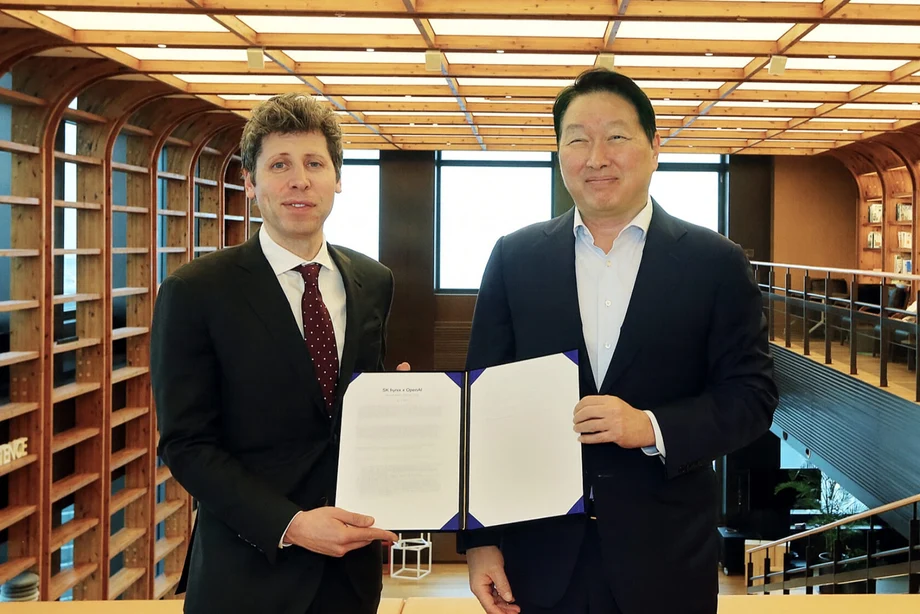
SK hynix ranked first in the world in DRAM revenue in the first half of 2025, and that standing is what turned a Korean memory maker into a partner of the most valuable AI company in the United States. On Oct. 1, 2025, SK Chairman Chey Tae-won and OpenAI chief executive Sam Altman met at SK headquarters in Seoul and signed a letter of intent and a memorandum of understanding, as set out in the SK-OpenAI agreement.
Under the letter of intent, SK hynix will put in place a production system able to meet OpenAI's high bandwidth memory demand for the Stargate project at up to 900,000 DRAM wafers a month, more than double the current capacity of the HBM industry. SK Telecom signed a separate memorandum to work with OpenAI on an AI data center in the southwest of Korea as part of Stargate Korea, covering next generation computing and data center solutions and AI services for consumers and businesses.
We are honored to participate as a core partner in the Stargate project, aimed at building future global AI infrastructure. By leveraging SK's integrated AI infrastructure capabilities from memory semiconductors to data centers, we will actively contribute to global AI infrastructure innovation and strengthening Korea's AI competitiveness at a national level.
Altman framed the deal around the country rather than the company.
Korea has the vision, technology, talent and infrastructure to lead globally in AI. We're proud to partner with SK hynix as part of our Stargate initiative, supporting Korea's leadership in AI and contributing to its continued success.
Supply volumes and arrangements under that letter of intent are still to be settled as the project advances. SK held a groundbreaking ceremony for the SK Ulsan AI Data Center in August 2025, the first concrete piece of the infrastructure the flywheel depends on.
A 2 gigawatt factory and a memory moat
At an AI summit in San Francisco on July 24 and 25, 2026, SK Group and Nvidia announced a partnership worth more than $500 billion. SK Telecom committed to building a factory in Korea that draws 2 gigawatts, running on Nvidia's DSX platform and Vera Rubin architecture and fed by SK hynix's HBM4 memory, with the first facility due to be operational in 2027. Nvidia and SK hynix signed a separate agreement to co-develop next generation AI memory.
Analysis by the research firm TrendForce put SK hynix's share of Nvidia's HBM4 allocation for Vera Rubin at about 70%, with Samsung and Micron dividing the rest. Tying the leading memory supplier to a multiyear development pact keeps Nvidia's own supply steady through the heaviest buildout the industry has seen, and makes it harder for rival chip designers to obtain the same memory in the same volume.
The letters of intent signed by both sides cover the factory and the memory framework. They are not final contracts, and detailed volumes will follow as the project moves. Nvidia's commitments in Korea extended beyond SK that week, with a separate investment of more than $1 billion in Naver's AI infrastructure.
- February 2023: SK Telecom launches the K-AI Alliance with seven companies.
- August 2025: SK breaks ground on the SK Ulsan AI Data Center.
- Oct. 1, 2025: SK hynix signs a memory letter of intent with OpenAI and SK Telecom signs a data center memorandum under Stargate Korea.
- June 2026: Nvidia's Vera Rubin platform enters full production, with customer shipments due in the third quarter.
- July 24-25, 2026: SK and Nvidia announce a partnership worth more than $500 billion in San Francisco.
- Nov. 27, 2026: the K-AI Alliance Seoul Meetup 2026 opens at the Walkerhill Hotel.
- Nov. 29, 2026: SK announces the 100 member, 100 trillion won target.
- 2027: SK Telecom's first 2 gigawatt AI factory is due to be operational.
Why 2 gigawatts is the number to watch
Most large corporate data centers run at 50 to 100 megawatts. The AI campuses that made headlines in 2026 run 100 to 750 megawatts per site. A 2 gigawatt facility running continuously draws roughly what a mid-sized city pulls from its grid, which places SK Telecom's plan in the same class as public utility infrastructure rather than corporate computing.
The demand behind that scale is documented. Gartner expects AI servers to consume more electricity than all conventional data center hardware combined by 2027, and total data center consumption to roughly double from about 485 terawatt hours in 2025 to 950 terawatt hours in 2030. Five data centers of 1 gigawatt or more were expected to come online worldwide across all of 2026, so a single 2 gigawatt Korean site would exceed that annual total on its own.
Nvidia's wider financing explains why the money is available. The chip company is in talks to guarantee up to $250 billion for OpenAI's data center buildout in Ohio, with separate discussions covering $350 billion more in chip financing, and its total exposure across AI deals passed $750 billion in the week before the SK announcement. SK Telecom, Korea's largest telecom operator, is now building computing capacity on a scale none of its domestic competitors has attempted.
Which Korean businesses could feel the effects
Investors read the alliance plan as a map of the AI supply chain, and each stage points to a different set of Korean companies. SK hynix sits at the start, as the memory supplier whose HBM output determines how fast clusters can grow. Rebellions designs inference chips, and its opportunity widens as AI moves from training models to running them for paying customers. HyperAccel works on computing efficiency, which speaks directly to Yoo's token efficiency goal.
Power equipment makers follow. AI data centers need higher power density than ordinary server halls, which lifts demand for transformers, switchgear and distribution systems. HD Hyundai Electric builds ultra high voltage transformers and power equipment, Hyosung Heavy Industries works on transmission and grid gear, and LS ELECTRIC supplies distribution systems and power automation. Robotics draws on the same logic: Doosan Robotics makes collaborative robots for factory and logistics automation, and Rainbow Robotics combines robot hardware with intelligent control. On the software side, Liner's AI search and information processing tools stand to gain if SK's push into paid AI services succeeds.
What is still open
SK did not say when the alliance expects to reach 100 members or the 100 trillion won combined value, and the figure describes the worth of member companies rather than sales the alliance would generate. The Nvidia and OpenAI arrangements rest on letters of intent, with volumes and schedules still to be negotiated, and the CXL based reference design Panasia proposed has yet to be built and tested in a live data center.
The next markers are set for 2027. SK Telecom's first factory is due to be operational that year, SK hynix is scheduled to fill HBM4 orders for Vera Rubin as shipments ramp, and the alliance's three tasks are meant to produce paying services within the same window. SK also plans to set up a physical AI consortium with member companies, which has no announced launch date.
Key Points
- SK aims to grow the K-AI Alliance from 54 members to 100, with a combined corporate value of 100 trillion won, close to $70 billion.
- Yoo Young-sang announced the target at the Seoul Meetup 2026 on Nov. 27 at the Walkerhill Hotel; SK disclosed it on Nov. 29.
- The alliance began in February 2023 with seven companies under SK Telecom, and its management passed to the SK AI Committee this year.
- Yoo said the AI flywheel is stuck in infrastructure and must reach paying applications within one to two years.
- Priorities for 2027 are lower AI use costs, essential AI services and sharing growth gains among members.
- The alliance signed a memorandum with venture firms Asia2G Capital and Sazze Partners to help startups go global.
- Panasia proposed a memory centric Korean data center design built on CXL and open standards, developed with SK Telecom.
- SK hynix committed to HBM supply for OpenAI's Stargate at up to 900,000 DRAM wafers a month under an October 2025 letter of intent.
- SK Telecom is building a 2 gigawatt AI factory on Nvidia's DSX and Vera Rubin platforms, due to run in 2027.
- SK hynix holds about 70% of Nvidia's HBM4 allocation for Vera Rubin, according to TrendForce.