A Very Bad Signal From Yogyakarta
Angga Dwimas Sasongko has spent 20 years making films in Indonesia and now runs Visinema, the Jakarta studio behind Jumbo, an animated family film that sold close to 10 million tickets. He used that standing at the opening weekend of JAFF Market to deliver an unwelcome message to a hall of producers, distributors and festival programmers.
Contents
- A Very Bad Signal From Yogyakarta
- The Ticket Counts Behind the Share Slide
- A $2.80 Ticket That Feels Like $9
- 2,293 Screens for 280 Million People
- An Industry Board With a Funding Problem
- Producers Who Also Have to Be Distributors
- Where Viewers Actually Find Their Films
- Hyperlocal Stories and Patient Money
- Co-Production, Animation and the Money Question
- What Growth Should Mean
- Key Points
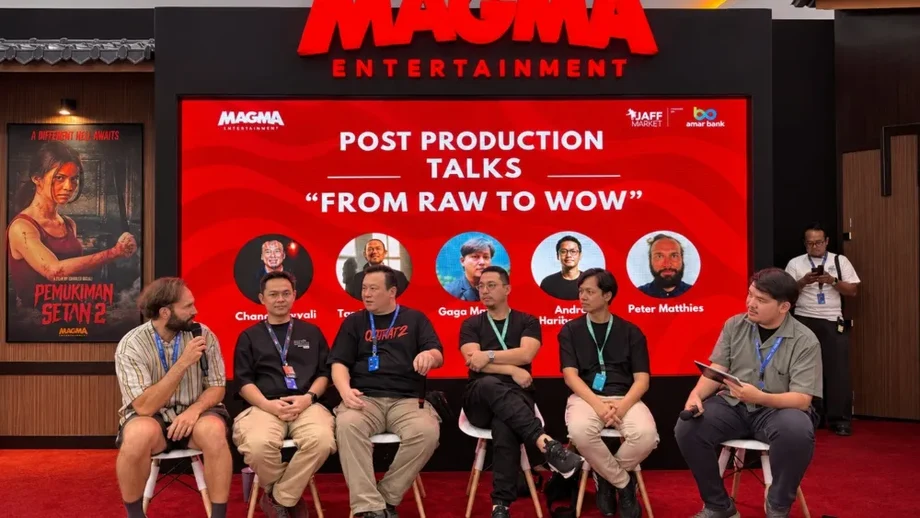
The session was titled Big Ideas Talk: Imagining the Next Chapter of Indonesian Cinema and moderated by the market's director, Linda Gozali. Sasongko began with the stock market. The Jakarta Composite Index, Indonesia's main share index, is down 38% so far this year, and most listed film companies have fallen further than the index itself.
"It's a bad, very bad signal for the industry in the next couple years," Sasongko said.
Behind those share prices sits a harder question about how Indonesian films earn their money. Capital markets, Sasongko said, are asking from a macro point of view whether the business model is sustainable and whether media stocks' price to earnings ratios make sense. In secondary markets, the cost of capital keeps rising as interest rates climb. A 38% drop in the main index means a listed company that produces or exhibits films now finds it more expensive to borrow than it did a year ago, at the same time as fewer people are buying seats.
The Ticket Counts Behind the Share Slide
Figures presented a day later at the market's Film & Market Conference put a number on the decline. Cinepoint, an Indonesian analytics platform, counted 57.9 million tickets sold for Indonesian films in the first 47 weeks of 2026, 15.7% fewer than in the same period a year earlier. Total admissions across all titles reached 95.7 million between Jan. 1 and Nov. 22, down 10.3% from 106.6 million at the same point in 2025.
Cinepoint co-founder Sigit Prabowo presented the data on Nov. 29.
"Are we down this year? Yes, we are," Prabowo said.
Imported films did the recovering. Hollywood's summer releases pulled imports from a 22.6% deficit at the halfway mark to 37.8 million admissions, just 0.3% short of last year. Local films lost more ground over the same stretch but still took 60.5% of all admissions. Sasongko described the gap on the opening day as ticket sales running 17% behind 2025 levels, and said the industry was "missing the equivalent of one big hit this year."
Jumbo was that hit. The film sold 10.2 million tickets in 2025, passing KKN di Desa Penari as the Indonesian title with the most admissions, and stands as the first local animated feature to pass 1 million. Disney's Frozen 2, the biggest foreign animation ever released in Indonesia, drew 4.2 million. Remove Jumbo from the comparison and the 2026 local slate trails the equivalent 2025 releases by just 1%, at 57.9 million against 58.52 million, according to Cinepoint.
Indonesian films set records of 82 million admissions in 2024 and 83 million in 2025. Prabowo asked the room not to treat those years as a normal baseline.
"I invite you not to look only at the years of 2024 and 2025 because that's a very big year, and not every year can have hits like that," he said.
Cinepoint projects local admissions of 62 million to 69 million by year end, between 9% and 21% above the 57 million five year moving average. Prabowo called that range conservative and said he was looking at 70 million to 71 million. Hits have also spread out: at week 47, 20 local releases had passed 1 million admissions against 14 at the same point in 2025, and the top five films' share of all admissions fell from 35.8% to 28.55%.
A $2.80 Ticket That Feels Like $9
The average cinema ticket in Indonesia costs about IDR46,000, or $2.80, less than a quarter of the $11 American average. Sasongko argues that comparison misleads. Adjusted for purchasing power parity, a method that recalculates prices using household consumption rather than exchange rates, the same ticket costs an Indonesian moviegoer the equivalent of $9.09. On that measure a cinema seat in Jakarta is priced close to a seat in a rich country, while incomes are far lower: Indonesia's GDP per capita sits slightly below $5,000.
The squeeze is visible in how much people will pay. Populix, a research agency, polled 1,300 viewers aged 18 and over across five regions of Indonesia in November. Some 94% said they would pay at least IDR40,000 for a ticket and 84% at least IDR50,000, but only 52% would go as high as IDR60,000. Populix research director Vivi Zabkie said the online sample is unweighted, so the results offer a broad picture rather than a nationally representative one.
A smaller paying public is the result Sasongko fears most. He warned that the share of the population who regularly buy cinema tickets could fall from 20 million to 10 million, a situation he called Indonesia's population paradox. A young, growing country with a fast expanding film output could end up with half as many people in its theatres.
He pushed the industry to look at its own habits before blaming the economy. "We should put external problems to the side. Otherwise, we risk blaming others before examining our own shortcomings," he said.
2,293 Screens for 280 Million People
Indonesia had 468 cinemas and 2,293 screens for a population of about 280 million, or 117,750 people for every screen, against roughly 15,000 in China and South Korea and 9,000 in the United States. The screen count reached about 2,354 by 2025, so the ratio has barely moved.
Coverage inside the archipelago is as uneven as the total. About 70% of screens are on Java, which holds 55% of the population.
Sasongko rejected the idea that building is the answer on its own. Even an expansion to 10,000 screens, he said, would have little impact if audiences lacked the money to visit them or if the films on those screens failed to connect. "There is no silver bullet," he said.
Admissions per person remain low by regional standards, which leaves room to grow through frequency rather than construction alone. Sandeep Atal, director of revenues at the circuit Cinepolis, told a panel after the Cinepoint presentation that local films contributed 30% to 35% of admissions before COVID and now take around 60%, with 65% a more natural level.
"Indonesia, the per capita moviegoing is still 0.6 per person per year, which is very low for the country of this size. So the prize is very big," Atal said.
An Industry Board With a Funding Problem
When Gozali raised Badan Perfilman Indonesia, the Indonesian Film Board, as an existing industry body, Sasongko said it remained institutionally weak because of limits in its legal framework. The board's own history explains why.
The BPI was mandated by Law No. 33/2009 on Cinema. Article 67 sets out the public's role in film organisation, and Article 68 provides for the board to strengthen that participation. The law took five years to act on. The board was formally established on Jan. 17, 2014, at the close of a two day general assembly in Jakarta that ran from Jan. 15.
Its legal status created a funding confusion. Article 68(3) describes the board as an "independent private institution," a phrase officials read as meaning it could not receive state money, and ministries held back. Article 70(2) and a subsequent presidential decree allow it to take funds from state and regional budgets. In its early years it received no government financial support, and there have been calls to redesignate it as a government institution reporting to no ministry, or as a state institution, to settle the question.
What the industry lacks, Sasongko argued, is a body with the lobbying weight of the Motion Picture Association, which represents the Hollywood studios in Washington and on the international stage.
"We still need to negotiate with four different government departments, including justice and culture ministries, and we don't have an institution strong as the MPA," he said.
The board does have industry people inside it. Producer Yulia Evina Bhara, founder of KawanKawan Media and head of international outreach at the BPI, was named a Chevalier dans l'Ordre des Arts et des Lettres on the market's opening day, with the honour presented by France's ambassador to Indonesia, Timor-Leste and ASEAN, Fabien Penone, on behalf of the French culture ministry. Her credits include Autobiography, Indonesia's Oscar submission in 2022-23, and the co-production Tiger Stripes.
Producers Who Also Have to Be Distributors
Three circuits dominate Indonesian exhibition: 21 Cineplex, which owns PT Omega Film and handles distribution of the American major studios, CGV Cinemas and Cinépolis. Each runs its own distribution arm and its own slate, and the country has few independent distributors, so producers negotiate directly with the chains and from a weak position.
Gozali described the queue facing any new release.
"If you tie up with one Indonesia's major studios, you have a better chance of getting distribution, but bear in mind, that 300 to 400 other movies are also competing for screens," she said.
A backlog of hundreds of unreleased films built up in one recent year. Sasongko called the mismatch structural.
"The problem is there's a big mismatch between the limited number of screens and growing numbers of productions," he said.
Indonesian output has grown faster than the number of hits. Releases rose from 106 in 2023 to 200 in 2025, while the number crossing 1 million admissions slipped from 20 to 16 over the same span. Sasongko also pointed to how production companies are built: many lurch from one project to the next because they revolve around the person running them rather than a system that outlives that person.
Where Viewers Actually Find Their Films
The audience research suggests the discovery problem is not a shortage of interest. TikTok is where the urge to watch begins for 56% of the Populix respondents, rising to 71% among 18 to 24 year olds. Film critics are the first trigger for just 4%. Indonesian films make up 60% of cinema visits but only 26% of viewing on unlicensed sites.
Viewers move between the cinema and the sofa by occasion rather than loyalty. Some 81% of respondents had watched the same film both in a cinema and at home. Cinema sells an outing: 82% of visits happen with friends, a partner or family, while only 24% of paid streaming sessions are shared. Income divides people more sharply than age or gender. Among respondents earning under IDR2.5 million ($138) a month, 7% went to the cinema six or more times in six months, against 32% of those earning more than IDR10 million ($552).
Piracy is widespread but shallow. Some 84% had used an unlicensed site in the past six months, yet those sites accounted for only 14% of viewing occasions, and 57% of users said piracy conflicts with their own principles. Streaming platforms want films sooner: 64% want new titles at home within a month of release, and 83% would pay a premium for earlier access.
Bryce Tsao, director of the international business department at iQIYI, said on the same panel that Indonesia now ranks among the platform's top five markets. About half its local users are under 25 and around 85% are female, a younger audience than in Taiwan or the U.S. The service relaunched in Indonesia last year and is starting with long form drama and microdrama, and Tsao said it is not yet ready to acquire Indonesian films. "So actually romance, love stories really matter," he said of the local appetite.
Prabowo closed the session with a line aimed at filmmakers. "Be brave, make your statement, the audience will come," he said.
Hyperlocal Stories and Patient Money
An audience member asked whether Indonesia could build film industries outside Java, in regions such as Kalimantan and Sumatra. Sasongko's answer was geographical.
I'm a hyper-local believer, because Indonesia is very huge, from Jakarta to Jayapura, you need to fly six hours," he said. "Another two hours, you land in Dubai.
Building regional production takes money that will wait. Sasongko put the horizon at five to eight years. "We cannot rely on capital that wants to turn over in the next two, three years," he said. He called the answer patient capital, and urged filmmakers to think in story terms and flywheels rather than in film terms alone, warning that narrow thinking risks a triple problem in the next couple of years.
Local stories also serve as a route in for new talent. "We need diverse stories," he said.
Ifa Isfansyah, festival director of JAFF and a producer at Forka Films, whose credits include Kamila Andini's Yuni, Before, Now & Then and the upcoming Four Seasons in Java, argued that rising international attention for Southeast Asian cinema has not yet been matched by stable systems at home. Treating film as a business commodity or as a trophy for national prestige will not sustain it, he said. Cinema, in his view, needs to be recognised as part of a country's cultural strategy, which requires long term investment, institutional support and lasting connections with the international film community. He also credited the strength of the domestic ecosystem to how loosely the lines between commercial, arthouse, independent and genre filmmakers are drawn, with rivals who know each other, compete, trade ideas and often back one another's work.
Co-Production, Animation and the Money Question
International partners offer one route to more capital and wider reach. The Netherlands and Indonesia have signed an official co-production treaty, and Dutch projects are increasingly planning to shoot in Indonesia. Mouly Surya's historical drama This City Is A Battlefield, set during the Dutch colonial period and the closing film at the International Film Festival Rotterdam, was assembled during the pandemic with co-producers from Singapore, the Philippines, Norway and Cambodia as well as the Netherlands. Denis Vaslin, chief executive of Rotterdam's Volya Films, said the Indonesian team's requests were practical: three Dutch actors, some visual effects work and Hubert Bals funding. The film drew 126,000 admissions in Indonesia and 10,000 in the Netherlands.
Tamara Tatishvili, who heads the Hubert Bals Fund, said collaboration could go beyond treaties and grants into talent development and infrastructure, through joint programmes that give Indonesian producers access to international expertise.
Sasongko sees the strongest commercial case in animation, where international partners are needed because the budgets are steep. Animation, he said, costs about twice what an action film does, so partners help carry the cost, take the intellectual property overseas and sharpen the product. He has a number to illustrate the size of the prize: had Jumbo drawn the same admissions in North America, it would have grossed $200 million.
What Growth Should Mean
Gozali, who has run JAFF Market since its 2024 launch, frames the task as converting a run of good years into something that lasts. A report the market produced with Cinepoint points to a basic mismatch between the volume of Indonesian production and the appetite for investment on one side, and limited exhibition infrastructure on the other.
"Any growth should not be mistaken for maturity," she said.
Her own summary of the market's purpose is about reach. "Our next chapter is learning how to reach international audiences without losing our cultural identity," she said. She attributes the gap between domestic hits and overseas business to producers who rightly treat Indonesia first, and notes that China, India and Japan also look inward before they look out.
This year's edition, the third, ran Nov. 28 to 30 at the Jogja Expo Center alongside the 21st Jogja-Netpac Asian Film Festival, which continues to Dec. 5. Its programme included a project market with 12 local and international titles, an IP Connection section, a new Producers Exchange with 14 producers, the third year of the Indonesia-France Film Lab with MTN Lab, and a talent programme focused on film journalism. Projects that found their next partners include Pangku and My Mother from JAFF Future Project, and Tikam Samurai, Bandits of Batavia, World Without Sleep, Timun Mas and Gloomy Sunday from the IP strand. Gozali singles out Slaughterground, presented as an IP at the inaugural edition and returning this year as a film in development, as proof the market can link things up over time.
Institutional ties run with the Adelaide Film Festival and a reciprocal IP exchange with Busan's Asian Contents & Film Market. The market is backed by Amar Bank, Indonesia's Ministry of Culture, the Ministry of Creative Economy and Jakarta City, and Gozali says it needs sustained support in funding and infrastructure to keep serving the industry. She also wants clearer regulatory frameworks, production incentives and tax rebate mechanisms so that Indonesian filmmakers can enter co-productions as equal partners. Her five year goal is modest in wording: "Growth is not necessarily about becoming bigger," she said. "It is about becoming more relevant, useful and consequential."
Sasongko's closing argument returned to the people the industry employs. He said he hoped JAFF could become an annual platform where stakeholders set a common framework, commit to carrying it out and review progress each year. "For me, a sustainable industry is one that can provide a livelihood for the people working within it," he said. He also noted how far the business has come since he started. "Ultimately, looking back at when I first started my career 20 years ago, the Indonesian film industry is in a much better place today," he said. Asked whether cinema is immune to recessions, he said the Indonesian industry survived the 2008 crash and the pandemic, but this time global uncertainty, wars and unsettled policy at home make the outlook harder to read. "So I think we need to think unconventionally," he said.
Key Points
- Visinema founder Angga Dwimas Sasongko told JAFF Market the 38% fall in the Jakarta Composite Index is a very bad signal, with listed film stocks down further.
- Cinepoint counted 57.9 million tickets for Indonesian films in the first 47 weeks of 2026, down 15.7%, and 95.7 million admissions in total, down 10.3%.
- Without 2025's Jumbo and its 10.2 million tickets, the 2026 local slate is 1% behind last year, at 57.9 million against 58.52 million.
- A ticket costing IDR46,000 ($2.80) is worth about $9.09 at purchasing power parity, against an $11 U.S. average.
- Indonesia has about 2,354 screens for roughly 280 million people, and 70% of them are on Java, home to 55% of the population.
- The Indonesian Film Board was created under Law No. 33/2009 but only established in January 2014, and its status as an independent private institution has muddied its access to state funding.
- Populix found 56% of viewers start with TikTok against 4% with critics, and that ticket demand collapses above IDR60,000.
- Per capita moviegoing is 0.6 visits a year, which Cinepolis calls a very big prize if frequency can be raised.
- Sasongko wants patient capital with a five to eight year horizon and hyperlocal production outside Java; JAFF Market's third edition ran Nov. 28 to 30 in Yogyakarta.