One Print, One Color, No Negative
Peter Matthies has one print of Pernikahan Berdarah to work from and nothing behind it. The Indonesian film, released by Garuda Film in 1987, has decayed until a single color is left, red, and no negative survives anywhere. "It's actually gone, because it's the last copy, right?" Matthies said.
Contents
- One Print, One Color, No Negative
- Cleaning a Brick, Then Scanning at 6K
- The Father's Studio Behind Those Red Frames
- What Indonesia Did, and Did Not Do, for Its Films
- ALIPH Enters Cinema for the First Time
- What the Indonesia Pilot Will Change at Sinematek
- Kyiv's 300,000 Reels and Syria's Damaged Archive
- Inside Magma's Post Team: 550 People on Set in One Day
- A Fussy Director and the Music He Left Alone
- Talent Is Not the Gap, Budget Is
- What Is Still Open, and What Comes Next
- Key Points
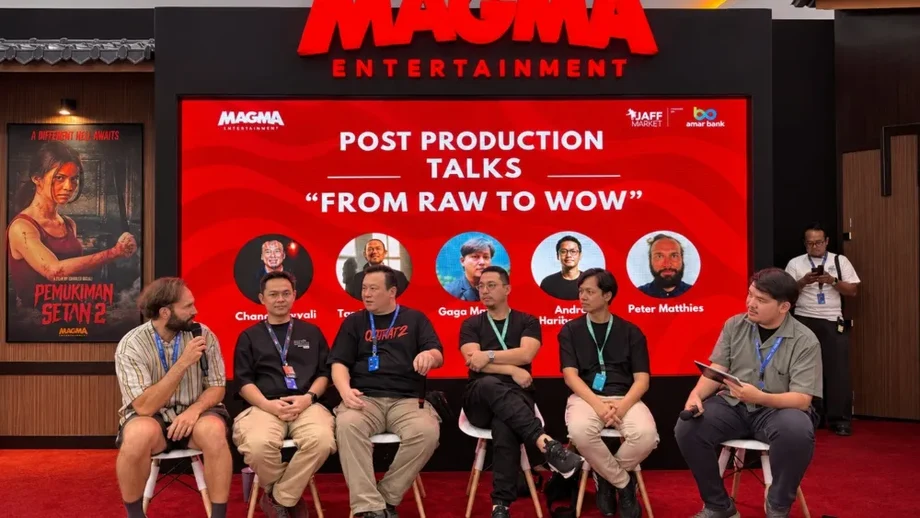
Matthies, a German restoration specialist who came to Indonesia and helped set up the Analog Film Center in Bali, described the job on a post-production panel at the Magma Entertainment booth at JAFF Market in Yogyakarta. He was joined by Charles Gozali, the director of Qodrat and chief executive of Magma, and three of the specialists who work on his films.
So our problem: there's only one color left, which is red. And we try to find the real colors and bring them back to life.
The print itself was heavily used before it reached the lab, and it is damaged. What remains is a film that still exists as an object to be scanned, and as an image that no longer shows what its makers shot.
Cleaning a Brick, Then Scanning at 6K
Work at the lab starts with hands, not software. Reels sometimes arrive so sticky that Matthies compares them to a brick, and they have to be cleaned before a scanner touches them. Scanning then runs at up to 6K, a resolution that keeps grain and surface detail large enough to work with. On Pernikahan Berdarah, the scanning is finished.
The image is now being split into separate red, green and blue channels, a standard route for lifting scratches and dirt out of a picture without smearing what lies underneath. Matthies and his team are also testing artificial intelligence to put color back, and they plan to scan a Betacam copy of the film to use as a color reference. That second source, lower in quality but still carrying the original palette, should keep the result close to what the filmmakers intended.
Dye fading is the most stubborn obstacle. The magenta layer of the film has been destroyed, which is why red has outlasted everything else. Matthies said it could take about a year to settle on the right combination of tools, and he wants the finished work to keep the organic texture of film instead of a clean digital sheen.
The Father's Studio Behind Those Red Frames
For Gozali, the restoration is a family matter. Garuda Film was led by his late father, the producer Hendrick Gozali, and Pernikahan Berdarah is one of the titles he wants to bring back to screens.
The two men met by accident. They were introduced at a tourism event in Jakarta at the moment Gozali was looking for someone who could restore his father's films, and he read the timing as more than coincidence.
It's like God's given signs.
Matthies brought a second motive to the project. Survival of a single print is not the whole difficulty, he said, because the negatives that do survive in Indonesian collections are deteriorating from a condition called vinegar syndrome. The film base releases acetic acid as it breaks down, the smell gives the condition its name, and the reaction feeds on itself once it starts. Cold, dry storage slows it down. Nothing reverses it.
The problem is that all the negatives, they have vinegar syndrome and you cannot stop it. So it's also like time is running actually, and we need to do something.
What Indonesia Did, and Did Not Do, for Its Films
Gozali used the panel to describe how the country has treated films made before 1990. Sinematek Indonesia, the country's film archive, lacked the budget for the work, he said, and the government showed little interest. He recalled a head of the archive who was reduced to tears when a funding request went unsupported.
They wanted to restore and preserve Indonesian films, but the support didn't reach them.
Gozali said preservation at Sinematek has improved since then. The archive's physical limits are still plain: it has run out of room for new acquisitions, and its existing holdings are exposed to humidity and other environmental conditions that damage film and tape.
ALIPH Enters Cinema for the First Time
Help is arriving from outside. The International Alliance for the Protection of Heritage, a foundation based in Geneva, has extended its mandate to film for the first time in its history, through a program called the Safeguarding of Cinematographic and Audiovisual Heritage at Risk. It was announced at the Lumière Summit in Saint-Paul-de-Vence, France, with France's CNC among the supporters.
ALIPH was set up in 2017 as a partnership of public and private funders, with the Getty Trust, Dr. Thomas S. Kaplan and the Leon Levy Foundation among its private partners. Over the past decade it has completed 640 projects in 65 countries at a cumulative cost of $138 million, all of it for cultural heritage in danger. Film is new ground for the foundation.
The sums attached to the cinema program are modest next to that record. An initial $500,000 has been set aside for emergency projects this year, and ALIPH aims to raise $15 million to keep the program running through 2032. The foundation states the need bluntly: only about 20% of the world's film heritage is safeguarded.
Three countries were picked as pilots, Indonesia, Ukraine and Syria. Work is also being scoped in Cambodia, Lebanon, Myanmar, the Philippines and across the Pacific.
What the Indonesia Pilot Will Change at Sinematek
Inside Indonesia, the ALIPH money is aimed at the archive Gozali criticised. The project at Sinematek Indonesia would improve temperature and humidity management, the two factors that decide how long film and magnetic tape survive in a tropical climate.
Two slower kinds of repair are part of the plan as well. Cataloguing would be strengthened, so the archive knows what it holds and can find it, and staff expertise would be built, so the skills stay in the country after the program ends. Storage space, the shortage Gozali described, is the immediate block on taking in new material.
The program puts government archives rather than private collectors at the centre, which means the Pernikahan Berdarah restoration and the ALIPH effort run on separate tracks. One is a single print being rebuilt in Bali. The other is the building and the staff meant to keep thousands of titles from reaching the same state.
Kyiv's 300,000 Reels and Syria's Damaged Archive
The other two pilots show what the program is built for. In Ukraine, the Dovzhenko Centre in Kyiv holds about 62,000 films and 300,000 reels, and it took a strike in June this year. The project will assess the condition of material at risk, find adequate storage and move collections where that is needed.
In Syria, years of conflict have badly degraded the storage and technical infrastructure of the National Film Archives. The program will work to protect the collection and to rebuild the institutional capacity to maintain it inside Syria over the long term.
All three pilots mix emergency intervention, physical infrastructure and training, the three pieces ALIPH says the film sector lacks in the places where collections are most exposed.
Inside Magma's Post Team: 550 People on Set in One Day
The second half of the panel belonged to Gozali's own production machine. His post-production team has worked on every film he has made since Qodrat, among them Pemukiman Setan, Qodrat 2, Tumbal Darah, Badut Gendong and the upcoming Jump Scare.
Badut Gendong, released this year, used a crew of 260 people not counting the cast. A carnival sequence pushed the numbers higher, with more than 350 additional people on set, so that over 550 people were working in a single day across at least three days of shooting.
Film is a collective work. No one person makes a film, except for amateur films.
Gozali builds that collective early. Editing, sound and visual effects staff are brought in from the script reading stage, and his computer graphics team visits the set almost every day of the shoot.
A Fussy Director and the Music He Left Alone
Gozali describes himself as difficult to please, and he says the results show in how little he changes once his specialists deliver.
Believe it or not, I'm a fussy person. I'm really picky, I'm OCD. But on Badut Gendong, there wasn't a single piece of music made by Aria Prayogi and Windu Rizkita, or sound design by Andre Harihandoyo, that I changed.
Visual effects artist Gaga Nugraha reshaped the movements of the wild dog that fights Marsha Timothy in Qodrat, Gozali said. Nugraha put the schedule in perspective: a standard film spends about three months in post-production, while a title as heavy on effects as Qodrat can need 10 months to almost a year.
Talent Is Not the Gap, Budget Is
Andre Harihandoyo, a sound designer at Alunan Post, argued that Indonesian crews match their foreign peers on skill and equipment, and lose on money.
We're losing on budget. They can block two streets in New York so the audio is clean. Sometimes we have to rent a cafe, and the producer doesn't have the budget to switch off the ice cream machine.
Gozali said the same shortage removes a safety net that filmmakers elsewhere take for granted. Pick-up shots, the extra days of filming used to fix what did not work, are not available to him.
Here we don't have that. Once we've shot, it's a wrap. We have no other option.
One consequence showed up on the poster for Jump Scare, where Randy Pangalila's look differs from how he appears in the film. The actor had already moved on to another production by the time the photograph was taken.
Editor Teguh Raharjo described the pace. A drama day can cover 10 to 15 scenes, while a single action scene can take one or two days to cut. He said the working relationship is not built only in the editing room.
Eating durian together... eating satay together, that's important.
What Is Still Open, and What Comes Next
No date has been given for when Pernikahan Berdarah will be finished. Matthies said around a year could pass before the right tools are settled, and the color rebuilt from the Betacam reference has to be judged against what the filmmakers intended, a standard nobody can check against a surviving negative.
ALIPH has not published how the $500,000 will be split among the three pilot countries, and the $15 million it wants to raise would have to carry the program through 2032. The foundation's Indonesia work will be measured in storage conditions, catalogue records and trained staff rather than in restored features.
Matthies set out what he wants the result to make possible.
That the younger generation can see all these wonderful movies.
Gozali closed with advice for the film students in the audience.
Your young age is the time to make lots of mistakes.
JAFF Market runs Nov. 28 to 30 at the Jogja Expo Center, alongside the 21st Jogja-Netpac Asian Film Festival, which continues through Dec. 5.
Key Points
- Pernikahan Berdarah, released by Garuda Film in 1987, survives as one print that has decayed to a single color, red, with no negative in existence.
- Restorer Peter Matthies, who helped set up the Analog Film Center in Bali, has finished scanning the print and is separating it into red, green and blue channels while testing AI to rebuild color.
- A Betacam copy will serve as the color reference; dye fading has wiped out the magenta layer; Matthies said about a year may pass before the right tools are settled.
- For Charles Gozali, director of Qodrat and chief executive of Magma, the film is personal because Garuda Film was run by his late father, the producer Hendrick Gozali.
- Gozali said Sinematek Indonesia lacked budget and government interest for older titles, though he said preservation there has since improved.
- ALIPH, the Geneva foundation set up in 2017, has moved into film for the first time, with Indonesia, Ukraine and Syria as pilot countries.
- The program has $500,000 for emergency projects this year and a target of $15 million to run through 2032.
- The Indonesia project focuses on temperature and humidity control, cataloguing and staff skills at Sinematek Indonesia.
- Magma's Badut Gendong used 260 crew and put over 550 people on set in a single day; its post-production staff join from the script reading onward.
- JAFF Market runs Nov. 28 to 30 at the Jogja Expo Center, alongside the 21st Jogja-Netpac Asian Film Festival, which continues through Dec. 5.