A record built from 550 million plastic balls
Japan's capsule toy business sold about 550 million capsules in fiscal 2025 and took in roughly 196 billion yen (S$1.58 billion), a record for an industry much of the world still associates with children and supermarket lobbies. The figure comes from the Japan Capsule Toy Association, an industry body in Nagoya, and it is about 2.7 times the 72 billion yen the market was worth in fiscal 2022. The same association projects the market will approach 300 billion yen in fiscal 2026, the year ending in March 2027.
Contents
- A record built from 550 million plastic balls
- Four floors, 1,500 machines and one delighted visitor
- From 72 billion to almost 300 billion yen
- Young women, tourists and the pull of fandom
- Why a capsule now costs five times what it did
- Nostalgia for the Heisei era, sold to adults with money
- The same handle, without the capsule
- Fan money spreads to hotels, trains and T-shirts
- Counterfeits and empty shelves
- What is still open
- Key Points
Capsule toys, called gashapon in Japan, are small figures, key chains, charms and novelties sealed inside clear plastic balls and sold from vending machines. A customer turns a handle, hears the capsule drop, and does not know which design is inside until the ball is opened. Machines in Japan mostly charge between 300 yen and 500 yen, about S$2.40 to S$4.00, and that price band now accounts for 90 percent of the market.
Two groups have carried the market to its record. Women in their teens to their forties buy capsules tied to anime, manga and idol groups, and inbound tourists buy them as souvenirs. Both have changed the products inside the balls, the shops that sell them and the price a customer will pay.
Four floors, 1,500 machines and one delighted visitor
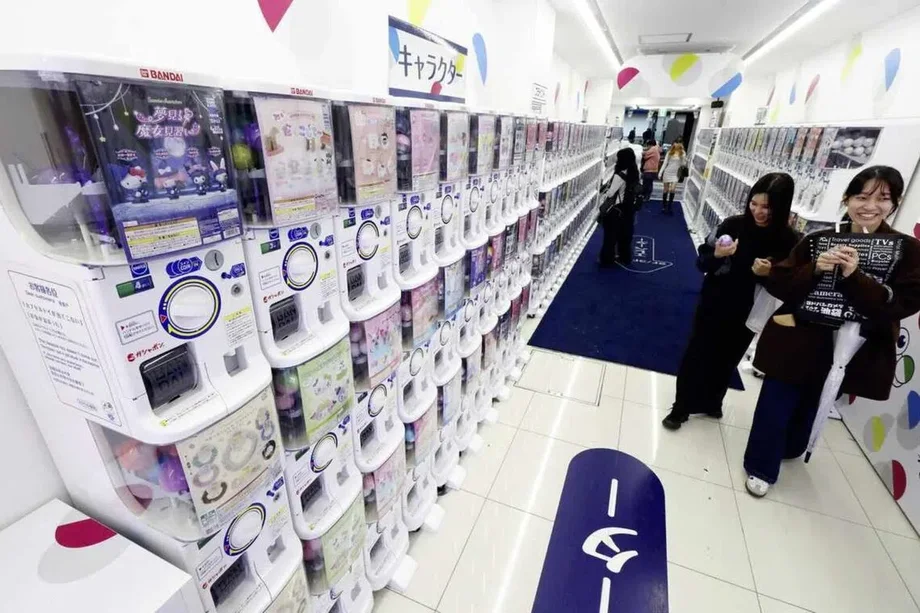
At Capsule Rakkyoku EX Ikebukuro, a speciality store in Tokyo's Toshima Ward, the machines fill four floors. Geo Amusement, the Nagoya company that runs the shop, said the branch opened in 2025 and holds 1,500 vending machines. The company ran 82 stores as of the end of October, most of them in the Tokyo metropolitan area, and its sales have grown every year.
"We have high expectations for our capsule toy division as a new pillar of growth," a representative of the company said.
Loic Couromme, a visitor from France aged 24 who was travelling with two friends in early November, described the experience as "like a fairy tale", saying nothing similar exists in his home country. A fan of Japanese anime and manga, he turned the handles again and again. The object inside is only part of the draw. The turning, the rattle and the small suspense of the drop are what customers pay for as much as the figure.
From 72 billion to almost 300 billion yen
Industry figures trace a climb that has not paused for four years:
- Fiscal 2022: about 72 billion yen
- Fiscal 2023: about 115 billion yen
- Fiscal 2024: about 141 billion yen, up roughly 20 percent on the year
- Fiscal 2025: about 196 billion yen, up 39 percent on the year
- Fiscal 2026: an association projection of close to 300 billion yen
Bandai Co., the toymaker in Tokyo that turned gashapon into a brand in 1977, holds about 57 percent of the domestic market and shipped about 220 million capsules in fiscal 2024 across roughly 1,530 product types. It runs 112 capsule toy stores in 17 countries and regions. In August 2025, Guinness World Records certified Gashapon as the largest capsule toy brand in the world.
Shops have multiplied alongside the machines. The Japan Gacha Gacha Association, a Tokyo group that studies the market, counted more than 1,300 speciality capsule toy stores nationwide as of April 2026, about 20 times the number seven years earlier. The Japan Capsule Toy Association counted 917 speciality stores at the end of January 2026, more than 200 above its own figure a year before.
Young women, tourists and the pull of fandom
A survey by Bandai found that the number of capsule toy buyers in their teens to their forties, women above all, has surged over the past six years, widening a market once dominated by children. The spending sits inside a wider habit called oshikatsu, the practice of supporting a favourite anime character, idol or group by buying, displaying and photographing related goods.
Katsuhiko Onoo, aged 61, representative director of the Japan Gacha Gacha Association, said items tied to Chiikawa and to K-pop idol groups are especially popular, along with a growing number of collaborations with cosmetics and apparel brands. Revivals of hits from the Heisei era (1989 to 2019) such as Tamagotchi are also selling well, he said.
Tourists add a second stream of demand. Animated films such as Demon Slayer: Kimetsu No Yaiba and Jujutsu Kaisen are widely popular overseas, and capsules tied to those franchises have lifted overall sales. At sightseeing spots, visitors often pick up items themed to the region as souvenirs.
Why a capsule now costs five times what it did
Prices once sat at 100 yen to 200 yen. Toys priced between 300 yen and 500 yen now make up 90 percent of the market, and the higher price bought detail: figures with more parts, sharper paint, licensed characters and practical goods a buyer can use. A wave of new manufacturers entered in 2022, and 700 to 800 new items now reach machines every month, according to the Japan Capsule Toy Association.
Practical items have also started appearing, making capsule toys a more familiar part of daily life," the association said. "The market is likely to expand even further.
Nostalgia for the Heisei era, sold to adults with money
Pendant accessories sold in sets with chocolate appeared at the end of the 1970s, and the thrill of opening the box to see which design came out belonged to a generation of Japanese girls. Set with a plastic stone and priced under two dollars, these "candy store jewels" are finding buyers again. Sebon Star's swan design, popular in the 2000s, has returned as fine jewelry set with topaz and amethyst, and the most expensive piece sells for about US$1,200.
The fine jewelry line came from a collaboration between the confectionery maker Kabaya Foods and the jewelry maker Karatz. Shiono Miwa of Karatz, who proposed the project and was a Sebon Star fan herself, said the response has been stronger than expected.
"We started this project just before the 'Heisei Girl' trend became popular. The timing was perfect, and it got a lot of attention," she said.
Tamagotchi, the handheld game shaped like an egg and first released in 1996, is selling again to adults who want to switch off. Takahashi Ayaka, an office worker who recently changed jobs, said the character she loved as a child has helped her through the transition. She now visits capsule toy stores about once a week hunting for new releases, a habit that began about a year ago.
"This goofy face relaxes me after work. Warms my heart," she said.
Kai Azusa, a homemaker raising two children, keeps more than 1,000 capsule toys and other items in a collection room, with a soft spot for designs themed around food that she has gathered since childhood. She sometimes spends tens of thousands of yen in a single month.
"These are my treasures. When I was in elementary school, my allowance was limited, so my mother could only buy me a few of them. Now that I'm an adult, I have more money. I can get the same sparkle I felt as a child. Nostalgia is a big part of it," she said.
Hirose Ryo of the NLI Research Institute, who studies youth culture and consumer trends, said spending driven by nostalgia grows when buyers want comfort and a reason to look ahead.
"Many consumers are looking for purchases that make them happy today and energize for tomorrow. I think nostalgia-driven consumption will continue to drive a trend in which older products are revived and their value is rediscovered," he said.
The same handle, without the capsule
The word gashapon copies two sounds: the gacha of the handle being turned and the pon of the capsule landing in the tray. Capsule machines reached Japan from the United States in 1965 through the trading firm Penny Shokai, and Bandai branded its version Gashapon in 1977, charging 100 yen a turn when 20 yen machines were the norm.
The digital version kept the handle and dropped the capsule. Players spend currency bought inside the game on random draws for characters, weapons or cards, and the draw itself becomes the product. Japan's domestic mobile game market reached 1.6736 trillion yen in 2024, about eight and a half times the size of the capsule toy market, and most of that revenue flows through such draws.
Fate/Grand Order, released by Sony Group's Aniplex in 2015, is the clearest example. The game passed 12 million downloads in Japan by August 2025 and has taken more than US$6 billion from players, about 960 billion yen at 160 yen to the dollar. Revenue works out at US$500 to US$600 per download, against US$100 to US$200 for other leading Japanese titles. Since January 1, 2022, the game has guaranteed the featured top rarity character within 330 pulls, a ceiling that limits the worst case spending.
Japanese regulators settled on limits rather than prohibition. In May 2012 the Consumer Affairs Agency said complete gacha, a mechanic that rewarded players for collecting a full set of items, breached the Premiums and Representations Act ban on prize matching, and the industry dropped the format within weeks. Ordinary draws stayed legal. The guidelines the Japan Online Game Association set for itself cover published drop rates and monthly spending limits for minors.
Fan money spreads to hotels, trains and T-shirts
Toyoko Inn, a business hotel chain, added a plan in October 2025 that lets guests check in with their plush toys for an extra 300 yen including tax, with a small bed and pajamas for the toy provided. The idea was tested at a single hotel in June 2025 and drew heavy attention online, and the chain now plans to offer it at around 120 hotels nationwide.
JR East Group and the anime Frieren: Beyond Journey's End will run their first joint campaign from January 7 to May 31, 2027, with a stamp rally at 15 spots across Tokyo, the Tohoku Shinkansen and six Tohoku prefectures, including Aomori Station and the Sendai Castle museum, and a quiz for passengers on the bullet train.
Uniqlo offers embroidery on its clothing from 1,000 yen for text and 700 yen for characters, at 20 of its 782 stores in Japan as of November 6. Some customers use the service for oshikatsu, stitching the signature color of a favourite idol into a garment, and foreign tourists order in the morning, go sightseeing and collect the finished item later.
The beauty brand SKIN1004 installed photo frames in its flagship stores in Seoul's Myeong-dong and in New York from November 11 that let customers pose as if standing beside its global ambassador, the actor Hudson Williams. Weekend sales at both stores reached about 1.5 times the level before the launch. Paidy's deferred payment service became available for domestic shipping on Weverse Shop Japan on November 25, with a lump sum payment by the 27th of the following month or three instalments at no fee.
Counterfeits and empty shelves
Bandai Spirits, Square Enix and Capcom carried out a joint crackdown on shops selling counterfeit goods in China, a sign that the value of character merchandise has attracted copying. Popularity also strains supply at home. At the Chiikawa Christmas Market, merchandise sold out shortly after 3 p.m. on the first day, and the organisers apologised and said they would open preorders.
What is still open
No government body publishes an official figure for the capsule toy market, so the yearly totals and the 300 billion yen forecast rest on the industry association's surveys. The two associations count speciality stores differently, which is why their totals diverge. Fiscal 2026 closes at the end of March 2027, when the projection can be checked against sales, and the JR East campaign runs until May 31, 2027.
Key Points
- Japan's capsule toy market reached a record of about 196 billion yen in fiscal 2025, about 2.7 times the fiscal 2022 figure, on roughly 550 million capsules sold.
- The Japan Capsule Toy Association projects close to 300 billion yen in fiscal 2026.
- Bandai holds about 57 percent of the domestic market and shipped about 220 million capsules in fiscal 2024.
- More than 1,300 speciality stores operate nationwide, about 20 times the number seven years earlier.
- Toys priced at 300 to 500 yen now account for 90 percent of the market, against a former norm of 100 to 200 yen.
- Women in their teens to forties and inbound tourists drive demand, much of it tied to anime, manga and idol fandom.
- Revivals from the Heisei era, from Sebon Star jewelry to Tamagotchi, draw adult buyers paying for childhood memories.
- The same draw mechanic powers a mobile game market worth 1.6736 trillion yen in 2024, about eight and a half times the size of the capsule toy business.