A consortium built for the newcomers
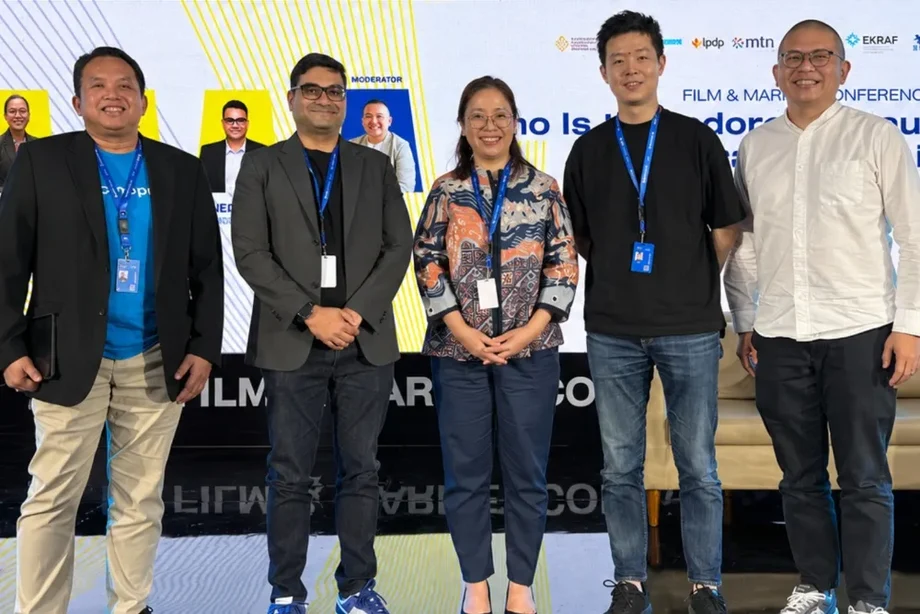
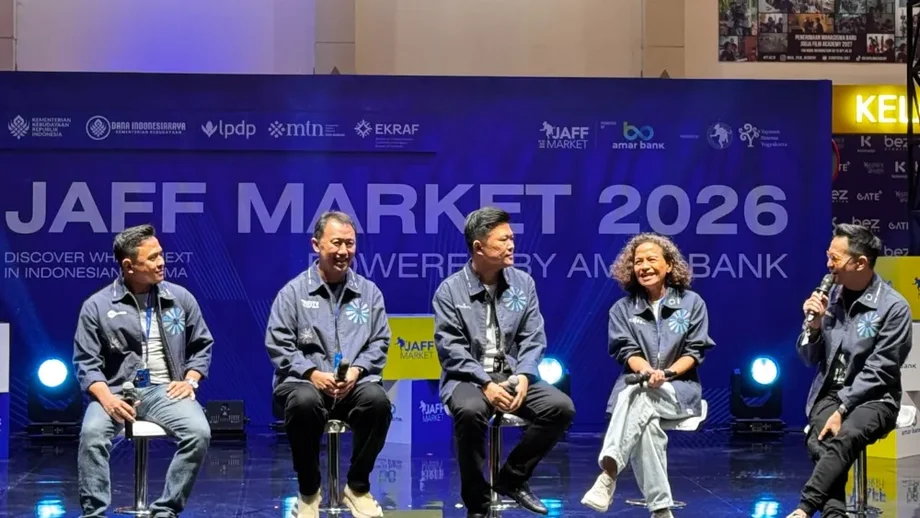
Five Indonesian film companies used JAFF Market in Yogyakarta to launch Sinerona, a consortium that will help new production houses finance, market and release films in a crowded local cinema market. The partners are Imajinari, the company behind the comedy Agak Laen, Mira Lesmana's Miles Films, Jagartha, Trinity Optima Production and Navvaros. Ernest Prakasa of Imajinari moderated the launch session, sitting alongside Lesmana, Jagartha's FX Iwan, Yonathan Nugroho of Trinity Optima Production and M. Noviar Rahman of Navvaros.
Contents
- A consortium built for the newcomers
- The track record the partners bring
- Two hundred films a year and 2,400 screens
- The trust problem at the cinema door
- Who ends up owning the rights
- The first two films: a ticket to Jakarta and a marching band
- Studio Antelope, from a student collective to a company
- Anggita Puri and the long walk to a first feature
- Maknatika, and Anggi Noen's numbers
- What each partner brings to a new producer
- How the five will choose their films
- The market around them
- Key Points
The group did not arrive empty handed. Two projects were presented on the same stage. Yosep Anggi Noen, the festival director whose film Laut Bercerita passed one million admissions in 11 days after opening on Oct. 29, brought Tiket Satu Arah, made through Maknatika, the company he runs with producer Sekarini Seruni. Anggita Puri brought Satu per Satu, produced by Florence Giovani for Studio Antelope. Both companies are steering a feature from financing to cinemas as lead producer for the first time, which is the gap Sinerona says it exists to close.
Sinerona will not make films itself or book screens on its own. The five companies pool money, marketing muscle and relationships with cinema chains behind projects they choose together, while leaving the production house in charge of the film and, the partners say, in charge of its rights.
The track record the partners bring
Imajinari, co-founded by Prakasa in 2021, produced Agak Laen, which drew 9.1 million admissions in 2024, with Jagartha and Trinity among its co-producers. The sequel, Agak Laen: Menyala Pantiku, overtook Avengers: Endgame this year to become the most watched film in Indonesian history with more than 10.98 million admissions, roughly 1.9 million more than the first film managed.
Miles Films made the 2002 teen romance Ada Apa dengan Cinta? and its 2025 musical reboot Rangga & Cinta, directed by Riri Riza. Trinity, one of Indonesia's largest record label and artist management companies, put money into Yandy Laurens' 2025 time travel romance Sore: Istri dari Masa Depan for Cerita Films alongside Imajinari, Miles Films and Jagartha. All five companies also belong to the Indonesian consortium behind Kamila Andini's Four Seasons in Java, which Forka Films leads.
Two hundred films a year and 2,400 screens
Jagartha entered the film business seven years ago with the aim of giving newcomers a way to compete with studios that have been around for decades. FX Iwan put the scale of the problem in numbers. Indonesian cinemas now release more than 200 local films a year from more than 100 production houses.
"You can imagine the opportunities aren't fair. The playing field isn't level," he said.
The exhibition side is just as concentrated. Indonesia has about 2,400 screens. Some 800 sit in Greater Jakarta, roughly 800 more across the rest of Java and close to 400 in Sumatra, which leaves about 400 for every other island combined. Iwan argued that matching individual films to the right programming slots would grow audiences across the industry, rather than moving the same ticket buyers from one title to another.
The trust problem at the cinema door
Access to screens is one of the main reasons the consortium exists, Prakasa said. A cinema weighing a film from an unknown producer is weighing two things at once: the film, and the likelihood that anyone will hear about it.
There's trust that needs to be built when a cinema looks at a film and thinks, 'The film is interesting, but can they promote it so people actually come?' That trust is sometimes missing when exhibitors deal with a new production house or producer. That's what we're trying to bridge.
Lesmana made the same point from the producer's side. A finished film can be good and still fail if the only thing its maker has arranged is a release date.
A film may be finished, and may well be good, but if you're only looking for a release date, it's useless when the film isn't promoted, marketed and packaged well. Cinemas also want to make sure a film doesn't just turn up without anyone knowing about it.
Who ends up owning the rights
Lesmana described the confusion that pushed the five companies into regular meetings. New production houses, she said, reach the distribution stage without ever having been told who ends up owning the intellectual property, the bundle of rights that lets a film be remade, streamed, licensed or turned into a stage show.
We imagined a film industry that could be more supportive of new talent, especially new production houses that have never entered distribution territory and are always confused about who ends up owning the IP. From coffee, from conversations, we decided: what if we just joined forces and built a consortium?
Iwan said the consortium wants independent producers to keep their copyrights while competing on equal terms. Rahman, of Navvaros, described commercialising that intellectual property as a revenue stream that is "still very underutilized" in film, meaning a story can keep earning in ways that go beyond ticket sales.
The first two films: a ticket to Jakarta and a marching band
The first slate puts two very different debuts side by side. Tiket Satu Arah, Anggi Noen's seventh feature, follows people who move to Jakarta to make a living. Satu per Satu, written and directed by Puri, follows a teenage girl recovering from a traumatic event.
It's a very personal project for me. It tells the story of a teenage girl trying to heal herself after a fairly traumatic event. In the process she faces a lot of problems, because recovery often doesn't move in a straight line.
A marching band runs through the film, which Puri called a metaphor for the support system a person needs while recovering. Lesmana said she was won over the moment she read the pitch deck, which carried the English title When the Girls Go Marching In. For Studio Antelope, the project is a first: Lesmana said the company had never carried a film alone from financing through distribution.
Studio Antelope, from a student collective to a company
Giovani and director Jason Iskandar founded Studio Antelope in Jakarta in 2011 as a community of students from eight universities who made short films together. Their work travelled to festivals at home and abroad, including JAFF, where Giovani's short Territorial Pissings was named best short film in 2010. The collective became a company in 2015. Its first feature, Iskandar's Akhirat: A Love Story, a 2021 fantasy romance about an interfaith couple, was made with Base Entertainment and is now on Netflix. The company has since produced films and series and recently finished shooting Perayaan Pertama, another film by Iskandar.
Giovani first pitched Satu per Satu informally to Prakasa at an event before Sinerona existed. Months later he called her to tell her about the consortium. Lesmana has followed the company for years and framed the ambition plainly.
Maybe right now it's still 'Sinerona presents,' but next it's going to be 'Studio Antelope presents.'
Anggita Puri and the long walk to a first feature
Puri is a Jakarta based writer, director and actor, and a graduate of the Fantastic Film School run by the Network of Asian Fantastic Films at South Korea's Bucheon International Fantastic Film Festival. Her credits include Seperti Sediakala and Soulmate Is a Strange Concept. Prakasa came across her around 2019, when he judged a short film competition in which she won several awards, and later offered her a scholarship to a screenwriting workshop, her first formal training in the craft.
Moving from short films to features really takes persistence, because it's so hard for someone to get access to a feature debut. But if we keep making work consistently and network with the right people, it's not impossible.
Maknatika, and Anggi Noen's numbers
Maknatika takes its name from the Indonesian words for meaning and mathematics. Anggi Noen said the aim is to make films with meaning that still do the math, and Prakasa joked that Seruni handles the numbers. The company launched at JAFF Market this week and has two projects moving forward this year. Anggi Noen was born in a village outside Yogyakarta, about 15 kilometers west of the market venue, and he and Seruni both later moved to Jakarta, a migration his new film shares.
His record shows how far a festival career can sit from a commercial one. His 2012 debut, Vakansi yang Janggal dan Penyakit Lainnya, played Rotterdam and Locarno and drew 352 admissions at home. Istirahatlah Kata-Kata, a drama about the disappeared poet and activist Widji Thukul that premiered at Locarno in 2016, drew 54,000. The Science of Fictions won a special mention in Locarno's international competition in 2019.
Laut Bercerita changed the scale. An adaptation of Leila S. Chudori's novel about student activists abducted in the late 1990s, it was produced by Pal 8 Pictures with Jagartha among its backers, premiered in competition at the Busan International Film Festival, opened in Indonesian cinemas on Oct. 29 and passed one million admissions in 11 days. Prakasa said Sinerona signed its deal with Maknatika before the film crossed that mark.
The idea of a feature film is sometimes boxed in. Festival films supposedly can't have big audiences, and when a festival film does get a big audience, people find it strange. Any film can be sold with good marketing. People can sell much bigger than we imagine.
Anggi Noen pointed to Mira Lesmana's Ada Apa dengan Cinta? as a model of what an Indonesian film can become, and described what he wants Maknatika to build.
I believe the future of a work is not just a film, but also an IP, something timeless. Our dream in creating Maknatika is that we too will have a 'Tiket Satu Arah' that lasts forever.
Lesmana returned the compliment, calling him, behind his visionary films, "a very grounded director when it comes to telling stories about family relationships and friendships."
What each partner brings to a new producer
- Trinity Optima Production: music rights, which newcomers often find hard to navigate, and access to artists under its management, according to Nugroho.
- Navvaros: social media reach and brand partnerships from a company that grew out of a media group.
- Jagartha: distribution and seven years of working with producers who had no studio behind them.
- Imajinari: production and marketing of broad commercial hits.
- Miles Films: a catalogue that includes one of Indonesian cinema's most enduring romances.
Seruni said the five bring together expertise that runs from packaging and distribution to music, communications and promotion.
So we really hope that with this collaboration, 'Tiket Satu Arah' can meet a much bigger and wider audience.
How the five will choose their films
Lesmana said scripts would likely reach her and Prakasa first, before the five partners discuss them together. Maknatika was signed before Laut Bercerita passed a million admissions, Prakasa said, an indication that the group is betting on people rather than on a proven box office record. Prakasa said Imajinari wants filmmakers who "have something to say", while adding that projects must make business sense.
Geography is not a criterion. Iwan described the approach as a meritocracy. "We're talking about people," he said. Prakasa noted a practical limit: a film in Bahasa Indonesia reaches a wider audience than one in a regional language, a calculation that will shape which projects the partners can sell. Lesmana set out the kind of producer the consortium is looking for.
The director might already have a big name, but if the producer is opening a production house for the first time, those are people we really need to support.
The market around them
Sinerona launched inside a film market that has grown into Indonesia's largest. JAFF Market runs Nov. 28 to 30 at the Jogja Expo Center, now in its third edition and with Amar Bank as main sponsor, alongside the 21st Jogja-Netpac Asian Film Festival, which continues through Dec. 5.
The domestic figures explain the interest. Data from Cinepoint, published in an industry trends and performance report for the first half of this year, counted 13 Indonesian films that passed one million admissions before mid year, the fastest pace recorded for that point in the calendar. Culture Minister Fadli Zon tied the government's backing of the market to production capacity rather than consumption alone.
We don't want to be only a market for the world's films. We also want to strengthen production, distribution and financing capacity so that more Indonesian works can compete internationally. Our hope is that this growing ecosystem can develop in an inclusive and sustainable way.
Market director Linda Gozali said the event's job is to connect projects with money and partners.
More and more projects are finding funding partners, talent is getting development opportunities, and Indonesian IP is reaching wider markets. The past two years show demand for an industry platform like JAFF Market keeps rising, in step with growing interest in investment and collaboration in the film sector.
Festival director Ifa Isfansyah put the gap in infrastructure terms, saying Indonesia holds strong talent and valuable intellectual property but still needs the industrial scaffolding to turn both into a business that lasts. Amar Bank president director Vishal Tulsian said the bank wants financial services designed around the way creative companies actually operate.
By moving toward solutions that fit the unique business model of this industry, we can make sure creative potential is fully transformed into sustainable economic value.
The market also works with the Indonesian Film Agency (BPI) and industry associations APROFI, IFDC, PILAR, INAFEd, ICS and ACI, and takes Indonesian creators to Marché du Film in Cannes, the Asian Contents & Film Market in Busan and the Asia TV Forum & Market in Singapore.
Key Points
- Imajinari, Miles Films, Jagartha, Trinity Optima Production and Navvaros launched Sinerona at JAFF Market in Yogyakarta.
- The consortium backs new production houses with financing, marketing and distribution help, while leaving them their copyrights.
- Its first two projects are Yosep Anggi Noen's Tiket Satu Arah for Maknatika and Anggita Puri's Satu per Satu for Studio Antelope.
- Indonesia releases more than 200 local films a year from more than 100 production houses, with about 2,400 screens, some 800 of them in Greater Jakarta.
- Imajinari's Agak Laen: Menyala Pantiku holds the national record with more than 10.98 million admissions.
- Anggi Noen's Laut Bercerita, backed by Jagartha, passed one million admissions in 11 days after its Oct. 29 release.
- Scripts will likely go to Mira Lesmana and Ernest Prakasa first before the five partners decide together.
- JAFF Market runs Nov. 28 to 30 at the Jogja Expo Center, alongside the 21st Jogja-Netpac Asian Film Festival through Dec. 5.