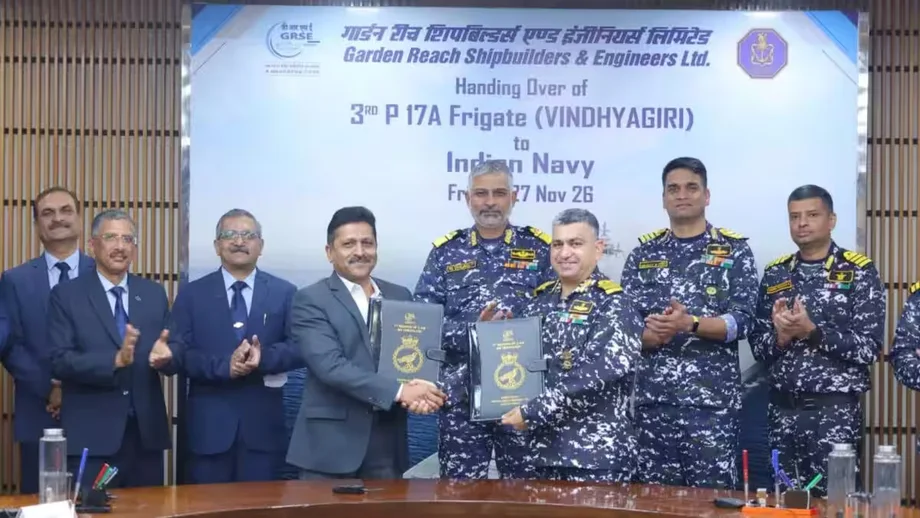
India Closes Out a Seven Ship Run in Kolkata
Rear Admiral R.S. Dhaliwal of Headquarters Eastern Naval Command formally accepted the frigate Vindhyagiri at the Garden Reach Shipbuilders and Engineers yard in Kolkata on Friday, 27 November. The 149 metre warship is the seventh and last of the Nilgiri class built under Project 17A, and the third of the class delivered by the Kolkata yard. Mazagon Dock Shipbuilders in Mumbai built the other four.
Contents
- India Closes Out a Seven Ship Run in Kolkata
- Twenty Three Months From Nilgiri to Vindhyagiri
- BrahMos, Barak 8 and an AESA Radar
- Diesel Engines and Gas Turbines on the Same Shaft
- A Sleeker Successor to the Shivalik Class
- Building in Blocks: Why the Final Ship Took 68 Months
- A Name Revived From a Karnataka Mountain Range
- Rs 45,000 Crore, 200 Suppliers and 4,000 Jobs
- What GRSE Is Building Next
- What Has to Happen Before Vindhyagiri Sails
- Key Points
The handover closes a programme ordered in 2019 at a cost of about Rs 45,000 crore and split between the two state owned yards. Vindhyagiri carries yard number 3024 and is the 811th vessel and the 121st warship delivered by GRSE, a Navratna public sector undertaking under the defence ministry whose history reaches back to a vessel repair workshop opened in Kolkata in 1884.
The defence ministry described the Project 17A ships as multimission platforms with a more advanced weapons and sensor suite than the earlier Shivalik class, built for anti surface, anti air and anti submarine warfare. The class runs from INS Nilgiri, Udaygiri, Himgiri, Taragiri, Dunagiri and Mahendragiri to Vindhyagiri. One account of Friday's delivery put the 2019 order at six frigates; the navy and the ministry count seven, four from Mazagon Dock and three from GRSE.
Twenty Three Months From Nilgiri to Vindhyagiri
INS Nilgiri, the first ship of the class, was delivered on 20 December 2024. All seven frigates followed within 23 months of that date, a pace the ministry held up as evidence of what Indian yards can now do with a complex warship. GRSE handed over its second frigate, Dunagiri, in March 2026, less than eight months before Vindhyagiri.
- 2019: the navy signs the Project 17A contract, worth about Rs 45,000 crore, with GRSE and Mazagon Dock.
- 17 August 2023: President Droupadi Murmu launches Vindhyagiri in Kolkata.
- 20 December 2024: INS Nilgiri, the lead ship, is delivered.
- March 2026: GRSE delivers Dunagiri.
- 27 November 2026: Rear Admiral Dhaliwal accepts Vindhyagiri, completing the class.
The gap between the first ship and the last shows up in build times. Vindhyagiri took 68 months from start to delivery. INS Nilgiri took 84. The navy credits lessons from the first six ships for the 16 month difference, a shortening of nearly a fifth on the same design.
BrahMos, Barak 8 and an AESA Radar
The frigate's main punch comes from BrahMos, a supersonic cruise missile developed jointly by India and Russia, carried here in both anti ship and land attack versions. Air defence rests on Barak 8, a medium range surface to air missile, backed by a 76 mm main gun and a mix of 30 mm and 12.7 mm close in weapon systems, the rapid fire guns meant to stop whatever gets past the missiles.
Above the weapons sits an active electronically scanned array radar, shortened to AESA. Instead of a single spinning antenna, the radar uses many small transmit and receive elements that steer the beam electronically, so it can hold several targets at once without moving. The picture runs through a CMS-17A combat management system, which pulls together the radar, the electronic warfare suite and the weapons so the crew works from one view of the sea and sky around them.
Vindhyagiri also carries anti submarine warfare sensors and underwater weapons, and full aviation facilities for operating helicopters, which extend how far it can watch and chase a submarine contact. Accommodation is provided for 225 personnel.
Diesel Engines and Gas Turbines on the Same Shaft
Each of the frigate's shafts is turned by two different machines, a diesel engine and a gas turbine, in what engineers call a combined diesel or gas arrangement, known as CODOG. The diesel does the slow, economical work of cruising and patrol. The gas turbine takes over when the ship needs to sprint, pushing the 6,670 tonne hull to about 28 knots. A clutch arrangement lets the crew choose one or the other on each shaft, and the power reaches the water through controllable pitch propellers, whose blades rotate to change their angle and the thrust they produce.
An integrated platform management system watches over the machinery, letting the crew monitor and control propulsion, electrical and auxiliary systems from central consoles rather than standing watches at every engine. The arrangement is meant to deliver higher speed and better fuel efficiency than the plants it replaces.
A Sleeker Successor to the Shivalik Class
The Nilgiri class displaces about 6,670 tonnes, five per cent more than the Shivalik class frigates it follows. Despite the extra size, the newer hull is drawn with a sleeker line and a smaller radar cross section, the measure of how much of an enemy radar pulse bounces back from the ship. Angled surfaces, sheltered exhausts and careful shaping make a 149 metre vessel appear smaller on a radar screen than it is.
The navy says the class brings improvements in stealth, automation and survivability over the Shivalik class, along with upgraded sensors to handle threats from surface vessels, aircraft and submarines. Systems that once needed manual control now run with fewer hands, and the layout is meant to keep a damaged ship fighting. The design came from the navy's own Warship Design Bureau, with the Warship Overseeing Team in Kolkata supervising construction at the yard there.
Building in Blocks: Why the Final Ship Took 68 Months
GRSE and the navy assemble these ships through what they call integrated construction. Hull, superstructure and internal systems go together separately in blocks of up to 250 tonnes, with cables and pipes routed through each block before it is welded to its neighbours. Getting the routing right at that stage avoids cutting open a finished hull later.
Artificial intelligence now helps decide the order in which blocks are built, when material has to arrive and how long each stage should take. The design bureau uses software to model how a hull will turn, sail, radiate heat and hold its stability, and to work out how much power it needs, where machinery should sit and how water will flow around it.
The effect shows in delivery times. Indian yards can now build a warship in about six years, against eight to nine years earlier, according to the navy. Project 17A's run of seven deliveries in 23 months is the clearest illustration of that change.
A Name Revived From a Karnataka Mountain Range
Vindhyagiri takes its name from the Vindhyagiri range in Karnataka. The name is not new to the fleet. The first INS Vindhyagiri was a Leander class frigate that served from 8 July 1981 to 11 June 2012, nearly 31 years. President Droupadi Murmu launched the new ship at GRSE on 17 August 2023.
An Indian Navy spokesperson said the ship marked a stride in design and firepower and stood as a symbol of the country's effort to build its own warships. The spokesperson put it this way:
This state-of-the-art frigate reflects a quantum leap in naval design, stealth, firepower, automation and survivability and is an admirable symbol of Atmanirbharta in warship building.
Atmanirbharta means self reliance, the label India's government attaches to its drive to design and build defence equipment at home instead of buying it abroad.
Rs 45,000 Crore, 200 Suppliers and 4,000 Jobs
Project 17A reached 75 per cent indigenous content, the ministry said, with more than 200 micro, small and medium enterprises supplying parts and services to the two yards. The programme is credited with about 4,000 direct jobs and more than 10,000 indirect ones. GRSE says its three ship share of the work created openings for MSMEs, start ups and equipment makers, and left supply chains that later projects can draw on.
Seven frigates at about Rs 45,000 crore works out at roughly Rs 6,400 crore a ship. For a navy that long bought warships abroad, the value of the programme lies in the industrial base it leaves behind, from steel and pipework to radar and combat software, and in the ability to keep a fleet at sea without waiting on foreign suppliers. GRSE notes that these are the largest and most sophisticated guided missile frigates it has built in more than six decades as a defence public sector undertaking.
What GRSE Is Building Next
The Kolkata yard is not standing idle after the last P17A hull. It is building 11 frontline naval platforms: two anti submarine warfare shallow water craft, four Next Generation Offshore Patrol Vessels and five next generation corvettes. Another 36 vessels are under construction, 13 of them for export customers, a sign that Indian yards are selling to foreign navies as well as supplying the home fleet.
What Has to Happen Before Vindhyagiri Sails
The defence ministry has not announced a date for the frigate's commissioning, the ceremony at which a ship joins the fleet and takes its place in the navy's operational order. The ship is expected to be commissioned within the next few weeks. Until then Vindhyagiri counts as a delivered vessel rather than a commissioned one, the last piece of paperwork in a programme that began with a contract in 2019.
Key Points
- Vindhyagiri was delivered to the Indian Navy at GRSE in Kolkata on 27 November 2026.
- It is the seventh and final frigate of the Nilgiri class under Project 17A, and the third from GRSE; Mazagon Dock built four.
- Rear Admiral R.S. Dhaliwal of Headquarters Eastern Naval Command accepted the ship, yard number 3024.
- The frigate is 149 metres long, displaces 6,670 tonnes, carries 225 personnel and reaches about 28 knots.
- Its weapons include BrahMos anti ship and land attack missiles, Barak 8 surface to air missiles, a 76 mm gun and close in weapon systems, with an AESA radar and the CMS-17A combat management system.
- Vindhyagiri took 68 months to build, against 84 for INS Nilgiri, and was launched by President Droupadi Murmu on 17 August 2023.
- All seven ships were delivered within 23 months of INS Nilgiri's handover on 20 December 2024.
- The programme cost about Rs 45,000 crore, reached 75 per cent indigenous content and involved more than 200 MSMEs, with about 4,000 direct jobs.
- No commissioning date has been announced; the ship is expected to join the fleet in the coming weeks.