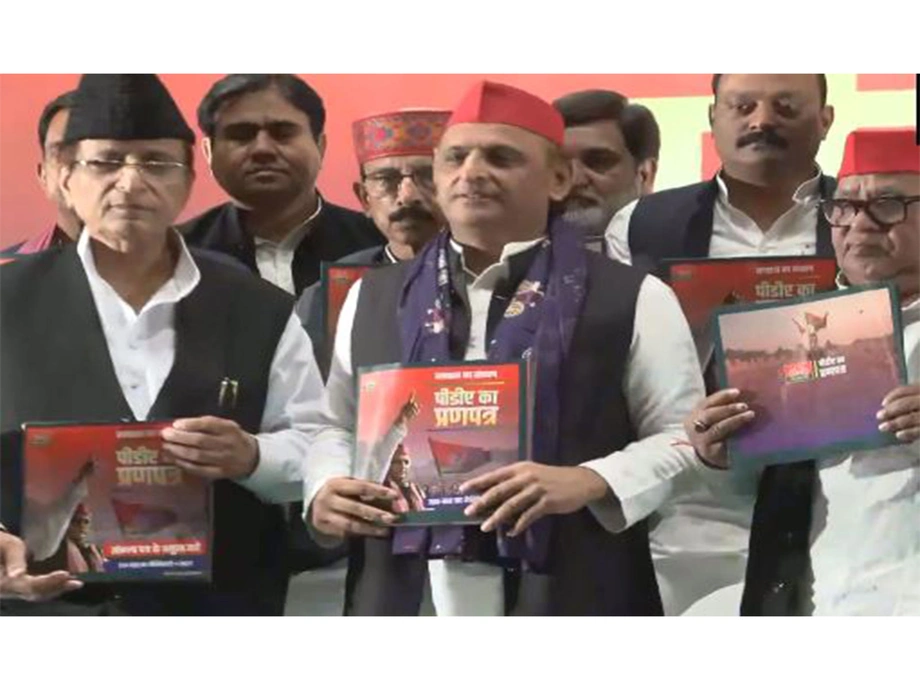
A Manifesto Released on Constitution Day
Samajwadi Party president Akhilesh Yadav released his party's manifesto for the 2027 Uttar Pradesh assembly elections in Lucknow on Thursday, November 26, 2026, choosing Constitution Day to argue that the state's next government must rest on the Constitution rather than on the wishes of those holding power. The document, titled PDA Ka Prannpatra, sets out promises on jobs, schools, farms, hospitals, policing and industry, and it carries a set of numbers the party wants voters to remember: 25 lakh government jobs in five years, a caste census within three months of taking office, a legal guarantee for minimum support prices, Rs 10 lakh health insurance for poor families and Rs 5,000 a month for graduates who cannot find work.
Contents
- A Manifesto Released on Constitution Day
- What PDA Means in the Party's Plans
- Jobs, Allowances and a Promise on Paper Leaks
- Education: 26,000 Schools, Laptops and 6 Per Cent of State Income
- Farm Promises: A Legal MSP for 23 Crops and Milk
- Health, Women and Everyday Entitlements
- Policing: Drones, Artificial Intelligence and a Women's Wing
- Industry, Traders and Digital Governance
- Workers, Agniveers and the Media
- Why the Party Is Rolling Out Manifestos in Stages
- The Alliance Question and the Road to 2027
- Key Points
Yadav framed the election as a contest over the Constitution itself, saying a small group of "dominant, supremacist and selfish" people wanted to keep their "thousands of years of power" intact and, in that attempt, wanted to amend the Constitution and then erase it.
"Our country will be governed by 'Samvidhan' (Constitution) and not 'Manvidhan' (arbitrariness)," he said.
He told the gathering in Lucknow that the date of the release was deliberate.
"We are releasing our manifesto today because 'Acche Din' never came, but 'Bure Din' are about to go away. They know that they are about to be ousted, so their language has changed," Yadav said.
Acche Din, or good days, was the slogan Prime Minister Narendra Modi used in the 2014 general election campaign. Yadav turned it around, and he also accused the state government of "ruining education" through high-handedness at universities and the closure of schools.
What PDA Means in the Party's Plans
PDA stands for Pichhda, Dalit and Alpsankhyak, the Hindi words for backward classes, Dalits and minorities, and the label has become the organising idea of the party's outreach since the 2022 defeat. Under the social justice section, the manifesto promises a caste census in Uttar Pradesh and a zero tolerance policy towards crimes against Dalits, backward communities, minorities, women and children.
The financial commitments are specific. The party says it will place 20 per cent of the state budget under the Special Component Plan for Scheduled Castes and Scheduled Tribes, a budget line meant to direct spending towards these groups. It promises to reimburse fees for backward, Dalit and Economically Weaker Section students who hold reserved seats in private schools, to create a Dalit Development Council chaired by the Chief Minister, and to launch a Dalit Startup Fund. Backlog vacancies in government posts would be filled, and 50 per cent of government contracts worth up to Rs 50 crore would be reserved for Dalits and PDA.
Separate boards are proposed for Scheduled Tribes and for workers in the informal sector, along with proportional representation for poor people in government contracts and welfare schemes. Yadav used the social justice plank to describe the election as a "war" between those who would misuse the Constitution and the PDA, who, in his words, want to "erase all differences, uphold reservation and equality".
Jobs, Allowances and a Promise on Paper Leaks
The employment plan is the part of the document aimed most directly at young voters, a group the party has been courting through Yadav's Vision India meetings with students, investors and business owners in Uttar Pradesh and outside the state, including Bengaluru.
"Our pledge is to provide government jobs to 25 lakh youth within five years, and make employment available to 2 to 3 crore youth in other sectors," Yadav said.
Recruitment would follow a published annual calendar of government vacancies, with examinations held on schedule. Recruitments that need a single exam would be completed in three months, and those with multiple stages in six months. Graduates without work would receive Rs 5,000 a month until they find a job or employment. The manifesto also promises a system in which question papers do not leak, with officials and ministers held personally accountable when they do.
The scale of those targets is worth setting against the state's record. Uttar Pradesh is India's most populous state, and 2 to 3 crore jobs outside government would be several times the number of people employed in the state's organised manufacturing and services sectors. The manifesto does not set out how the party would verify that a graduate is unemployed before paying the allowance, or which department would run the payment.
Education: 26,000 Schools, Laptops and 6 Per Cent of State Income
The party says it will reopen 26,000 primary schools that, it alleges, the present government shut down, and bring back a scheme that gave free laptops to students who pass Class 12. The promise revives a programme from Yadav's earlier term as Chief Minister and sets it against the current government's tablet distribution, which he criticised during the launch.
"The Samajwadi Party will ensure a bright future for the young men and women of Uttar Pradesh. For this, equal opportunities for quality education will be provided to everyone," Yadav said.
The education section commits 6 per cent of the Gross State Domestic Product, the total value of goods and services produced in the state, to education. A State Education Policy would be introduced, Wi-Fi provided in all primary and secondary schools, residential hostels built for male and female students in major cities, and higher education courses aligned with what employers need. Vacant teaching posts would be filled within a year, contractual hiring ended, and Shiksha Mitras, the state's contract instructors, given a special drive for regularisation along with an interim increase of Rs 5,000 a month in their honorarium. Unaided schools would receive Rs 5,000 a month.
Farm Promises: A Legal MSP for 23 Crops and Milk
Agriculture carries the heaviest spending pledges in the document. The party promises a legal guarantee for the minimum support price covering all 23 crops and milk, meaning a farmer would have a legal right to sell at the announced price rather than a policy assurance that governments have implemented unevenly. A state price compensation system is proposed for potato, tomato, onion and other crops that are not covered by the national MSP system.
Other promises include an immediate farm loan waiver, Rs 1.5 lakh crore for rural infrastructure, and a Rs 15,000 crore corpus fund to make sure sugarcane farmers are paid within 24 hours, with prices revised every year on the basis of cost. Irrigation would be free of charge, rural households would get up to 300 units of free electricity, and village clusters would be connected to the internet. Gram, Block and Zila Panchayats would receive dedicated budgets under the 73rd Constitutional Amendment, the 1992 law that made village councils constitutional bodies with regular elections and defined functions.
Sugarcane is the sharpest local issue in that list. Growers in western Uttar Pradesh have repeatedly protested over delayed payments from mills, and the promise of payment within a day goes far beyond current practice. The manifesto does not say where the Rs 15,000 crore would come from, whether fresh borrowing or a reallocation of existing budgets.
Health, Women and Everyday Entitlements
A State Health Policy 2027 is proposed, with free treatment for PDA and poor citizens in government hospitals and Rs 10 lakh health insurance for families living below the poverty line. Women appear in the law and order section as well, with 33 per cent reservation in new police recruitments and a women's police structure that would reach down to villages.
Welfare promises extend to older people and informal workers. The party pledges a Rs 40,000 annual pension for elderly women, including women artisans, paid directly into bank accounts, along with a Maintenance and Welfare of Senior Citizens Act covering dementia care, old age homes and clubs for older people. Samajwadi Canteens would serve meals at Rs 5 a plate, a Migrant Workers Helpline would be set up, and persons with disabilities would receive electric tricycles. The document also promises Rs 40,000 pension and Rs 10 lakh health insurance for elderly construction workers, a Migrant Labour Card, and a constitutional right to equal pay for equal work.
Policing: Drones, Artificial Intelligence and a Women's Wing
On law and order, the party promises zero tolerance against crime, organised gangs and riots along caste or religious lines. A special task force with patrol vehicles in a distinct colour would be created to curb land grabbing, cyber units would be set up in every district, and traffic and crime control would use artificial intelligence. Towns and villages would be covered by CCTV and drone surveillance within a year, linked to the UP 100 and 112 emergency response numbers.
For constables and officers, the manifesto lists fixed duty hours, weekly offs, government housing, a higher diet allowance, a motorcycle and mobile allowance in place of the existing bicycle allowance, and efforts to post married police couples in the same district. The 1090 helpline, the state's women's power line, would be reinforced, and a women's police structure monitored by a special Director General of Police would extend to villages. All police vacancies would be filled immediately, with 33 per cent of new recruits women.
These pledges address complaints that recur in constable associations and in recruitment disputes: long shifts without rest, the cost of a bicycle deducted from a small salary, and transfers that separate families across districts. The document gives no cost estimate for the vehicles, drones and cameras, nor a timetable for hiring beyond the words immediately and within a year.
Industry, Traders and Digital Governance
A New Industrial Policy 2027 would be introduced, with a revival package for micro, small and medium enterprises, clearances through a single window with deadlines, and industrial land converted to freehold. The party promises a statewide startup ecosystem and a Samajwadi Digital Policy that builds hubs for artificial intelligence and information technology, alongside Wi-Fi zones in every city and village.
Traders get their own section. A Trade Security Commission, named Vyapar Suraksha Ayog, would be set up, with dedicated market police patrols. The framing borrows from the anger among small traders over enforcement drives, and it treats shopkeepers as a distinct constituency alongside farmers and young people.
Workers, Agniveers and the Media
A Dial 1890 Mazdoor Power Line would handle workers' complaints, and Rs 5 Samajwadi Thali meals and the Migrant Labour Card would serve labourers arriving from other states. On defence recruitment, the party repeats its opposition to the Agnipath scheme, under which soldiers enlist for four years with only a quarter retained afterwards. The manifesto says it will press the central government to roll back the scheme and, until that happens, ensure state police and other government jobs for Agniveers who do not receive a permanent commission.
Journalists would be covered by a welfare policy providing health insurance and social security, with media facilitation centres at the tehsil level, the administrative unit below a district, and Media Convention Centres in Noida and Lucknow. A separate welfare policy is promised for YouTubers and social media influencers, a group no earlier Uttar Pradesh manifesto has addressed.
Why the Party Is Rolling Out Manifestos in Stages
November 26 was not the end of the exercise. Yadav said at a press conference in Lucknow on November 21 that the party would issue Manifesto One, Manifesto Two and separate manifestos at the district level. The second document, due a few weeks after the first, will focus on women and girls, covering safety, empowerment and income. District manifestos for all 75 districts are expected by January.
The drafting drew on months of consultation with young people, farmers, women, industry representatives, investors, intellectuals and marginalised communities, with lawyers, former armed forces personnel and media professionals addressed through specific welfare proposals. The released document also has a shorter version for public circulation. A senior party leader said the staged approach had a practical purpose.
"Releasing the manifestos in phases will give us time to explain our commitments to different sections of society, seek feedback and take a more focused message to voters," the leader said.
The timing marks a break from the party's recent past. Yadav released the 2017 manifesto on January 22, 20 days before polling began on February 11, and the Samajwadi Vachan Patra on February 8, 2022, two days before the first phase of voting on February 10. Ideas weighed during the drafting but not listed among the released promises included restoring the Old Pension Scheme for state employees and teachers who joined service after 2005, and the party had signalled that environmental protection, forest conservation and climate change would appear in its plans.
- January 22, 2017: manifesto released, 20 days before polling began on February 11
- February 8, 2022: Samajwadi Vachan Patra released, two days before the first phase on February 10
- November 21, 2026: Yadav announces a phased set of manifestos in Lucknow
- November 26, 2026: first manifesto, PDA Ka Prannpatra, released on Constitution Day
- A few weeks later: second manifesto, focused on women and girls
- By January: separate manifestos for all 75 districts
The Alliance Question and the Road to 2027
The Samajwadi Party intends to fight the 2027 election in alliance with the Congress. In the first round of seat talks the party offered 26 seats, while the Congress asked for 120 and has been unwilling to accept a lower number. Discussions are continuing, and no seat sharing agreement has been announced.
The arithmetic behind the party's confidence comes from 2022, when it won 111 seats. It lost the 2017 election as well, and the 2027 vote is its third attempt to dislodge the Bharatiya Janata Party from power in Lucknow. The manifesto's mix of cash transfers, farm guarantees and jobs for young people is designed to hold the PDA coalition together while adding the graduate vote, and the phased release gives the party a longer window than it had in either of the last two campaigns.
Key Points
- Akhilesh Yadav released the Samajwadi Party's 2027 Uttar Pradesh election manifesto, PDA Ka Prannpatra, in Lucknow on November 26, 2026, on Constitution Day.
- The party promises 25 lakh government jobs in five years, work for 2 to 3 crore people in other sectors, and Rs 5,000 a month for unemployed graduates.
- A caste census would be held, 20 per cent of the budget placed under the Special Component Plan for Scheduled Castes and Scheduled Tribes, and 50 per cent of government contracts up to Rs 50 crore reserved for Dalits and PDA.
- Farm pledges include a legal guarantee for the minimum support price on 23 crops and milk, an immediate loan waiver, Rs 1.5 lakh crore for rural infrastructure and a Rs 15,000 crore fund to pay sugarcane growers within 24 hours.
- Health cover of Rs 10 lakh is promised for families below the poverty line, with 33 per cent reservation for women in new police recruitments.
- The party would reopen 26,000 primary schools, restore free laptops for Class 12 graduates and spend 6 per cent of Gross State Domestic Product on education.
- A second manifesto focused on women and girls is due a few weeks later, with district manifestos for all 75 districts expected by January.
- Seat sharing talks with the Congress remain unresolved: the SP offered 26 seats, the Congress sought 120, and the party won 111 seats in 2022.