A Visit That Ended With the Largest Cheque Nepal Has Received
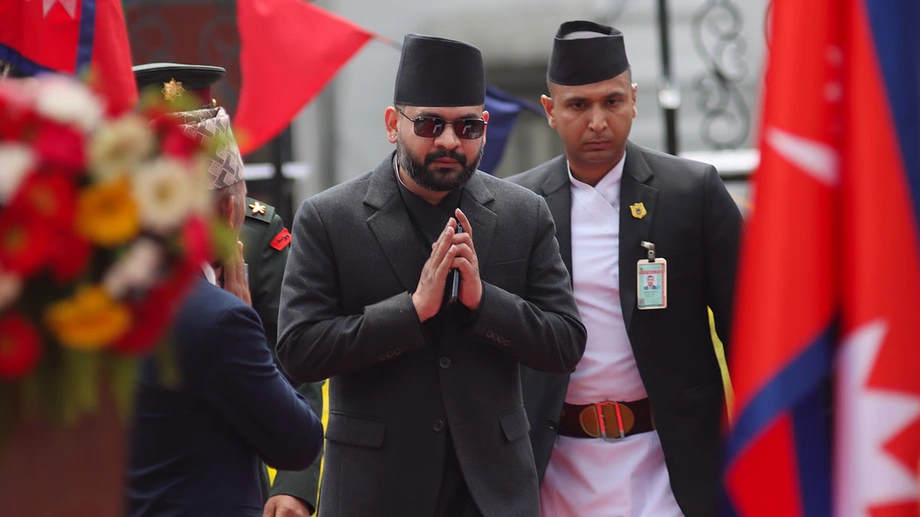
Balendra Shah landed in New Delhi on 22 November for a state visit that ended the next afternoon, his first trip to India since he took office on 27 March 2026 and his first bilateral journey abroad as prime minister. He flew home with eight signed agreements, a new train across the border, the promise of access to two Indian seaports and a pledge of Indian development money worth 15,000 crore rupees, about NPR 24,000 crores, or $1.62 billion.
Contents
- A Visit That Ended With the Largest Cheque Nepal Has Received
- The Train, the Bridge and Two New Ports
- Aviation Delivers Half a Win
- Power, Water and the Pancheshwar Puzzle
- Eight Agreements, a Satellite and an IIT Campus
- Where Did the Border Dispute Go?
- The Expert Group Report Is Set Aside
- A Knot Still Tied, Say Some of Nepal's Own Diplomats
- The Bill Nepal Still Has to Pay
- Next Stops: Beijing and a Meeting in 2027
- Key Points
The figures sit in the joint press release issued after the talks: a grant of 3,500 crore rupees (NPR 5,600 crores) for rebuilding after this year's floods and for new infrastructure, and a line of credit of 11,500 crore rupees (NPR 18,400 crores) for energy projects. A crore is ten million, so the total comes to 150 billion Indian rupees. Nepal's foreign minister, Shishir Khanal, called the visit a historic milestone that put relations back on a positive track.
The two halves of the package work differently. The grant is money Nepal does not repay. The line of credit is a loan, drawn in rupees and repaid with interest, which is why Gokul Baskota, a former minister from the Communist Party of Nepal (Unified Marxist Leninist), argued that the aid arrives with strings attached. He wrote that any lender will provide a loan once interest is assured. Neither side has named the projects the money will pay for. The joint press release says only that specific projects and the way the assistance is released will be settled through mutual consultations.
India chose to lend in rupees rather than dollars this time. The Indian rupee is pegged at 1.6 Nepali rupees, so a loan written in Indian currency carries less exchange risk for Kathmandu, and officials on both sides expect electricity sales to India to help service it.
The Train, the Bridge and Two New Ports
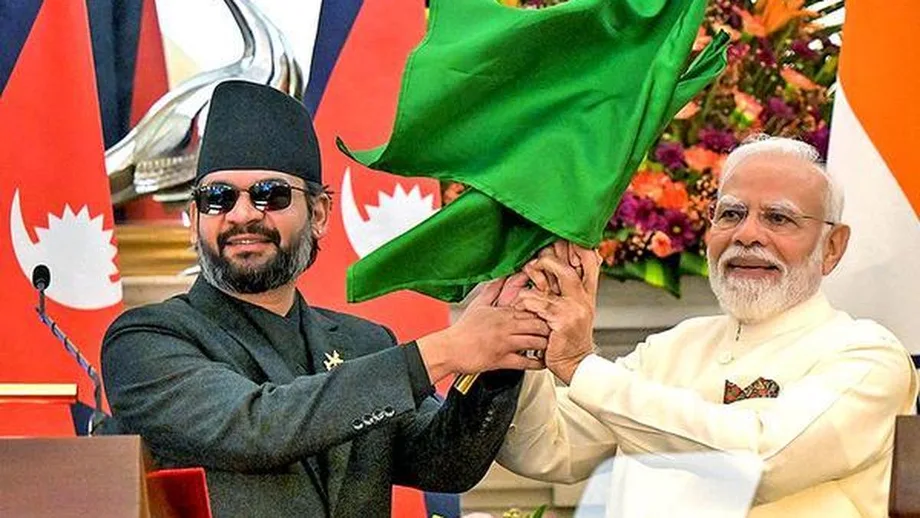
Modi and Shah flagged off the Sarayu-Kamala Express, a weekly train between Ayodhya Cantt in Uttar Pradesh and Janakpur Dham in Nepal, with stops at Gorakhpur, Basti, Raxaul, Sitamarhi, Madhubani and Jaynagar. Ayodhya is revered as the birthplace of Lord Ram and Janakpur as the birthplace of Sita, and both governments presented the service as a religious and cultural link as much as a transport one. The two sides agreed to explore similar connections for Buddhist and Shiv-Shakti pilgrimage circuits.
Friends, the relations between India and Nepal are woven with threads of shared history, faith, culture, and deep people-to-people ties. Lord Ram and Mother Sita are the symbols of our shared civilisation and faith.
Modi said that at the joint press statement in Delhi, before describing the new railway as a bond that would make the ties between the two countries more vibrant. Shah answered with a line of his own about the neighbours.
The ties between Nepal and India stand as firm as the Himalayas and as vast as the ocean, and our closeness is so profound that words alone can scarcely capture it. As a dependable and trusted neighbour, India has consistently stood as a first responder during natural disasters and in difficult times.
A motorable bridge between Dharchula in Uttarakhand and Darchula in Nepal was inaugurated at the same time, tying far western Nepal more directly to Indian roads. For a country that depends on India for almost all of its transit trade, the quieter announcements may matter more: India offered a new route through Deendayal Port at Kandla in Gujarat, and access to Paradip in Odisha once the infrastructure is ready. Nepal's trade has leaned heavily on a single Indian corridor.
Rail plans moved as well. The field location survey for the proposed Raxaul to Kathmandu electrified railway was declared complete, and the two governments said they would work together on the East-West Railway inside Nepal. The leaders laid the foundation stone for a new integrated check post at Banbasa and noted progress at Bhairahawa, Sunauli and Dodhara-Chandani, where three such posts already operate. On the energy side, they dedicated the second phase of the Motihari to Amlekhgunj petroleum pipeline, laid the foundation for a petroleum terminal at Jhapa and pressed for early work on a pipeline between Siliguri and Jhapa.
Aviation Delivers Half a Win
Nepal has spent years asking India for more air entry points, arguing that without them its new international airports at Bhairahawa and Pokhara cannot pull in enough traffic to pay for themselves. The joint statement answers part of that. The existing route known as B345, which links Kathmandu, Bhairahawa and Lucknow in one direction only, will be made bidirectional. Technical consultations to work out the details have not yet been held.
There was no movement on the additional routes Nepal wants through India's western and central regions. Anil Trigunayat, a former Indian diplomat, tied the gap to Indian concerns about Chinese involvement in the two airport projects, saying the airport in Pokhara can pose certain security challenges for India. Govind Pokharel, a former vice chairman of Nepal's National Planning Commission, put the result in plain terms.
Nepal invested a huge amount of money in those airports. It fell short of expectations, but the bidirectional route is a breakthrough.
Vijaykant Karna, a former Nepalese ambassador to India, counted the air route among the reasons to call the visit a breakthrough. He said India had cooperated from the first days of the Bhotekoshi disaster and had now announced assistance worth 240 billion rupees, an amount no other country has offered Nepal.
Power, Water and the Pancheshwar Puzzle
The two leaders laid the foundation stone, by video link, for the 669 MW Lower Arun Hydro-Electric Project and said Indian companies working in Nepal's hydropower sector should finish their projects quickly. They noted progress on joint ventures for two transmission lines with large capacity, one between Inaruwa in Nepal and New Purnea in India and the other between Dododhara and Bareilly.
Older projects remain stuck. The Pancheshwar Development Authority and the Joint Committee on Water Resources were told to finalise the Detailed Project Report for the Pancheshwar Multipurpose Project and begin work, a scheme that has waited years for a cost sharing agreement that has still not been reached. The two governments also asked for faster work on the reports for the Saptakoshi and Sunkoshi multipurpose projects, which they see as a way to hold back floods as well as generate power.
The direction of travel is set by the Long Term Power Trade Agreement signed in Kathmandu in January 2024, which runs for 25 years and aims at 10,000 MW of Nepali electricity exports to India. The credit line in rupees was written with that trade in mind.
Eight Agreements, a Satellite and an IIT Campus
Eight memoranda of understanding were exchanged at Hyderabad House. The Indian Space Research Organisation and Nepal's Ministry of Information and Communication will build a satellite communication network using the South Asia Satellite, a communications and meteorology satellite launched in 2017 that also serves Afghanistan, Bangladesh, Bhutan, the Maldives, Sri Lanka and India. National Forensic Sciences University in Gandhinagar will work with investigators from Nepal Police's Crime Investigation Department, a tie that was already used when Indian forensic experts helped with DNA examination after the Bhotekoshi floods. Rashtriya Raksha University will partner Nepal's National Police Academy.
Other agreements cover training for Nepali civil servants through India's National Centre for Good Governance, cooperation on Ayurveda and other traditional systems of medicine, a health and medicine pact between the two health ministries, technical help on urban development, and livestock and fisheries. India also agreed to set up a campus of the Indian Institutes of Technology in Nepal, and to build a park for agricultural industry in Chitwan with grant money.
The two prime ministers adopted a vision document, Viksit Bharat and Samunnat Nepal, built on ten pillars that cover economic partnership, connectivity, energy and water, contacts between people, climate resilience, disaster management, sports, start-ups, digital services, space and innovation. Shah's government presents it as a break with the agenda of the parties it replaced. Critics see a list of ambitions with few deadlines.
Where Did the Border Dispute Go?
Few politicians in Nepal have been as loud on territory as Shah once was. As mayor of Kathmandu in 2023 he hung a map of Greater Nepal in his office, showing land Nepal ceded to British India under the Treaty of Sugauli in 1816, after a row over a mural in India's new Parliament. In August 2025 he accused India and China of infringing on Nepal's sovereignty by agreeing to reopen trade through the Lipulekh pass. In May 2026, two months into his term, a planned visit to Kathmandu by India's foreign secretary, Vikram Misri, was called off after Shah declined to meet him.
In Delhi the subject was handled at arm's length. The joint press release records that the two leaders noted progress in joint field work on the repair of boundary pillars and directed their foreign secretaries to work on outstanding boundary issues. Neither leader mentioned Kalapani, Lipulekh, Limpiyadhura or Susta in public. Misri said Nepal's objection to trade through Lipulekh was not raised. It wasn't discussed between the two sides, he said.
Khanal defended the wording, arguing that the boundary question would not have appeared in the document at all had it not been discussed. Officials in Nepal's foreign ministry had prepared for the subject to be central to the visit and found on the morning of 22 November that it had been dropped from the agenda. The mechanism run by the two foreign secretaries has not met in recent years.
The border dispute has remained the same for years, and there has been no progress on it. Although the issue of the 1950 treaty has been raised for a long time, no solution has been found.
Nilambar Acharya, a former Nepalese ambassador to India, reached that conclusion and added that keeping the issue suppressed serves no one. Suresh K Goel, a former Indian diplomat, read the omission differently.
The visit was a clear indication that we are breaking with the past of the relationship, and we want to chart a new pathway.
The Expert Group Report Is Set Aside
For a decade, Nepali politicians have asked Delhi to hand over the report of the Eminent Persons Group, a panel of four members from each country set up in 2016 to recommend changes to the 1950 Treaty of Peace and Friendship and to other parts of the relationship. The group finished its work in July 2018. The report was never formally submitted to either government.
Misri closed the file at a briefing after the visit, saying the two countries would work from the new vision document instead.
We are looking at a forward-looking approach. We're not looking backward. And to me, therefore, the report that you have mentioned is not relevant.
The vision document keeps one door open. It says existing bilateral agreements, including the 1950 Treaty of Peace and Friendship, could be reviewed on the basis of mutual consent. The treaty had not appeared in a joint statement for years, after both sides stopped mentioning it once the expert group began work.
Reaction in Kathmandu split along party lines. K.P. Sharma Oli, chairman of the CPN-UML, said the trip was akin to a personal visit because Shah did not raise the expert group report, the border row or the trade imbalance. Gagan Kumar Thapa, president of the Nepali Congress, said there had been no progress on issues that have lingered for years. Two former Indian ambassadors, Manjeev Puri and Rakesh Sood, said Shah had shown maturity by concentrating on what he could win. Sood added that no rule obliges an Indian prime minister to act on such a report.
A Knot Still Tied, Say Some of Nepal's Own Diplomats
Three former ambassadors gave three verdicts. Karna called the visit a breakthrough achieved through quiet diplomacy, with the finance and foreign ministries doing the work without the publicity that surrounded earlier governments. Dinesh Bhattarai called it a success overall, saying the money will bring real relief, while noting that the substance is not very different from earlier visits.
Acharya listed what he says is still missing: the border, the treaty, the stalled South Asian Association for Regional Cooperation, of which Nepal is chair, the expert group report and the trade deficit. He credited India with helping during the Bhotekoshi disaster and with running the Ayodhya to Janakpur train, and said progress in the relationship is real even if the politics has not moved.
Pradeep Kumar Gyawali, a former foreign minister, raised a different complaint before the visit, saying Shah had not consulted political parties or even informed the President. He described a trust deficit between Delhi and Kathmandu as the main problem to fix.
He has not held any consultations with political parties, and he has not even informed the President about this state visit. This is an unprecedented approach.
Jhala Nath Khanal, a former prime minister, made a similar point, saying Shah had not set out a common national agenda before leaving, so nobody could tell what he would agree to.
The Bill Nepal Still Has to Pay
The floods that swept the Bhotekoshi and Rasuwa areas killed more than 1,400 people, with thousands still missing, and the government estimates that rebuilding could cost as much as $4.8 billion. Against that, the Indian grant of about $400 million covers a fraction. Shah told the UN General Assembly in September that when climate disasters devastate poorer countries, the answer cannot simply be another mega loan.
Modi framed the package as help for that recovery.
We express our deep condolences for the loss of lives caused by the severe floods in Nepal in August. And today, to provide new strength to Nepal's reconstruction and long-term development, we announce a Development Cooperation Package of 24,000 crore Nepali rupees.
Diplomats in both capitals point to India's record on delivery as the test ahead. India took about 20 years to complete the National Police Academy in Nepal and a decade to build three integrated check posts, while Chinese projects of a similar size have taken three or four years. A dispute over India's Agnipath recruitment scheme, announced without consulting Kathmandu, led Nepal to stop sending Gorkha recruits to the Indian Army and has not been settled.
Next Stops: Beijing and a Meeting in 2027
Kathmandu is already looking north. Talks have begun on a visit by Shah to Beijing, most likely before the Chinese New Year on 6 February, though no dates have been fixed and Nepal is waiting for China to propose them. Shah met China's ambassador, Zhang Maoming, on 10 August and told him he wanted to deepen historical ties. Misri had travelled to Kathmandu on 5 November to deliver India's invitation.
Officials on both sides will have to keep the file moving. The High Level Monitoring Group, set up in 2016, is to be reactivated and to meet at least once every six months, and the next Joint Commission meeting is due in 2027. Modi accepted Shah's invitation to visit Nepal, with dates to be settled through diplomatic channels.
Key Points
- Prime Minister Balendra Shah made a state visit to India on 22 and 23 November 2026, his first since taking office on 27 March.
- India pledged 15,000 crore Indian rupees, about NPR 24,000 crores or $1.62 billion: a 3,500 crore grant and an 11,500 crore line of credit in rupees for energy projects.
- Eight agreements were signed, covering space, forensic science, policing, civil service training, Ayurveda, health, urban development, and livestock and fisheries.
- The Sarayu-Kamala Express began weekly runs between Ayodhya Cantt and Janakpur Dham, and a bridge linked Dharchula in India to Darchula in Nepal.
- Nepal gained transit access through Deendayal Port at Kandla, with Paradip to follow, and the B345 Kathmandu, Bhairahawa and Lucknow air route will become bidirectional.
- Foundation stones were laid for the 669 MW Lower Arun project, a check post at Banbasa and a petroleum terminal at Jhapa.
- The border dispute over Kalapani, Lipulekh, Limpiyadhura and Susta was left to the two foreign secretaries, and India's foreign secretary said the Eminent Persons Group report is no longer relevant.
- The 1950 Treaty of Peace and Friendship could be reviewed on the basis of mutual consent, according to the new vision document.
- Former ambassadors Vijaykant Karna and Dinesh Bhattarai called the visit a success, while Nilambar Acharya said the main political disputes remain unresolved.
- Nepal is negotiating dates for a visit by Shah to Beijing, likely before 6 February.