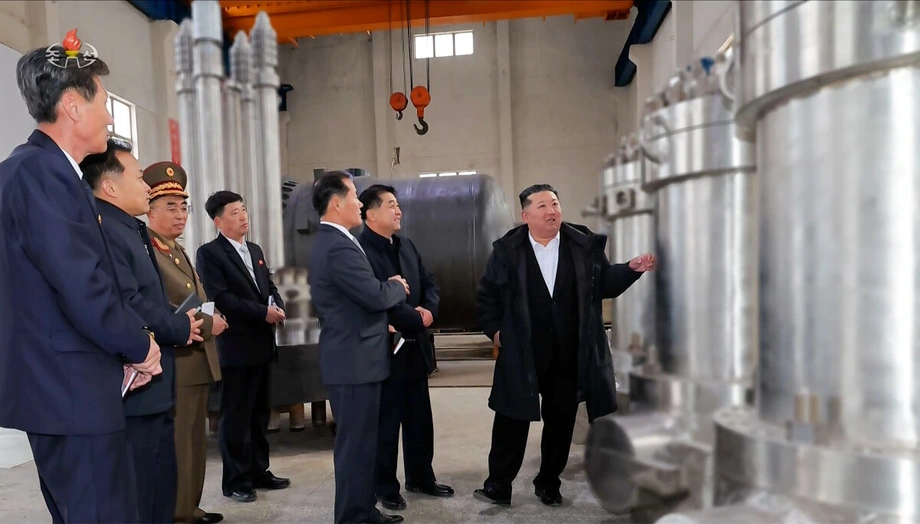
A factory tour instead of a handshake
Kim Jong Un spent 25 November 2026 inside buildings that make the ingredients for nuclear bombs, and North Korea's state media released the photographs the following day. The Korean Central News Agency reported that Kim inspected a "newly-built important materials production factory" and a second plant "under expansion project", then visited a facility it called a "nuclear-powered equipment production base" and the Nuclear Weapons Institute, where he reviewed this year's output of nuclear material and weapons.
Contents
- A factory tour instead of a handshake
- What the cameras were allowed to see
- The first picture of a submarine reactor
- Yongbyon grows a hall 95 metres long
- Sixty warheads, or eighty, or 120?
- Trump keeps the door open, alone
- An arsenal written into the constitution
- Why AUKUS keeps coming up
- Tactical warheads aimed across the southern border
- Four plant tours, four diplomatic moments
- Seoul's response and the questions left open
- What Washington's choice comes down to
- Key Points
The dispatch named no locations and gave no production numbers. It quoted Kim telling officials to "consolidate the nuclear posture of the country in every way by further accelerating the exponential updating of the self-defensive nuclear capabilities", and to answer what he called "the recent intolerable moves of the enemy states which are highly developing the nuclear capabilities".
Five days earlier, on 19 November, President Donald Trump had left the Asia-Pacific Economic Cooperation summit in Shenzhen, China, without the meeting with Kim that he had publicly sought. Six days earlier, the leaders of the United States, China and Russia had pledged to hold talks on reducing nuclear risks and preventing proliferation. Kim answered both with a declaration that the global rules against spreading nuclear weapons no longer work.
He called it a "reality" that "the international nuclear non-proliferation system has collapsed" and that "the danger of using nukes is increasing day by day due to the enemies' moves to gradually facilitate the nuclear technology transfer and access to nuclear weapons". In the same breath he promised the North would "never abuse" its status as a nuclear state, and said that treating its arsenal as a provocation "is a real provocation and a major threat that should be countered and eliminated at any cost".
What the cameras were allowed to see
Rodong Sinmun, the newspaper of the ruling Workers' Party, printed the images on 26 November. One set shows Kim and uniformed officials walking between two dense rows of tall metal cylinders in a low, dimly lit hall: the arrangement that analysts identify as gas centrifuges, the machines that spin uranium gas until the fissile isotope uranium-235 is concentrated enough for a weapon. Enrichment to about 90 percent gives weapons-grade uranium; the same process stopped at a few percent gives fuel for power reactors.
South Korea's government assessed that the centrifuge hall shown this time is a new nuclear material production facility at Yongbyon, the complex at the centre of the programme since the 1980s. The June 2025 disclosure showed a different site, judged by outside experts to be another enrichment plant at the same complex, while the September 2024 images were assessed by Seoul as likely taken at Kangson.
A second set of photographs shows a corridor lined with warhead casings. Some are dark, in the style of the Hwasan-31 tactical warhead first photographed in March 2023. Others are silver, and the nameplates on their stands read Hwasan-14, Hwasan-21, Hwasan-22, Hwasan-24, Hwasan-25, Hwasan-31-1, Hwasan-31-2 and Hwasan-31-3. Pyongyang had never published designations beyond the Hwasan-31, and the display implies a family of warheads sized for different launchers and missions rather than a single battlefield design.
Shin Jong-woo, secretary general of the Korea Defence and Security Forum, reviewed the pictures and said:
The North appears to be developing various peanut-shaped and rugby ball-shaped hydrogen bombs in the Hwasan series.
The peanut-shaped device, blurred in the released images, was first shown in September 2017, the year of the North's sixth and most powerful nuclear test. An hourglass silhouette among the silver casings drew particular attention, because two-stage thermonuclear weapons built for high yield tend to be shaped that way. Lee Choon-geun, a director at the Korea Advanced Institute of Science and Technology, described the implication:
(This can be seen as) developed small thermonuclear weapons beyond small atomic bombs. If large thermonuclear weapons are in the megaton range, small thermonuclear weapons can be considered to be around several hundred kilotons.
A kiloton is the explosive force of 1,000 tonnes of TNT. The bombs dropped on Hiroshima and Nagasaki in 1945 were in the range of 15 to 21 kilotons, so several hundred kilotons on a short-range missile aimed at a neighbouring country would go far beyond any battlefield use.
The first picture of a submarine reactor
Among the most consequential images was the least dramatic: machinery inside what KCNA called a nuclear-powered equipment production base. Ankit Panda of the Carnegie Endowment for International Peace, who described the site as a naval reactor facility, wrote that the disclosure was "a very notable disclosure". Shin Jong-woo said the plant was believed to be producing submarine reactors and parts, and that the equipment pictured could serve the nuclear-powered submarine North Korea says it is building, a vessel of about 8,700 tons that he expects to be launched next year.
The critical technology is a small modular reactor, a compact pressurized water unit that fits inside a submarine hull and drives it for years without surfacing. Its value is strategic as much as engineering. A submarine that stays hidden at sea gives a country a second-strike capability, meaning the ability to survive an enemy's first nuclear attack and still fire back. North Korea's land-based missiles sit on sites that satellite imagery can find, while a submarine cannot be mapped as easily.
Pyongyang revealed the vessel's exterior in December last year, and some analysts dismissed it as a hull without a propulsion plant. The new photographs appear designed to end that doubt. Neither the equipment's purpose nor the submarine's nuclear propulsion has been independently verified, and state media did not say the machinery was a reactor. Analysts have also raised the possibility that Russia supplied related technology, given the military cooperation the two countries have built since 2024.
Yongbyon grows a hall 95 metres long
The IAEA has had no inspectors inside North Korea since 2009 and relies on satellite imagery. Its director general, Rafael Grossi, told the agency's Board of Governors on 18 November that a further extension to the original Yongbyon enrichment facility had been under construction since mid-September 2026 and that the new section was externally complete by late October.
The ongoing expansion of the DPRK's uranium enrichment programme remains a cause for serious concern.
Grossi added that the agency could not fully assess what happens inside. The Institute for Science and International Security, a Washington research group, went further with commercial imagery of the site, which sits about 100 kilometres north of Pyongyang. Its assessment described a new hall roughly 95 metres long and 10 metres wide with no internal dividing walls, a space large enough for rows of centrifuges. The institute noted that the original plant was expanded once in 2013 and again in the 2021-22 period, and that the newest work began in September and moved fast.
Possible uses it listed include more low-enriched uranium, extra support space for existing plants, or research and development. It also raised the option that matters most: "Another possibility is that the added hall is designed specifically to make weapon-grade uranium." David Albright, the institute's president, told Voice of America the hall could turn out more than 100 kilograms of weapons-grade uranium a year, enough for four or five warheads, partly by further enriching the low-enriched uranium North Korea already holds. No equipment has been confirmed as installed, and no enrichment has been confirmed as started.
Chung Dong-young, South Korea's unification minister, said last year that the North was running four uranium enrichment facilities and operating them every day. North Korea can build warheads from highly enriched uranium or from plutonium, and Yongbyon has plants for both.
Sixty warheads, or eighty, or 120?
No outsider can count the stockpile, and the published figures are estimates. SIPRI's 2026 Yearbook put North Korea at about 60 assembled warheads in January 2026, up from 50 a year earlier, with enough fissile material for at least 30 more. South Korea's defence minister said in August that Pyongyang is generally believed to hold between 80 and 120 warheads, while noting the range comes from private research groups and cannot be officially confirmed. Trump told reporters in August 2026 that Kim "has 57 very powerful nuclear weapons", the first time a sitting U.S. president had publicly attached a number to the arsenal.
Kim claimed in June 2026, during an earlier facility visit, that the North's capacity to produce weapons-grade material had more than doubled in five years. The country has conducted six nuclear tests since 2006, the last and largest in 2017.
Trump keeps the door open, alone
Trump arrived in Shenzhen saying "we may meet with Kim Jong Un also". He left on 19 November after a three-way session with Xi Jinping and Vladimir Putin and no encounter with Kim, telling reporters he expected to see the North Korean leader on some future date that nobody has scheduled. A senior White House official had said before the trip that Trump "is ready to talk with Kim Jong Un, whether by phone or in person" and that "the ball is very much in North Korea's court".
In an interview with the New York Post, Trump rejected the idea that he had been snubbed.
No, he didn't ignore it. You know, we had many leaders there ... There'll be a time when we meet ... It was just not really the right time. It was a very busy two-day period.
Trump added that he could restart the letter exchanges he kept with Kim during his first term and that contact could "start up right away", though he conceded the two had not written "recently" and that "We've been off to other things".
An arsenal written into the constitution
Kim's language on 25 November tracked legal changes made three years earlier. In 2023 North Korea enshrined its nuclear weapons policy in its constitution, and in 2022 a nuclear forces law broadened the circumstances in which warheads could be used, including some attacks that involve no nuclear weapons. At the Ninth Workers' Party Congress in February 2026, Kim said nuclear state status had been "permanently cemented" and was irreversible, and that better relations with Washington depended on the United States changing its posture.
On this tour he called that status "absolutely inviolable".
Whoever attempts to deny or plunder the constitutional status of our state, it will be the most serious infringement on our national sovereignty and interference in our internal affairs aimed at forcing us to give up our Constitution and social system. And we will regard this as an open declaration of war and him as our enemy.
The same report carried a line that closes off the old negotiating agenda: "Our possession of nuclear weapons is an absolutely irreversible choice as long as malicious forces exist that use nuclear weapons as a means of achieving hegemony." Kim also said: "Our nuclear capability is now a reality."
Why AUKUS keeps coming up
Kim built his case on two foreign submarine programmes. He said Washington had "incited its vassal states in the vicinity of our country to the possession of nuclear-powered submarines", introducing "the dangerous precedent of nuclear proliferation" to Northeast Asia through AUKUS, the pact under which the United States and Britain will help Australia operate submarines driven by nuclear reactors. He also accused Washington of assembling a "nuclear military alliance system" by planning to share and jointly use nuclear weapons with allies.
South Korea is pursuing nuclear-powered submarines of its own, a plan Trump approved in October 2025, according to a White House joint fact sheet. Nuclear propulsion does not mean a vessel carries nuclear weapons, a distinction Kim's statements blur. His words are also aimed at Seoul's programme, which he presents as evidence that the rules are being rewritten around him.
An analysis published this week by the Synergia Foundation describes a maritime security dilemma in which each state's investment in undersea nuclear propulsion deepens its neighbours' insecurity, and it notes that the operational maturity of North Korea's naval nuclear ambitions remains uncertain.
Tactical warheads aimed across the southern border
KCNA said Kim ordered the weapons sector to "pay attention to utilizing the tactical nukes of different missions in multiple domains", calling it an urgent task arising from "the inevitable reality facing the border with the most dangerous enemy state". North Korean broadcasts this week named South Korea as the "most harmful hostile state". Tactical nuclear weapons are lower-yield warheads meant for battlefield use, as distinct from strategic weapons built to destroy cities at long range. Spreading them across land, sea and air launchers is what Kim means by multiple domains.
Hong Min, a senior research fellow at the Korea Institute for National Unification in Seoul, read the instruction as a plan to tie tactical warheads to the firepower units along the southern border, which would lower the threshold for using them. The Synergia Foundation analysis ties the same shift to the 2022 law, arguing that a wider menu of smaller weapons blurs the line between conventional fighting and nuclear escalation.
Lim Eul-chul, a professor at Kyungnam University, saw the tour as a negotiating tactic rather than a closed door.
This is not so much North Korea permanently closing the door to dialogue with the United States as a strategy of raising the bar: 'denuclearization talks' are over, and if talks open in future, it will deal only on a 'nuclear state versus nuclear state' basis.
Moon Seong Mook of the Korea Research Institute for National Strategy put the message in plainer terms.
Trump has talked about a willingness to meet Kim Jong Un, but the basic U.S. position that North Korea must denuclearize remains unchanged. So Kim Jong Un wants to say 'Look at how powerful we are. Don't talk about denuclearization if you want to meet us.'
Moon added that the inspection also let Kim check progress on this year's targets before a Workers' Party conference at the end of the year, where new goals are likely to be set.
Four plant tours, four diplomatic moments
North Korea had shown the inside of a uranium enrichment plant only rarely before September 2024, most famously to visiting American scholars in 2010. Since then it has staged four such disclosures, each close to a diplomatic turn.
- 13 September 2024: KCNA reported Kim's visit to the Nuclear Weapons Institute and a weapons-grade nuclear material plant, the first release of photographs from inside an enrichment hall. It followed Putin's June 2024 trip to Pyongyang and a treaty pledging mutual military support, and the August decision to send troops to Russia.
- 29 January 2025: Rodong Sinmun reported another visit to a nuclear material production base and the Nuclear Weapons Institute, nine days after Trump's second inauguration.
- 3 June 2025: Kim toured a new enrichment facility at Yongbyon a week before Xi Jinping's visit to Pyongyang.
- 25 November 2026: the factory tours and submarine reactor images, released a day after Trump said he was open to resuming his letter diplomacy.
Each disclosure landed when Pyongyang's backing from Moscow or Beijing was firm enough to absorb the criticism, and when Washington was deciding how to approach it.
Seoul's response and the questions left open
South Korea's defence ministry said it takes Kim's remarks on battlefield nuclear weapons seriously. A spokesperson, Jeong Bit-na, said:
We view gravely the stated intention to expand the operation of tactical nuclear weapons (on the Korean Peninsula). They must immediately cease attempts to justify nuclear development.
The ministry said Seoul would keep a firm military readiness with the United States, strengthen deterrence through consultations and upgrade its response to nuclear threats, and it called on Pyongyang to implement UN Security Council resolutions. The Joint Chiefs of Staff declined to share its analysis of the facilities shown by KCNA, calling that confidential information held by South Korea and the United States.
Several things remain unknown. KCNA did not say where any of the three sites are, what the new factory makes, or how much. No government has confirmed that the hall at Yongbyon holds centrifuges or that the machinery shown is a submarine reactor, and the IAEA still has no access. No date has been set for a Trump-Kim meeting, and Pyongyang has not publicly replied to the invitation. Kim Yo Jong, the leader's sister, has said dialogue remains theoretically possible while indicating the North sees no value in pursuing it now.
What Washington's choice comes down to
Kelsey Davenport, director for nonproliferation policy at the Arms Control Association, described the trend behind the photographs.
Over the past eight years, North Korea's nuclear arsenal has expanded both quantitatively and qualitatively.
She said the growth now includes sea-based delivery systems. The Synergia Foundation analysis argues that production capacity may matter more than the warheads themselves, since a plant that makes material every year keeps adding to the stockpile while negotiators count only what already exists. It also sets out the trap for Washington: engaging a nuclear-armed North Korea without demanding disarmament may reduce the risk of miscalculation, while insisting on disarmament first may simply buy Pyongyang more time to build.
Key Points
- Kim Jong Un inspected two nuclear material plants, a "nuclear-powered equipment production base" and the Nuclear Weapons Institute on 25 November 2026.
- KCNA said he ordered an accelerated build-up and declared the international non-proliferation system collapsed.
- Photographs showed centrifuge halls, warheads labelled Hwasan-14 through Hwasan-31-3, and equipment analysts link to a submarine reactor.
- The IAEA says a new Yongbyon enrichment extension was externally complete by late October 2026; the Institute for Science and International Security estimates the hall could yield material for four or five warheads a year.
- SIPRI estimated about 60 warheads in January 2026; South Korea's defence minister gave an unconfirmed range of 80 to 120.
- Kim said any attempt to deny the North's constitutional nuclear status would be an "open declaration of war".
- Trump left the APEC summit in Shenzhen on 19 November without meeting Kim and says a meeting will happen later.
- Seoul's defence ministry urged Pyongyang to stop justifying its nuclear programme; no date is set for talks.