A date, a plane and a promise to walk home
Sheikh Hasina, the prime minister Bangladesh forced out of office in August 2024, has fixed a date for her return: December 16, the anniversary of the country's victory over Pakistan in 1971. Her spokesperson, Syed Mozzamemel Ali, announced the date on November 24 and asked the government in Dhaka to send an aircraft operated by the national carrier, Biman Bangladesh Airlines, to Delhi to collect her. Hasina is 79 years old and has lived in India for more than two years. This is the first time she has named a specific day for her homecoming.
Contents
- A date, a plane and a promise to walk home
- What she asked for, and what Dhaka sent back
- Nine crossings, and a scouting trip to one of them
- Running a party in exile from a phone
- India separates the flight from the handover
- The weeks that set up December 16
- Gopalganj becomes the flashpoint
- Why December 16 carries such weight
- The case for leaving her where she is
- Key Points
The request hit a wall within hours. Her close aide Abu Obaidha Arin then described a plan few in Dhaka had considered. If no aircraft is provided, he said, she will come by road. Supporters have identified nine crossing points along the 4,096 km frontier India and Bangladesh share across West Bengal, Assam, Meghalaya, Tripura and Mizoram.
She is even prepared to walk into Bangladesh," Arin said. "This is a carefully thought-out, precise plan. This is serious.
Humaiun Kobir, Bangladesh's state minister for foreign affairs, answered with a line that has since travelled further than most official statements in the dispute.
Reality and desire are different things," Kobir told reporters in Dhaka. "She's not a regular commercial passenger. She can only be brought back in handcuffs.
Behind the exchange sits a legal fact neither side disputes. Hasina was sentenced to death in her absence by Bangladesh's International Crimes Tribunal on November 17, 2025, for crimes against humanity linked to the crackdown on the uprising that ended her rule. She rejects the charges. The United Nations has estimated that as many as 1,400 people were killed by security forces during that unrest.
Her Awami League is banned. Much of its leadership is abroad, jailed or underground, and thousands of cases have been filed against its workers. The government says she would be arrested the moment she set foot on Bangladeshi soil.
What she asked for, and what Dhaka sent back
The paperwork problem came first. On November 9, Hasina's legal representatives at Matrix Chambers, a law firm based in London, asked the Bangladesh High Commission in New Delhi to issue her a fresh passport and national identity card, both cancelled months after she left. Dhaka refused, a decision that helped set off the first wave of street protests in her name.
Her spokesperson argued that the government owes her the transport as well. Hasina was flown to India aboard a Bangladeshi aircraft on August 5, 2024, so the return leg, Ali said, is Dhaka's responsibility.
Since Sheikh Hasina was flown to India on a Bangladesh aircraft on August 5th, 2024, she now calls upon the government to arrange for her air transport from Delhi back to Dhaka," Ali said in a statement. "Having exiled her contrary to the Constitution under such circumstances, it is now the responsibility of the government to make possible her return to Bangladesh on Victory Day on December 16th.
Kobir called her "a convicted criminal; a fugitive terrorist" and said Bangladesh "will not entertain any such delusional request". Aminul Islam, chief prosecutor of the tribunal that convicted her, said it was "ridiculous" for a condemned fugitive to expect the state to send a plane, describing the request elsewhere as "nothing but madness".
Members of the government have set out what they say will happen next. Zahed Ur Rahman, the information and broadcasting adviser to Prime Minister Tarique Rahman, said the death sentence will be carried out if she returns and that no negotiations are planned. Foreign Minister Shama Obaed Islam said that as soon as she tries to enter, "she will be arrested. And she will be taken to jail, and the law will take its course".
Rahman, who took office in February, governs through a difficult stretch of his own. His administration is fighting one of the world's worst measles outbreaks, garment workers have been demanding higher wages, and growth has slowed to about 3.5 percent.
Nine crossings, and a scouting trip to one of them
The talk of a land route is not entirely rhetorical. Four senior Awami League leaders, among them Jahangir Kabir Nanak and Bahauddin Nasim, travelled to the Petrapole crossing in West Bengal's North 24 Parganas district on November 23 and spent about two hours at the immigration centre there. On the Bangladesh side lies Benapole, the counterpart crossing, and Dhaka sits roughly 230 km away. The Agartala-Akhaura crossing has been mentioned as another option.
Arin's claims go beyond logistics. He says the party can bring five million people onto the road between the border and the capital to form a human chain, and that it has the "organisational capacity to make that happen". That number would dwarf anything the party has put on the streets since it was banned, and such a crowd is impossible to verify from outside. Its mobilisations so far have been flash protests, torch marches and processions in districts such as Pabna, Tungipara, Gafargaon, Muktagacha and Kaliakair.
Running a party in exile from a phone
Hasina has kept her political network alive through interactive audio sessions on Telegram, according to Arin. He says she has held more than 300 of them over 18 months, reaching party workers in all 64 districts and the country's 300 constituencies through the Awami League's 78 local units, with individual sessions running four or five hours.
The format matters in a country where the party cannot hold public meetings. A broadcast that runs one way would let her speak at supporters. These sessions are built to let her listen, hear grievances from local units and gauge what is happening on the ground. With much of the leadership abroad, in jail or underground, the phone line is one of the few channels left.
Rezwan Howlader, an Awami League youth leader in Gopalganj, Hasina's ancestral district and the centre of the recent unrest, described a membership that has absorbed pressure and stayed in place.
People are no longer staying silent," Howlader said. "Despite arrests, pressure and harassment, our leaders and activists remain steadfast and hopeful. No one can erase Sheikh Hasina or the support she enjoys among millions of people waiting to welcome her back to Bangladesh.
India separates the flight from the handover
New Delhi has chosen its words with care. At a briefing on November 25, the Ministry of External Affairs spokesperson, Randhir Jaiswal, put daylight between two things Dhaka treats as one: a citizen travelling home voluntarily with a valid document, and a formal request for extradition.
"The extradition request is being examined in line with our established process," Jaiswal said, adding that "the case of a citizen willing to return voluntarily to her country on a travel document is a matter separate from the extradition request".
Asked whether India was helping arrange her journey, Jaiswal said the matter was between Hasina and the Bangladesh government and declined to say more. He also voiced concern about the law and order situation in Bangladesh.
The distinction carries weight because the machinery behind each path is different. Bangladesh's extradition request was filed while the interim government under Muhammad Yunus was in office, and it falls under a treaty signed in 2013 and amended in 2016 to speed up the transfer of fugitives. India has not conveyed a response. Minister of State for External Affairs Kirti Vardhan Singh told the Rajya Sabha that no reply had been given to Dhaka, and a parliamentary standing committee recorded the government's position that Hasina's stay was allowed on humanitarian grounds.
Dhaka has begun to look past the treaty. On November 27, the speaker of Bangladesh's parliament, Hafiz Uddin Ahmed, said the government could take the matter to the International Court of Justice if India does not hand her over. From the other side of the political spectrum, the National Citizen Party's Nahid Islam urged Prime Minister Rahman to enforce the death sentence and press Delhi harder.
The weeks that set up December 16
- August 5, 2024: Hasina flees to India as an uprising led by students ends her 15 years in power.
- November 17, 2025: The International Crimes Tribunal sentences her to death in absentia for crimes against humanity.
- November 9, 2026: A law firm based in London asks the Bangladesh High Commission in Delhi for a passport and identity card on her behalf. Dhaka refuses.
- November 23, 2026: Four Awami League leaders visit the Petrapole crossing in West Bengal.
- November 24, 2026: Her spokesperson names December 16 and requests a Biman Bangladesh Airlines flight.
- November 25, 2026: India's foreign ministry separates voluntary travel from extradition.
- November 27, 2026: Parliament speaker Hafiz Uddin Ahmed raises the possibility of going to the International Court of Justice.
- November 29 and 30, 2026: The Awami League's announced nationwide shutdown.
- December 1, 2026: The BNP holds a rally in Dhaka, the start of programmes running through December 31.
- December 16, 2026: Victory Day, and the date Hasina says she will return.
Gopalganj becomes the flashpoint
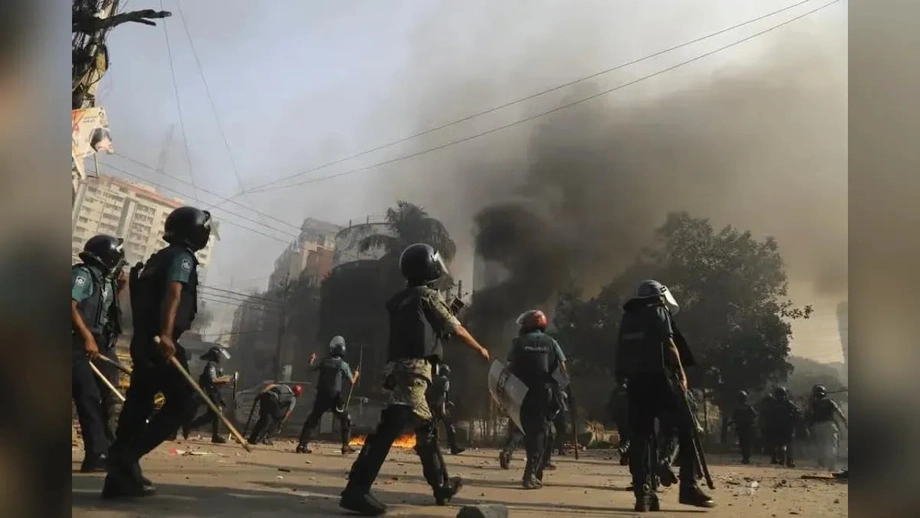
Whatever happens on December 16, the weeks before it have already been violent. Awami League supporters have attacked police stations, burned vehicles and targeted homes and offices belonging to leaders of the ruling Bangladesh Nationalist Party, with Gopalganj the hardest district to control. Highways have been blocked with felled trees and burning tyres, and police have pulled back from some areas.
Conflict monitoring group Acled counted 40 demonstrations and more than 140 riots by November 23. At least 11 people, including two civilians, were killed in political violence during November, six of those deaths tied directly to the unrest. Clashes in Gopalganj left at least 30 injured and 12 shops vandalised, with crude bombs going off. In Narail, more than 50 homes and shops were torched after two BNP leaders were killed. In Chattogram, the house of former interim leader Muhammad Yunus was set ablaze.
Security forces have moved in numbers. Some 120 platoons of Border Guard Bangladesh are deployed across seven districts: 56 in Gopalganj, 17 in Savar and Ashulia, 19 in Gazipur, seven in Narayanganj, eight in Chattogram, seven in Cox's Bazar and two in Bhaluka, with four on standby. An earlier count put the total at 108. The deployment follows directions from the Ministry of Home Affairs and uses drones and cameras worn on the body to watch the streets.
Arrests have run alongside. More than 100 people linked to the Awami League were picked up in Dhaka alone, among them the former education minister Nurul Islam Nahid. Dhaka has also suspended funding and public services to Gopalganj district. The party has called a nationwide shutdown for November 29 and 30, the first real test of how many people it can still move.
Rival parties are filling the same calendar. The BNP has planned a large rally in Dhaka on December 1 and events through December 31, Jamaat-e-Islami has announced a programme spanning 40 days, and the National Citizen Party has scheduled its own activities. All three say they will stay on the streets to resist any revival of the banned party.
Why December 16 carries such weight
The date is not a convenience. On December 16, 1971, Pakistani forces surrendered to the joint command of Bangladeshi and Indian troops, ending a nine month war and sealing the creation of Bangladesh. The day is observed as Victory Day, or Bijoy Dibosh, and the 2026 edition is the 55th anniversary. Hasina's father, Sheikh Mujibur Rahman, led the movement that produced the country.
By choosing that date, Hasina ties her return to the founding story of the state that convicted her. Her supporters present the choice as a signal to Jamaat-e-Islami and the National Citizen Party, the forces that drove the 2024 uprising and that she accuses of sympathy with the losing side of 1971.
The case for leaving her where she is
Two accounts of the standoff help explain why neither capital is in a hurry. The editor of the weekly newspaper Counterpoint, Zafar Sobhan, describes an elaborate game of chicken, in which Dhaka demands a handover it may not want to complete and Delhi holds a guest it cannot easily move.
Avinash Paliwal, who teaches politics and international studies at SOAS University of London, argues that Hasina's announcement has "shifted the burden of choice to Dhaka rather than Delhi". India, he says, "feels it has tried its best" with Rahman's government over 10 months, from appointing a senior politician as high commissioner with cabinet rank to offering fresh talks on security and trade.
The failure of this outreach has left India disillusioned with Dhaka. India seems to have decided that bilateral relations will likely remain tense whatever it does, so there is little reason to stop Hasina from stirring the political pot.
Almost 10 months into his term, Rahman has not visited India. A trip was said to be in preparation in August before a Hasina press conference in Delhi set the effort back.
Inside Bangladesh, the calculations are just as tangled. Shafiqul Alam, editor of the Daily Waadaa and a former press secretary to the Yunus interim government, sees the Awami League "exploiting cracks in the unity forged during the uprising", with disagreements over the July Charter, proposed constitutional changes and a referendum widening the gap between the BNP and rivals Jamaat-e-Islami and the National Citizen Party.
The Awami League sees an opening," Alam said. "The party believes this is an opportune moment to take to the streets, exploiting a weakened police force and divisions among the forces of the July uprising.
Economic grievance feeds the mood. Garment workers took to the streets in early November demanding a monthly minimum wage of Tk 30,000, up from Tk 12,500 fixed in 2023, while the 2026 national pay scale raised salaries for soldiers and senior officials by nearly 138 percent. Between 2009 and 2023, the economy grew from $109 billion to $437 billion, a record Hasina's supporters now hold up against her successors.
Extradition would force Dhaka to do what it has threatened: arrest her, try her and carry out the sentence. That outcome could unite a fractured Awami League, inflame Gopalganj and the streets of Dhaka, and pull the army back into a political role it has avoided since August 2024. Kobir has called her a "thorn" in relations between the two countries, a guest India can neither send away nor stop dealing with.
Whether Hasina boards a plane, walks through a border post or stays in Delhi remains undecided. No carrier has been arranged, no travel document has been issued, and India has given no signal that it will help either way.
Key Points
- Sheikh Hasina, 79, says she will return to Bangladesh on December 16, Victory Day, and has asked Dhaka to send a Biman Bangladesh Airlines aircraft from Delhi.
- Her aide Abu Obaidha Arin says nine crossing points have been identified on the 4,096 km border and she is prepared to walk into Bangladesh if the flight fails.
- Bangladesh's government refuses. State Minister for Foreign Affairs Humaiun Kobir says she can return only by extradition, "in handcuffs, and under strict surveillance".
- Hasina was sentenced to death in absentia by the International Crimes Tribunal on November 17, 2025. Her Awami League is banned.
- India's foreign ministry says the extradition request is being examined through established processes, while a voluntary return on a travel document is a separate matter.
- Bangladesh's parliament speaker has said Dhaka could go to the International Court of Justice if India does not hand her over.
- Acled recorded 40 demonstrations and more than 140 riots up to November 23, with at least 11 killed in political violence in November.
- Some 120 Border Guard Bangladesh platoons are deployed across seven districts, 56 of them in Hasina's home district of Gopalganj.
- The Awami League has called a nationwide shutdown for November 29 and 30, while the BNP, Jamaat-e-Islami and the National Citizen Party have announced programmes through December.