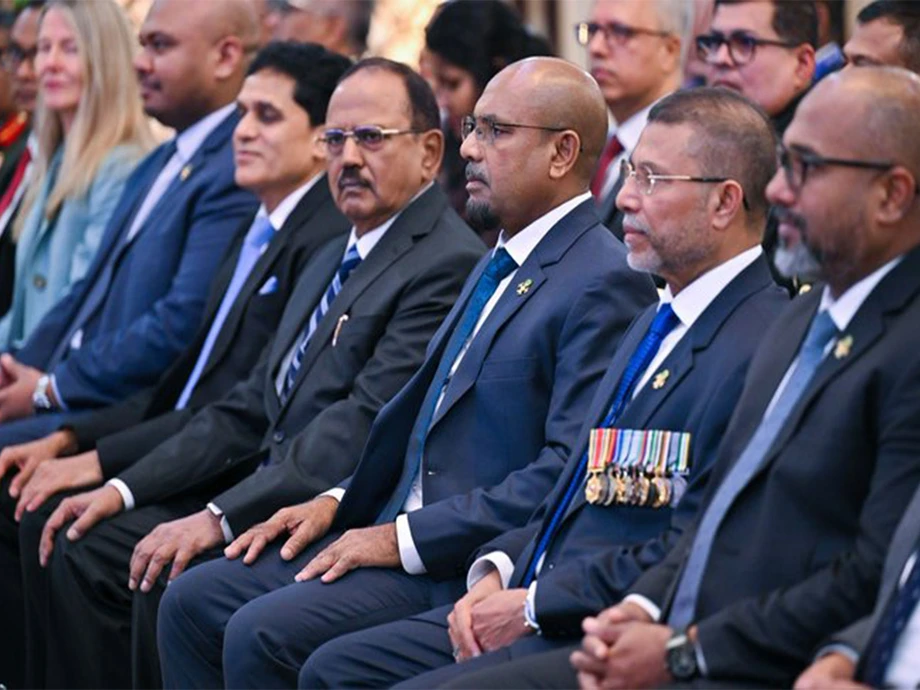
A Roadmap for 2026 and 2027
Four Indian Ocean governments signed a set of agreed minutes and adopted a roadmap of cooperation for 2026 and 2027 on Wednesday, November 25, as the eighth National Security Adviser level meeting of the Colombo Security Conclave closed at Villa Nautica Paradise Island in the Maldives. India's Ministry of External Affairs announced the adoption on Thursday.
Contents
- A Roadmap for 2026 and 2027
- Who Sat at the Table in Male
- What the Five Pillars Actually Cover
- Doval Casts the Indian Ocean as a Bridge
- A Grouping With a Secretariat and a Scorecard
- Drugs Today, Artificial Intelligence Tomorrow
- Two Guests India Wants as Members
- The Missing Member and Bangladesh's Paperwork
- Why the Indian Ocean Weighs on Delhi
- Key Points
The roadmap lists deliverables and planned activities under five pillars of cooperation: maritime safety and security; countering terrorism and radicalisation; combating trafficking and transnational organised crime; cyber security and protection of critical infrastructure and technology; and humanitarian assistance and disaster relief. Training, the sharing of best practices and work to build capacity are the tools named for carrying the plan forward.
In its statement, the Ministry of External Affairs said member states had reaffirmed their commitment to regional peace and security through sustained cooperation and had stressed closer collaboration across the five pillars. The text read:
The Meeting further reaffirmed the collective commitment of Member States to promote regional peace and security through sustained cooperation.
The Maldives hosted the gathering, which opened on November 24 and closed on November 26, with the delegations meeting on the Wednesday.
Who Sat at the Table in Male
Maldives National Security Adviser Lieutenant Colonel (Retd.) Ibrahim Latheef led the host delegation. India sent National Security Adviser Ajit Doval. Sri Lanka was represented by Air Vice Marshal (Retd.) Sampath Thuyacontha, Secretary of the Ministry of Defence, and Bangladesh by Lieutenant General Md Faizur Rahman, Commandant of the National Defence College.
Mauritius joined the proceedings by video link. Two countries outside the grouping attended as guests: Australia, represented by Sarah Storey, First Assistant Secretary of the South and Southeast Asia Group and Head of the Office of Southeast Asia at the Department of Foreign Affairs and Trade, and Malaysia, represented by Khairul Azhar (Nik) bin Abu Bakar, Director of the Maritime Security and Sovereignty Division at the National Security Council in the Prime Minister's Department.
The minutes and the roadmap were signed by the Maldives, India, Sri Lanka and Mauritius, the four members present in the room or on the link. Bangladesh took part in the discussions while it finishes the internal steps its membership requires.
What the Five Pillars Actually Cover
Each pillar of the roadmap targets a threat that crosses borders faster than any single coast guard, police force or disaster agency can handle alone.
- Maritime safety and security: coordination on threats in the Indian Ocean, the waterway that carries trade and energy supplies between Asia, Africa and Europe, which makes the safety of its waters a shared concern for every state along the coastline.
- Countering terrorism and radicalisation: tighter coordination against terrorism and extremist activity, a core reason the grouping was created.
- Combating trafficking and transnational organised crime: joint work against networks that move drugs, people and goods across frontiers.
- Cyber security and protection of critical infrastructure and technology: guarding ports, power systems and other essential assets against digital attack.
- Humanitarian assistance and disaster relief: better regional readiness and faster responses when cyclones, floods or other emergencies strike.
Adding cyber security to a body that began with maritime and military questions widens its brief well beyond patrolling waters. Delegations that took the floor in Male pointed to attacks on ports and critical infrastructure carried out with artificial intelligence as one of the emerging priorities the new plan has to answer.
Doval Casts the Indian Ocean as a Bridge
In his address on November 25, India's national security adviser, Ajit Doval, argued that the countries along the ocean's rim share more than water. He pointed to centuries of cultural and trading ties that he said bind the region together, and asked those present to think about what they pass on.
We the littoral states of the Indian Ocean region share a common maritime space and are connected by civilisational heritage shaped over a long period of history. Let us leave for our progeny also a heritage, a tradition that will bind them together and not divide them through these seas.
Doval placed the conclave inside two frameworks of Indian foreign policy. Neighbourhood First is New Delhi's stated priority for ties with its immediate neighbours. Mahasagar, an acronym for Mutual and Holistic Advancement for Security and Growth Across Regions, was announced by Prime Minister Narendra Modi in March 2025 during a visit to Mauritius and covers security and economic cooperation with countries of the Global South.
For India, the Colombo Security Conclave represents the intersection of our Neighbourhood First outlook and the Mahasagar vision, which stands for Mutual and Holistic Advancement for Security and Growth Areas. We are committed to continue working closely with the CSC countries to enhance our collective capacities in dealing with the evolving serious security challenges.
As one of the countries that initiated the grouping, Doval promised practical backing for members' goals.
I assure all of you here that India, as one of the partner countries here, as one of the countries that initiated the idea of the Colombo Security Conclave, will give its best and will try to give all necessary help and assistance, and we assure you of our fullest commitment to achieve our common objectives.
A Grouping With a Secretariat and a Scorecard
Vice Admiral (Retd.) S N Ghormade, the conclave's first Secretary General, opened the substantive work with a review of how far members had come in carrying out decisions taken at the previous summit. That seventh meeting was held in New Delhi on November 20, 2025.
- November 2020: the Colombo Security Conclave is launched at India's initiative.
- August 2024: members adopt the CSC Charter and a Memorandum of Understanding establishing the secretariat.
- 2024: the members agree to base a permanent secretariat in Colombo, Sri Lanka.
- November 20, 2025: the seventh National Security Adviser meeting is held in New Delhi.
- November 24 to 26, 2026: the eighth meeting takes place in the Maldives, producing the new roadmap.
Doval described the change from an informal idea to a body with staff, a charter and a chief executive as the grouping's most important structural gain.
The idea subsequently developed; it was with the cooperation of all of you that today now we have got a secretariat, we have got a proper Secretary General, and we do hope that in the coming months, we will be able to carry it forward.
Drugs Today, Artificial Intelligence Tomorrow
Doval told the meeting that action against narcotics sits at the centre of the grouping's work and that India already trades intelligence on traffickers with Sri Lanka and the Maldives.
We have been collaborating, sharing information, and India has been trying to work very closely with Sri Lanka, with Maldives, and the other countries, and we want to see that this cooperation is further extended.
He also warned that the members cannot afford to plan only for the threats they face today, pointing to artificial intelligence and other new technologies as the source of future conflict and future cooperation.
Challenges of tomorrow have yet to come. Artificial intelligence and others are going to make the world entirely a new challenge area with the new frontiers of conflict and cooperation.
Cooperation on technology, on best practices and on shared experience, he said, could open many more fields of joint work. Doval sketched a long horizon for the body itself.
I am very confident that with the type of cooperation and the spirit with which we are working, at some time, we will be really able to make it a very powerful and effective instrument in the Indian Ocean Region that can provide collective security and also look after our interests.
Two Guests India Wants as Members
Australia and Malaysia sat in as guests, bringing perspectives from outside the group of littoral states. Neither endorsed the 2026 and 2027 roadmap, since neither is a member.
Doval used the occasion to invite both to sign up. A wider membership would give the conclave reach beyond South Asia and into Southeast Asia and the wider Indo-Pacific, where Australia's maritime surveillance capacity and Malaysia's stake in the Strait of Malacca give the grouping added weight on shipping and trafficking questions. The CSC began in 2020 as an Indian initiative and has since grown from four countries to a six member body with a charter.
The Missing Member and Bangladesh's Paperwork
Seychelles, admitted as the sixth member at the seventh conclave in 2025, did not take part in the Male meeting. No official reason was given for its absence.
Bangladesh's membership has been approved, but Dhaka is still completing the internal processes that membership requirements demand. Its delegation, led by the commandant of the National Defence College, attended the sessions and joined the discussion of the five pillars.
The two gaps leave the grouping's membership picture uneven at the moment the roadmap takes effect: four members signed, one joined remotely, one was absent and one is still working through its own procedures.
Why the Indian Ocean Weighs on Delhi
The meeting took place while China widens its economic, diplomatic and maritime footprint across the Indian Ocean, including in the Maldives. For India the stakes are shipping lanes that carry its trade and energy imports, the security of island neighbours close to those routes, and its own influence among smaller states that have other partners to choose from.
On November 24, a day before the main session, Doval met Maldives Defence and National Service Minister Hassan Rasheed to discuss deepening defence and security cooperation between the two countries. The encounter was the first contact at this level between New Delhi and Male since President Mohamed Muizzu's visit to Pakistan, during which the two sides signed 20 memorandums of understanding, including agreements on defence and maritime cooperation.
That record matters because the Maldives sits close to the shipping lanes that cross the Indian Ocean, and because India has been trying to keep defence ties with Male steady through a period of diplomatic friction. Doval's presence on the island, and the Maldivian hosting of the conclave, put the relationship back on a working footing without any announcement of new bilateral agreements.
The next steps set out in Male are practical: training programmes, exchanges of operational experience and joint work to build capacity, all scheduled under the 2026 and 2027 plan. Ghormade's secretariat in Colombo is the body that will track whether the deliverables are met before the next meeting of national security advisers.
Key Points
- Member states signed agreed minutes and adopted a Roadmap of Cooperation for 2026 and 2027 at the eighth National Security Adviser level meeting of the Colombo Security Conclave, held at Villa Nautica Paradise Island in the Maldives on November 25.
- The roadmap covers five pillars: maritime safety and security, countering terrorism and radicalisation, trafficking and transnational organised crime, cyber security and critical infrastructure, and humanitarian assistance and disaster relief.
- Delegations were led by Ibrahim Latheef of the Maldives, Ajit Doval of India, Sampath Thuyacontha of Sri Lanka and Md Faizur Rahman of Bangladesh. Mauritius joined virtually. Australia and Malaysia attended as guests.
- Vice Admiral (Retd.) S N Ghormade, the first Secretary General, reviewed progress on decisions taken at the seventh meeting in New Delhi on November 20, 2025.
- Doval said the Indian Ocean must connect nations rather than divide them, and linked the grouping to India's Neighbourhood First policy and the Mahasagar vision announced in March 2025.
- Doval named counternarcotics as central to the group's work, flagged artificial intelligence as a future challenge, and urged Australia and Malaysia to join as members.
- Seychelles did not attend and no official reason was given. Bangladesh's membership is approved while Dhaka completes its internal processes.
- Doval met Maldivian Defence Minister Hassan Rasheed on November 24, the first contact at this level since President Muizzu's visit to Pakistan.