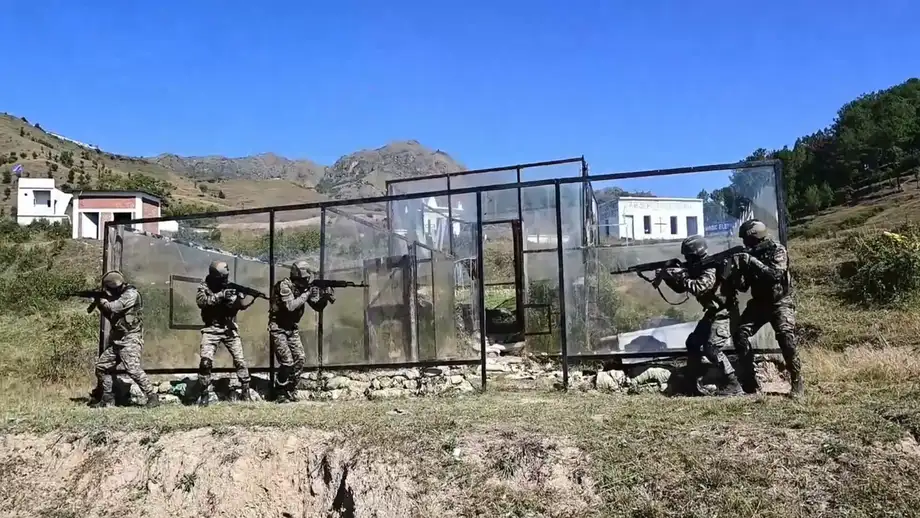
668 Soldiers Begin 14 Days of Training in Nepal
India and Nepal opened the 20th edition of their Surya Kiran joint military exercise on Wednesday, November 25, 2026, at the Nepal Army Battle School in Saljhandi, in Rupandehi district of southwestern Nepal. The training will run until December 8, a period of 14 days. Nepal Army statements also use the name Abhyas Suryakiran, with abhyas meaning exercise.
Contents
The Indian Army has sent 334 personnel, while the Nepal Army has fielded an equal number. That makes 668 participants in total. Indian troops come from the Kumaon Regiment, with Nepali accounts identifying the participating unit more specifically as 12 Kumaon Regiment. Nepal is represented by troops from Shri Jwala Dal Battalion, written as Shri Jawla Dal Battalion in India's Ministry of Defence statement.
Major General Purna Bahadur Khatri, Commander of the Nepal Army's Mid Western Division Headquarters, inaugurated the exercise. He also attended the opening ceremony in his capacity as the division's General Officer Commanding. The Indian contingent had reached Saljhandi ahead of the ceremony, after arriving on the Monday before the opening.
Saljhandi therefore hosts two equally sized contingents rather than a small team of observers. Nepali officials describe the participation as being organised at battalion level. In practical terms, this means units training together in a structured formation, with enough personnel to practise coordination, field procedures and emergency tasks alongside classroom instruction.
What Will the Soldiers Practise?
India's Ministry of Defence, which announced the contingent details, defined the central military purpose in these words:
The aim of the exercise is to enhance interoperability, operational coordination and mutual understanding between the two armies through joint training in counter-insurgency and counter-terrorism operations in challenging terrain.
For the 668 soldiers, interoperability means being able to work together without confusion over commands, procedures or the way a task is carried out. Two armies may have similar objectives yet use different methods. Joint training gives their personnel an opportunity to learn those methods before they face a real emergency or operational mission.
Counterinsurgency concerns operations against armed campaigns challenging state authority, while counterterrorism focuses on preventing or responding to terrorist violence. The ministry places both kinds of training in challenging terrain, where movement, communication and coordination can become more difficult.
The announced programme extends across four main activities:
- Joint tactical operations, so that troops can practise coordinating their movements and actions.
- Heliborne operations, meaning the movement and deployment of soldiers by helicopter.
- Disaster response, including coordination during relief and emergency situations.
- Medical training, covering knowledge and practices needed to support troops and respond to emergencies.
Personnel will also exchange operational experiences and best practices. They will refine tactics, techniques and procedures, a military phrase for the detailed methods used to carry out a task. The value lies in making those methods familiar to both contingents, rather than simply having soldiers train beside one another.
Disaster Relief and Jungle Warfare Share the Programme
The Nepal Army's description places particular weight on disaster management, jungle warfare and humanitarian assistance. Soldiers will exchange theoretical knowledge, practical skills and specialised experience in those areas. This combines explanation and discussion with work in the field.
Jungle warfare involves operating where dense vegetation can restrict visibility and movement. Disaster management and humanitarian assistance concern a different but related set of skills: reaching affected communities, organising relief, providing aid and coordinating with other responders. The inclusion of medical training connects those humanitarian tasks with the wider military programme.
Nepal's army says this exchange should develop professional knowledge, improve military capabilities and deepen mutual understanding among personnel. It also links the training to friendly relations between the two countries. Those are institutional objectives for the exercise, while its immediate output will be the experience gained by the soldiers taking part.
The Dates Surrounding the Opening
The Saljhandi exercise follows a previous edition in India, a visit by India's army chief to Nepal and an official visit to New Delhi by Nepal's prime minister. The main dates are:
- December 2025: The 19th edition was completed at Pithoragarh in Uttarakhand, India.
- August 17, 2026: Nepal's president conferred an honorary general's rank on Indian Army Chief General Dhiraj Seth during his visit to Nepal.
- November 22 and 23: Nepal's Prime Minister Balen Shah made an official visit to New Delhi.
- November 25: Major General Khatri opened the 20th edition at Saljhandi.
- December 8: The exercise is scheduled to conclude. The Nepal Army also gives this date as 22 Mangsir 2083 in the Nepali calendar.
The opening came two days after Shah's visit to New Delhi ended. Surya Kiran rotates between India and Nepal, which explains why Pithoragarh hosted the previous edition and Saljhandi is hosting this one.
Nepal Army historical accounts date the exercise to 2067 BS. That Nepali calendar year spans parts of 2010 and 2011, and English versions accordingly give either 2010 or 2011 as the starting year. The consistent details are the rotational hosting arrangement and Pithoragarh's role as the venue for the 19th edition.
Why Does the 2025 Edition Matter?
Pithoragarh provides a detailed point of comparison because the 19th edition also involved 668 troops: 334 from India and 334 from Nepal. The Indian contingent then came mainly from the Assam Regiment, while Nepal's personnel came from the Devadatta Regiment. This year, the same total is divided equally again, but 12 Kumaon Regiment and Jwala Dal Battalion are the participating units.
The December 2025 training covered jungle warfare and counterterrorism in hilly terrain. According to India's Ministry of Defence, it centred on counterterrorism operations under Chapter VII of the United Nations Charter. Chapter VII deals with threats to peace, breaches of the peace and acts of aggression, providing the framework used for that training scenario.
At the closing of the 19th edition, the Directors General of Military Operations from both countries observed an exercise lasting two days and organised at battalion level. These officers, commonly abbreviated as DGMOs, hold senior responsibilities for military operations in their respective armies.
Technology also had a visible place at Pithoragarh. The training used intelligence, surveillance and reconnaissance systems, often shortened to ISR, along with drones for target identification and strikes. Other equipment included weapon systems usable by day and night, surveillance systems using artificial intelligence and secure communication technology. ISR refers to the work of gathering and understanding information before commanders decide how to act.
Troops in that edition also practised special operations guided by information, helicopter deployment of personnel and joint strategic operations in complex terrain. Those details document how the previous exercise combined field skills with surveillance, drones and communications. For Saljhandi, the published scope names joint tactical operations, helicopter operations, disaster response and medical training.
Military Ties Extend Beyond the Training Ground
The Indian Embassy in Kathmandu describes a defence relationship supported by institutional mechanisms, visits by senior leaders, military training, joint exercises and equipment supplies. Surya Kiran is one recurring part of that wider relationship, bringing personnel together at unit level while senior officers maintain separate official contacts.
Nepali Gorkha soldiers serve in the Indian Army, and more than 100,000 Indian Army ex-servicemen live in Nepal. Those connections give the military relationship a human dimension beyond annual exercises. They connect serving personnel, veterans and communities across the two countries.
Since 1950, India and Nepal have also followed a reciprocal tradition of conferring the honorary rank of General on each other's army chiefs. The honour is ceremonial, and each army remains under its own national command. Its continuation provides a visible symbol of the formal military relationship.
General Dhiraj Seth travelled to Nepal in August at the official invitation of Nepali Army Chief General Ashok Raj Sigdel. During that visit, President Ram Chandra Paudel conferred on Seth the honorary rank of General of the Nepali Army on August 17. The Saljhandi opening took place just over three months later.
What the Training Is Intended to Change
For an individual soldier, the most immediate gain is familiarity with the other army's working methods. A participant who has practised a helicopter deployment, discussed a relief operation or trained alongside foreign counterparts has a clearer idea of how joint work might proceed. Equal contingent sizes also give the exercise a visibly balanced structure, with each country contributing 334 personnel.
For the two armies, the exercise creates a setting for comparing procedures and correcting misunderstandings during training rather than during an emergency. Disaster response and medical instruction make that practical value easy to understand: responders need clear coordination, defined roles and reliable communication when time is limited.
At government level, India's Ministry of Defence links Surya Kiran to stronger bilateral defence cooperation, mutual trust, camaraderie and a shared commitment to regional peace, stability and security. Nepal's army similarly connects the exercise with friendly relations, professional knowledge and better understanding between soldiers.
The launch statements do not provide a day-by-day training schedule, a complete equipment list for Saljhandi or details of a closing ceremony. The next firm date is December 8, when the 14-day programme is due to end. Until then, the confirmed developments are the opening, the participation of 668 troops and the published training scope.
Key Points
- The 20th Surya Kiran exercise opened on November 25, 2026, at Saljhandi in Nepal's Rupandehi district and is due to end on December 8.
- India and Nepal each sent 334 personnel, giving a total of 668 participants.
- India is represented by troops from 12 Kumaon Regiment and Nepal by troops from Jwala Dal Battalion.
- Major General Purna Bahadur Khatri of the Nepal Army's Mid Western Division inaugurated the exercise.
- Training covers joint tactical and helicopter operations, counterinsurgency, counterterrorism, disaster response and medical skills.
- The Nepal Army highlights disaster management, jungle warfare and humanitarian assistance, alongside the exchange of practical and theoretical knowledge.
- The 19th edition took place at Pithoragarh in December 2025 with the same total of 668 troops and included drones, ISR systems and secure communications.
- Wider ties include Nepali Gorkha soldiers in the Indian Army, more than 100,000 Indian Army veterans in Nepal and an honorary rank tradition dating to 1950.