A vast subsidy bill renews the case for renewables
Bangladesh spent Tk 34,000 crore subsidising imports of liquefied natural gas between March and September 2026, Professor Dr Rashed Al Mahmud Titumir, the prime minister's adviser on finance and planning, said on Saturday, November 28. One crore equals 10 million, making the stated subsidy Tk 340 billion. Titumir called the period six months, while the March to September span was also described as seven months.
Contents
- A vast subsidy bill renews the case for renewables
- Why public finances are under renewed pressure
- What the supply numbers reveal
- How cargo purchase prices climbed
- Can solar financing turn targets into generation?
- Why speakers want communities to produce power
- What the US$20 billion MIDI plan would involve
- Where the budget squeeze could fall
- What the Dhaka conference will produce
- Key Points
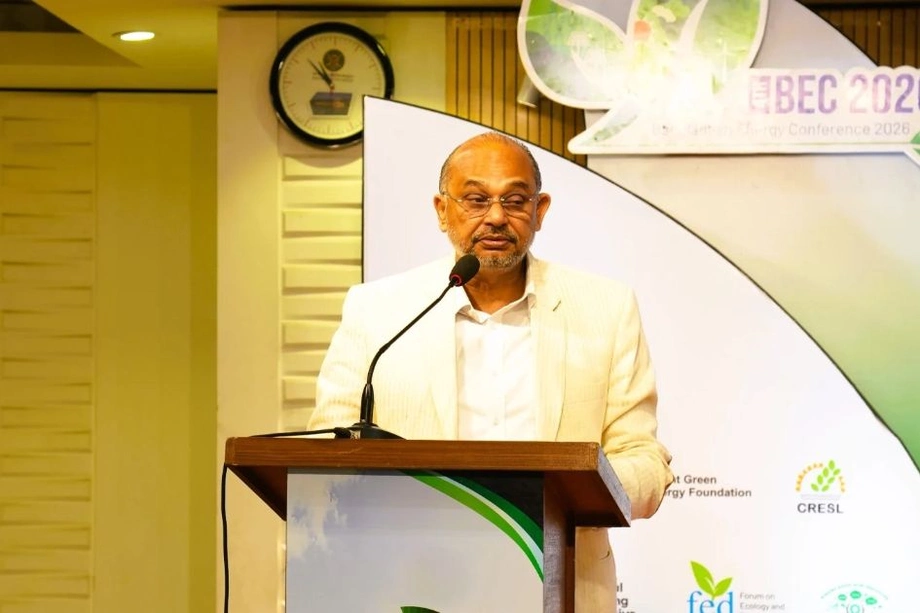
He disclosed the figure at the Bangladesh Military Museum in Dhaka during the opening of the Fourth Bangladesh Energy Conference. The meeting, organised by the Bangladesh Working Group on Ecology and Development (BWGED) with 14 partner organisations, is scheduled to continue until November 30 under the theme that there is no alternative to renewable energy for energy security.
Speaking as chief guest, Titumir told policymakers, energy specialists and civil society representatives that Bangladesh had to improve the entire electricity system rather than simply build more generation capacity.
Simply increasing electricity generation will not solve the energy crisis. Efficiency must be improved at every stage of the energy system, from generation and transmission to distribution.
Titumir said subsidies for imported LNG were placing substantial pressure on public finances. His remedy was to reduce dependence on imported fuel, limit losses and waste across the electricity system, and bring renewable energy into the mainstream. Other speakers went further, urging the government to abandon plans for five additional LNG terminals and direct the money towards solar power and electricity systems owned by communities.
Why public finances are under renewed pressure
Finance Division figures show the strain continuing beyond the period covered by Titumir. The division has released Tk 22,300 crore for gas subsidies since July, the start of the 2026 to 2027 fiscal year, against an allocation of around Tk 6,000 crore for the entire year. The releases include Tk 3,000 crore in one day and amount to nearly four times the annual allocation in about four and a half months. Officials said the subsidy bill could exceed Tk 50,000 crore by the end of the fiscal year.
The adviser's Tk 34,000 crore figure concerns LNG import subsidies from March to September. The Finance Division's Tk 22,300 crore figure records releases for gas subsidies since July. Together, they show both the cost already incurred and the speed at which the current fiscal year's budget is being overtaken.
Declining production from Bangladesh's own gas fields, conflict in the Middle East and disrupted shipments from Qatar have increased purchases from the spot market, where cargoes are bought for relatively prompt delivery rather than under contracts spanning many years. Prices have approached US$30 per million British thermal units (MMBtu), compared with about US$9 to US$10 before the outbreak of the Iran war. An MMBtu is a measure of energy commonly used in international gas trading.
LNG is natural gas cooled until it becomes liquid so that ships can carry it. Import terminals then turn it back into gas for pipelines serving power stations, factories, businesses and homes. A senior Energy Division official said the government had considered raising gas prices but put the plan on hold because of labour unrest and the political situation. Reducing expensive spot purchases is also under consideration, while Finance Division officials warned that development allocations or funds for other sectors could be redirected if costs remain high.
What the supply numbers reveal
Petrobangla data for November 18 show the physical shortage behind the financial problem. Gas supply was 2,662 million cubic feet per day (mmcfd), against demand of 3,800 mmcfd. That left a daily gap of 1,138 million cubic feet, almost 30 percent of demand, before considering the additional demand that would arise if all approved loads were included.
Domestic fields supplied 1,610 mmcfd and regasified LNG supplied 1,052 mmcfd. Imports therefore provided about 39.5 percent of the gas available that day. When cargoes are delayed or terminals stop operating, the effects can spread through electricity generation and industrial production as well as household gas supplies.
The import system had already been strained by Excelerate Energy's delivery suspension. By October, the company had supplied two cargoes before invoking force majeure, a contractual provision allowing obligations to be suspended because of events beyond a company's control. Its 2026 agreement covered about 12 cargoes. The suspension was extended until November, and no confirmed restart date or revised delivery schedule had been given at that stage.
An IEEFA subsidy assessment released on November 5 calculated that Bangladesh would need to provide more than Tk 60 in subsidy for each cubic metre of gas when imported LNG costs US$20 per MMBtu. Asian spot LNG prices reached US$27.50 in September. That assessment connects the international purchase price with the support needed to cover the difference between supply costs and revenue from consumers.
How cargo purchase prices climbed
The Energy Division's plan for 2026 listed 115 LNG cargoes: 86 under contracts spanning many years, 12 under contracts of shorter duration and 17 from the spot market. Approvals by the Cabinet Committee on Government Purchase show how prices rose as supply disruptions increased the need for available cargoes.
- August 17: The committee approved two cargoes from BP Singapore at US$21.878 and US$21.778 per MMBtu.
- August 24: Two further cargoes were approved at US$24.625 and US$24.25 per MMBtu.
- September: Two cargoes were approved at US$28.95 and US$29.795 per MMBtu, close to US$30.
- October 25: A proposal was recommended for five cargoes from BP Singapore and one from Qatar Energy Trading. Their respective prices were set US$0.17 and US$0.10 per MMBtu below the Japan Korea Marker, an Asian LNG price benchmark.
Prices were not disclosed for some subsequent purchase approvals. Petrobangla had arranged 19 cargoes for October and November to maintain supplies. Ten arrived in October, while nine were planned for November. Securing a cargo addresses only one part of the supply chain: the fuel must also arrive on schedule and pass through an operating terminal before it can enter the national grid.
Can solar financing turn targets into generation?
Titumir said the government wants renewable sources to provide 20 percent of electricity generation by 2030 and 30 percent by 2040. The renewable policy approved in 2025 gives 2041 for the later target, one year after the date he stated. The MIDI study released alongside the conference also refers to a government goal of 10 gigawatts of renewable electricity by 2030. A gigawatt measures capacity, while the percentage goals concern the electricity actually generated.
The government has allocated Tk 1,500 crore for solar installations. Titumir said rural households would be able to obtain loans at 6 percent interest, repayable over 12 years. He identified rooftops on public and commercial buildings and suitable agricultural land as additional locations for solar projects. Other incentives include zero percent tax on solar power until 2035 and imports of solar equipment without duties.
Earlier policy results show the delivery challenge. Bangladesh's 2008 renewable policy sought a 5 percent share by 2015 and 10 percent by 2020, but both targets were missed. In 2024, renewables supplied about 5 percent to 8 percent of demand and represented less than 5 percent of installed electricity capacity. Installed capacity is the maximum equipment can produce under suitable conditions; actual generation also depends on sunshine, wind and the ability of the grid to carry the power.
The new MIDI study estimates that Bangladesh has potential for 240 gigawatts of solar power and 30 gigawatts of onshore wind. Hasan Mehedi of BWGED argued at the conference that this potential exceeds the ambitions in existing policies, making financing and public participation central to the debate.
Why speakers want communities to produce power
Hasan Mehedi, member secretary of BWGED, criticised plans to build five LNG terminals in environmentally sensitive locations, including Hiron Point in the Sundarbans region and Mongla. He said the money spent on one LNG cargo could produce greater benefits over time if invested in renewable energy. He also argued against concentrating the response in large central power stations.
Instead of relying on large-scale power plants, we need to bring ordinary people into electricity generation.
Mehedi advocated decentralised systems owned by communities, with citizens participating in both generation and management. In this model, solar installations and other local sources can serve nearby users rather than leaving every consumer dependent on a distant plant and imported fuel. He said this approach could strengthen energy security while giving people a direct role in the power sector.
Iftekharuzzaman, executive director of Transparency International Bangladesh, said lobbying by domestic and international interests had established the structural and institutional dominance of fossil fuels. He argued that renewable energy must become a national priority, rather than being treated merely as an alternative, if that dominance is to be broken.
What the US$20 billion MIDI plan would involve
On the same day that the Dhaka conference opened, a MIDI master plan study released in Cox's Bazar examined another major expansion of imported gas. The study, LNG's Last Ditch: The MIDI Master Plan for Bangladesh, was published by Market Forces, Waterkeepers Bangladesh and Dharitri Rakkhay Amra (DHORA).
It says about US$20 billion is planned under the Moheshkhali-Matarbari Integrated Infrastructure Development Initiative in southeastern Bangladesh. Approximately US$19 billion would support power plants burning gas and US$1 billion would fund an onshore LNG terminal. The master plan prepared by the Japan International Cooperation Agency proposes 13 gigawatts of generation based on LNG in the Chattogram region and a terminal able to supply 1,000 mmcfd of gas.
The study calculates that annual LNG imports could cost as much as US$25.8 billion if average prices forecast for 2027 persist, or fall to US$7 billion if international prices decline. These scenarios show the exposure to world fuel prices. At the high estimate, a single year of imports would cost US$5.8 billion more than the entire US$20 billion infrastructure programme.
Munira Chowdhury, Asia Energy Transition Director at Market Forces and an author of the study, directed her criticism at the Japanese businesses and interests involved in the proposed expansion.
Japanese companies and interests are coercing Bangladesh into a last-ditch dangerous dependence on liquefied natural gas, risking the lives of millions of people and a safe climate.
The study estimates that plants proposed under MIDI could emit more than one billion tonnes of carbon dioxide during their operating lives, over 10 times Bangladesh's current emissions linked to fossil fuels. It warns of greater climate and health risks. Sharif Jamil, coordinator of Waterkeepers Bangladesh and member secretary of DHORA, said the investment could lock the country into pollution, mangrove destruction, debt and volatile energy prices, with consequences for the garment industry. Chowdhury said companies including JERA, Sumitomo and Itochu could instead invest in solar and wind projects.
The study also examines the 1,200 megawatt Matarbari 1 coal plant, built with Japanese assistance at an estimated cost of US$6 billion. It alleges displacement, river damage, pollution, debt and corruption associated with the project and says more than 20,000 salt farmers, fishers and other local producers lost their livelihoods during construction.
Where the budget squeeze could fall
Officials quoted the average cost of gas from combined domestic and imported supplies at about Tk 52 per cubic foot, compared with an average selling price of about Tk 23 per cubic foot. The consumer tariff schedule set by the Bangladesh Energy Regulatory Commission uses cubic metres: power plants pay Tk 15.50 to Tk 16, fertiliser factories Tk 29.25, industrial users Tk 30 and commercial consumers Tk 30.50. Since April 2025, new industrial connections and consumption above approved limits have been charged Tk 40 per cubic metre, while captive power plants pay Tk 42. There has been no major general revision since May 2024.
The subsidy pressure coincides with weak revenue and slow development spending. Preliminary National Board of Revenue data show collections of less than Tk 1.28 trillion from July to October, against a target of about Tk 1.78 trillion, leaving a shortfall exceeding Tk 50,000 crore. The Implementation Monitoring and Evaluation Division reported on November 15 that Annual Development Programme implementation was 6.53 percent during those four months, compared with 8.33 percent in the same period of fiscal 2026 and 7.90 percent in fiscal 2025. It was 11.54 percent in fiscal 2024 and 12.64 percent in fiscal 2023.
Mahbub Ahmed, a former finance secretary, described the difficult choice between supporting energy consumers and protecting public finances.
Financing subsidies is difficult, but withdrawing them could fuel inflation. There is no easy solution under the current global and domestic political circumstances.
Masrur Reaz, chairman of Policy Exchange Bangladesh, said the Tk 6,000 crore allocation was inadequate and that policy errors had left Bangladesh excessively dependent on imported energy. He supported additional subsidies alongside rationing for nonessential and less productive uses, with priority for production, exports, transport and electricity generation. He also urged the government to avoid indiscriminate cuts to infrastructure, health, education and skills development, recommending instead that essential projects be separated from those of lower priority.
What the Dhaka conference will produce
More than 350 participants from Bangladesh and abroad are expected, including policymakers, regulators, financial institutions, investors, renewable energy entrepreneurs, researchers, academics, journalists, civil society representatives and youth activists. Thirteen thematic sessions will examine institutional reform, LNG and coal expansion, transition financing, regional cooperation and industrial decarbonisation. Other sessions will address development banks, local governments, media and energy justice, youth employment, and the participation of workers, Indigenous communities and women.
The opening also heard from Abdullah Al Noman of Lawyers for Energy, Environment and Development; Abil Bin Amin of Ethical Trading Initiative Bangladesh; Shahriar Ahmed Chowdhury of the Center for Renewable Energy Services Ltd; Sekendar Ali Meena of Safety and Rights Society; City Bank deputy managing director and chief economist Ashanur Rahman; and Mostafa Al Mahmud, president of the Bangladesh Sustainable and Renewable Energy Association. BWGED convener Dr Kazi Maruful Islam chaired the session.
The first conference was held in April 2023, followed by editions in 2024 and 2025. A joint declaration containing recommendations and commitments is scheduled for release on November 30. Its text had not been published at the opening, and no decision was announced there on the five proposed LNG terminals or a possible gas price increase.
Key Points
- Finance and planning adviser Rashed Al Mahmud Titumir put LNG import subsidies for March to September 2026 at Tk 34,000 crore.
- The Finance Division has released Tk 22,300 crore for gas subsidies since July, against an allocation of about Tk 6,000 crore for the full fiscal year.
- The government is offering Tk 1,500 crore in solar financing and targeting renewables for 20 percent of generation by 2030.
- Conference speakers opposed five new LNG terminals and called for decentralised renewable systems with public participation.
- A separate study warned that MIDI gas expansion could cost about US$20 billion and expose Bangladesh to an annual LNG bill of up to US$25.8 billion.
- A joint conference declaration is scheduled for November 30.
Gas supply on November 18 was 2,662 mmcfd against demand of 3,800 mmcfd, while some approved LNG cargoes cost close to US$30 per MMBtu.