A vacancy lasting 23 years reaches Vietnam's top inspector
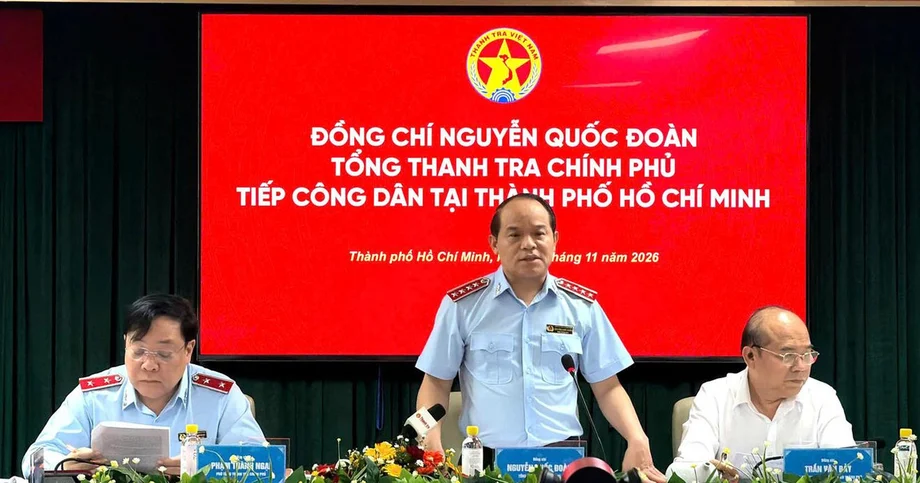
On 27 November 2026, Government Inspector General Nguyen Quoc Doan chaired an unannounced citizen reception at the Ho Chi Minh City Inspectorate, linked online to the Central Citizen Reception Board in Hanoi. The main case concerned the investment and construction project for residential towers on Lots 13 and 14 in Thanh My Tay Ward. Residents said the project has stood empty for 23 years in a valuable city location while people holding certificates proving land use rights still lack housing.
Contents
- A vacancy lasting 23 years reaches Vietnam's top inspector
- Who was in the room and what residents demanded
- The land record behind Lots 13 and 14
- A timeline of decisions and delays
- Why residents say the empty site still matters
- What the inspector general found troubling
- What the December decision should cover
- Phu Giao and the dispute over 193 hectares
- What changes for residents and city agencies
- What remains undecided
- What to Know
Nguyen Quoc Doan said he would recommend strict handling of any violations found, including possible criminal violations, and public disclosure of the results. He also ordered preparation for a comprehensive inspection decision to be published in December 2026. For residents, the order turns a grievance lasting many years into a formal review with a named unit and a deadline.
The same reception also covered a separate land dispute involving 193 hectares in Phu Giao Commune. Putting both cases in one session showed the scale of unfinished land administration issues facing the city, from an empty inner city housing site to certificates over a former forestry area.
The inspectorate is the agency that checks how public bodies use power and handles citizen complaints. A comprehensive inspection means looking at the whole chain of decisions, land records and petitions rather than answering only one point. The meeting placed the project under that wider form of review.
The city location raised the stakes for residents. They argued that land kept idle for decades should either serve a public purpose or be handled through a lawful process that recognises their claims.
Who was in the room and what residents demanded
The Government Inspectorate delegation included Deputy Inspector General Pham Thanh Ngai, Central Citizen Reception Board head Nguyen Hong Diep, Department III head Tran Dinh Hung and Planning and Finance Division head Le Quang Linh. Representatives of the President's Office and the National Assembly Committee for Citizen Petitions and Supervision joined online.
Ho Chi Minh City People's Committee Vice Chairman Tran Van Bay attended and spoke. City inspectorate, police, agriculture and environment, construction, planning and architecture, finance and justice officials were present, along with the Binh Thanh ward project management board, Thanh My Tay Ward government and the city People's Committee office. Five residents represented the households: Nguyen Thi Kim Nhung, Nguyen Van Kha, Vo Thi Anh Hong, Tran Cong Dien and Duong Vinh.
Nguyen Thi Kim Nhung told the inspector general that families held certificates proving land use rights but could not secure their lawful rights and had nowhere to live. She asked for a comprehensive inspection, strict handling of breaches, action on citizen denunciations and protection of household interests. Her list covered the inspection authority, changes of investor and land use purpose, land recovery boundaries, compensation and site clearance.
Duong Vinh, one of the five resident representatives, said he felt moved by the chance to speak directly to the head of the inspectorate. He asked for clear responsibility and a fair conclusion so that residents' lawful interests could be restored. He said:
Being received and listened to directly by the Government Inspector General moved us deeply. People's trust in the Party and the State has been strengthened. We respectfully ask the Government Inspectorate to clarify responsibility and reach a fair conclusion so that residents' legitimate rights can be restored.
The land record behind Lots 13 and 14
A representative of the Ho Chi Minh City Department of Agriculture and Environment told the meeting that the area formerly in Ward 22, Binh Thanh District and now in Thanh My Tay Ward contained two adjacent but separate projects. Each had its own land boundary. Separating them matters because residents' claims about recovery boundaries and project approvals depend on which decision applies to which parcel.
Phase 1 was the resettlement housing area. Decision No. 427/QD-TTg issued by the prime minister on 12 April 2001 recovered 29,827 square meters, including 13,997 square meters of residential land and 15,830 square meters of public land, and assigned it to Thanh Nien Xung Phong Company.
Phase 2 was the residential tower project at the centre of the complaint. Decision No. 2720/QD-UB issued by the Ho Chi Minh City People's Committee on 18 June 2003 assigned 13,070 square meters to Thanh Nien Xung Phong Company, with a boundary independent of phase 1. On 2 April 2007, Decision No. 1365/QD-UBND assigned the recovered land to Vinh Phat Agricultural Products Limited Company, now Vinh Phat Investment Joint Stock Company, as investor.
A timeline of decisions and delays
The written record given at the session stretches across more than two decades. The sequence below explains how the land moved from recovery decisions to a new investor and then to a long period without construction.
- 12 April 2001: Decision No. 427/QD-TTg recovered 29,827 square meters for the phase 1 resettlement housing project.
- 18 June 2003: Decision No. 2720/QD-UB assigned 13,070 square meters for the phase 2 residential tower project.
- 2 April 2007: Decision No. 1365/QD-UBND named Vinh Phat Agricultural Products Limited Company, now Vinh Phat Investment Joint Stock Company, as investor.
- 27 November 2026: The Government Inspector General held the citizen reception in Ho Chi Minh City and ordered preparation of a full inspection.
- December 2026: The inspection decision is to be published, according to the instruction given at the meeting.
The timeline shows a long gap between the 2007 investor change and the 2026 citizen reception, which is why the December decision has become the next concrete step.
Why residents say the empty site still matters
A certificate proving land use rights is the document that tells a household it may legally use a plot. Nguyen Thi Kim Nhung's argument was practical: certificates existed, but households still had no secure place to live after the project stalled. Site clearance, the process of agreeing compensation and handing land to an investor, sat at the centre of that grievance.
Residents also questioned how the project moved from one investor to another and whether the approved land use purpose changed. They asked who had authority to inspect the project and why earlier complaints and denunciations had not been settled. Those questions now form the natural scope of a comprehensive review.
The figures show that the phase 2 parcel of 13,070 square meters was about 44 percent of the 29,827 square meters covered by the phase 1 decision. It helps explain why residents see the idle phase 2 parcel as a significant piece of land in a dense urban area.
What the inspector general found troubling
Government Inspector General Nguyen Quoc Doan described the case as complex and longstanding. He said the prime minister and the Government Inspectorate had repeatedly directed and urged a comprehensive inspection, yet it had not been carried out. He said the inspection process had dragged on and the handling of complaints and denunciations had remained slow and unresolved.
Nguyen Quoc Doan described the meeting as an effort to improve how citizens are heard. He said the goal was to listen directly, explain the issues and act in a way that builds public confidence. His working motto was:
Listen to citizens speak, speak so citizens understand and act so citizens trust and have confidence.
The inspector general also criticised weaknesses at the stage where cases are accepted for handling. In Vietnamese administrative work, that stage, known as thu ly, determines whether an authority formally takes up a petition. He said delays at that stage and in answering citizen denunciations had helped the dispute continue for years.
What the December decision should cover
Nguyen Quoc Doan assigned Department III to prepare and propose an inspection decision in line with legal rules for publication in December 2026. A southern regional inspection and complaint resolution unit was also tasked with advising on a rigorous decision, reviewing files and comparing each petition with earlier resolution outcomes.
The Central Citizen Reception Board was instructed to work with that unit on file review and monitoring. The inspector general asked the chairman of the Ho Chi Minh City People's Committee to accept and fully resolve complaints, denunciations, petitions and feedback under the rules. He said violations found by inspectors should be handled strictly, including criminal violations where they exist, and results should be made public so residents can monitor them.
A comprehensive inspection is broader than a reply to one letter. It can check the chain of land recovery decisions, boundaries, investor changes, compensation records, complaint handling and the conduct of agencies involved. That makes it the tool residents had asked for, but its findings will depend on documents and explanations gathered during the process.
Phu Giao and the dispute over 193 hectares
The second case concerned an area of 193 hectares in subarea 488 of Phu Binh State Forestry Enterprise in Phu Giao Commune, formerly Tam Lap Commune, Phu Giao District, Binh Duong Province. Citizens asked for a review of land use right certificates that had been issued, revoked or cancelled in several cases. They also asked officials to reconsider certificates granted to people who already had decisions allowing them to use land.
Nguyen Quoc Doan asked the chairman of the Ho Chi Minh City People's Committee to direct agencies to review and clarify those petitions, answer the issues raised and report on the implementation of conclusions issued by the Government Inspectorate and the former Binh Duong Provincial Inspectorate. Matters already resolved should be communicated to citizens in writing, with results reported back to the Government Inspectorate.
The inspector general also asked residents to comply with conclusions reached by competent authorities and to provide records that can help clarify the cases. He instructed the southern inspection and complaint resolution unit to monitor the city People's Committee's handling. If new documents appear that could affect earlier conclusions, the agencies must report to the Government Inspectorate for further direction.
What changes for residents and city agencies
Ho Chi Minh City authorities now have to take up all complaints, denunciations, petitions and feedback in the two cases under the process set out by the inspector general. For the Lots 13 and 14 project, that means city agencies must work with inspectors on the documents behind the 2001, 2003 and 2007 decisions. For Phu Giao, it means written answers and a report on what happened to earlier conclusions.
Residents gain a clearer route for documents and follow up, but they also have duties. The inspector general asked them to cooperate and provide records. Inspectors will need the land records, previous petitions, resolution outcomes and any new documents that bear on the two cases.
What remains undecided
No inspection decision had been published at the time of the reception. The meeting set no end date for the review, no compensation figure, no finding on the investor changes and no decision on criminal liability. Those questions are now inside the inspection process, and the next dated step is the December 2026 decision.
For the households in Thanh My Tay Ward, the practical issue is whether their certificates will lead to housing, compensation or another lawful remedy. For Phu Giao residents, the issue is whether old certificates and earlier conclusions will be explained in writing or changed after review. Both matters need decisions from competent authorities, and the inspectorate has promised public results.
What to Know
- Government Inspector General Nguyen Quoc Doan chaired an unannounced citizen reception in Ho Chi Minh City on 27 November 2026.
- Residents said the Lots 13 and 14 project has been empty for 23 years and asked for a comprehensive inspection.
- The inspector general ordered an inspection decision prepared for publication in December 2026.
- Officials said the phase 1 and phase 2 projects have separate boundaries, with land decisions issued in 2001 and 2003 and an investor change in 2007.
- The same session covered a separate dispute over an area of 193 hectares in Phu Giao Commune.
- Violations found during the review may be referred for strict handling, including possible criminal cases, and results are to be made public.